 The Itinerary
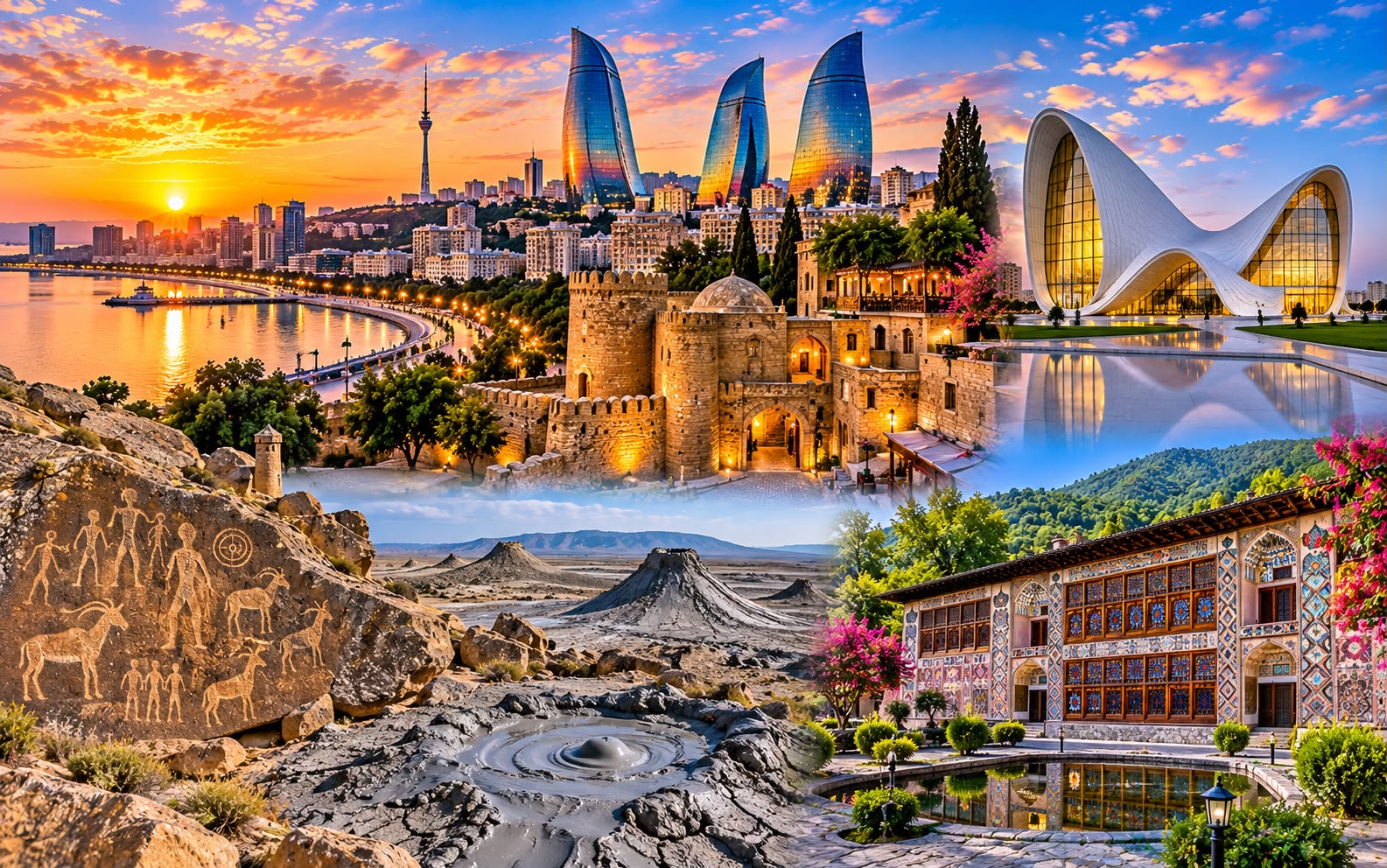
Azerbaijan in 7 days: Baku, fire country and Sheki
The land of fire in one week — Baku's flame-lit skyline and walled Old City, bubbling mud volcanoes and Stone Age rock art, a burning mountain, and the Silk Road palace town of Sheki in the Caucasus foothills.
- Caucasus
- 7 days
- ≈ AED 2,150 / person
- First-time visitors
Before you go
Azerbaijan is the Caucasus with the contrast turned up: a capital where a UNESCO-walled medieval city sits under flame-shaped glass towers, a desert coast that leaks fire and mud from the earth itself, and — five hours inland — Sheki, a Silk Road town whose Khan’s Palace might be the most beautiful room between Istanbul and Samarkand. It’s three hours from the Gulf on budget airlines, visa-easy for almost everyone, and cheaper than its skyline suggests.
This guide completes our Caucasus trio — Georgia and Armenia are its siblings — and ends with the overland trick that links them.
Go April–June or September–October for the sweet spot. July– August cooks on the Absheron peninsula (35°C+); November–March is cool, moody and fine for the city but grey in the mountains. Sheki runs ~8°C cooler than Baku year-round.
All costs are in Azerbaijani manat (AZN), with conversions calculated at today’s exchange rate — the manat sits near 1.7 to the US dollar, so prices are gentler than they look.
Before you go: the 15-minute admin
Visas — easier than you think
- Visa-free (90 days): UAE, Qatar, Turkey, and most CIS passports (Russia, Kazakhstan, Uzbekistan and more).
- The residence-permit shortcut: holders of a valid UAE residence visa or GCC permanent residence get a 30-day visa on arrival at Baku airport, whatever their passport.
- Everyone else — the ASAN e-visa: most nationalities (including India, EU, UK, USA) apply at evisa.gov.az — USD 25, issued within 3 working days (urgent: USD 60, ~3 hours), single entry, 30-day stay. One of the world’s least painful e-visas.
- The regional fine print, stated plainly: Azerbaijan’s border with Armenia is closed and Armenian citizens cannot enter; ordinary Armenian tourist stamps in other passports are not an issue. Building a full Caucasus trip? Route it Azerbaijan → Georgia → Armenia (or reverse) — Georgia is the hinge, and this guide ends conveniently near its border.
Money
- The manat (AZN) is stable and strong (~1.7/USD). Cards work widely in Baku — including Bolt taxis and most restaurants — but Sheki and the road stops are cash country: withdraw in Baku before Day 5.
- Costs run friendly: metro rides 0.50 AZN, a good dinner for two 35–60 AZN, museum entries 5–15 AZN.
- Tipping: 5–10% appreciated, occasionally added — check the bill.
SIM and data
- Tourist SIM/eSIMs from Azercell (best coverage) or Bakcell at the airport or city stores — passport needed, ~20–35 AZN for generous data. International eSIMs work fine for a week.
Getting around
- Baku: the metro (BakiKart, pennies per ride) covers the spread-out sights, and Bolt is everywhere and absurdly cheap (most rides 3–8 AZN). Install before you fly.
- The day trips (Gobustan + the fire sites) are easiest as one organised day (~45–55 AZN/person plus entries) or a private car (~USD 80–90) — the sights are scattered and taxis-in-waiting add up to the same money with more hassle.
- Baku ⇄ Sheki: a private transfer with sightseeing stops (~150–180 AZN per car, 6–7 h with stops) is the move this guide is built on — the road is a highlight. Budget alternatives: the comfortable overnight train (dep ~23:30, arr ~6:20; berths ~8–20 AZN) or hourly buses (~8.40 AZN, 6.5 h) — both skip the best stops.
Travelling with kids?
- An easy country with children: short city distances, the mud volcanoes are a genuine kid-thriller (bubbling, plopping, faintly ridiculous), and Azerbaijanis dote on little ones.
- The flame-and-fire sights (Yanar Dag, Ateshgah) need standard fire-adjacent supervision; the Gobustan day is long — pack snacks and the carrier.
- Sheki’s palace has a strict no-touching rule that tests toddlers; the fortress lawns outside forgive them.
Day by day
Day 1 — Land in Baku, first walk in the Old City
Stay in or beside Icherisheher (the walled Old City) or along the Boulevard — everything central is walkable from either.
- Afternoon — Land at Heydar Aliyev airport (GYD; ~25 min to the centre by Bolt or the H1 Aerobus). Direct budget flights reach Baku in ~3 h from Abu Dhabi, Sharjah and Dubai. Check in, first tea.
- 17:00 — Enter Icherisheher through the Double Gates: caravanserais, carpet shops, cats with tenure. Orbit the Maiden Tower from outside as the stone goes gold.
- 19:00 — Dinner in the Old City — a tendir-bread courtyard restaurant: warm bread from the clay oven, saj plates, pomegranate everything (~40–60 AZN for two).
- 20:30 — Walk out to see the Flame Towers lit up — the LED fire show washes over the whole skyline every evening.
Where to stay in Baku (four nights)
- Luxury: Fairmont Baku, Flame Towers — inside the icons themselves; Caspian views from the clouds.
- Mid-range: The Merchant Baku — superbly rated boutique at the Old City’s edge, steps from Nizami Street.
- Budget: Austin Hotel — cheap, central, breakfast included (and no lift — pack accordingly).
Day 2 — Baku: medieval morning, Zaha Hadid afternoon
- 9:30 — Palace of the Shirvanshahs (~9:00–18:00; ~15 AZN) — the 15th-century royal complex at the Old City’s crown: courtyards, the shah’s mosque, carved portals.
- 11:00 — Maiden Tower (~15 AZN) — climb the enigmatic 12th-century tower for rooftops-and-Caspian views; nobody agrees what it was for, which is half the charm.
- 12:30 — Lunch off Nizami Street — the pedestrian shopping spine; qutab (stuffed flatbreads) make the perfect quick plate.
- 14:30 — Bolt to the Heydar Aliyev Center (~11:00–19:00, check Mondays; ~15–25 AZN) — Zaha Hadid’s wave of white, the building that rebranded Baku. The exterior lawns alone justify it; inside are galleries and the classic-car collection.
- 17:30 — Funicular up to Highland Park (runs ~10:00–22:00, pennies) — the panorama: Flame Towers overhead, crescent bay below, at golden hour.
- 19:30 — Descend to the Baku Boulevard — the Caspian seafront promenade — and dinner nearby; end at the Mini-Venice canals or the Ferris wheel if the kids are still going.
Day 3 — Fire country: Gobustan, mud volcanoes and eternal flames
The signature Azerbaijan day — four sites, one loop south and north of the city. Organised day tour ~45–55 AZN/person + entries, or private car ~USD 80–90.
- 9:00 — Depart south along the Caspian.
- 10:00 — Gobustan National Park (9:00–17:00; ~10 AZN including the reserve guide) — 6,000+ petroglyphs up to 40,000 years old: dancing figures, reed boats, aurochs. The modern museum first makes the rocks come alive.
- 12:00 — The mud volcanoes — 4x4s shuttle you from the paved road up to a lunar field of gurgling, cold, grey cones (small per-jeep fee, cash). Absurd, wonderful, and the kids’ favourite thing in Azerbaijan. Don’t wear white.
- 13:30 — Late lunch back toward the city.
- 15:00 — Ateshgah Fire Temple, Surakhani (~9:00–18:00, ~9 AZN) — the pentagonal temple where Zoroastrian and Hindu fire worshippers tended natural gas flames for centuries; the central altar still burns.
- 16:30 — Yanar Dag, the Burning Mountain (~9 AZN) — a hillside that has been on fire for decades, fed by seeping gas. Most dramatic as the light fades — time it last, stand close, feel the heat.
- 19:00 — Back in Baku; easy dinner. You have now seen why they call it the Land of Fire.
Day 4 — Baku your way: bazaars, carpets, hammam, jazz
- 9:30 — Taza Bazar — the green market: pomegranate pyramids, saffron, mountains of herbs, cheese sellers who insist you taste.
- 11:00 — Carpet Museum (closed Mon; ~10 AZN) — the rolled-carpet building on the Boulevard; Azerbaijan’s weaving tradition is UNESCO-listed and the collection shows why.
- 13:00 — Lunch: dushbara (tiny dumpling soup) or plov — Azerbaijan’s saffron-crowned version.
- 15:00 — Choose your afternoon: a proper hammam (the historic Old City baths take walk-ins; scrub ~20–40 AZN), the Museum of Miniature Books (free, charming, ten minutes), or Boulevard idling with a Baku Eye spin.
- 19:30 — Dinner then live jazz — Baku’s jazz pedigree is real (mugham-jazz fusion was born here); the clubs around downtown run sets most nights. Pack for the mountains; cash out at an ATM tonight.
Day 5 — The mountain road to Sheki
The best road day in Azerbaijan — private transfer with stops (~150–180 AZN/car, ~6–7 h door to door).
- 8:30 — Leave Baku west across the semi-desert.
- 10:00 — Diri Baba Mausoleum, Maraza — a two-storey 15th-century shrine grown out of a cliff face; ten minutes of stairs, one great photograph.
- 11:00 — Shamakhi Juma Mosque — one of the Caucasus’s oldest mosque sites (founded 743), serenely rebuilt; free, modest dress.
- 12:30 — Detour up the Girdimanchay gorge to Lahij — a cobbled mountain village that has hammered copper for centuries: workshops ringing, tinned pots gleaming, lunch in a family courtyard (~15–25 AZN for two). The 40-minute canyon road up is its own attraction.
- 16:00 — On through hazelnut country to Sheki; check in.
- 18:30 — First taste of Sheki halva — the town’s saffron-and-hazelnut baklava-like signature, sold everywhere and argued about locally; then dinner of piti, the clay-pot saffron lamb stew Sheki does best (~20–30 AZN for two).
Where to stay in Sheki (two nights)
- Comfort: Sheki Saray Hotel — the town’s main full-service hotel, walkable to everything.
- Modern mid-range: Macara Sheki City Hotel — quiet and well-reviewed near the centre.
- The experience: Yukari Karvansaray — sleep in a genuine 18th-century Silk Road caravanserai’s vaulted brick cells: basic, atmospheric, impossible to book online (call ahead or ask on arrival) — choose it for romance, not luxury.
Day 6 — Sheki: the palace, the crafts, the church on the hill
- 9:30 — Walk up through the fortress walls to the Khan’s Summer Palace (10:00–18:00; ~5 AZN, interior visits guided, no photos inside) — two storeys built without a single nail, every surface painted, and the famous shebeke windows: thousands of hand-cut glass pieces set in wood, no glue. Small, perfect, worth the whole drive.
- 11:00 — The shebeke workshop by the palace — watch the craft done, buy a small panel; then the Winter Palace (~5 AZN, photos allowed) for the quieter twin.
- 13:00 — Lunch in the bazaar quarter; tea at the Karvansaray courtyard even if you’re not sleeping there.
- 15:00 — Kish village (15 min by taxi/marshrutka) — the round-towered Albanian church, over eight centuries old, in a walnut-shaded hamlet — the relic of Caucasian Albania, Azerbaijan’s pre-Islamic Christian past.
- 17:30 — Golden hour on the fortress lawns; halva shopping for the flight home.
- 19:30 — Farewell dinner — piti round two, or saj by the fireplace; Sheki evenings are mountain-cool all year.
Day 7 — Back to Baku, fly home
- 9:00 — Direct return drive (~4.5–5 h without stops; or the overnight-train option the night before for budget romantics).
- 15:00 — Reach Baku with buffer for an evening flight — Gulf departures run late enough to make this comfortable; if yours is early, swap this for a sixth Baku night and do Sheki’s return the previous evening.
Costs and practicalities
Best time to visit
April–June and September–October. Baku’s summer is humid as well as hot, and the Caucasus villages — Sheki, Lahic, Xinaliq — are at their best in late spring and early autumn.
- April–June — green foothills, comfortable in Baku, and the mountain roads open.
- July–August — 35°C and humid on the Caspian. The mountains are the escape and Azerbaijanis use them.
- September–October — the pomegranate and quince harvest, clear light, and the best month for Sheki.
- November–March — Baku is wet and windy rather than cold, and the Xinaliq road can close with snow.
Novruz in late March is the biggest holiday of the year and much of the country stops for a week.
Travel tips
- The border with Armenia is closed, entirely. Plan Caucasus routes through Georgia.
- Evidence of travel to Nagorno-Karabakh is a serious problem at immigration. An ordinary Armenian stamp is not, but do not expect a relaxed conversation about it.
- The e-visa (ASAN) is quick and the only sensible route for most nationalities.
- Cards work well in Baku and poorly outside it. Carry manat for the mountain villages.
- Carpets need an export certificate. Buying one without the paperwork means losing it at the airport; reputable shops arrange it.
- Tea is constant and comes with the jam, not in it. Take a spoonful separately.
- Marshrutkas and shared taxis cover most routes; a hired driver for the Sheki or Quba run is inexpensive and saves a day.
What this trip actually costs
Two people, 6 nights, mid-range comfort, international flights excluded:
| Item | Cost |
|---|---|
| Hotels, 6 nights (4 Baku + 2 Sheki) | AZN 780 (≈ AED 1,684) |
| Fire-country day tour, Baku–Sheki transfers with stops, Bolt and metro | AZN 470 (≈ AED 1,015) |
| Entries: palaces, towers, Gobustan, temples, museums | AZN 160 (≈ AED 346) |
| Food and drink, 7 days | AZN 490 (≈ AED 1,058) |
| SIM, hammam, extras | AZN 100 (≈ AED 216) |
| Total for two | AZN 2,000 (≈ AED 4,319) |
- Roughly AZN 1,000 (≈ AED 2,160) per person (~USD 590) — Caucasus pricing under a Dubai-grade skyline: guesthouses and buses pull it near AZN 700 (≈ AED 1,512); the Fairmont and nightly feasting still struggle to double it.
- Book in this order: flights → visa check (VoA with a GCC residence permit; e-visa 3+ days out otherwise) → Baku hotel → the Baku–Sheki transfer and fire-country tour a few days ahead → Sheki rooms (small town, few beds — book summer and holiday weekends earlier). The Karvansaray, charmingly, you phone.
- Hotel and restaurant picks here are unsponsored — no affiliate links in this article. Chosen on location and current ratings; always check prices and recent reviews before booking.
What to pack
- Layers: Baku is windy year-round (“city of winds” is official), and Sheki runs ~8°C cooler than the coast.
- Shoes you can ruin-adjacent: mud-volcano fields and Lahij cobbles.
- Modest cover for mosques and Ateshgah; a scarf serves.
- Sun kit for Gobustan’s shadeless rock — even in October.
- Cash drawn in Baku before the Sheki leg.
- Room for halva, saffron, and the copper pot you didn’t plan to buy in Lahij.
FAQ
Is Azerbaijan safe? Baku is one of the safest-feeling capitals anywhere — heavily walked at night, low street crime — and the Sheki road is ordinary tourist country. The closed Armenian border region is far from every stop in this guide and irrelevant to it.
Which Caucasus country first — Georgia, Armenia or Azerbaijan? Any order works except Armenia→Azerbaijan directly (that border is closed; route via Georgia). The elegant grand tour: this guide, then cross from Sheki’s region into Georgia — the Lagodekhi border is ~1.5 h from Sheki, and Sighnaghi, where our Georgia loop ends, is ~3 h away — then Georgia → Armenia. Three of our guides, one overland line.
Is Baku expensive? The skyline lies. Outside the five-star lobbies, Baku costs Tbilisi-plus-a-little: 5 AZN museum tickets, 4 AZN Bolt rides, 50 AZN dinners for two with wine.
Halal and vegetarian food? Halal is the default in this Muslim-majority (and firmly secular — alcohol flows freely) country. Vegetarians manage well: qutab with greens or pumpkin, dovga (herb yogurt soup), aubergine everything, and the bread-and-cheese-and-herb table that starts every meal.
Do people speak English? In Baku’s tourist core, increasingly; elsewhere Azerbaijani and Russian dominate. Translation apps and goodwill cover the gaps — and Turkish speakers will understand nearly everything.
Is one night enough for Sheki? Two is right, as planned: the palace-and-crafts day needs the full day, and arriving via the Lahij road eats the first. Day-tripping Sheki from Baku (10+ hours of driving) is the region’s most common regret.
Prices and entry rules change, and what you need depends on your passport; last checked 8 October 2026, so confirm with the embassy or your airline before booking.


