 The Itinerary
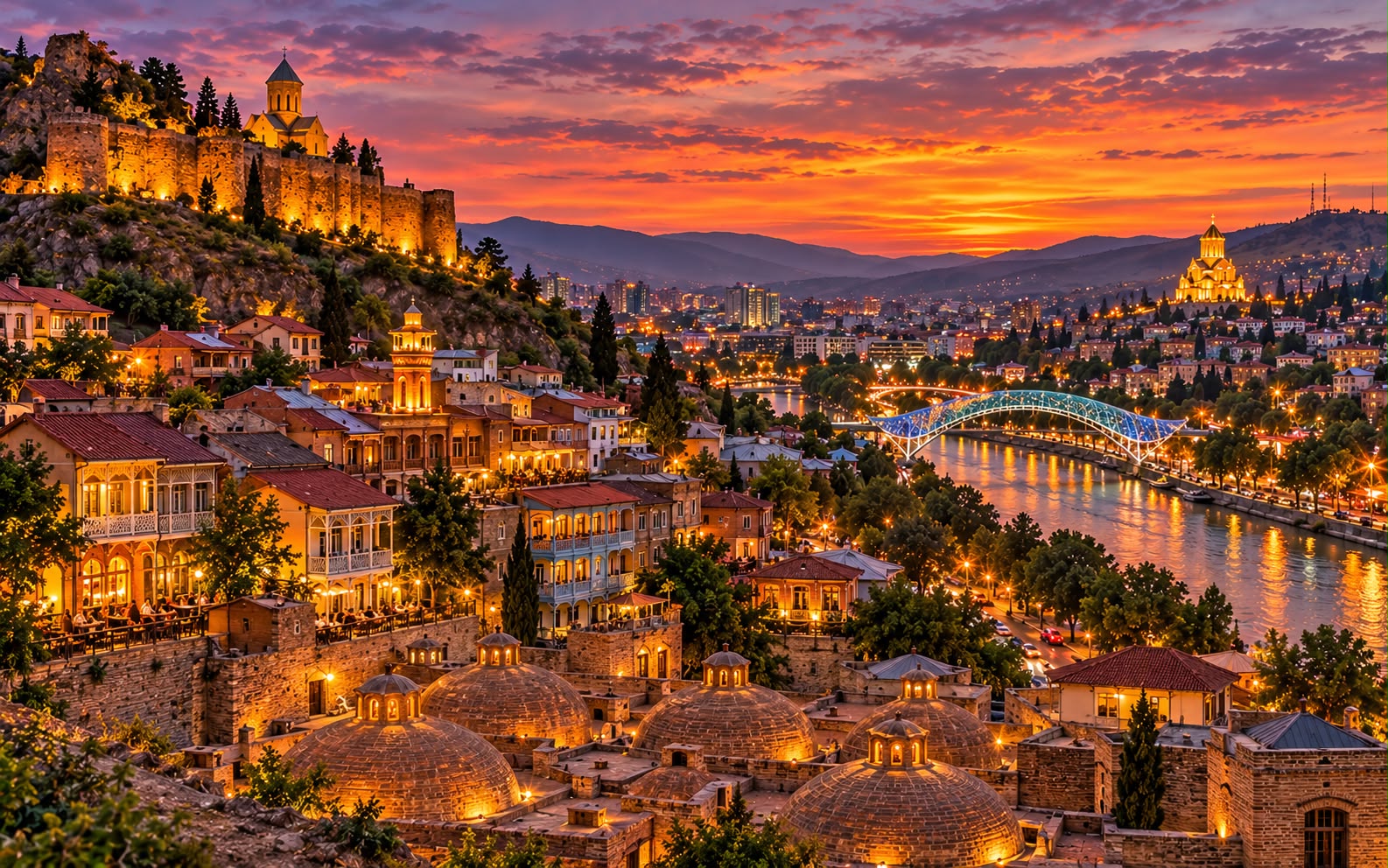
The Caucasus in 12 days: Baku, Tbilisi and Yerevan, with the closed border worked around
A flame-lit capital on the Caspian, a Georgian supra that goes on for hours, a church on a saddle below Kazbek, and monasteries hung off Armenian gorges — three countries that share a mountain range and very little else, routed around a border that has been shut for thirty years.
- Caucasus
- 12 days
- ≈ AED 5,500 / person
- Three countries, three alphabets, and one border you cannot cross
Before you go
Before you go: the admin
The closed border is the whole plan
- Armenia and Azerbaijan have no open border. There is no crossing, no bus, no flight. Every Caucasus itinerary routes through Georgia, which is why Tbilisi sits in the middle of this one.
- Go Azerbaijan first, then Georgia, then Armenia. Azerbaijan is the stricter of the two about the other, and an Armenian stamp in a fresh passport invites questions at Baku immigration. The reverse order does not.
- Evidence of travel to Nagorno-Karabakh is a serious problem at Azerbaijani immigration, and that is separate from an ordinary Armenian stamp. Do not carry photographs, tickets or receipts from it.
- Armenia does not care about an Azerbaijani stamp.
Visas, three systems
- Azerbaijan issues an ASAN e-visa in three working days to most nationalities. Print it.
- Georgia admits most nationalities visa-free for a year, which is among the most generous policies anywhere.
- Armenia is visa-free for many nationalities and issues an e-visa or visa on arrival for the rest.
- Check all three for your own passport before booking; they differ more than neighbouring countries usually do.
Flights, and the legs between
- Fly into Baku and out of Yerevan, or the reverse if you want to invert the order — but see the border note above.
- Baku to Tbilisi is an overnight sleeper train, about thirteen hours, or a short flight. The train is comfortable, cheap and the better story.
- Tbilisi to Yerevan is a six-hour drive or a marshrutka. A hired car with a driver costs little more split two ways and lets you stop at Sadakhlo and Haghpat on the way.
- There is no sensible flight between Tbilisi and Yerevan — the road is the route.
Money
- Three currencies: Azerbaijani manat, Georgian lari, Armenian dram. None convert usefully to the others; change as you go and spend down before each border.
- Cards work in Baku, Tbilisi and Yerevan and much less reliably outside them. Carry cash for Sheki, Kazbegi and the Armenian monasteries.
- ATMs are plentiful in all three capitals.
One gentle brief
- Three alphabets. Azerbaijani uses Latin, Georgian has its own curling script, Armenian has another. Road signs are transliterated on main routes and not on minor ones.
- Russian is the common second language across all three and is more useful than English outside the capitals — but it is politically loaded in Georgia in particular. Open in English.
- The hospitality is relentless and the toasting is structured. Pace yourself from Baku onwards.
Day by day
Day 1 — Land in Baku, walk the Old City
- 14:00 — Arrive and go to İçərişəhər, the walled Old City, which is UNESCO-listed and takes an afternoon.
- 15:00 — The Maiden Tower, whose purpose nobody has settled, and the roof for the bay.
- 16:30 — The Palace of the Shirvanshahs from the fifteenth century, with the divanxana and the royal tombs.
- 18:30 — The Caspian boulevard in the evening, which is where Baku walks.
- 21:00 — The Flame Towers above it come on after dark and run through their fire animation — gaudy, and the image of the city.
Day 2 — Baku: oil, carpets and the mud volcanoes
- 09:00 — Gobustan, an hour south: UNESCO-listed petroglyphs, some of them 12,000 years old, on a hillside of fallen boulders. The museum first; it makes the carvings legible.
- 12:00 — The mud volcanoes beyond it — Azerbaijan has around half of all the mud volcanoes on earth, and they bubble cold and grey in a lunar field. A 4x4 from the Gobustan car park is the only way in. Wear what you do not mind ruining.
- 15:30 — Ateshgah and Yanar Dag on the way back, the fire temple and the hillside that has been burning since antiquity. Yanar Dag is far better after dark.
- 18:00 — The Carpet Museum, shaped like a rolled carpet, which is better than that sounds — the regional weaving traditions laid out properly.
Day 3 — Sheki, through the foothills
- 08:00 — Five hours north-west through the Greater Caucasus foothills, with the mountains on the right the whole way.
- 14:00 — The Palace of the Sheki Khans, UNESCO-listed, with shebeke windows — stained glass assembled from thousands of pieces of wood and coloured glass with no nails or glue. Some panels have 5,000 pieces in a square metre.
- 16:00 — The caravanserai in the old town, still operating as a hotel, with a courtyard you can sit in.
- 17:30 — The silk workshop and the old bazaar, which is what Sheki was built on.
- 19:30 — Piti for dinner, the local mutton and chickpea stew served in a clay pot you break the crust off.
Day 4 — Cross into Georgia, arrive in Tbilisi
- 09:00 — The Lagodekhi crossing is two hours from Sheki and straightforward. Allow an hour for formalities.
- 13:00 — Stop at Signagi and the Bodbe monastery in Kakheti on the way, which is the better plan — a walled hill town over the Alazani valley with the Caucasus across it.
- 15:00 — A family winery near Signagi, where qvevri wine is fermented underground in clay, skins and all.
- 19:00 — Arrive in Tbilisi in the evening and walk Rustaveli or the sulphur bath district.
Day 5 — Tbilisi: the old town and the baths
- 10:00 — Narikala fortress by cable car, then walk down through Betlemi to the old town.
- 13:00 — The Bridge of Peace and the Tsminda Sameba cathedral, and the Dry Bridge flea market if it is a weekend — Soviet badges, cameras and genuine junk.
- 16:00 — The Abanotubani sulphur baths — domed brick roofs over hot springs, and a private room with a scrub is the thing to do here. Chreli Abano is the pretty one.
- 20:00 — A supra in the evening. The toasting is led by a tamada and you do not drink ahead of him. Beer is for toasting your enemies; wine is for everything else.
Day 6 — Kazbegi and the Military Highway
- 08:00 — The Georgian Military Highway north — three hours to Stepantsminda, past the Ananuri fortress on the Zhinvali reservoir and over the Jvari Pass at 2,379m.
- The pass closes intermittently in winter for snow and avalanche. Check before committing.
- 11:00 — The Gudauri viewpoint, a Soviet mosaic arc on the gorge edge.
- 14:00 — Gergeti Trinity Church on its saddle at 2,170m with Mount Kazbek behind it, which is the photograph of Georgia. A 4x4 up, or two hours on foot.
- Kazbek shows itself about half the time, and mornings are better than afternoons.
- 18:00 — Back to Tbilisi, or stay the night in Stepantsminda, which is better if the forecast is clear.
Day 7 — Mtskheta, then south to Armenia
- 08:30 — Mtskheta on the way out, 20 minutes from Tbilisi: Svetitskhoveli cathedral and Jvari monastery above the confluence, both UNESCO-listed and the religious heart of Georgia.
- 11:30 — Then south to the Armenian border at Sadakhlo, about two hours, and across.
- 15:00 — Haghpat and Sanahin just inside Armenia, two tenth-century monasteries UNESCO-listed together, and the best introduction to Armenian church architecture there is.
- 19:00 — On to Yerevan, arriving in the evening.
Day 8 — Yerevan: the city, and what it carries
- 09:30 — The Genocide Memorial and Museum at Tsitsernakaberd. It is essential and it is hard. Allow two hours and do not schedule anything cheerful afterwards.
- 14:00 — The Matenadaran for the illuminated manuscripts, which is the other half of the national story — 17,000 manuscripts, some rescued across the desert in pieces.
- 17:00 — The Cascade, a vast flight of steps up the hillside with the Cafesjian sculpture collection on the terraces, and Ararat straight ahead when the air is clear.
- 20:30 — Republic Square and the singing fountains in the evening.
Day 9 — Garni, Geghard and a brandy
- 09:00 — Geghard monastery, UNESCO-listed, partly carved directly into the rock face — and if there is a choir singing in the upper chamber, stay for it. The acoustics are the reason the ensembles record there.
- 11:30 — The Temple of Garni below it, the only Greco-Roman colonnaded building left in the former Soviet Union, on a gorge edge above basalt columns.
- 13:00 — Lavash baked in a tonir at a village house between them, which is UNESCO-listed in its own right as a practice.
- 16:00 — The Ararat brandy factory in Yerevan in the afternoon, where Churchill’s order is the story they lead with.
- 19:00 — The Vernissage area for dinner.
Day 10 — Khor Virap, Noravank and the south
- 08:00 — Khor Virap, where Gregory the Illuminator was imprisoned for thirteen years, with Ararat filling the entire horizon behind it — and the closed Turkish border in the foreground, which is the point. Morning light is behind you; go early.
- 12:00 — Areni on the way for wine, including the cave where a 6,100-year-old winery was excavated in 2007 — the oldest known.
- 15:00 — Noravank, up a red-rock gorge, with Momik’s carved tympanum and a cliff-edge church you climb to by an external stone stair with no rail.
- 18:00 — On south to Goris or Halidzor for the night, which makes tomorrow sane.
Day 11 — Tatev, by the longest cable car in the world
- 09:00 — The Wings of Tatev is 5.7km, holds the record for the longest non-stop double-track cable car, and crosses the Vorotan gorge in twelve minutes.
- 10:00 — Tatev monastery itself, ninth-century, on a promontory, and in its time a university. The gavazan swaying column in the courtyard is the oddity — it tilts and rights itself, and nobody has fully explained the mechanism.
- 13:00 — The Devil’s Bridge below, a natural travertine arch over the river with hot springs under it.
- It is a long day from Yerevan — four hours each way — and is better broken with a night at Goris or Halidzor, which is why this itinerary does exactly that.
- 18:00 — Back toward Yerevan.
Day 12 — Fly out of Yerevan
- 10:00 — The Vernissage market if it is a weekend — carpets, duduks, Soviet cameras and silver.
- 13:00 — A last Armenian coffee, and water from a pulpulak fountain, which runs continuously with excellent mountain water.
- Zvartnots airport is twenty minutes out and most departures are at unsociable hours — a day-use room is worth it if yours is at three in the morning.
Costs and practicalities
Best time to visit
May–June and September–October. Those are the months when Ararat is actually visible — summer haze hides it for weeks — and when the Jvari Pass to Kazbegi is reliably open.
- May–June — green foothills, wildflowers in Vayots Dzor, long light, and the mountain roads open.
- July–August — Baku is humid and 35°C, Tbilisi and Yerevan both pass 35°C, and the mountains are the escape. Azerbaijanis and Georgians use them accordingly.
- September–October — the best of the year. The Georgian rtveli grape harvest in Kakheti, the Areni wine festival in early October, pomegranates everywhere, and the clearest air for Ararat and Kazbek.
- November–April — the capitals are mild and cheap, Gudauri skis from December, and the Jvari Pass closes intermittently, which removes Kazbegi from the itinerary.
Novruz in late March stops Azerbaijan for a week, and Vardavar in July is a country-wide water fight in Armenia from which nobody is exempt.
Travel tips
- Do the countries in this order — Azerbaijan, Georgia, Armenia — and keep nothing in your luggage from Nagorno-Karabakh. It is the single most consequential piece of planning on this route.
- Abkhazia and South Ossetia cannot be entered from Georgia, and entering either from Russia means being refused entry to Georgia afterwards.
- Nagorno-Karabakh is no longer accessible and has not been since September 2023. Any operator offering it is selling something that does not exist.
- Drink from the pulpulaks in Yerevan and the springs in Georgia. The water is excellent and bottled water is unnecessary in both.
- Marshrutkas leave when full and stop by early evening. For Kazbegi, Tatev or Kakheti a hired driver for the day is inexpensive and saves hours.
- Carpets need an export certificate in Azerbaijan. Buying one without the paperwork means losing it at the airport; reputable shops arrange it.
- Cover shoulders, and women cover hair, at Georgian and Armenian monasteries. Wraps are usually provided at the door.
What this trip actually costs
Two people, 11 nights, mid-range comfort, international flights excluded:
| Item | Cost |
|---|---|
| Hotels and guesthouses, 11 nights | USD 990 (≈ AED 3,636) |
| Drivers, day hires and the two border transfers | USD 900 (≈ AED 3,305) |
| Baku–Tbilisi sleeper or flight, two people | USD 260 (≈ AED 955) |
| Guides, monastery entries and the Tatev cable car | USD 330 (≈ AED 1,212) |
| Food and drink, 12 days | USD 520 (≈ AED 1,910) |
| Total for two | USD 3,000 (≈ AED 11,018) |
- Roughly USD 1,500 (≈ AED 5,509) per person. Georgia is the cheapest of the three and Azerbaijan the dearest.
- The driver line is the one that makes this work. Public transport exists but the Kazbegi, Tatev and Noravank days each cost a whole day on a marshrutka.
- Three currencies means three sets of leftover notes. Spend down before each border; none of them is worth changing back.
- Hotel picks here are chosen on location, not on commission — always check prices and recent reviews before booking.
What to pack
- A warm layer and a windproof. Kazbegi at 2,170m and the Jvari Pass are cold in any month.
- Shoes with grip for the Noravank stair and the Gergeti walk, neither of which has a handrail.
- A scarf for monastery entries.
- Cash in three currencies as you go, and a wallet with compartments.
- Something for the toasting. Rehydration salts, taken seriously, are the Georgian supra’s best companion.
FAQ
Can I cross between Armenia and Azerbaijan? No. The border has been closed for three decades and there is no crossing, bus or flight. Every route goes through Georgia.
Does an Armenian stamp stop me entering Azerbaijan? Not by itself, but it invites questions. Evidence of travel to Nagorno-Karabakh is a different and much more serious matter. Go Azerbaijan first and the question does not arise.
Is Georgia in Europe or Asia? Both, depending who you ask — the site files it under Asia for the Caucasus region. Georgians will tell you Europe.
Do I need a guide? Not for the cities. A driver for Kazbegi, Tatev and the Vayots Dzor monasteries saves days and costs little split two ways.
What language should I open in? English in the capitals and with anyone under about 40. Russian works everywhere and is politically loaded in Georgia — let the other person offer it.
Prices and entry rules change, and what you need depends on your passport; last checked 29 October 2026, so confirm with the embassy or your airline before booking.


