 The Itinerary
Azerbaijan in 5 days: Baku, Gobustan, Absheron and Gabala
Five days is Baku plus two day trips and a night in the Caucasus foothills: rock carvings older than the pyramids, half the world's mud volcanoes, a hillside that has been alight since antiquity, and a walled old city in the middle of it all.
- Caucasus
- 5 days
- ≈ AED 1,600 / person
- A three-hour flight from the Gulf to petroglyphs, mud volcanoes and a fire that has burned for centuries
Before you go
Azerbaijan is three hours from Dubai, visa-light for most, and almost nobody from the Gulf goes — which is strange, because it has a UNESCO-listed walled city, prehistoric rock art, and more mud volcanoes than anywhere on earth.
Two nights in Baku either side of a day on the Absheron peninsula, a day at Gobustan, and one night up at Gabala in the Caucasus foothills. That is the shape of five days.
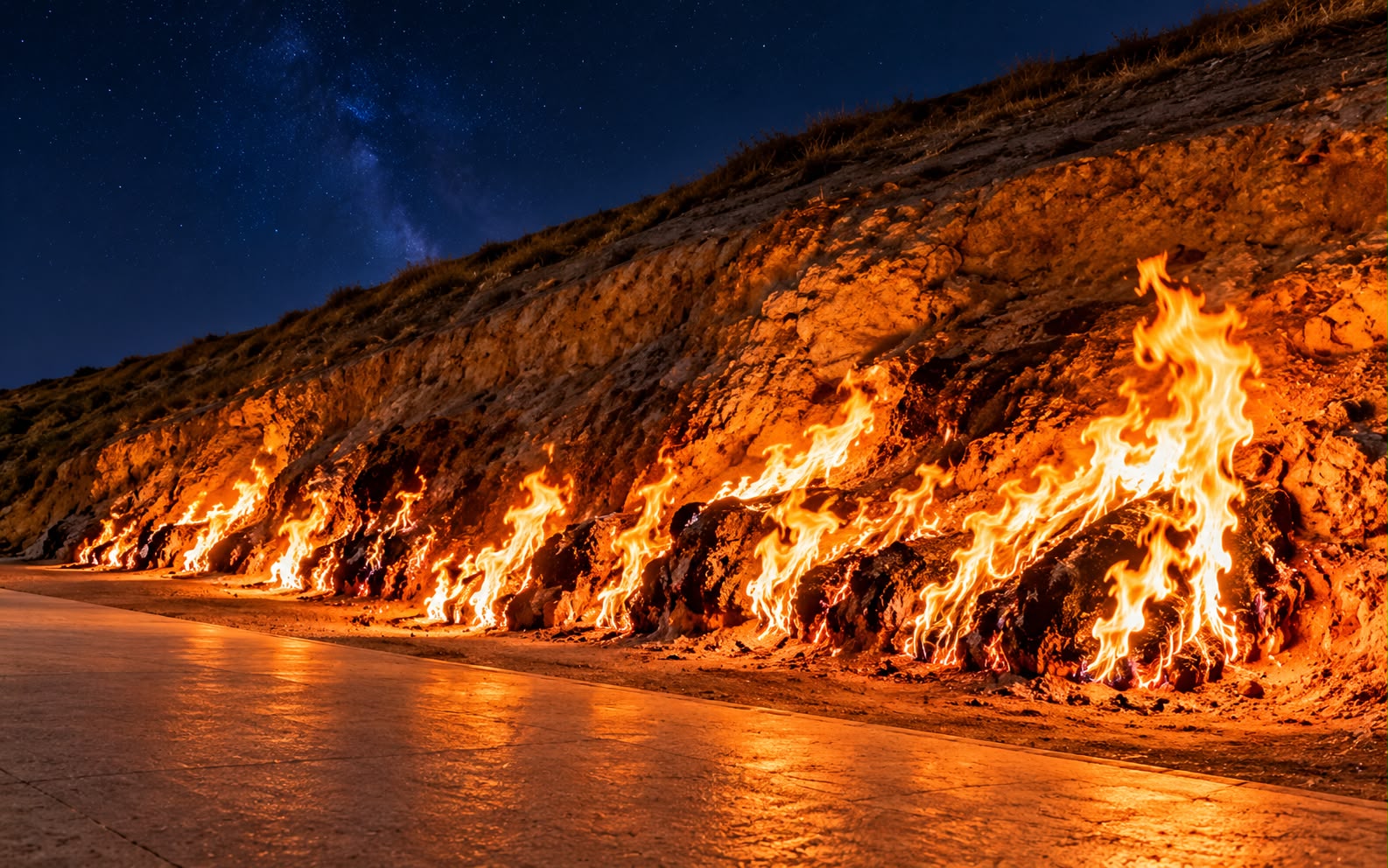
The country’s name is usually glossed as “land of fire”, and the two sites that earn it — Yanar Dag, a hillside that has burned continuously for centuries on escaping natural gas, and Ateshgah, a fire temple used by Zoroastrians and Hindu traders — are forty minutes from the capital.
Seven days adds Sheki and the mountain villages.
Figure AZN 750 (≈ AED 1,620) per person. April to June and September to October.
Before you go: the admin
Entry
- ASAN Visa is an e-visa issued online, usually within three working days, for a long list of nationalities including India and the GCC states.
- Apply on the official government portal only. There are many lookalike sites charging multiples of the fee.
- GCC citizens and several others can get a visa on arrival at Baku — check your own before relying on it.
- Six months’ validity.
One thing that will stop you at the border
- An Armenian stamp, or any evidence of travel to Nagorno-Karabakh, means refusal of entry. This is strictly enforced and is not negotiable. If Armenia is on your itinerary, do Azerbaijan first or on a separate passport.
Getting around
- Baku’s metro is cheap and easy; get a BakuKart.
- Bolt works in the city and is very cheap.
- A driver for the two day trips — roughly AZN 120–160 a day including fuel. Gobustan and Absheron can each be done as a half day, so one driver day covers both if you start early.
- Gabala is three hours inland; a driver or an intercity bus from Baku’s main terminal.
Money
- Manat, pegged to the dollar at about 1.70.
- Cards work in Baku; carry cash outside it.
Day by day
Day 1 — Baku old city
- 10:00 — İçərişəhər, the walled old city, UNESCO-listed and lived in — washing on the lines, cats on the steps, and families who have been there for generations.
- 11:00 — The Maiden Tower. Nobody is certain what it was for, which is part of its appeal — fire temple, observatory, fortress, all argued. The roof gives you the bay.
- 13:00 — The Palace of the Shirvanshahs, fifteenth century, the best surviving medieval architecture in the country, with the divanxana courtyard and the royal tombs.
- 16:00 — Nizami Street and the nineteenth-century oil-boom mansions, built when Baku produced half the world’s oil — the Rothschilds and the Nobels both made fortunes here.
- 18:30 — Baku Boulevard along the Caspian at dusk, which the city uses as its living room.
- 21:00 — The Flame Towers above, three glass towers lit at night with what look like flames climbing them — the display cycles every few minutes and is best seen from the Boulevard.
Day 2 — Gobustan and the mud volcanoes
- 09:00 — An hour south.
- 10:00 — Gobustan National Park — over 6,000 rock carvings spanning 40,000 years, of hunters, boats, dancers and aurochs, on boulders above the Caspian. UNESCO-listed, and the museum explains them properly before you walk up — do not skip it.
- A Roman inscription here is among the easternmost ever found — a centurion of the Twelfth Legion, under Domitian.
- 13:00 — The mud volcanoes, a short, very rough drive beyond. Azerbaijan has around 400 of the world’s roughly 1,000, and these are cold-bubbling grey mud rather than lava. You will need a local 4x4 from the site; ordinary cars cannot make the track.
- Wear clothes you do not mind ruining. The mud gets everywhere.
- 17:00 — Back in Baku for the evening.
Day 3 — Absheron: fire and fortresses
- The peninsula east of the city.
- 10:00 — Ateshgah, the fire temple at Surakhani — a pentagonal caravanserai around a natural gas vent, used by Zoroastrians and by Hindu and Sikh traders from India, with Sanskrit and Punjabi inscriptions still legible over the cells.
- 12:30 — Mardakan and Ramana fortresses, square stone keeps in the middle of orchard villages.
- 15:00 — The Bibi-Heybat Mosque on the bay, rebuilt after the Soviets dynamited the original in 1936.
- 19:00 — Yanar Dag, “burning mountain” — a hillside where escaping natural gas has burned continuously for centuries. Go after dark if you can; it is unimpressive in daylight and remarkable at night.
- Head to Gabala in the late afternoon, or the following morning.
Day 4 — Gabala
- 08:00 — Three hours inland, into the southern Caucasus foothills — green and forested, which after Baku’s semi-desert is a surprise.
- 11:30 — Tufandag cable car up to 1,920m, with the Caucasus main range behind — three stages, and the top one often sits above the cloud.
- 14:00 — Nohur Lake, which is turquoise and ringed with forest, with pedalos and a lot of Baku families at weekends.
- 16:00 — The Seven Beauties waterfall (Yeddi Gözəl) and a walk in the beech woods below it.
- Gabala is a ski resort in winter and a hill retreat in summer, and is where Baku goes in August — book ahead then.
Day 5 — Back to Baku, and out
- 09:00 — Three hours back, and most Gulf flights leave late, so the day is usable at the far end.
- 13:00 — The Heydar Aliyev Center on the way in — Zaha Hadid’s building, all curves and no straight lines, and arguably the best modern building in the Caucasus.
- 15:30 — The Carpet Museum, built in the shape of a rolled carpet, which is less silly inside than out — and the weaving demonstrations on the top floor are genuine.
- 17:00 — Taza Bazaar for pomegranates, saffron and dried fruit to take home.
- Baku airport is 30 minutes from the centre.
Costs and practicalities
Best time to visit
- April–June — green, mild, wildflowers in the foothills, and Baku before the heat. The best window.
- September–October — warm, clear, the pomegranate harvest in the valleys, and the Caspian still swimmable in September.
- July–August — 35°C and humid in Baku, and the city empties to Gabala. The mud volcanoes in this are genuinely unpleasant.
- November–March — cold and windy in Baku (it is called the city of winds for reason), and Gabala is a ski resort, which is a different and good trip. Yanar Dag is at its best on a cold night.
Novruz in late March is the spring new year and the biggest festival of the year, with bonfires and street celebrations.
Travel tips
- Apply for the ASAN visa on the official portal only.
- An Armenian stamp means refusal of entry. Plan the order of a Caucasus trip around this.
- Yanar Dag after dark. In daylight it is a low flame on a hillside; at night it is the reason the country is called what it is.
- You need a local 4x4 for the mud volcanoes — the track destroys ordinary cars and drivers will refuse.
- Combine Gobustan and Absheron into one long driver day if you are short of time.
- Baku is windy. The Caspian wind is constant and the city is colder than the forecast suggests.
- Use Bolt rather than street taxis.
- Tea is served with jam, not milk, and refusing it is rude.
What this trip actually costs
Two people, 4 nights, mid-range comfort, international flights excluded:
| Item | Cost |
|---|---|
| Hotels, 4 nights | AZN 560 (≈ AED 1,209) |
| Drivers for Gobustan, Absheron and Gabala | AZN 420 (≈ AED 907) |
| Food and drink, 5 days | AZN 320 (≈ AED 691) |
| Entries, cable car and the mud-volcano 4x4 | AZN 150 (≈ AED 324) |
| Metro, Bolt and airport transfers | AZN 50 (≈ AED 108) |
| Total for two | AZN 1,500 (≈ AED 3,239) |
- Roughly AZN 750 (≈ AED 1,620) per person, which makes Azerbaijan one of the cheapest short-haul trips from the Gulf after Georgia.
- Baku is more expensive than the rest of the country by a clear margin — Gabala costs noticeably less for the same standard.
- Food is good value. Two people eat well for AZN 60 a day.
- Hotel picks here are chosen on location, not on commission — always check prices and recent reviews before booking.
What to pack
- A windproof layer, whatever the season. Baku’s wind is constant.
- A warm layer for Gabala, which is cooler and higher.
- Walking shoes with grip for Gobustan’s boulders and the volcanoes, which are slippery.
- Clothes you do not mind getting muddy at the volcanoes.
- Sun protection — the Absheron peninsula has no shade.
- A Type C/F adapter, 220V.
FAQ
Do I need a visa? Most nationalities, including Indian passport holders, use the ASAN e-visa, which is issued online in about three working days. Some GCC citizens can get one on arrival.
Will an Armenian stamp cause problems? Yes — it means refusal of entry, and it is strictly enforced. If you are touring the Caucasus, visit Azerbaijan before Armenia.
Is Baku expensive? More than Tbilisi, less than the Gulf. The old city and the boulevard cost nothing; the restaurants and hotels in the centre are where the money goes.
Are the mud volcanoes worth the trip? If you like strange landscapes, yes — Azerbaijan has about 400 of the world’s 1,000. Be aware the access track needs a local 4x4 and the site is cold, grey and exposed.
Is five days enough? For Baku, the peninsula, Gobustan and one night in the foothills, yes. Sheki and the mountain villages of the north-west need seven.
Prices and entry rules change, and what you need depends on your passport; last checked 29 October 2026, so confirm with the embassy or your airline before booking.


