 The Itinerary
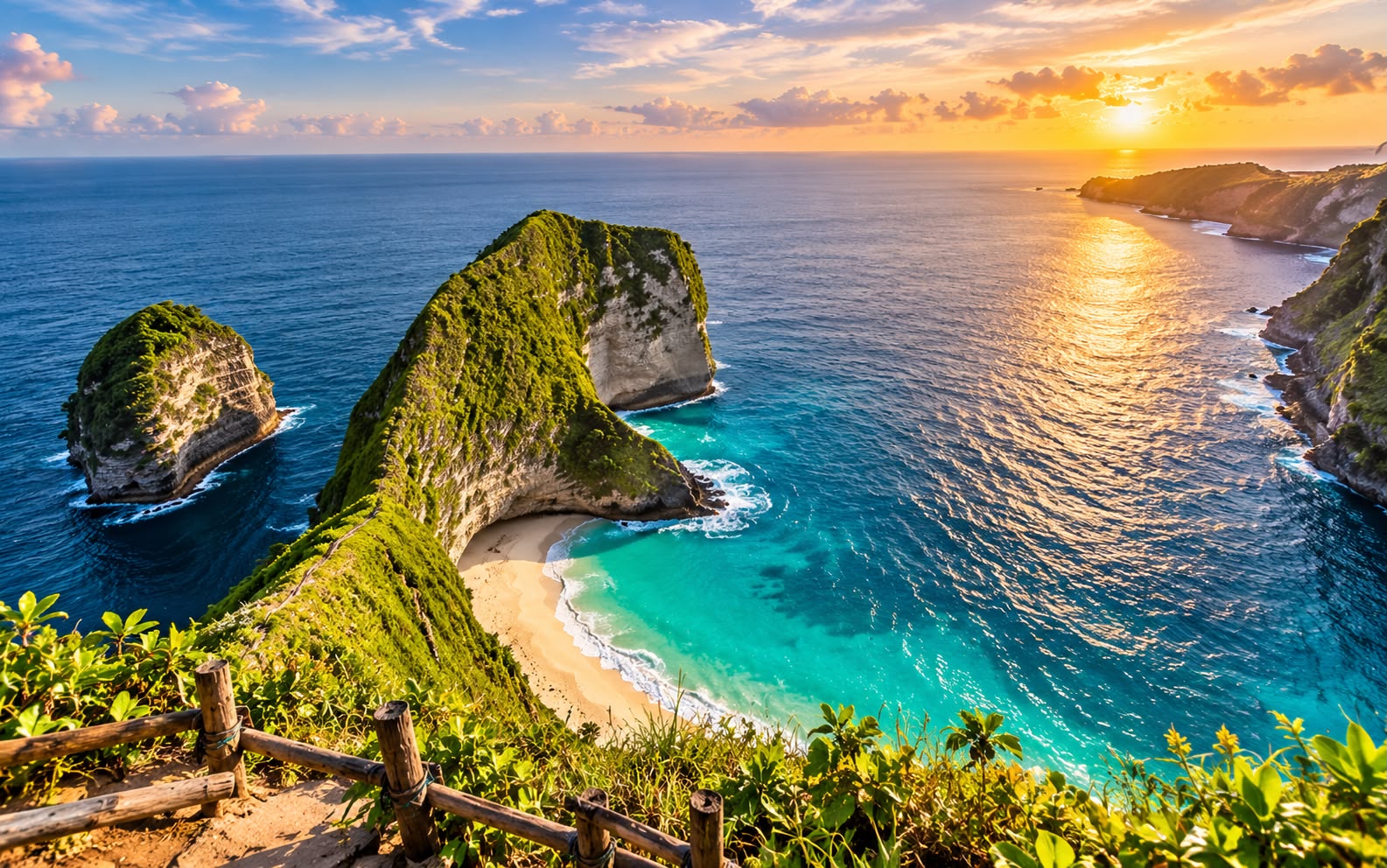
Bali in 7 days: Ubud, Uluwatu and Nusa Penida
A week in Bali works when you stop moving: three nights inland at Ubud, three on the southern cliffs, and one long day out to Nusa Penida. The traffic that ruins most Bali itineraries, the temple sarong rule, and why the Kelingking photograph costs you a whole day.
- Southeast Asia
- 7 days
- ≈ AED 3,100 / person
- Two bases, one island day trip, and no two-hour transfer every morning
Before you go
Most Bali weeks fail the same way: four hotels in seven nights, and three hours a day in a car. The island is small and the traffic is terrible, which sounds contradictory and is the single most important planning fact here. Ubud to Uluwatu is 45km and takes two hours.
So this week has two bases and one day trip. Three nights in Ubud — rice terraces, temples, the monkey forest, and the hinterland within an hour. Three nights in the south — the Uluwatu cliffs and the beach clubs of Seminyak. One long day to Nusa Penida, which is the best thing on this list and the most tiring.
Figure IDR 15,200,000 (≈ AED 3,084) per person. April to October is the dry season, and May, June and September are the sweet spot.
Before you go: the admin
Entry
- Visa on arrival for most nationalities, including Indian and most Gulf residents — 30 days, extendable once, payable by card at the airport. e-VOA online beforehand saves the queue.
- The Bali tourist levy of IDR 150,000 per person is separate from the visa and is paid online or on arrival. Keep the QR code.
- Six months’ passport validity and an onward ticket.
Getting around, which is the whole problem
- Hire a driver by the day rather than per trip. Around IDR 600,000–800,000 for eight to ten hours including fuel, and it is the single best money you spend here.
- Grab and Gojek work in the south and around Ubud, but are banned or obstructed in some areas by local transport co-operatives. Do not rely on them for an airport run at 5am.
- Scooters are how Bali moves and also how tourists get hurt. You need an international permit with a motorcycle endorsement for your insurance to be valid; most visitors riding here do not have one.
- Allow double the time any map gives you between Ubud and the south.
Money
- Indonesian rupiah, and the zeroes are worse than Vietnam’s. One million rupiah is about sixty dollars.
- Use bank ATMs attached to actual branches. Skimming at freestanding machines is a real problem here.
- Cards work in hotels, beach clubs and better restaurants. Warungs, markets and temples are cash.
Temples, and the sarong
- A sarong and sash are required at every temple, over whatever else you are wearing. They are lent or rented at the entrance for a small sum, or buy one on day one and carry it.
- Menstruating women are asked not to enter temples. It is stated on the signs and it is a genuine religious rule rather than a formality.
Day by day
Day 1 — Arrive in Ubud
- Arrive and do nothing. The airport to Ubud is 90 minutes in light traffic and considerably more in real traffic, and there is a lot of real traffic.
- 16:00 — The Campuhan Ridge Walk, free, easy, and it empties by nine in the morning — which makes late afternoon the other good window.
- 18:00 — Ubud Palace, and a legong dance performance in the courtyard at half past seven. Tickets are sold at the gate that afternoon.
- 20:00 — Dinner on Jalan Hanoman or Jalan Goutama, both quieter than the main road.
Day 2 — Terraces, temples and the monkeys
- 07:00 — Tegalalang rice terraces, before the coaches and before the heat. By ten it is a queue for a swing.
- 09:30 — Tirta Empul, the purification temple, where you can take part in the spring ritual properly with a guide rather than photographing it — sarong, sash, and you go under each spout in order.
- 11:30 — Gunung Kawi, rock-cut shrines in a river valley down 300 steps, and Goa Gajah, the elephant cave, both within half an hour.
- 15:00 — The Sacred Monkey Forest — 1,200 long-tailed macaques and three temples. They will take sunglasses, phones and anything in an open bag. Nothing loose, nothing shiny.
- 18:30 — A warung dinner, and book tomorrow’s class tonight.
Day 3 — The market, and a kitchen
- 06:00 — Ubud market before the tourist stalls take over, when it is still the produce market the town actually uses.
- 08:00 — A cooking class, which in Ubud starts at the market and is among the best in Asia — you buy the ingredients, then cook six or seven dishes and eat them.
- 14:00 — The afternoon off, or the Bali Swing and the waterfalls at Tegenungan if you want them.
- Mount Batur sunrise trek is the alternative shape for this day: a 2am start, two hours up, and genuinely spectacular. It costs you most of the following day, so do it tonight only if you are willing to give up tomorrow morning.
- 19:00 — Pack. You leave early.
Day 4 — Nusa Penida
- 07:00 — The boat from Sanur, back by five. Book the fast boat and a driver on the island together, through your hotel.
- 09:30 — Kelingking Beach, the T-rex headland photograph. The viewpoint is a ten-minute walk; the descent to the beach is a 45-minute scramble down a near-vertical bamboo handrail and the climb back up in the heat defeats a lot of people. The view from the top is the photograph.
- 12:00 — Angel’s Billabong and Broken Beach, a few minutes apart on the same western loop.
- 14:30 — Crystal Bay for the swim.
- The roads are bad and the island is bigger than it looks. Three stops is a full day; four is a rush.
- Consider staying one night on Penida instead if you would rather not do six hours of boat and road in a day.
Day 5 — South to Uluwatu
- 10:00 — Move south. Two hours from Ubud, and go mid-morning rather than at rush hour.
- 13:00 — Padang Padang and Bingin, beaches below the cliffs, reached by steps through a rock cleft — Padang Padang’s entrance is a gap you turn sideways to get through.
- 17:30 — Uluwatu Temple on the cliff at sunset, with the Kecak fire dance at six — a hundred men chanting the Ramayana without instruments, on a clifftop, as the sun goes down. Book ahead; it sells out.
- More monkeys here, and these ones are worse. They take glasses and trade them back for fruit.
- 20:00 — Jimbaran for grilled fish on the sand, twenty minutes north.
Day 6 — Seminyak or Canggu
- 09:00 — A slow morning. This is the beach day and it should be.
- 11:00 — Seminyak or Canggu for the beach clubs, the restaurants and the sunset. Seminyak is smarter, Canggu is younger and more congested.
- 14:00 — A surf lesson at Batu Bolong or Seminyak beach, both of which are forgiving beach breaks.
- 17:00 — Tanah Lot at sunset, 40 minutes north — the sea temple on a rock, and the most photographed thing on the island after Kelingking. It is only an island at high tide.
- 20:00 — Dinner in Seminyak, which has the best of it.
Day 7 — Out
- 08:00 — A last swim, early, before the sand gets hot.
- 11:00 — Massage and a late checkout, which most hotels will do for very little.
- The airport is 30–45 minutes from Seminyak — and three hours on a Saturday in August. Check the day before and leave earlier than feels necessary.
Costs and practicalities
Best time to visit
April to October is the dry season, and the shoulders of it are the best weeks.
- May, June and September — dry, less humid, and noticeably cheaper and quieter than July and August. The best value on the island.
- July–August — peak. Dry and reliable, and busy enough that Ubud and Canggu traffic becomes genuinely unpleasant. Prices up 40–60%.
- April and October — shoulder months, mostly dry, good value.
- November–March — the wet season. Rain is usually a heavy afternoon downpour rather than all day, everything is green, and prices fall. January and February are the wettest and the sea can be rough enough to cancel Penida boats.
Nyepi, the Balinese day of silence, falls in March. The entire island shuts for 24 hours — no flights, no traffic, no lights, nobody outdoors, including visitors, who must stay inside their hotel. It is extraordinary, and it is not a day to be arriving.
Travel tips
- Two bases, not four. The transfers are what ruin a Bali week.
- Hire a driver by the day. Cheaper than three separate trips and he will wait while you walk a ridge.
- Everything outdoors before nine or after four. The middle of the day is heat and coaches.
- Carry your own sarong rather than renting one at every temple.
- Nothing loose at the Monkey Forest. They are quick and they are not tame.
- Use ATMs inside bank branches, not freestanding ones.
- The Kelingking climb is harder than it looks. The viewpoint is the photograph; the beach is a serious scramble.
- Book the Kecak dance and the Penida boat the day before, not on the day.
What this trip actually costs
Two people, 6 nights, mid-range comfort, international flights excluded:
| Item | Cost |
|---|---|
| Hotels, 6 nights across two bases | IDR 11,200,000 (≈ AED 2,272) |
| Food and drink, 7 days | IDR 6,400,000 (≈ AED 1,298) |
| Nusa Penida day trip, entries and the Kecak | IDR 5,600,000 (≈ AED 1,136) |
| Drivers and airport transfers | IDR 4,800,000 (≈ AED 974) |
| Scooter hire, sarongs and incidentals | IDR 2,400,000 (≈ AED 487) |
| Total for two | IDR 30,400,000 (≈ AED 6,167) |
- Roughly IDR 15,200,000 (≈ AED 3,084) per person, and Bali stretches further at both ends than almost anywhere — you can halve this in a guesthouse or quadruple it in a cliff villa without changing the itinerary.
- The daily driver is the line people query and the one that makes the week work.
- July, August and the Christmas fortnight run well above this.
- Hotel picks here are chosen on location, not on commission — always check prices and recent reviews before booking.
What to pack
- A sarong, bought on day one.
- Reef-safe sun cream and a rash vest.
- Walking sandals with grip — temple steps, the Penida scramble and wet stone.
- A dry bag for boat days.
- Mosquito repellent; dengue is present and the mosquito bites by day.
- A light long-sleeve layer for Ubud evenings and Batur at dawn.
- A Type C/F adapter — Bali runs European-style two-pin at 230V.
FAQ
Is seven days enough for Bali? For the south, Ubud and one island, comfortably. It is not enough to add Lombok, the Gilis or east Bali without the week becoming transfers. Ten days opens up Munduk and the north.
Ubud or the beach first? Ubud first. It is 90 minutes from the airport whichever order you go, and finishing in the south puts you 30 minutes from your flight on the last morning rather than two hours.
Should I rent a scooter? Only if you ride at home and hold an international permit with a motorcycle endorsement. Without it your travel insurance will not pay out, and Bali’s roads are not where you learn.
Is Nusa Penida worth the day? Yes, and it is the most tiring day of the week. If six hours of boat and bad road in one day sounds like too much, stay a night there instead.
When is Bali cheapest? November to March, the wet season — and the rain is usually a heavy afternoon hour rather than a ruined day. January and February are the wettest.
Prices and entry rules change, and what you need depends on your passport; last checked 29 October 2026, so confirm with the embassy or your airline before booking.


