 The Itinerary
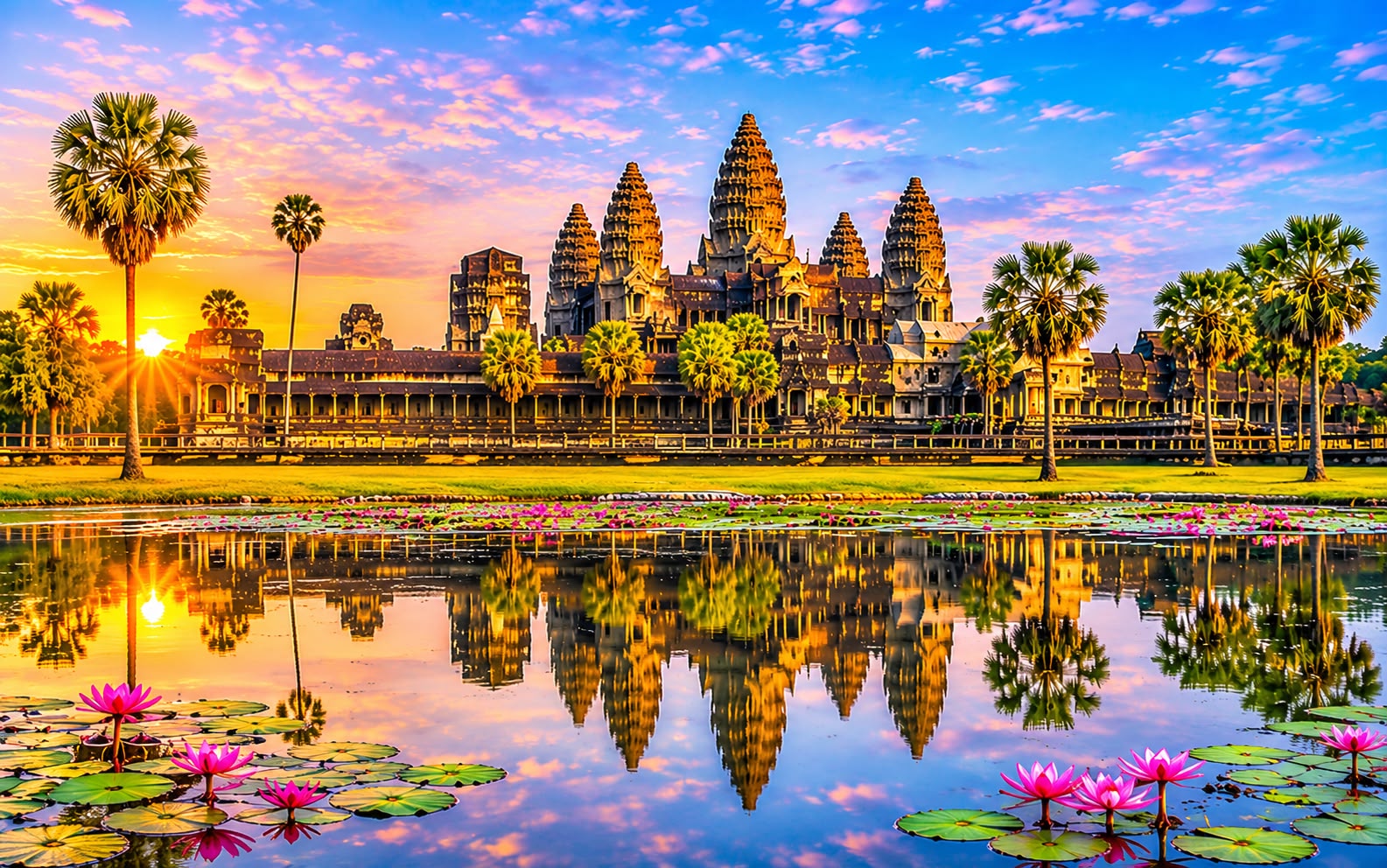
Thailand and Cambodia in 12 days: Bangkok, Ayutthaya, Angkor and Phnom Penh
Bangkok and the ruins at Ayutthaya, then four days at Angkor and two in Phnom Penh. The land border everyone warns about and when to use it anyway, why Angkor needs three days rather than one, and the hardest afternoon on this site.
- Southeast Asia
- 12 days
- ≈ AED 4,750 / person
- Two ruined capitals and one living one, in the order that makes sense
Before you go
This is the pairing that makes historical sense. Ayutthaya was sacked in 1767 and Angkor was abandoned in the fifteenth century, and Bangkok and Phnom Penh are what each of those civilisations became. Seeing the ruins and the living capitals in the same fortnight is the whole argument for doing them together.
Four days in Thailand and seven in Cambodia, with a travel day between. Cambodia gets the bulk of it because Angkor is not a day trip — it is 400 square kilometres and three days is the honest minimum.
Thailand in 14 days and Cambodia in 7 days are each on their own.
Figure USD 1,300 (≈ AED 4,774) per person. November to February.
Before you go: the admin
Visas
- Thailand: visa-free for a long list of nationalities, commonly 30 or 60 days, plus a free digital arrival card submitted online before you land. The sites charging for that card are not official.
- Cambodia: e-visa online, or visa on arrival at both airports and the main land crossings. The e-visa costs a few dollars more and removes the queue and the improvised fees.
- Carry a passport photo for Cambodia if you are taking the visa on arrival; they will charge you for one otherwise.
- Last checked: 2 November 2026.
Getting from Bangkok to Siem Reap
- The flight is an hour and is what most people should book. Siem Reap’s airport opened in 2023 and is 40 minutes from town, which is further than the old one.
- The land border at Poipet is the cheap option and has a reputation. It is passable — but take the e-visa, refuse any “processing fee” at an office before the actual border post, and do not use a bus company that collects passports. Budget a full day.
- Take the flight unless the overland leg is the point. On a twelve-day trip, a day lost at Poipet is a day lost at Angkor.
Money in Cambodia
- Cambodia runs on US dollars. Prices are quoted in dollars and ATMs dispense them; riel comes back as change under a dollar, at roughly 4,000 to one.
- Bring clean, unmarked notes. Torn or heavily creased dollars are refused, which surprises people every time.
- Small denominations. Nobody wants to break a fifty for a tuk-tuk.
Day by day
Day 1 — Land in Bangkok
- Arrive and do nothing structural.
- Stay near a Skytrain or Metro station. Bangkok’s traffic is the one thing that eats a short stay, and the rail removes it entirely.
- Evening — Yaowarat Road in Chinatown, which is a street food market running late, or a riverside dinner.
Day 2 — The Grand Palace and the river
- 08:00 — the Grand Palace and Wat Phra Kaew at opening. Shoulders and knees covered, and they enforce it at the gate.
- 11:00 — Wat Pho for the reclining Buddha, and a massage at the temple’s own school, which is where Thai massage is taught.
- 14:00 — the cross-river ferry to Wat Arun, a few baht and the best short crossing in the city.
- If a friendly stranger tells you the palace is closed today, it is not. The alternative tour ends at a gem shop.
Day 3 — Ayutthaya
- The old Siamese capital, 80 km north — a UNESCO site of brick stupas and roofless temples, sacked by the Burmese in 1767 and left as it fell.
- Go by train from Hua Lamphong or by car. The train is cheap and slow and the carriages are open to the air; the car is 90 minutes.
- Wat Mahathat for the Buddha head held in the fig roots, Wat Chaiwatthanaram for the Khmer-style towers on the river, and Wat Phra Si Sanphet for the three stupas.
- Hire a bicycle or a tuk-tuk for the day. The site is spread across an island and walking it in that heat is a mistake.
- Go early. By one in the afternoon the brick is radiating.
Day 4 — Bangkok markets, then fly to Siem Reap
- Morning — Chatuchak if it is a weekend, 15,000 stalls; otherwise Pak Khlong Talat, the flower market, which runs around the clock.
- Or Jim Thompson House, a teak compound in the middle of the city and the best air-conditioned hour in Bangkok.
- Afternoon — fly to Siem Reap. One hour, then 40 minutes from the new airport into town.
- Evening — buy the Angkor pass today if you can. A pass bought after 17:00 is valid from the next day and lets you in for that evening’s sunset — which is the one useful piece of scheduling at Angkor.
Day 5 — Angkor Wat at sunrise, and the small circuit
- 05:00 — Angkor Wat for sunrise, reflected in the northern pond. It is crowded and it is still worth it.
- 07:00 — inside Angkor Wat while everyone else goes to breakfast. The bas-reliefs along the outer gallery run for most of a kilometre and tell the Churning of the Ocean of Milk.
- 09:30 — Angkor Thom and the Bayon, with its 200-odd stone faces, then the Terrace of the Elephants.
- 11:30 — Ta Prohm, the one the trees have taken.
- 13:00 — stop. Three to four hours is what anyone actually absorbs, and the afternoon heat is not negotiable.
- Hire a guide for this day. Angkor without one is a lot of beautiful stone and no story.
Day 6 — The grand circuit, and Banteay Srei
- 08:00 — Preah Khan, Neak Pean and Ta Som on the outer loop, all far quieter than the day before.
- 11:00 — Banteay Srei, 37 km out: pink sandstone cut so finely it looks like woodwork, and the best carving at Angkor.
- 14:00 — the Landmine Museum on the road back, which is small, free to leave at any point, and part of the same history.
- 17:00 — sunset from Pre Rup rather than Phnom Bakheng, which caps numbers and queues.
Day 7 — Beng Mealea, or the lake, or nothing
- Beng Mealea, an hour out: unrestored, collapsed, and you walk through the rubble. What Angkor looked like before the clearing.
- Or Tonlé Sap — go to Kampong Phluk, not Chong Kneas. Chong Kneas is the one every tout sells and the one with the pressure to buy rice for the school.
- Or nothing. Three days of temples is genuinely tiring and Siem Reap has a good market, decent restaurants and a pool.
Day 8 — Siem Reap to Phnom Penh
- The bus is six hours on a good road and costs very little. The flight is an hour and costs more than the distance suggests.
- Take the morning bus and you are in Phnom Penh for a late lunch with the afternoon intact.
- Evening — the riverfront where the Tonlé Sap meets the Mekong, which is where the city walks at dusk.
Day 9 — The hard day
- Tuol Sleng, then Choeung Ek. S-21 was a school the Khmer Rouge turned into a prison; the killing fields are 15 km out.
- Take the audio guide at both. It is narrated in part by survivors and it is the reason to go rather than read.
- Do both in one morning and then stop for the day. Do not schedule anything after it — people consistently underestimate this and book a palace visit for the afternoon.
- This is not optional on a Cambodia trip. Everyone over fifty here lived through it.
- Think hard about bringing children. The site does not moderate what it shows.
Day 10 — The Royal Palace and the river
- 08:00 — the Royal Palace and the Silver Pagoda, floored with five tonnes of silver tiles. Opens at eight, closes at eleven, reopens at two.
- 10:00 — the National Museum, which holds the Angkorian sculpture that is not still at Angkor.
- Afternoon — the Central Market, an art deco dome from 1937, or a sunset cruise on the Mekong, which is cheap and genuinely pleasant.
Day 11 — Out of Cambodia
- Fly home from Phnom Penh if your ticket allows an open jaw — into Bangkok, out of Phnom Penh.
- Otherwise the hop back to Bangkok is an hour fifteen, and the last evening is a massage and a final meal somewhere good.
- Leave the afternoon loose. Both airports are slow.
Day 12 — Home
- Allow three hours at Suvarnabhumi. It is a very large airport.
- Spend the last of the riel. It converts badly outside Cambodia and small notes are worth little anywhere else.
Costs and practicalities
Best time to visit
November to February, which suits both countries at once.
- November to February — dry and comparatively cool in both. Angkor at 28–32°C instead of 38°C, which changes how much of it you see. Peak season, and worth it.
- March to May — the hot season. Angkor in April is brutal and Bangkok builds to 40°C. Songkran in mid-April is a nationwide water fight and Khmer New Year falls in the same week — plan around both or into them.
- June to October — the wet season. Rain comes hard in the afternoon and clears, the moats fill, the countryside is green and prices drop. Beng Mealea and the outer temples get muddy.
- September and October are the wettest and the months to avoid if the temples are the point.
Travel tips
- Three days at Angkor, not one. The one-day pass is the commonest mistake on this trip.
- Buy the Angkor pass after 17:00 the day before — it covers that evening’s sunset and starts the next morning.
- Hire a guide for your first Angkor day.
- Temples at dawn, hotel at midday, temples again at four.
- Fly Bangkok to Siem Reap unless the overland leg is the point.
- Clean, unmarked dollars for Cambodia, in small notes.
- Do not schedule anything after the memorials.
- Cover shoulders and knees at Angkor — it is enforced at Angkor Wat’s upper level, and at the Grand Palace in Bangkok.
- Agree a tuk-tuk day rate in advance, in both countries.
- Take the Thai digital arrival card on the official site, free.
What this trip actually costs
Two people, 11 nights, mid-range throughout, international flights excluded:
| Item | Cost |
|---|---|
| Hotels, 11 nights across both countries | USD 880 (≈ AED 3,232) |
| Food and drink, 12 days | USD 480 (≈ AED 1,763) |
| Angkor three-day pass, guide and tuk-tuk | USD 420 (≈ AED 1,542) |
| Internal flights, two people | USD 340 (≈ AED 1,249) |
| Ground transport, Ayutthaya and transfers | USD 260 (≈ AED 955) |
| Phnom Penh entries and the memorials | USD 220 (≈ AED 808) |
| Total for two | USD 2,600 (≈ AED 9,549) |
- Roughly USD 1,300 (≈ AED 4,774) per person for twelve days.
- The Angkor line is the one that surprises people. A three-day pass is USD 62 (≈ AED 228) per person before a guide or a tuk-tuk, and it is the right spend on this trip.
- Taking the Poipet land crossing instead of the flight saves about USD 250 (≈ AED 918) and costs a day. On twelve days, the flight wins.
- Cambodia is cheaper than Thailand for beds and about the same for food.
- Hotel picks here are chosen on location, not on commission — always check prices and recent reviews before booking.
What to pack
- Modest clothing for temples in both countries — shoulders and knees, enforced.
- Proper shoes. Angkor’s stairs are steep, uneven and original, and Beng Mealea is a rubble scramble.
- A hat, sunglasses and more sunscreen than you think. There is no shade at Angkor Wat.
- A head torch for a 05:00 start.
- Clean small-denomination dollars for Cambodia.
- Insect repellent with DEET — dengue is present in both.
- A refillable bottle. Tap water is not drinkable in either.
- A Type A/C/G adapter for Cambodia, Type A/B/C/O for Thailand, 230V and 220V.
Part of a bigger trip?
- Cambodia in 7 days is the Cambodian half on its own, with the coast added.
- Thailand in 14 days is Thailand at full length.
- Vietnam and Cambodia in 12 days is the other way to pair Angkor.
- Thailand and Laos in 11 days is the quiet northern alternative.
- Bangkok in 3 days is the city on its own.
FAQ
How many days do I need at Angkor? Three. The one-day pass gets you Angkor Wat, the Bayon and Ta Prohm in a rush and in the heat, which is how people come away saying the temples blurred together. Three days lets you take the mornings, sit out the afternoons, and reach Banteay Srei and Beng Mealea, which are the two best things outside the main loop.
Should I take the land border at Poipet or fly? Fly, unless the overland journey is something you actively want. The border is passable with an e-visa and a bus company that does not collect passports, but it takes a full day and the scams are persistent. The flight is an hour and costs roughly $250 more for two — on a twelve-day trip, that buys back a day at Angkor.
Is Phnom Penh worth two days? Yes, and the two days do different things. One is Tuol Sleng and Choeung Ek, which is difficult and is the reason to come. The other is the Royal Palace, the National Museum and the river, which is the city as it is now. Doing both in one day does justice to neither.
Why does Cambodia use US dollars? A legacy of the UN administration in the early 1990s, and it stuck. Prices are quoted in dollars, ATMs dispense them, and riel appears as change under a dollar at about 4,000 to one. Bring clean, unmarked notes in small denominations — torn or heavily creased dollars get refused.
What is the best month for this trip? December and January. Both countries are dry, Angkor sits around 28–32°C rather than 38°C, and Bangkok is as pleasant as it gets. It is peak season and you pay for it, but the difference in how much of Angkor you actually walk is large.
Prices and entry rules change, and what you need depends on your passport; last checked 2 November 2026, so confirm with the embassy or your airline before booking.


