 The Itinerary
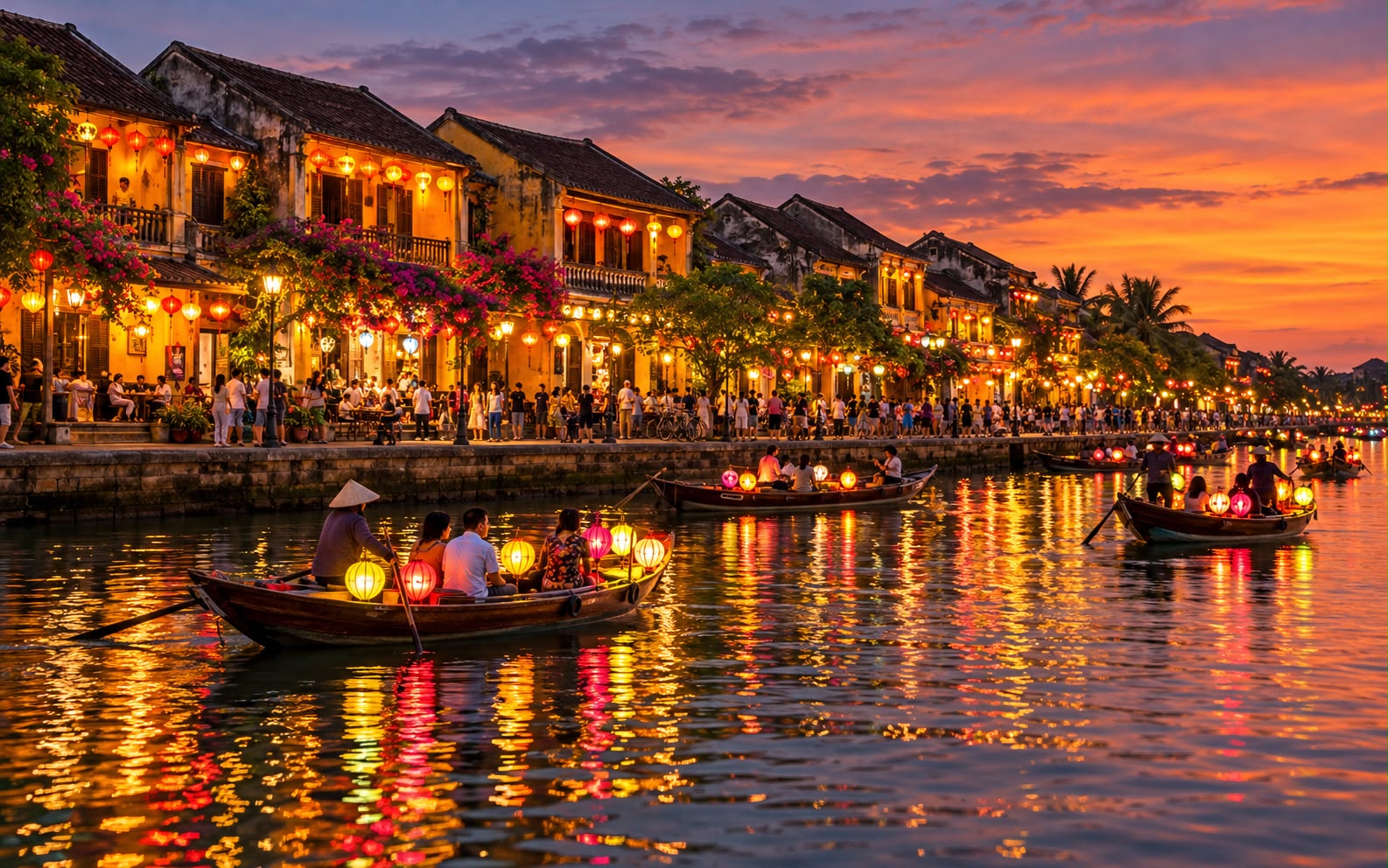
Vietnam and Cambodia in 12 days: Hanoi, Ha Long, Hoi An, Saigon and Angkor
Vietnam top to bottom and then the temples: a limestone bay slept on, a lantern-lit tailoring town, a war museum that pulls no punches, and Angkor at sunrise — two countries, one open border, and a route the airlines have made easy.
- Southeast Asia
- 12 days
- ≈ AED 5,900 / person
- The classic Indochina run, with the temples at the end rather than the start
Before you go
Before you go: the admin
Two visas, both straightforward
- Vietnam issues an e-visa to most nationalities, 90 days, single or multiple entry, applied for online. Allow a week; it usually comes in three working days. Print it.
- Cambodia issues an e-visa too, 30 days, and also does visa on arrival at Siem Reap and Phnom Penh airports. The e-visa costs a few dollars more and removes the queue.
- Use only the official sites — evisa.gov.vn and evisa.gov.kh. The lookalike sites that rank above them in search charge three times the fee for the same document.
- Passports need six months’ validity and a blank page.
Flights, and why this direction
- Fly into Hanoi and out of Siem Reap. An open-jaw ticket costs much the same as a return and saves a day of backtracking.
- Two internal flights do the heavy lifting: Hanoi to Da Nang for Hoi An, and Da Nang to Ho Chi Minh City. Vietnam’s domestic network is cheap and frequent; the train on the same route is sixteen hours.
- Ho Chi Minh City to Siem Reap is an hour in the air. The overland crossing via Phnom Penh takes two days and is only worth it if the Mekong is the point.
- Book the internal legs early. Tet and the Lunar New Year week aside, they are inexpensive; last-minute they are not.
Money
- The dong has a lot of zeros. 500,000 and 20,000 notes look alike and the mistake is expensive — check every note.
- Cambodia runs on US dollars. ATMs dispense them, prices are quoted in them, and riel appears as change below a dollar. Bring clean, untorn notes; torn ones are refused.
- Cards work in cities and hotels in both. Markets, tuk-tuks and street food are cash.
- Draw dollars before you leave Vietnam if you want them clean — Cambodian ATMs charge a fee per withdrawal.
One gentle brief
- This is an easy trip. Both countries are used to visitors, English is widely spoken in the tourist corridor, and nothing here requires nerve.
- The two halves feel different. Vietnam is fast, dense and commercial; Cambodia is slower and quieter, and Siem Reap after Saigon is a decompression rather than a climax.
- Put Angkor last. It is the thing people remember, and it works better as a finish than as an opener you spend the rest of the trip measuring everything against.
Day by day
Day 1 — Land in Hanoi, walk the Old Quarter
- Arrive, drop the bag, and go straight out. Hanoi is best met on foot and jet lag is better fought with noise than with a nap.
- Crossing the road is the first skill. Walk slowly and predictably; the scooters flow around you. Stopping or running back is what causes accidents.
- 13:00 — Bún chả for lunch — grilled pork in broth with noodles and herbs, the Hanoi dish.
- 15:00 — The Old Quarter’s thirty-six streets are still named for the trades — Hàng Bạc for silver, Hàng Mã for paper offerings — and most still sell roughly the right thing.
- 17:00 — Egg coffee in the afternoon at one of the cafés off Hàng Gai.
- 19:30 — A bia hoi corner, where fresh beer brewed that morning costs about thirty cents on a plastic stool.
Day 2 — Hanoi: the mausoleum, the lake and the water puppets
- 07:30 — Ho Chi Minh’s Mausoleum opens early and closes by eleven, and the queue is long. No bags, no cameras, no shorts, and you walk past in silence. It closes entirely for about two months most autumns for maintenance — check before you join the queue.
- 09:30 — The One Pillar Pagoda and the Presidential Palace gardens are in the same compound and take another hour.
- 13:00 — The Temple of Literature, Vietnam’s first university, founded 1070, with the stelae of doctoral laureates carried on stone turtles.
- 17:00 — Hoàn Kiếm lake at dusk, and the red bridge to Ngoc Son temple on its island.
- 19:00 — The Thăng Long water puppets in the evening — a thousand-year-old village art performed in a waist-deep pool, and much better than it sounds.
Day 3 — Ha Long Bay, slept on
- 08:30 — Transfer is three hours on the expressway to Ha Long or Lan Ha. Most cruises collect from Hanoi hotels mid-morning.
- Sleep on the bay. A day trip gives you four hours of it in the middle of the day, which is the worst light and the most boats. One night gives you the evening and the dawn.
- Lan Ha Bay, off Cat Ba, is the quieter half of the same limestone karst and increasingly the better choice.
- Cruise quality varies enormously. Pay for a reputable operator; the cheap boats are crowded, loud and poorly maintained.
- 14:00 — Kayaking into the lagoons and a cave if the itinerary has one. The swimming is from the boat, in water that is warm and not especially clear.
- 18:30 — Sunset from the top deck, which is the hour a day trip never sees.
Day 4 — Back to Hanoi, fly to Da Nang, drive to Hoi An
- 07:00 — A slow morning on the water, breakfast, and back ashore around midday.
- 15:00 — Fly Hanoi to Da Nang in the late afternoon — about eighty minutes — then forty minutes by road south to Hoi An.
- 18:30 — Arrive in time for the lanterns. The old town’s silk lanterns come on at dusk and the riverfront is the single prettiest hour of the trip.
- 20:00 — Dinner by the river, and the full-moon nights are the ones when the electric lights go off altogether.
Day 5 — Hoi An: the old town, and a fitting
- 08:00 — This is the tailoring town. If you want something made, order it on the first morning — a good shop needs two fittings and 24 to 48 hours, and the rushed overnight job is how people end up with a jacket they never wear.
- 10:00 — The old town is UNESCO-listed and a ticket covers entry to five of the heritage houses, temples and assembly halls. The Japanese Covered Bridge is the one on the banknote.
- 13:00 — Cao lầu is the local noodle, made with water from one specific well, and bánh mì here is as good as it gets in Vietnam.
- 16:00 — The first fitting, and a cycle out through the rice fields afterwards.
- 19:30 — The night market on An Hội for the lanterns, and a boat with a paper lamp on the river if you can bear the sentiment.
Day 6 — My Son, or the beach
- 06:30 — My Son, an hour inland, is the Cham sanctuary — brick towers from the fourth to thirteenth centuries, bombed in 1969 and partly restored. Go at opening; by ten it is coaches and heat.
- 11:00 — Back for the second fitting.
- 14:00 — Or An Bang beach, fifteen minutes from the old town, which is the local answer to a hot afternoon.
- The Hai Van Pass north of Da Nang is the other option — a half-day by car or motorbike with the best coastal view in the country — but it replaces My Son rather than joining it.
- 18:00 — Collect everything, and pack it flat.
Day 7 — Fly to Ho Chi Minh City
- 09:00 — Da Nang to Saigon is ninety minutes. Arrive late morning.
- 13:00 — The War Remnants Museum is the afternoon. It is one-sided, it says so, and it is still the most important hour in the city — the photojournalism room and the Agent Orange exhibits in particular.
- 16:00 — The Independence Palace, frozen in April 1975, with the basement war rooms and the rooftop helipad.
- 18:00 — Bến Thành market at dusk and the street-food stalls that set up outside it after the stallholders go home.
- 21:00 — A rooftop on Nguyễn Huệ, which is the pedestrian boulevard the city walks on in the evening.
Day 8 — Cu Chi, and the city after dark
- 07:00 — The Cu Chi tunnels, two hours out — 250km of hand-dug tunnel, a short widened section you can crawl through, and a firing range that some find distasteful and some do not.
- Go early and take the Ben Duoc entrance over Ben Dinh if you can; it is less visited and less staged.
- 13:00 — Back for lunch.
- 15:00 — The Jade Emperor Pagoda, dim and smoky and the best temple in the city, or the Museum of Fine Arts.
- 19:00 — The Chinatown night market at Bình Tây in Cholon, which is where the city actually eats.
Day 9 — Fly to Siem Reap
- 10:00 — An hour in the air, and the pace changes immediately.
- The Cambodian e-visa should be arranged before travel.
- 15:00 — Buy the Angkor pass this afternoon at the official ticket office on Road 60, not at the temples. One, three and seven-day passes; the three-day can be used across a week. Your photograph is printed on it.
- 17:30 — Sunset from Phnom Bakheng is the famous one and is capped and crowded. The Srah Srang reservoir or a quiet terrace at Pre Rup are both better.
- 20:00 — Pub Street exists and is exactly what it sounds like. The Old Market lanes either side of it are better.
- Hire one tuk-tuk driver for both temple days. The circuits are too spread out otherwise, and a good driver positions you ahead of the coaches.
Day 10 — Angkor: the grand circuit at dawn
- 05:15 — Angkor Wat at sunrise. Be at the west causeway by 5.15 for the reflection in the northern pond. It is busy and it is still worth it.
- 07:00 — Then into the temple proper while everyone else goes for breakfast — the bas-reliefs of the Churning of the Sea of Milk along the eastern gallery, and the upper level, which has a dress code and a queue.
- 10:00 — Angkor Thom and the Bayon, whose 216 faces are the image most people carry away, plus the Terrace of the Leper King and the Elephant Terrace.
- 13:00 — Lunch and a long break. It is 35°C with no shade and the afternoon is better spent slowly.
- 16:00 — Ta Prohm in the afternoon, the one the trees have taken, and go late when the light comes sideways through the strangler figs.
Day 11 — Banteay Srei, Beng Mealea and the lake
- 07:00 — Banteay Srei, 35km out, is small, pink and the finest carving at Angkor — a tenth-century sandstone jewel box. Go at opening.
- 10:00 — Beng Mealea, further again, is the unrestored one: a collapsed temple in forest with walkways through the rubble, and far fewer people.
- 15:00 — Or the Tonlé Sap instead — the floating villages at Kampong Phluk or Kampong Khleang. Choose the operator carefully; several of the lake tours are exploitative, and Kampong Khleang is the least staged.
- 18:00 — The lake at sunset, which is the reason to do it in the afternoon rather than the morning.
Day 12 — Fly home from Siem Reap
- 06:30 — One last early temple if the pass allows — Preah Khan is the quiet one and takes an hour.
- 10:00 — The Angkor National Museum or the Artisans Angkor workshops if the flight is late.
- Leave two hours for the airport, which is new, calm and 40km from town — the distance is the part people forget.
Costs and practicalities
Best time to visit
November–February is the cool dry season across both countries and the only months when Angkor in the middle of the day is reasonable.
- November–February — dry, 25–30°C, low humidity. Peak season; Siem Reap and Hoi An are both full over Christmas and Angkor’s sunrise is genuinely crowded.
- March–May — the hot season, reaching 38–40°C in Cambodia. Angkor is punishing by ten in the morning and Ha Long is hazy.
- June–October — the monsoon, arriving as heavy afternoon bursts. The countryside is luminous, the Angkor moats are full, and the temples are at their most atmospheric and least crowded. Ha Long cruises are cancelled for storms more often.
- Hoi An floods most years in October and November, which is the one date to check before booking.
Tet, the Vietnamese lunar new year in late January or February, shuts Vietnam for about a week — transport sells out and many businesses close.
Travel tips
- Put Angkor at the end. Both countries reward it: Vietnam builds, Cambodia resolves. The reverse leaves you comparing everything to the temples.
- Clean dollars for Cambodia. Torn, marked or pre-2013 notes are refused outright, and this catches out more visitors here than anything else.
- Grab works in Vietnam for cars and motorbikes and removes every fare argument. In Cambodia it is PassApp and Grab.
- Cover shoulders and knees at Angkor — it is enforced at Angkor Wat’s upper level and at Bayon — and never touch a child’s head or point your feet at a Buddha image in either country.
- Do not support orphanage visits in Siem Reap. The practice funds a documented industry; the same applies to buying from begging children.
- Landmines remain in rural Cambodia away from the temple circuits. Stay on marked paths.
- Street food with a queue is the safest street food in both countries. High turnover is the whole test.
What this trip actually costs
Two people, 11 nights, mid-range comfort, international flights excluded:
| Item | Cost |
|---|---|
| Hotels, 10 nights | USD 880 (≈ AED 3,232) |
| Ha Long or Lan Ha cruise, 1 night, two people | USD 400 (≈ AED 1,469) |
| Three internal flights, two people | USD 700 (≈ AED 2,571) |
| Angkor pass, guides and site entries | USD 460 (≈ AED 1,689) |
| Food and drink, 12 days | USD 480 (≈ AED 1,763) |
| Transfers, tuk-tuks and local transport | USD 280 (≈ AED 1,028) |
| Total for two | USD 3,200 (≈ AED 11,752) |
- Roughly USD 1,600 (≈ AED 5,876) per person, which makes this one of the best-value long trips on the site.
- The internal flights are the line worth paying. The alternative is three long overnight journeys and two lost days.
- The Angkor three-day pass is a large single cost and is not optional if you want more than one temple morning.
- Hotel picks here are chosen on location, not on commission — always check prices and recent reviews before booking.
What to pack
- Clean US dollar notes for Cambodia, in small denominations.
- Light, modest clothing — shoulders and knees covered for the temples, for men as well.
- A proper sun hat and SPF 50. Angkor has very little shade.
- Shoes you can take off easily and socks, because you will.
- A dry bag for the bay and the monsoon afternoons.
- Mosquito repellent with DEET and your malaria advice checked — the temple circuits are low risk, rural Cambodia less so.
FAQ
Which direction is better? Hanoi in, Siem Reap out. Vietnam builds and Cambodia resolves, and an open-jaw ticket saves a day of backtracking.
Is three days enough for Angkor? Two temple days is the minimum and three is comfortable. The three-day pass is valid across a week, so you can take a day off in the middle.
Do I need to go to Phnom Penh? Not on twelve days. It deserves two nights of its own for Tuol Sleng and the Royal Palace, and adding it means cutting Vietnam.
Can I cross overland instead of flying? Yes, via Moc Bai to Phnom Penh and then on to Siem Reap, but it is two days and the bus is long. Fly unless the Mekong is the reason you came.
What languages will I need? None. Vietnamese and Khmer are the languages, and English is widely spoken across the whole tourist corridor.
Prices and entry rules change, and what you need depends on your passport; last checked 29 October 2026, so confirm with the embassy or your airline before booking.


