 The Itinerary
Thailand and Laos in 11 days: Bangkok, Chiang Mai and the Mekong slow boat to Luang Prabang
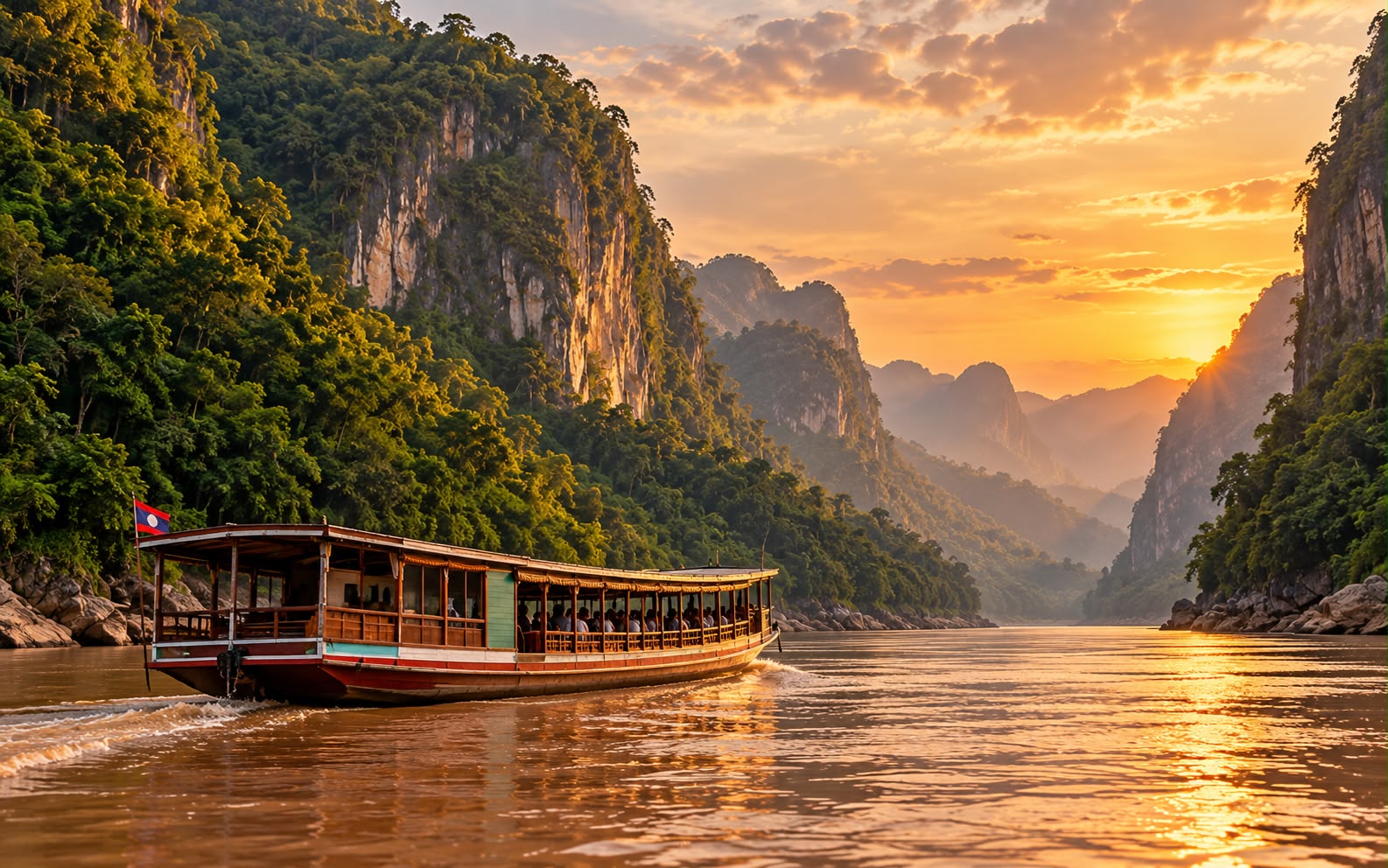
Thailand's north and then the river out of it: temple mornings in Chiang Mai, a hill-country drive to the Golden Triangle, and two slow days down the Mekong into Laos, finishing in a town of French shutters and saffron robes that nobody wants to leave.
- Southeast Asia
- 11 days
- ≈ AED 4,400 / person
- Two days drifting down the Mekong, with a border crossing you do by boat
Before you go
Before you go: the admin
Two entries, two systems
- Thailand admits most tourist nationalities without a visa. Allowances were shortened on 15 September 2026 — Indian passports now get 30 days, down from 60 — which still swallows the Thai half of this trip whole.
- The TDAC (Thailand Digital Arrival Card) is mandatory for everyone and must be completed within three days before departure. Free, online, and only at tdac.immigration.go.th — the paid “agents” for it are the trip’s first scam.
- Laos issues an e-visa and also does visa on arrival at the Huay Xai friendship bridge. The e-visa is the smoother option at a land crossing; print it.
- You leave Thailand by land and enter Laos by land, which is an ordinary crossing and takes about an hour including the shuttle bus over the bridge.
Flights, and the one that matters
- Fly into Bangkok and out of Luang Prabang, routing home via Bangkok or Hanoi. An open-jaw saves two days of backtracking.
- Bangkok to Chiang Mai is an hour and costs little. The overnight sleeper train is the romantic alternative and takes thirteen hours — a genuinely good journey if you have the time, and it books out days ahead in high season.
- Luang Prabang’s airport is small and the Bangkok and Hanoi services are limited. Book the way out before you book anything else.
- There is now a railway from Luang Prabang to Vientiane and on to the Chinese border, which has transformed travel inside Laos — but it does not help this route.
Money
- Thai baht in Thailand, Lao kip in Laos, and the kip has a great many zeros. Thai baht and US dollars are both accepted in Luang Prabang, usually at a poor rate.
- Cash dominates in Laos. ATMs exist in Luang Prabang and Huay Xai and have low limits; cards work at the better hotels and restaurants.
- Change money before the slow boat. Pakbeng has one unreliable machine and the boat takes cash only.
- 7-Eleven tops up everything in Thailand — there is one every two hundred metres and it is a national institution.
One gentle brief
- The slow boat is the trip, not the transfer. Two days on the Mekong with an overnight at Pakbeng, on wooden benches or salvaged minivan seats, with the gorge going past at walking pace.
- Do not take the speedboat. It is the same route in six hours, in a hull with a car engine bolted to it, and it has a genuine fatality record. Helmets are handed out, which should tell you something.
- The two halves have different volumes. Thailand’s north is busy and organised; Laos is slow, quiet and conservative, and Luang Prabang runs to monastery hours.
Day by day
Day 1 — Land in Bangkok, eat in Chinatown
- Keep the first evening simple. Bangkok is better met sideways than head-on.
- 15:00 — Arrive, drop the bag, and get on the river. The Chao Phraya express boat is the best way into the city and costs almost nothing. The orange flag is the local one.
- 18:00 — Yaowarat after dark — Chinatown’s street-food stretch, which sets up around six and runs past midnight. The crab omelette and the oyster pans are the things to find.
- 21:00 — A walk back along the river, with Wat Arun lit across it.
Day 2 — Bangkok: the Grand Palace and a long-tail boat
- 08:30 — The Grand Palace and Wat Phra Kaew at opening. Shoulders and knees covered — they will turn you away, and the hire-sarong queue is long. Anyone outside telling you it is closed today is steering you to a gem shop; it is open.
- 11:00 — Wat Pho next door for the reclining Buddha and the massage school, which is the real thing and cheap.
- 14:30 — A long-tail boat through the Thonburi khlongs in the afternoon — the canal side of the city, stilt houses and monitor lizards. Agree the hour and the price at the pier.
- 18:00 — Wat Arun at dusk from the Tha Tien side of the river, which is where the photograph is taken from.
- 20:30 — Dinner in Banglamphu, and book tomorrow’s flight transfer tonight.
Day 3 — Fly to Chiang Mai, walk the old city
- 09:00 — An hour in the air, and the temperature drops a few degrees.
- 13:00 — The old city is a square kilometre inside a moat with about thirty temples in it. Wat Chedi Luang and Wat Phra Singh are the two to see properly.
- 16:00 — Monk chat at Wat Suan Dok or Chedi Luang — novices practising English, an hour, free, and the best conversation you will have on the trip.
- 18:30 — The Sunday walking street if your dates land on one, otherwise the night bazaar.
- Book the elephant sanctuary tonight — the good ones fill a week ahead.
Day 4 — Doi Suthep, and an elephant sanctuary done properly
- 07:00 — Wat Phra That Doi Suthep at opening, up the mountain road — 306 steps up the naga staircase, or the funicular. Early is also when the cloud is still in the valley below.
- 09:30 — Elephants: choose carefully. No riding, no bathing shows, no bullhooks. A genuine sanctuary keeps the herd at distance, does not perform, and will say no to things you ask for. Elephant Nature Park and a handful of others meet that bar.
- 15:00 — A cooking class in the afternoon is the Chiang Mai cliché and is also genuinely good — the market tour first is the useful half.
- 19:00 — Khao soi for dinner, which is the northern dish and exists properly only up here.
Day 5 — North to Chiang Rai and the Golden Triangle
- 08:00 — Three hours by road, and worth breaking at the Mae Kachan hot springs or the Khun Korn waterfall.
- 11:30 — Wat Rong Khun, the White Temple — not ancient at all, a contemporary artist’s ongoing work, and either the best or the strangest thing in northern Thailand depending on your mood.
- 14:00 — The Blue Temple and the Black House (Baan Dam) complete the set of three, and the Black House is the darkest of them.
- 16:30 — The Golden Triangle itself, where Thailand, Laos and Myanmar meet on the Mekong, and the Hall of Opium museum, which is better than the viewpoint.
- 19:00 — Overnight in Chiang Rai or Chiang Khong, and Chiang Khong saves two hours tomorrow.
Day 6 — Cross to Huay Xai, and board the boat
- 07:00 — Two hours to Chiang Khong, then the Fourth Thai–Lao Friendship Bridge. You clear Thai exit, take the shuttle bus across, and clear Lao entry on the far side.
- Allow the morning for it. The slow boat leaves Huay Xai around eleven and does not wait.
- The Lao visa on arrival wants US dollars cash and a passport photo.
- 10:00 — Buy water, fruit and a cushion in Huay Xai. The boat sells little, the benches are hard, and six hours is six hours.
- 11:00 — The first day’s run is five to six hours through the gorge, with the river brown and fast and nothing on the banks but forest and the occasional buffalo.
- 17:00 — Into Pakbeng, and take a room that was booked rather than bid for on the jetty.
Day 7 — Pakbeng to Luang Prabang
- Pakbeng is a one-street village that exists for the boats. It has electricity for part of the evening and a surprisingly good Indian restaurant.
- 09:00 — Day two is seven or eight hours and the better half — the river widens, the villages multiply, and the boat stops at a couple of them.
- 15:00 — Pak Ou caves near the end, two caverns in a limestone cliff holding four thousand discarded Buddha images.
- 17:30 — Arrive at Luang Prabang in the late afternoon, which is the right way to see it for the first time.
- 19:30 — Dinner on the peninsula, and an early night if you want the alms round.
Day 8 — Luang Prabang: the peninsula on foot
- 05:30 — The alms round at dawn is a religious act, not a show. If you watch, do it from across the street in silence and at a distance; if you participate, buy from a monastery and kneel. The mass-tourism version has become a problem the monks have publicly objected to.
- 08:00 — Wat Xieng Thong, the finest temple in Laos, with the tree of life mosaic on the rear wall.
- 10:30 — The Royal Palace Museum and the Phra Bang itself, the gold standing Buddha the town is named for.
- 14:00 — The afternoon slow, which is what this town is for.
- 17:30 — Mount Phousi at sunset — 300 steps, crowded at the top, and the alternative is a riverside terrace with a Beerlao.
Day 9 — Kuang Si falls and the bears
- 08:00 — Kuang Si, 30km out, is a staircase of turquoise limestone pools. Go at opening; by eleven the tuk-tuks have arrived.
- The colour is a dry-season phenomenon — low sediment makes the blue. In the wet months it runs brown and powerful instead.
- 10:00 — The Free the Bears sanctuary is at the entrance and holds moon bears rescued from the bile trade. Ten minutes and worth it.
- 14:00 — The Traditional Arts and Ethnology Centre, which is the best museum in the country for understanding who lives in the hills.
- 18:00 — The night market on Sisavangvong, which is textiles rather than tat.
Day 10 — The Nam Khan, or a weaving village
- 09:00 — Kayaking or tubing on the Nam Khan, the quieter of the two rivers, which is how Luang Prabang is best seen from the water.
- 13:00 — Ban Xang Khong across the river for weaving and saa paper, reached by the bamboo footbridge in the dry season and by boat the rest of the year. The bridge is rebuilt every year after the flood takes it.
- 16:00 — Or simply do nothing. Luang Prabang is the one town on this route that rewards a slow day, and the curfew at half past eleven means the evenings are quiet by design.
- 18:30 — A sunset boat on the Mekong, an hour, for almost nothing.
Day 11 — Fly out of Luang Prabang
- 07:00 — The morning market on Th Chao Fa Ngum, which is a food market for residents rather than a souvenir one.
- 09:00 — A last coffee — Lao coffee from the Bolaven Plateau, strong and served with condensed milk.
- The airport is ten minutes out and small. An hour and a half is plenty.
Costs and practicalities
Best time to visit
November–February is the cool dry season in both countries and the only window that suits the whole route.
- November–February — dry, 20–28°C, clear skies, and the Mekong is high enough for the slow boat and low enough to be safe. Peak season in both Chiang Mai and Luang Prabang.
- March–April — the hot season, over 35°C, and the burning season: agricultural fires fill the northern Thai and Lao valleys with smoke for weeks. Chiang Mai’s air quality in March is regularly among the worst in the world. Avoid March if you possibly can.
- Mid-April — Songkran in Thailand and Pi Mai in Laos fall together, three days of water-throwing that shut both countries down and are either the best or the worst week to travel.
- May–October — the monsoon. Heavy afternoon rain, the countryside luminous, Kuang Si at full volume and brown rather than blue, and the slow boat runs fast and high.
Luang Prabang’s Boun Awk Phansa in October, the end of Buddhist Lent, brings boat races and candlelit processions.
Travel tips
- Never take the speedboat. The slow boat is two days and the speedboat is six hours, in a hull with a car engine bolted on and a real fatality record. The helmets are not decorative.
- Buy a cushion in Huay Xai. The benches are wooden and the first day is six hours.
- March’s smoke is a genuine health issue, not an inconvenience — if you have asthma, do not come then.
- Vapes are illegal in Thailand. Possession means confiscation and a fine, and the ban is enforced at airports.
- Laos is conservative. Cover shoulders and knees in Luang Prabang, not just at temples, and women must never touch a monk or hand anything directly to one.
- Unexploded ordnance remains across Laos — the most heavily bombed country per capita in history. It is not an issue on this route, but stay on paths anywhere rural.
- Luang Prabang has a curfew around 11.30pm. It is a UNESCO town and it genuinely closes.
What this trip actually costs
Two people, 10 nights, mid-range comfort, international flights excluded:
| Item | Cost |
|---|---|
| Hotels and guesthouses, 10 nights | USD 700 (≈ AED 2,571) |
| Bangkok–Chiang Mai and Luang Prabang–Bangkok flights, two people | USD 440 (≈ AED 1,616) |
| Slow boat, two days, with Pakbeng night, two people | USD 260 (≈ AED 955) |
| Guides, entries, Kuang Si and the sanctuary | USD 300 (≈ AED 1,102) |
| Food and drink, 11 days | USD 400 (≈ AED 1,469) |
| Local transport, tuk-tuks and the border transfer | USD 300 (≈ AED 1,102) |
| Total for two | USD 2,400 (≈ AED 8,814) |
- Roughly USD 1,200 (≈ AED 4,407) per person, which makes this the cheapest multi-country route on the site.
- The slow boat is the single best value on the page — two days of travel, accommodation and the best scenery of the trip, for the price of a short flight.
- An ethical elephant sanctuary costs more than a riding camp. That difference is the whole point of it.
- Hotel picks here are chosen on location, not on commission — always check prices and recent reviews before booking.
What to pack
- A cushion or an inflatable seat pad for the boat. Everyone who has done it says this first.
- Light long sleeves and long trousers — modest for the temples and useful against mosquitoes.
- A warm layer. Chiang Mai and Luang Prabang are genuinely cool in December and January mornings.
- A dry bag for the Mekong and the monsoon.
- A torch — Pakbeng’s power is intermittent.
- An N95 mask if you are travelling anywhere near the burning season.
FAQ
Is the slow boat worth two days? Yes, and it is the reason to do this route rather than fly between the two countries. It is slow, hard-benched and the best part of the trip.
Can I do the crossing in the other direction? Yes — Luang Prabang upriver to Huay Xai takes the same two days against the current and is slightly longer. Most people go downstream.
Do I need a guide? No. This is an easy route to do independently; a guide for one Chiang Mai temple morning and one Luang Prabang walk adds a lot and is cheap.
What about Vientiane? It is four hours by the new railway from Luang Prabang and is the least interesting part of Laos. Skip it on eleven days.
Will my cards work? In Thailand, mostly. In Laos, at better hotels and restaurants only — carry kip and keep some Thai baht as a fallback.
Prices and entry rules change, and what you need depends on your passport; last checked 29 October 2026, so confirm with the embassy or your airline before booking.


