 The Itinerary
Thailand in 14 days: Bangkok, Chiang Mai, Chiang Rai and the Andaman coast
Two weeks is the length that holds both Thailands: the temples and hill country of the north, and the Andaman limestone in the south. Two internal flights, five nights on beaches, and the elephant-sanctuary question answered honestly.
- Southeast Asia
- 14 days
- ≈ AED 4,700 / person
- North and south in one trip, with enough nights in each to stop moving
Before you go
Two weeks is where Thailand opens up. The seven-day route has to choose between the north and a beach; this one does not.
Bangkok for three nights. Chiang Mai for four, with Chiang Rai as an overnight or a long day. Then a flight south to Krabi and on to Koh Lanta, which is the island that rewards a longer stay — quieter than Phi Phi, bigger than Railay, and with enough on it to fill four nights without a boat every morning.
Two internal flights, both about ninety minutes, and no overnight buses.
Figure THB 43,000 (≈ AED 4,706) per person. November to February is the season for both halves.
Before you go: the admin
Entry
- Visa exemption covers most nationalities, including Indian passport holders, for up to 60 days under the 2024 rules. Thailand has changed this repeatedly — check yours.
- The Thailand Digital Arrival Card (TDAC) replaced the paper form in 2025 and is completed online before you arrive.
- Six months’ passport validity, and proof of onward travel is occasionally requested at check-in.
The two flights
- Bangkok → Chiang Mai, 75 minutes, many daily.
- Chiang Mai → Krabi, about two hours, usually with Thai AirAsia or Thai Vietjet. There are direct flights; check before routing via Bangkok.
- Book both two or three weeks out. Inside a fortnight the fares roughly double.
- Krabi to Koh Lanta is a two-hour minivan-and-ferry, or a longer ferry in season. Hotels arrange it.
Money
- Thai baht. ATMs charge a flat ฿220 or so per withdrawal, so take larger amounts less often.
- Cards in hotels, malls and larger restaurants; cash for street food, boats, markets and tuk-tuks.
- Grab works in Bangkok and Chiang Mai and settles the fare in advance.
Elephants, honestly
- Do not ride them. The training that makes an elephant rideable is the problem, not the weight.
- “Sanctuary” is not a protected word. Plenty of places use it and still offer rides, bathing and chaining.
- Look for no riding, no bathing, no performances, small groups and elephants that can move away from visitors. Elephant Nature Park near Chiang Mai is the best known and books out weeks ahead.
- Bathing looks kind and is not — it means the animal must stand in water with strangers all day, every day.
Day by day
Day 1 — Bangkok: the river temples
- 08:30 — The Grand Palace and Wat Phra Kaew at opening, and dress for it: shoulders and knees covered, for everyone. The cover-up queue at the gate is long and it is the thing that ruins people’s mornings.
- 11:00 — Wat Pho next door for the reclining Buddha, 46m of it, and an hour of massage at the school where Thai massage is taught.
- 15:00 — The Chao Phraya express boat, the orange-flag local one, as both transport and sightseeing for about 20 baht.
- 17:30 — Wat Arun at sunset from the Bangkok side of the river, which is where the photograph is — not from the temple itself.
- 19:30 — Chinatown’s Yaowarat Road, the best eating street in the country, which only starts at seven.
Day 2 — Jim Thompson, and the markets
- 09:00 — Jim Thompson House, the silk merchant’s teak compound — and the man himself vanished in the Cameron Highlands in 1967 and was never found.
- 12:00 — Lunch, then the heat.
- 16:00 — Chatuchak if it is a weekend — 15,000 stalls, and go late when it cools.
- Or Amphawa floating market on a weekend evening, which is a real market, rather than Damnoen Saduak, which is staged for coaches.
Day 3 — North to Chiang Mai
- 09:00 — Fly up, about 75 minutes.
- 13:00 — The old city inside its moat. Wat Chedi Luang, half collapsed in a 16th-century earthquake and better for it, and Wat Phra Singh.
- 17:30 — Doi Suthep above the city: 309 steps up a naga staircase, best at sunset or very early.
Day 4 — Cooking, and the elephants
- 08:30 — A cooking class, which here starts in a market and usually includes a garden — you pick what you cook.
- Or an ethical elephant day, booked weeks ahead: observation and feeding only, no riding and no bathing. The good sanctuaries are full months out and that is a good sign.
- 18:00 — The night bazaar, or the Sunday Walking Street on Ratchadamnoen if the day falls right — the best market in Thailand, and it swallows a whole evening.
Day 5 — Doi Inthanon
- 07:30 — Doi Inthanon, the highest point in the country, as a day trip: waterfalls, two royal chedis at 2,500m, and a cloud forest at the top with a boardwalk through the moss.
- 15:00 — Wachirathan falls on the way down.
- Or the Sticky Waterfalls (Bua Thong), which you can genuinely walk up barefoot because the mineral deposits give grip, and which almost no visitors reach.
Day 6 — Chiang Rai
- 07:00 — Three hours north by bus or minivan.
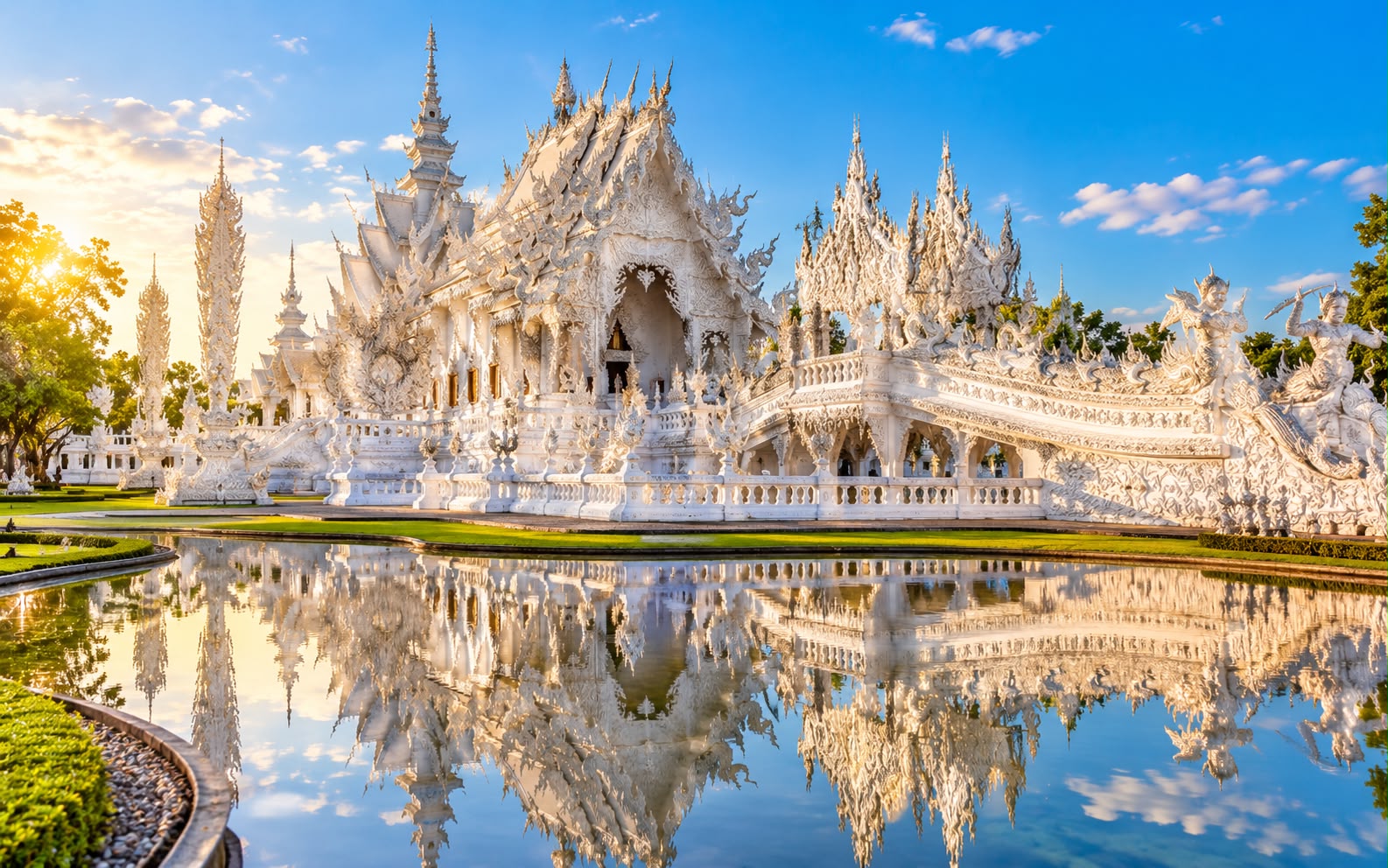
- 10:30 — Wat Rong Khun, the White Temple — a contemporary artist’s ongoing project, part temple and part installation, with a bridge over reaching hands.
- 13:00 — The Blue Temple (Wat Rong Suea Ten), newer and emptier.
- 15:00 — The Black House (Baan Dam), the dark counterpart to the White Temple and genuinely strange — animal hides, bones and dark wood.
- Stay the night rather than doing it as a very long day.
Day 7 — The Golden Triangle, and back
- 08:30 — The Golden Triangle at the Mekong, where Thailand, Laos and Myanmar meet, if you want the border rather than the temples. The opium museum there is better than it sounds.
- 14:00 — Back to Chiang Mai, three hours.
Day 8 — South to Krabi
- 10:00 — Fly south from Chiang Mai, about two hours.
- 14:00 — Ao Nang, which is the practical base; Tonsai next door is the climbers’ beach.
- 17:00 — The beach, and nothing else after a flight.
Day 9 — Railay and the islands
- 08:30 — Railay by longtail — limestone walls rising from the sand, and Phra Nang beach at its southern end, which is the one in the photographs.
- 13:00 — The four-island tour by longtail rather than speedboat: slower, quieter, half the price.
- Or Hong Island, which is the better single trip, and the lagoon at high tide is the reason — check the tide before you book.
Day 10 — Over to Koh Lanta
- 10:00 — Two hours by minivan and ferry.
- 14:00 — Long Beach (Phra Ae) for the sunsets and the restaurants, or Kantiang Bay in the south for the best swimming.
- 16:00 — Hire a scooter. Lanta is the one place on this route where the roads are quiet enough to make that sensible.
Day 11 — The Emerald Cave
- 08:00 — The Four Islands tour from Lanta: Koh Kradan, Koh Mook and the Emerald Cave — which you swim through a dark tunnel to reach, 80m in pitch black holding a rope, and which opens into a hidden beach inside a collapsed cave.
- Not if you are claustrophobic or a weak swimmer. There is no turning back halfway.
- 17:00 — Back for sunset on Long Beach.
Day 12 — The national park and Old Town
- 09:00 — Mu Ko Lanta National Park at the southern tip: a lighthouse, a short jungle trail, and monitor lizards on the path — they are harmless and large.
- 14:00 — Old Town on the east coast, stilt houses over the water, for an afternoon and a late lunch.
Day 13 — Nothing
- The day the fortnight has earned. Kantiang Bay, a long lunch, and a last snorkel off the rocks.
- 17:30 — Sunset from the west coast, which faces exactly the right way.
Day 14 — Home
- Fly home from Krabi, two hours away including the ferry — so leave four before the flight, not two.
Costs and practicalities
Best time to visit
November to February suits both halves, which is rarer than it sounds for a country this long.
- November–February — dry everywhere, 28–32°C on the coast and cooler in the north. Chiang Mai in December and January can drop to 12°C at night, which surprises people.
- March–April — hot, up to 40°C inland. Northern burning season runs roughly February to April and Chiang Mai’s air quality becomes genuinely poor; this is the one real argument against the north in spring.
- Songkran in mid-April is a nationwide water fight and Chiang Mai is its epicentre.
- May–October — the southwest monsoon. Afternoon rain rather than all-day, prices a third lower, and some Andaman boat trips cancelled in a swell.
- September–October are the wettest.
Travel tips
- Book both internal flights two to three weeks out.
- Check Chiang Mai’s air quality if you are travelling between February and April. The burning season is a real health issue, not a minor haze.
- Dress for the Grand Palace and skip the cover-up queue.
- Longtail over speedboat for islands — cheaper, quieter, and you can hear.
- No riding and no bathing when choosing an elephant camp, and book weeks ahead for the good ones.
- Use the orange-flag river boat in Bangkok.
- Carry small notes. No food stall wants to break ฿1,000.
- A scooter is reasonable on Lanta and a bad idea in Bangkok or Chiang Mai’s old city traffic.
What this trip actually costs
Two people, 13 nights, mid-range comfort, international flights excluded:
| Item | Cost |
|---|---|
| Hotels, 13 nights | THB 31,850 (≈ AED 3,485) |
| Food and drink, 14 days | THB 19,600 (≈ AED 2,145) |
| Two internal flights, two people | THB 14,000 (≈ AED 1,532) |
| Tours, temples, elephants and islands | THB 13,000 (≈ AED 1,423) |
| Local transport, ferries and transfers | THB 7,550 (≈ AED 826) |
| Total for two | THB 86,000 (≈ AED 9,411) |
- Roughly THB 43,000 (≈ AED 4,706) per person for fourteen days, which is among the best value-per-day on the site.
- An ethical elephant day is the single biggest activity line at roughly US$80 each, and it is the one worth paying properly for.
- Peak-season Andaman beach hotels over Christmas and New Year run well above this figure.
- Hotel picks here are chosen on location, not on commission — always check prices and recent reviews before booking.
What to pack
- Temple clothing — shoulders and knees, in cotton or linen.
- A sarong or scarf.
- A warm layer for the north. Chiang Mai nights in December are genuinely cold.
- Reef-safe sun cream, a rash vest and a dry bag.
- Shoes you can get wet for longtail boats.
- Strong repellent, applied by day as well as at night.
- An N95 mask if you are travelling in burning season.
FAQ
North first or beaches first? North first. Finishing on an island means your last days are restful and your flight home leaves from Krabi, which is small and quick.
Is Koh Lanta better than Phi Phi? For four nights, yes. Phi Phi is spectacular and crowded and better as a day trip; Lanta is big enough to have quiet beaches, a road, and somewhere to eat that is not a party.
How bad is the burning season really? Bad. Chiang Mai regularly records some of the worst air quality in the world in March. If your dates are February to April, consider swapping the north for more time south.
Can I add Koh Samui or the Gulf islands? Not sensibly in the same trip. The Gulf and the Andaman have opposite monsoons and are a long way apart. Pick one coast.
Do I need a guide in Chiang Mai? No for the temples, yes for Doi Inthanon and the elephant day, which both work better with someone who knows the place.
Prices and entry rules change, and what you need depends on your passport; last checked 30 October 2026, so confirm with the embassy or your airline before booking.


