 The Itinerary
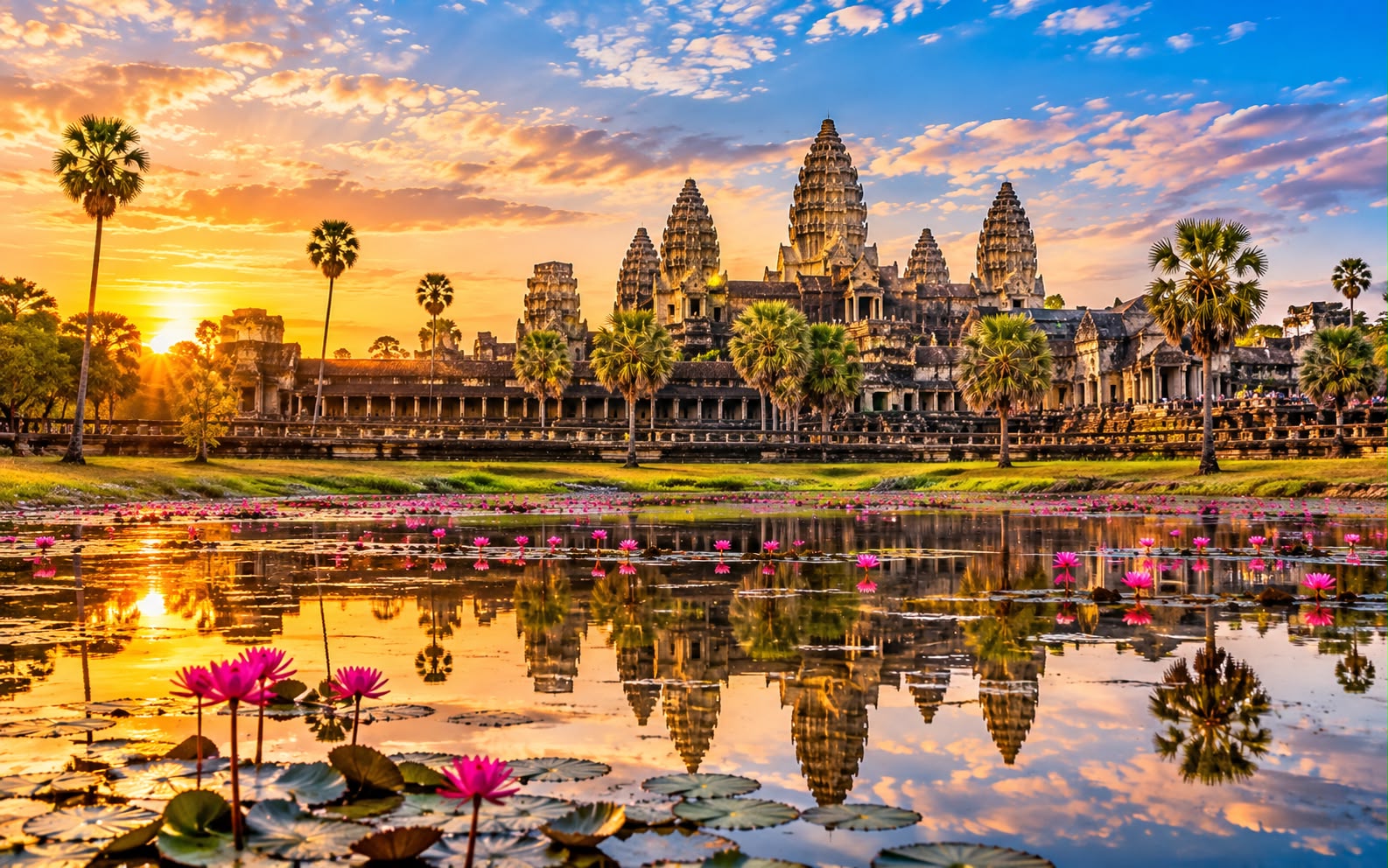
Cambodia in 7 days: Siem Reap and Phnom Penh
The greatest temple complex ever built, at sunrise, for $62: Angkor's three-day pass paced properly, a stilt village on Asia's beating-heart lake, a circus that will out-emotion the temples — then Phnom Penh's palaces and its hardest history, handled with the respect it demands.
- Southeast Asia
- 7 days
- ≈ AED 2,550 / person
- Temples + history
Before you go
Angkor is not a temple; it’s a vanished megacity — at its height around 1200 AD, when London held 20,000 people, close to a million lived here among reservoirs and boulevards whose stone survivors now rise out of jungle. You will have seen a thousand photos of Angkor Wat’s towers against a pink dawn. The photos undersell it. Nothing prepares you for Ta Prohm’s strangler figs digesting whole galleries, or the Bayon’s 200 stone faces smiling in every direction at once.
This 7-day shape pairs the wonder with the country: Siem Reap (4 nights) for the temples, the lake and the best circus you’ll ever see, then Phnom Penh (2 nights) for royal gold, riverside ease — and the Khmer Rouge history that explains modern Cambodia, visited the respectful way.
Cambodia runs on US dollars (riel for small change — details below), so the budget does too: figure USD 700 (≈ AED 2,571) per person excluding international flights. Go November–February: dry, “cool” (30°C), green from the monsoon just gone. March–May is a furnace; June–October is wet-green with afternoon downpours and the best light.
Before you go: the admin
The e-visa and the arrival card
- e-Visa, the easy kind: US$30 + US$6 processing (≈ $36 all-in) at the official evisa.gov.kh — passport scan + photo, 3–5 working days, 30-day single-entry stay. Visa-on-arrival ($30 cash, two photos) also works at Siem Reap and Phnom Penh airports, but the e-visa skips the queue after a long connection. Use only the official site; lookalikes charge double.
- Plus the free e-Arrival Card at arrival.gov.kh within 7 days of flying — ten minutes, QR code, airlines increasingly ask.
Getting there
- Getting there: no non-stops from the Gulf — one-stop via Bangkok, Kuala Lumpur, Singapore or Ho Chi Minh City, ~US$490–820 return, 9–12 h door to door. Note both airports are NEW: Siem Reap–Angkor (SAI) sits 40 km east of town (~$30–35 taxi, 50 min), and Phnom Penh’s Techo International (opened 2025) is ~30 km south.
Money and apps
- The dollar–riel dance: prices quote in USD; change under a dollar comes in riel (~4,100 = $1). Both are real money — spend the riel on tuk-tuks and water. Bring crisp, untorn USD notes (worn bills get refused), and small denominations: breaking a $50 at a noodle stall is a diplomatic incident.
- Apps: Grab and PassApp price every tuk-tuk ride fairly ($1–3 around town) and end all haggling drama. Download before landing.
Day by day
Day 1 — Land in Siem Reap, buy tomorrow’s dawn
- Evening arrival via your connection; taxi into town, check in.
- 19:30 — First amok (coconut fish curry steamed in banana leaf, $4–7) in the lanes off Pub Street — touristy, twinkly and fun for exactly one evening — and a Night Market wander.
- 21:00 — Buy the Angkor Pass online tonight at ticket.angkorenterprise.gov.kh (3-day pass $62 — any 3 days within 10; 1-day $37, 7-day $72; under-12s free with passport). Or use the old trick: the ticket office after 5 pm sells passes valid from tomorrow, skipping the 4:45 am queue.
Where to stay in Siem Reap (four nights)
- Luxury: Jaya House River Park — 5.0/5 on TripAdvisor (~5,400 reviews) and routinely in world-best lists: riverside calm, plastic-free pioneer, staff who remember your coffee order. ~$260+.
- Mid-range: Viroth’s Hotel — 5.0/5 (~3,100 reviews), 60s-modernist pool courtyard, endlessly photographed. ~$90–130.
- Value: Golden Temple Residence — 5.0/5 (~4,800 reviews, the town’s #1 Best Value): near-boutique rooms, airport pickup and legendary hospitality at ~$45–65.
Day 2 — Sunrise at Angkor Wat, Ta Prohm’s jungle
- 04:45 — Tuk-tuk into the dark (temple-day tuk-tuks: ~$20–25 small circuit, agree the day price up front or book via the hotel). Stake out the north reflecting pond at Angkor Wat; sunrise cracks over the five towers around 6:00 to a soundtrack of two thousand shutters. Then do what the crowd doesn’t: go inside immediately — the galleries’ 800 m of bas-reliefs (churning of the ocean of milk!) and the steep top tier are half-empty while everyone else eats breakfast.
- 10:30 — Back to town or the hotel pool through the midday furnace — this is the pacing secret of Angkor: temples 5–10 am and 3–6 pm, water in between.
- 15:00 — Ta Prohm — the “Tomb Raider temple”, left half-swallowed: silk-cotton roots pour over doorways like slow-motion waterfalls. Late light makes the stones glow and thins the tour groups. Finish at Banteay Kdei across the road, blissfully ignored.
- 19:00 — Khmer barbecue dinner ($8–12) and early to bed; tomorrow has 200 faces.
Day 3 — Angkor Thom, then the circus steals the day
- 07:00 — Angkor Thom, the walled capital: enter by the South Gate’s causeway of gods and demons, then the Bayon — 54 towers, 200 serene colossal faces, corridors of everyday-life carvings. This is the morning to hire a licensed guide (~$35–45/day, shared): the difference between piles of stones and a functioning city reassembling in your imagination.
- 10:00 — Baphuon’s flying causeway, the royal terraces of the Elephants and the Leper King, exit via Victory Gate.
- 12:30 — Pool. Non-negotiable.
- 17:00 — Gentle sunset option: Pre Rup’s brick towers (fewer buses than the famous Phnom Bakheng scrum, which we’d honestly skip).
- 20:00 — Phare, the Cambodian Circus ($18–38 by seat tier — book a day ahead): young performers from at-risk backgrounds telling Khmer stories through acrobatics and fire. Ask anyone who’s been: it out-emotions the temples. The site’s strongest evening recommendation in Southeast Asia.
Day 4 — Pink sandstone and the grand circuit
- 07:30 — Drive out (37 km, tuk-tuk ~$35–45 or share a car) to Banteay Srei, the 10th-century “citadel of women”: miniature, rose-pink, and carved so finely it looks 3D-printed by devas. En route back, the Landmine Museum ($5) tells one de-miner’s astonishing story — small, sobering, worthwhile.
- 13:00 — Lunch + pool.
- 15:30 — Finish the pass on the grand circuit: Preah Khan’s long corridors going golden, or Neak Pean’s island shrine on the old reservoir — the quiet, crowd-free Angkor most visitors never meet.
- 19:30 — Best-dinner night: Siem Reap’s new Khmer kitchens ($15–25 pp) do tasting menus that would cost 4× in Bangkok.
Day 5 — The lake, then fly to the capital
- 08:00 — Tonlé Sap — Southeast Asia’s largest lake, which quadruples in size each monsoon and feeds half of Cambodia. Do the ethics-checked version: Kampong Phluk (or Kompong Khleang) — genuine stilt villages ~$25–30 pp with boat — and skip Chong Khneas, the near-shore “floating village” infamous for rice-buying and crocodile-farm shakedowns. Wet season floats the forests; dry season turns stilts into 8-metre ladders — both are extraordinary.
- 13:00 — Lunch, pack, tuk-tuk goodbyes.
- 16:00 — Fly Siem Reap → Phnom Penh (45 min, ~$70–100 — or the honest budget swap: Giant Ibis bus, $15, 6 h of countryside).
- 18:30 — Check in, then the riverside: the Tonlé Sap and Mekong meet at Sisowath Quay — evening aerobics classes, monks with phones, dinner on a breezy terrace ($6–12).
Where to stay in Phnom Penh (two nights)
- Luxury: Raffles Hotel Le Royal — 4.5/5 (~2,700 reviews), 1929 grande dame; Jackie Kennedy’s cocktail is still on the bar menu. ~$180+. (Sofitel Phokeethra, 4.7, is the modern five-star.)
- Mid-range: Palace Gate Hotel — 4.9/5 (~2,900 reviews), beside the Royal Palace with breakfast in. ~$70–100.
- Value: Pavilion — 4.6/5 (~3,400 reviews), colonial villas, garden pools, adults-calm. ~$50–70.
Day 6 — The kingdom’s gold and its darkest chapter
- 08:00 — Tuol Sleng (S-21) — the school the Khmer Rouge turned into a prison, now the genocide museum (~$10 with the essential audio guide). Go early, go quiet, give it two hours. Some mornings, the last survivors sign books in the courtyard — shake their hands.
- 10:30 — Choeung Ek killing fields (15 km out, tuk-tuk ~$15 return; $6 with audio): the memorial stupa of skulls, the orchard paths, the quiet. Our honest guidance: this pairing is emotionally heavy — take it in the morning, together; think hard before bringing under-12s (the audio guide is unflinching); and let the afternoon be gentle. Cambodia asks visitors to witness this, and rewards those who do with understanding the country’s miracle: everything you’ve enjoyed all week was rebuilt from zero after 1979.
- 14:30 — The gentle afternoon: the Royal Palace & Silver Pagoda ($10 — gold spires, emerald Buddha, a floor of 5,000 silver tiles; opens 14:00, shoulders/knees covered), then the Art-Deco dome of Central Market or a sunset Mekong cruise ($10–15, drinks aboard).
- 19:30 — Dinner in Bassac Lane’s shophouse bars-and-bites alley — Phnom Penh’s cheerful modern face, which after today feels like the point.
Day 7 — Russian Market, fly home
- 08:30 — Toul Tom Poung (Russian) Market: the best souvenir hunting in the country — kramas (checked scarves), silver, coffee, $3 “brand” T-shirts of negotiable authenticity — plus a legendary local breakfast corner (noodle soup, $2).
- 11:30 — Pack, checkout, and out to Techo International (~45 min–1 h with traffic — pad it) for the flight home via your connection.
Costs and practicalities
Best time to visit
November–February — the cool dry season, and the only months when walking round Angkor in the middle of the day is reasonable.
- November–February — 25–30°C, low humidity, clear skies. Peak season; Angkor sunrise is genuinely crowded and Siem Reap is full over Christmas.
- March–May — the hot season, reaching 38–40°C. Angkor is punishing by ten in the morning.
- June–October — the monsoon. Rain comes in heavy afternoon bursts, the countryside is luminously green, and the temples are at their most atmospheric and least crowded. The moats and the Tonlé Sap are full, which is when Beng Mealea and the floating villages are at their best.
- Early November brings Bon Om Touk, the water festival, when the Tonlé Sap reverses its flow and Phnom Penh fills for boat races.
Travel tips
- Buy the Angkor pass at the official ticket office, not at the temples. One, three and seven-day passes; the three-day can be used across a week. Your photo is taken and printed on it.
- Dress code at Angkor is enforced — shoulders and knees covered. Bayon and Angkor Wat’s upper level will turn you away.
- The US dollar is the working currency. ATMs dispense dollars, prices are quoted in them, and riel appears as change below a dollar. Bring clean, untorn notes.
- Hire a tuk-tuk driver for the day, not per trip. The temple circuits are too spread out otherwise and a good driver positions you ahead of the coaches.
- Never touch a child’s head, and do not point your feet at a Buddha image. Both are serious here.
- Landmines remain in rural Battambang and the Thai border areas. Stay on marked paths.
- Do not support orphanage visits. The practice funds a documented industry; the same applies to buying from begging children.
What this trip actually costs
Two people, 6 nights, mid-range, excluding international flights:
| Item | Cost |
|---|---|
| Siem Reap hotel, 4 nights | USD 220 (≈ AED 808) |
| Phnom Penh hotel, 2 nights | USD 120 (≈ AED 441) |
| Angkor 3-day passes ×2 | USD 124 (≈ AED 455) |
| Temple tuk-tuk, 3 days (shared) | USD 95 (≈ AED 349) |
| Licensed Angkor guide, 1 day | USD 40 (≈ AED 147) |
| Tonlé Sap stilt-village boat trip ×2 | USD 60 (≈ AED 220) |
| Phare circus tickets ×2 | USD 55 (≈ AED 202) |
| Flight Siem Reap→Phnom Penh ×2 | USD 170 (≈ AED 624) |
| Phnom Penh sights: palace, S-21, Choeung Ek + tuk-tuks | USD 75 (≈ AED 275) |
| Food, 7 days | USD 300 (≈ AED 1,102) |
| eSIM | USD 15 (≈ AED 55.09) |
| Airport transfers (new airports are FAR) | USD 90 (≈ AED 331) |
| Buffer: coconuts, kramas, second amok | USD 36 (≈ AED 132) |
| Total for two | USD 1,400 (≈ AED 5,142) |
- USD 700 (≈ AED 2,571) per person — wonder-of-the-world sightseeing at Southeast Asia’s gentlest prices. Swap the internal flight for the $15 Giant Ibis bus and the total drops $140 for two; upgrade to Jaya House and Raffles and you’re still under most single-city Europe trips on this site.
- Book in this order: international flights → e-visa (evisa.gov.kh, 3–5 days) + free e-Arrival card in the last week → hotels → Phare circus (a day or two out) → Angkor pass online the night before temple day one → everything else is turn-up-and-go.
- Hotel and restaurant picks are unsponsored — no affiliate links in this article. Chosen on location and current TripAdvisor ratings; check recent reviews and prices before booking.
What to pack
- Temple uniform: shoulders AND knees covered (strictly enforced on Angkor Wat’s top tier) — light linen, not leggings-as-pants; a scarf upgrades any outfit at a doorway.
- Real walking sandals or trainers — temple stairs are ship-ladders polished by nine centuries.
- Sun kit: hat, SPF 50, refillable bottle (hotels refill; the heat is a pickpocket).
- Mosquito repellent (dusk, and the lake trip), small torch for sunrise footing.
- Crisp small-denomination US dollars — the packing item unique to Cambodia.
- Modest-lightweight for the memorial morning; cameras stay down inside S-21’s rooms as marked.
FAQ
Is the e-visa really all we need? Any airport surprises? That plus the free e-Arrival QR — Cambodian immigration is quick and friendly by regional standards. The only classic surprise is money: worn or torn dollar bills refused at the visa desk (VoA payers) or shops. Bank-fresh notes solve it.
Halal and vegetarian food? Manageable with light planning. Cambodia’s Cham Muslim community runs halal Khmer restaurants in both cities (clusters near Siem Reap’s Old Market and Phnom Penh’s mosques), and Malaysian/Indian halal spots back them up. Vegetarians: veg amok, stir-fried morning glory, fresh spring rolls and a solid Indian-restaurant bench in both towns — say “no fish sauce/prahok” clearly (it hides in everything).
Is it safe? Anything to watch? Tourist Cambodia is friendly and low-threat; the real items are bag-snatching from moving motos in Phnom Penh (phones and totes on the road-side arm — wear cross-body, riverside especially), standard scam-radar at Chong Khneas (we route you elsewhere) and around child-begging (give to vetted NGOs, never at temples — it keeps kids out of school), and tuk-tuk pricing solved by Grab/PassApp. Roads are the actual hazard: cross like Vietnam taught you — steady pace, no darting.
Can our kids handle the Phnom Penh history day? Teens: yes, and many call it the most important thing they’ve seen. Under-12s: we’d skip S-21 and Choeung Ek entirely — one parent can visit while the other does the Royal Palace and a riverboat. The audio guides pull no punches, and that’s what makes them worth it for those who go.
One-day, three-day or seven-day Angkor pass? Three-day, almost always: $62 vs $37 buys you sunrise day, Angkor Thom day and the Banteay Srei/grand-circuit day WITHOUT temple-fatigue death-marches. Archaeology obsessives with slow itineraries take the $72 seven-day. The one-day pass is for layovers only — and it shows.
What’s Cambodia guide #2? The south coast: Kampot’s pepper farms and river kayaks, Kep’s crab market, and Koh Rong Samloem’s blissed-out beaches — the after-the-temples decompression week. On the list.
Prices and entry rules change, and what you need depends on your passport; last checked 8 October 2026, so confirm with the embassy or your airline before booking.


