 The Itinerary
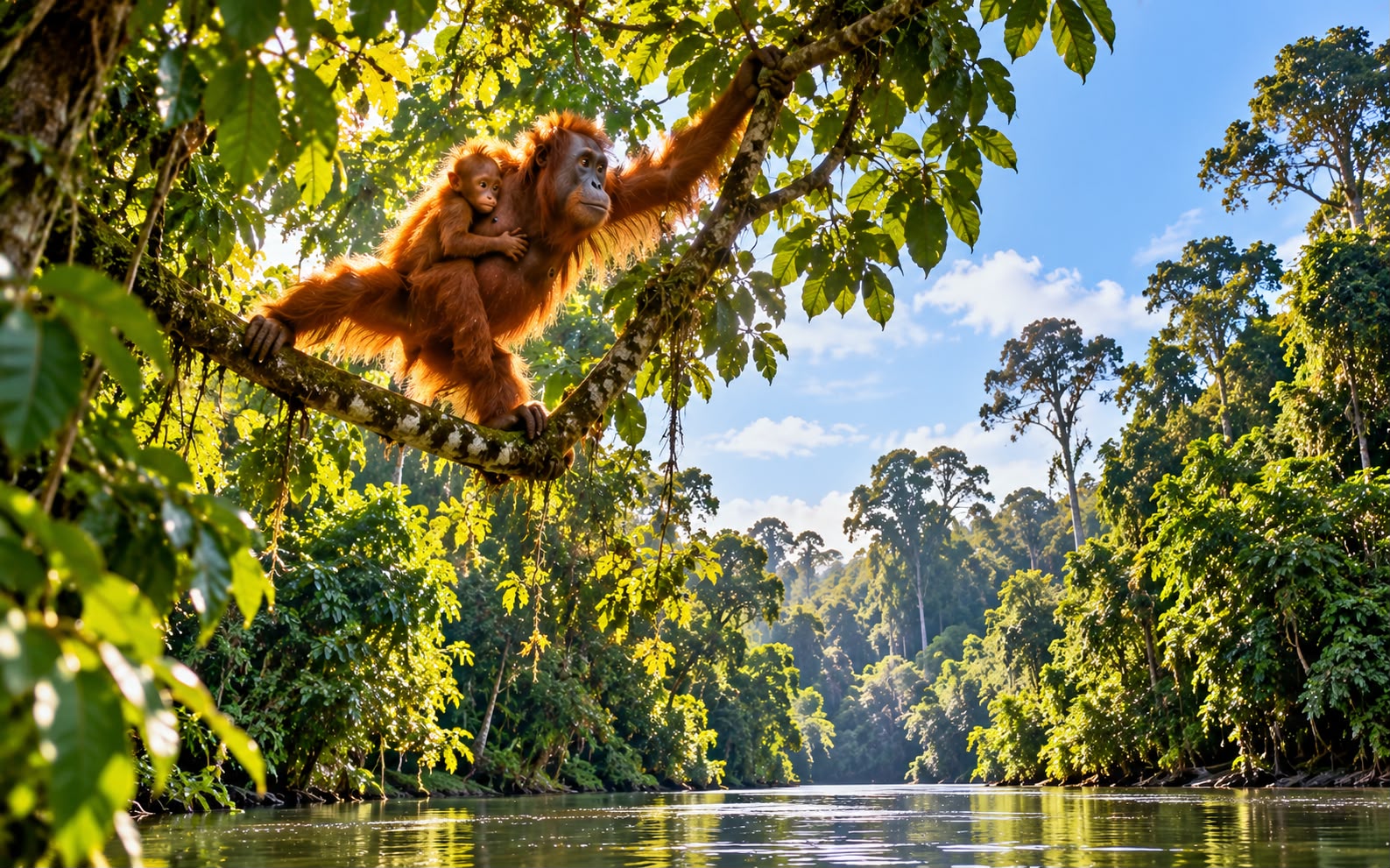
Borneo in 12 days: Sepilok, the Kinabatangan, Danum and Tanjung Puting
The third largest island on earth, split between three countries, holding a rainforest 140 million years old. Malaysian Sabah for the river and the primary forest, Indonesian Kalimantan for the klotok boat up a blackwater river to the orangutans.
- Southeast Asia
- 12 days
- ≈ AED 11,750 / person
- Orangutans from both sides of one island, and the difference between them
Before you go
Before you go: the admin
One island, two countries, two systems
- Malaysia admits most nationalities visa-free for 90 days, and Indonesia issues a visa on arrival or e-VOA for 30 days, extendable once.
- Sabah has its own immigration. You clear immigration again flying from Peninsular Malaysia to Sabah, and you get a separate Sabah stamp. It is routine and it surprises people.
- There is no sensible land crossing on this route. Sabah to Kalimantan is a flight, usually via Kuala Lumpur or Jakarta, which is the one awkward joint.
- Both ask for proof of onward travel.
Flights, which are the logistics
- Fly into Kota Kinabalu and out of Jakarta or Kuala Lumpur.
- Sabah’s internal legs: KK to Sandakan is 45 minutes; Lahad Datu for Danum is another short hop.
- Sabah to Kalimantan is KK or Tawau to Pangkalan Bun via Kuala Lumpur or Jakarta, and it is most of a day. Build a buffer; the connections are tight and change.
- Tanjung Puting is reached from Pangkalan Bun by road to Kumai and then by klotok.
Money
- Malaysian ringgit and Indonesian rupiah, neither usable in the other, and the rupiah has a great many zeros.
- Cards work in Kota Kinabalu, Sandakan and the lodges. The river lodges, the klotok and the park fees are cash.
- Draw what you need in the cities. ATMs in Pangkalan Bun exist and are not to be relied on.
One gentle brief
- The two halves are genuinely different. Sabah is organised, English-speaking and lodge-based; Kalimantan is quieter, Indonesian-speaking and the accommodation is the boat itself.
- The orangutans are different too. Sepilok is a rehabilitation centre with feeding platforms; the Kinabatangan is wild animals on a degraded river corridor; Danum is primary forest where sightings are rare and real; Tanjung Puting is semi-wild around feeding stations. Seeing all four is the argument for the route.
- Palm oil is the context. You will fly over hundreds of kilometres of it and the Kinabatangan’s forest is a thin ribbon between plantations. The guides will tell you; it is not a detail to skip past.
Day by day
Day 1 — Land in Kota Kinabalu
- 14:00 — The Sunday market on Gaya Street if your dates land on one, which runs from six until one and is the best thing in the city centre.
- 16:00 — Signal Hill for the harbour and the islands beyond it.
- 18:00 — Arrive and go to the waterfront for the sunset, which KK does better than anywhere in Sabah.
- 19:30 — The Filipino night market for grilled fish, chosen from the ice and cooked while you wait.
- Mount Kinabalu is two hours away at 4,095m and needs a permit booked months ahead and two days — it is a separate trip and this route does not include it.
Day 2 — Sepilok
- 08:00 — Fly to Sandakan, 45 minutes.
- 10:00 — The Sepilok Orangutan Rehabilitation Centre — feeding platforms at 10am and 3pm, with orphaned and rescued animals at various stages of release. It is a conservation facility, not a zoo, and the number of animals that turn up depends on how much fruit is in the forest — in a mast year almost none come, which is a good sign rather than a bad one.
- 11:30 — The Bornean Sun Bear Conservation Centre next door, which is the only one in the world and is quietly excellent.
- 15:00 — The second orangutan feeding, which is usually the quieter of the two.
- 17:00 — Sandakan Memorial Park for the death marches, if you want the other history — of 2,345 prisoners, six survived.
Day 3 — The canopy, and east
- 06:00 — The Rainforest Discovery Centre canopy walkway at dawn for the hornbills. Eight towers over 300m of walkway, and the first hour is when everything calls.
- 09:00 — The Sepilok trails below it, which almost nobody walks.
- 12:00 — Lunch in Sandakan, and the Agnes Keith house if you have an hour.
- 14:00 — Two hours to Sukau or Bilit on Sabah’s longest river.
- 16:00 — The first dusk cruise on arrival, which is always the best use of a travel afternoon here.
Day 4 — The Kinabatangan
- 05:30 — Dawn and dusk river cruises: proboscis monkeys, long-tailed and pig-tailed macaques, hornbills, and wild Bornean orangutans in the riverside trees.
- The Kinabatangan is a corridor of remnant forest between oil palm, and that concentration is why the wildlife viewing is so good — and it is the reason it is good, which is the uncomfortable part.
- 09:00 — Back for breakfast, and the middle of the day off; the animals do the same.
- 16:00 — The afternoon cruise, further upriver.
- 20:00 — Night walks and night cruises for civets, slow lorises and kingfishers asleep on branches.
Day 5 — Oxbow lakes, and the elephants
- 05:30 — Pygmy elephants are the prize — a Bornean subspecies, around 1,500 left, and sightings are a matter of luck and season. They move in herds along the river and the lodges radio each other when one is found.
- 09:00 — Oxbow lakes by small boat for the crocodiles, reached off the main channel.
- 14:00 — The Gomantong caves if you want them — swiftlet nests harvested for soup, two million bats, and a floor of cockroaches that is genuinely hard to walk across.
- 17:00 — A last cruise, and leeches are a fact of any walk here: socks over trousers, and they are harmless.
Day 6 — Danum Valley
- 07:00 — Three to four hours to Lahad Datu, then two more on logging roads. The permit and the transfer are arranged by the lodge; you cannot drive in.
- 14:00 — Danum is 438km² of primary lowland dipterocarp forest that has never been logged — one of the oldest rainforests on earth, around 140 million years old.
- 16:00 — The first walk, and it is the opposite of the Kinabatangan. Sightings are rare, the canopy is 70m up, and what you get is the forest itself — the sound of it, the leeches, and the understanding of what the rest of Borneo used to be.
- 20:00 — A night drive off the back of a truck with a spotlight.
Day 7 — Danum, properly
- 05:30 — The canopy walkway at dawn, which is when the gibbons start and the mist is still in the valley.
- 08:30 — The trail to the viewpoint, which is a steep hour and gives you the forest canopy unbroken to the horizon.
- Clouded leopard, sun bear and orangutan are all here and you will probably see none of them. That is the point.
- 13:00 — The river for a swim, which is cold and clear and the best thing in the middle of the day.
- 16:00 — The Coffin Cliff trail and the burial site, or a second canopy session.
- The Borneo Rainforest Lodge is expensive; the Danum Valley Field Centre is the researcher’s option and much cheaper.
Day 8 — To Kalimantan
- A long travel day — Lahad Datu or Tawau to Pangkalan Bun via Kuala Lumpur or Jakarta.
- This crosses from Malaysia into Indonesia and the immigration is a full entry — have the e-visa arranged.
- Build a spare day around this if your flights home are tight.
- 19:00 — Into Pangkalan Bun or Kumai, and the klotok boards in the morning.
Day 9 — Onto the klotok
- 09:00 — Board a klotok at Kumai — a two-storey wooden riverboat where you sleep on the open upper deck under a mosquito net, with a crew of three and a cook. The boat is the accommodation and it is the best part of the trip.
- 11:00 — Up the Sekonyer, a blackwater river the colour of strong tea, past nipa palm and pandanus.
- 15:00 — Tanjung Harapan, the first of three feeding stations.
- 18:00 — Proboscis monkeys crossing the river at dusk, which they do in troops at the narrow points.
- 20:00 — Fireflies in the riverside trees at night, and the boat moors mid-river where there are no mosquitoes.
Day 10 — Camp Leakey
- 06:00 — Gibbons calling at dawn, which carries for kilometres over the water.
- 09:00 — Pondok Tanggui, the second station.
- 14:00 — Camp Leakey, established by Biruté Galdikas in 1971 and the longest-running orangutan study in the world.
- The orangutans here are semi-wild — released or born to released mothers — and they come close. Do not touch them and keep food out of sight; they carry and catch human diseases.
- 17:00 — The boardwalk and the research station, and the afternoon feeding.
Day 11 — Back down the river
- 06:00 — A last dawn on the deck, which is what people remember.
- 09:00 — Back down the Sekonyer, stopping where you did not on the way up.
- Two nights on the boat is the right length; three is better — this itinerary gives you two.
- 15:00 — Into Kumai, and Pangkalan Bun for the night.
Day 12 — Fly out via Jakarta
- 08:00 — Back down to Kumai and Pangkalan Bun, then Jakarta or Semarang.
- Leave real margin. Indonesian domestic connections slip and Pangkalan Bun is a small airport — a single delayed hop here costs an international connection.
Costs and practicalities
Best time to visit
March–October is the drier half across both sides, and Borneo is wet in every month — this is a relative statement.
- March–October — the drier season. June to September is the most reliable for the Danum trails and the Kinabatangan river cruises.
- Fruiting season, roughly February to April, draws orangutans deep into the forest and away from the Sepilok and Tanjung Puting feeding platforms — fewer animals turn up because they do not need to. Good for the forest, bad for the guaranteed sighting.
- November–February — the wettest months, with heavier rain and higher rivers. The Kinabatangan floods, which pushes wildlife to the riverbanks and can make viewing excellent. Some lodges close.
- Turtle nesting at Selingan, off Sandakan, is year-round with a peak July to September.
Leeches are present year-round in Danum and worse after rain. They are harmless and relentless.
Travel tips
- Build a buffer day around the Sabah–Kalimantan flight. It routes through Kuala Lumpur or Jakarta, the connections are tight, and it is the single point of failure on this route.
- You clear immigration again entering Sabah from Peninsular Malaysia. It is routine and it catches people out.
- Leech socks for Danum. Not optional, and the lodge sells them if you forget. Leeches are harmless; the bleeding is alarming and stops.
- Do not touch the orangutans, and keep food and drink out of sight. They share our diseases both ways, and a habituated animal that learns to take bags becomes a problem animal.
- Neutral colours and long sleeves for the river cruises and the forest.
- Cash for the lodges, the klotok and the park fees. Draw it in Sandakan or Pangkalan Bun.
- Ask your guides about the palm oil. They live with it, the answers are more complicated than the headlines, and it is the context for everything you are looking at.
What this trip actually costs
Two people, 11 nights, mid-range lodges and a klotok, international flights excluded:
| Item | Cost |
|---|---|
| Lodges, 8 nights | USD 2,200 (≈ AED 8,080) |
| Kinabatangan and Danum packages | USD 1,400 (≈ AED 5,142) |
| Flights within Borneo and the Sabah–Kalimantan leg | USD 900 (≈ AED 3,305) |
| Klotok charter, 3 days, two people | USD 900 (≈ AED 3,305) |
| Permits, guides and park fees | USD 600 (≈ AED 2,204) |
| Food and drink outside packages | USD 400 (≈ AED 1,469) |
| Total for two | USD 6,400 (≈ AED 23,504) |
- Roughly USD 3,200 (≈ AED 11,752) per person. Danum is the expensive night — the Borneo Rainforest Lodge is a genuine luxury property in the middle of primary forest and prices accordingly.
- The Danum Valley Field Centre instead of the lodge roughly halves that line and is a researcher’s dormitory rather than a hotel.
- The klotok is the best value on the page — boat, crew, cook, accommodation and three days of wildlife.
- Hotel picks here are chosen on location, not on commission — always check prices and recent reviews before booking.
What to pack
- Leech socks for Danum, and long trousers tucked in.
- A proper waterproof and a dry bag. It is rainforest in every month.
- Binoculars, one pair each. Sharing is the common regret on a river cruise.
- Neutral, long, light clothing and insect repellent with DEET.
- Quick-dry everything. Nothing dries properly in that humidity.
- A torch for the night walks and a power bank — the klotok runs a generator for part of the evening.
- Cash in ringgit and rupiah, kept separate.
FAQ
Why both countries? Because the orangutans are different on each side — Sepilok’s rehabilitation platforms, the Kinabatangan’s wild riverside animals, Danum’s primary forest where you probably see nothing, and Tanjung Puting’s semi-wild population around Camp Leakey. Seeing all four is the trip.
Is Danum worth it if I might see nothing? That is the question, and for most people the answer is yes — it is the oldest rainforest on earth and the only place on this route that shows you what Borneo was before the plantations.
Sabah or Kalimantan if I only do one? Sabah, for infrastructure, English and variety. Kalimantan, for the klotok, which is the single most memorable thing on the route.
Can I add Mount Kinabalu? Only with two extra days and a permit booked months ahead. It is a separate undertaking from this itinerary.
How bad are the leeches? Numerous in Danum, harmless, and they will get through ordinary socks. Leech socks solve it entirely.
Prices and entry rules change, and what you need depends on your passport; last checked 29 October 2026, so confirm with the embassy or your airline before booking.


