 The Itinerary
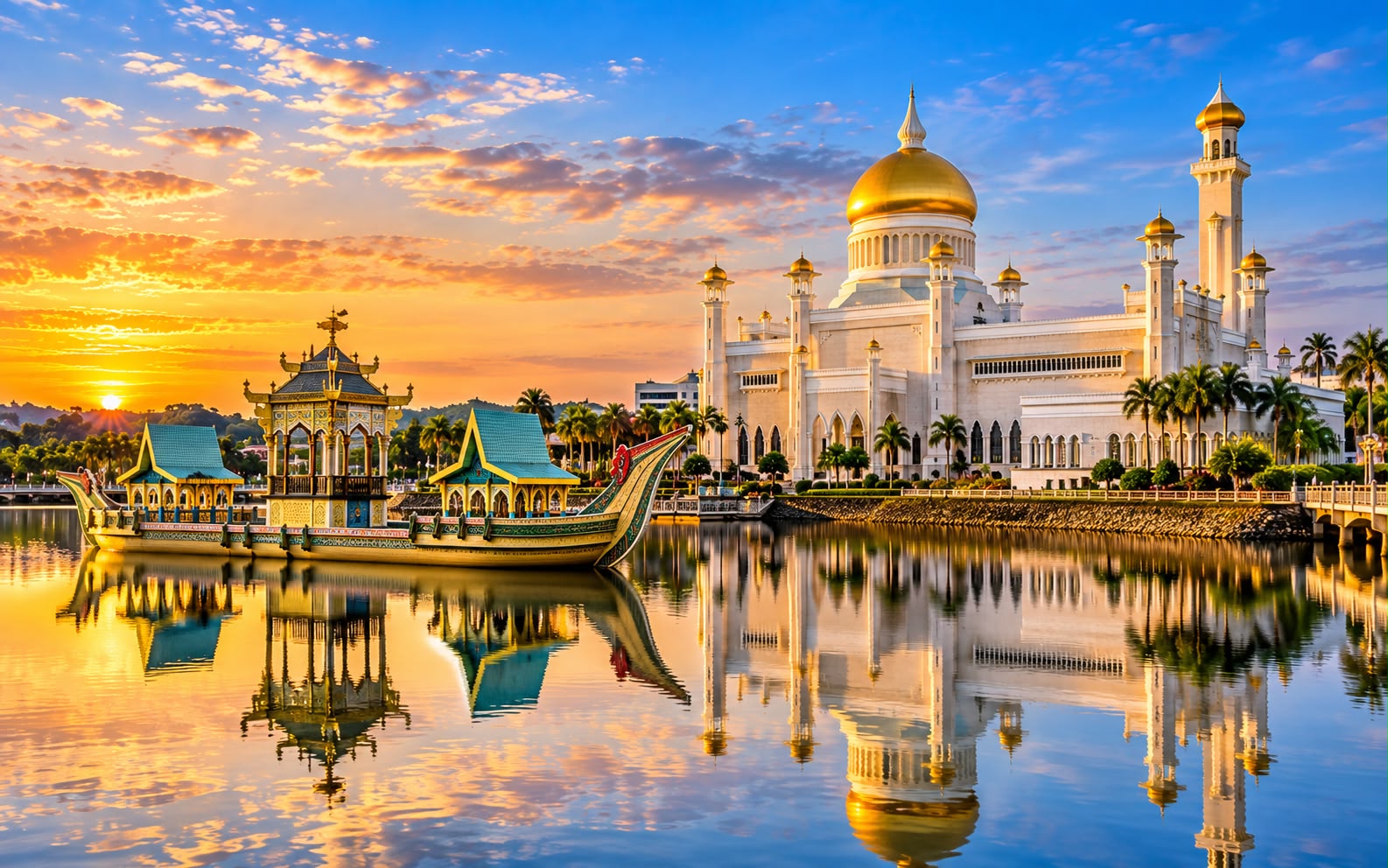
Brunei in 4 days: a water village, a rainforest canopy and the Sultan's capital
Thirteen thousand people living on stilts over a river, a canopy walkway fifty metres up in untouched rainforest, two of the most extravagant mosques in Asia — and a set of local laws worth understanding properly before you book rather than discovering at customs.
- Southeast Asia
- 4 days
- ≈ AED 1,550 / person
- Primary rainforest and the largest water village on earth
Before you go
Brunei is a sultanate on the north coast of Borneo, split into two pieces by a slice of Malaysia, and almost entirely covered in forest. It sits on oil, charges its citizens no income tax, and has been ruled by the same family for six centuries.
Most people pass through it on a layover. That is enough for the mosques and nothing else, and the nothing else is the better half.
Kampong Ayer is the reason to stop. A village built on stilts over the Brunei River, lived in for more than a thousand years, with around thirteen thousand residents, its own schools, clinics, mosques and fire service, all connected by boardwalks and reached by water taxis that cost under a dollar. Antonio Pigafetta, sailing with Magellan, described it in 1521 as the Venice of the East. It is still there, and still a working neighbourhood rather than an exhibit.
Ulu Temburong National Park is the other one. Primary rainforest that has never been logged, reached by longboat up a shallow river, with a canopy walkway on towers that puts you fifty metres up, above the treetops, at dawn. Brunei protects a far higher share of its forest than either of its neighbours — the oil money meant it never had to cut it down.
And the mosques are genuinely extraordinary: the Sultan Omar Ali Saifuddien, gold-domed and standing in its own lagoon with a replica royal barge moored in front, and the Jame’ Asr Hassanil Bolkiah, bigger, with twenty-nine golden domes for the twenty-ninth sultan.
Four days is right. Figure USD 420 (≈ AED 1,542) per person excluding flights. Go January–May, the drier half of the year, and avoid Ramadan unless you understand what it means for a visitor — the section below covers it.
Before you go: the 15-minute admin
What the law means for a visitor
- Brunei applies Sharia law, phased in from 2014. This shapes a visit in specific, practical ways rather than vague ones, and knowing them in advance removes all the friction.
- Alcohol is not sold anywhere in the country. No bars, no shops, none in hotels or restaurants.
- Non-Muslim visitors aged 17 and over may bring in a personal allowance — in the region of two litres of spirits or wine plus a dozen cans of beer. It must be declared on the customs form on arrival, and drunk in private, not in public or in a restaurant. Confirm the current allowance on the Royal Customs site before you fly; it is the detail most often got wrong.
- Dress modestly. Shoulders and knees covered is the norm for everyone; mosques provide robes for visitors and require them.
- During Ramadan, eating, drinking or smoking in public during daylight hours is prohibited for non-Muslims too. Hotels serve meals discreetly. Many restaurants close during the day.
- Public displays of affection are not acceptable, and this is enforced socially rather than loudly.
- Friday midday — roughly 12:00 to 14:00 — the country stops for prayers. Shops shut, mosques close to visitors. Plan around it.
Visas and entry
- Many nationalities enter visa-free for stays of 14 to 90 days depending on passport; others can get a visa on arrival. Check your own case on the official immigration site.
- Passport valid six months. An onward ticket is sometimes asked for.
Money
- The Brunei dollar (BND), pegged at par with the Singapore dollar — and Singapore dollars are accepted interchangeably, at face value, everywhere. If you are coming via Singapore, leftover notes just work.
- Cards are fine in hotels, malls and larger restaurants. Carry cash for water taxis, markets and Temburong.
- Not an expensive country for food. The night markets are excellent and cost almost nothing.
SIM and data
- Tourist SIMs from DST or imagine at the airport, cheap and straightforward.
- Coverage is good across the populated strip and disappears in Temburong, which is the point of Temburong.
Getting around
- There is almost no public transport. The bus network is minimal and not built for visitors.
- Taxis are scarce and expensive; ride-hailing (Dart) works in the capital and is the practical answer.
- Hiring a car is easy, cheap and on the left. It is the best option if you want Tutong or the oil coast.
- Water taxis across to Kampong Ayer cost about a dollar and are flagged down from the waterfront like cabs.
- Temburong used to mean a boat through Malaysian waters. Since the 30-kilometre Sultan Haji Omar Ali Saifuddien Bridge opened in 2020 — the longest in Southeast Asia — it is a 45-minute drive, which is why a day trip now works at all.
Travelling with kids?
- Water taxis and longboats are the whole appeal and they are fast, open and loud. Life jackets on the park boats.
- The canopy walkway is a steel tower with open steps. There is no minimum age, but there is a lot of climbing and a lot of exposure — judge your own child.
- Jerudong Park, the royal amusement park, is a strange and enjoyable survivor of the 1990s.
- No alcohol anywhere makes the restaurant scene relentlessly family-friendly.
Day by day
Day 1 — Bandar Seri Begawan
- Morning — Arrive, into town in about 20 minutes.
- 10:00 — Sultan Omar Ali Saifuddien Mosque, the one on the postcards: Italian marble, an Italian architect, English stained glass, a gold dome, and a replica sixteenth-century royal barge sitting in the lagoon in front of it. Non-Muslims may enter outside prayer times; robes are provided.
- 12:00 — The Royal Regalia Museum. Free, shoes off, and more interesting than it sounds: the coronation chariot, the gold hand and crown, and room after room of state gifts from every country you can name.
- 14:00 — Lunch, then the Tamu Kianggeh riverside market.
- 16:30 — A river safari on the Brunei River. The draw is proboscis monkeys — the Borneo endemic with the pendulous nose — which come down to the mangroves in the late afternoon, plus crocodiles and monitor lizards. Boatmen take you from the waterfront for a set price; agree it first.
- 19:00 — Gadong Night Market for dinner. This is where the food is: satay, ambuyat, grilled fish, and a bill that will not reach ten dollars.
Where to stay in Bandar Seri Begawan (three nights, no repacking)
- Mid-range: the city centre near the waterfront, walking distance to the mosque and the water taxis.
- Splurge: the Empire, a former royal guesthouse on the coast — vast, marble, and oddly cheap for what it is.
Day 2 — Ulu Temburong
- 06:30 — Early start. This is a full day and the tour operators set the time, not you.
- 08:00 — Over the Temburong Bridge, thirty kilometres across the bay and the mangroves.
- 09:30 — Longboat from Batang Duri: a shallow temuai poled and motored up the Temburong river, through rapids, with the forest closing over the top.
- 11:00 — The canopy walkway. An aluminium tower and a series of walkways taking you to roughly fifty metres, above the canopy, with primary rainforest in every direction and hornbills and gibbons audible below. The climb is the hard part; the view is the reward.
- 13:00 — Lunch at the field centre, then the waterfall and river pools — cold water, and small fish that will nibble your feet if you let them.
- 17:00 — Back to the capital.
- This must be booked in advance. The park requires a permit and a guide, and independent entry is not possible.
Day 3 — Kampong Ayer, and the rest of the capital
- 09:00 — Jame’ Asr Hassanil Bolkiah Mosque, the national mosque, built for the sultan’s silver jubilee: twenty-nine golden domes for the twenty-ninth sultan of the line, and bigger than the one in town.
- 11:00 — Kampong Ayer, properly. Take a water taxi across and walk the boardwalks. The Cultural and Tourism Gallery at the far end explains it and has a tower you can climb for the view back over the roofs. Better still, arrange a homestay lunch with a family — the operators in town set these up and it is the best hour in Brunei.
- 14:30 — Pass the gates of Istana Nurul Iman, the sultan’s palace and the largest residential palace in the world at 1,788 rooms. It opens to the public for three days at the end of Ramadan and not otherwise, so from the road is as close as most people get.
- 16:00 — Tasek Lama Recreational Park on the edge of the centre: a short forest walk to a waterfall, inside the city.
- 19:00 — Dinner at the Tamu Selera food stalls.
Day 4 — Fly out
- Morning — The Brunei Museum or the Malay Technology Museum by the river if the flight is late, then the airport, 20 minutes out.
Costs and practicalities
Best time to visit
January–May is the driest stretch of a country that is wet all year. Brunei sits on the equator and the difference between seasons is one of degree rather than kind.
- January–May — the driest and sunniest months, and the best window for Ulu Temburong and the river trips.
- June–August — warm, humid, with increasing afternoon showers.
- September–December — the wettest part of the year, with the heaviest rain around November and December.
Ramadan changes everything. Eating, drinking or smoking in public during daylight is prohibited for everyone, including non-Muslims, and most restaurants close until dusk. The Sultan’s birthday in July brings parades and an open-palace reception that is genuinely open to visitors.
Travel tips
- Alcohol is not sold anywhere in Brunei. Non-Muslim adults may import a small personal allowance and must declare it on arrival; drinking is private, never public.
- This is a conservative Muslim country with Sharia-based law. Dress modestly, avoid public displays of affection, and be aware that the legal code is stricter than its neighbours’.
- Fridays close the country between about noon and 2pm for prayers, including shops and offices.
- The Brunei dollar is pegged one-to-one with the Singapore dollar and Singapore notes are accepted interchangeably.
- Water taxis across to Kampong Ayer are cheap, constant, and the proper way to see the water village. Agree the fare or use the fixed-price jetty.
- Ulu Temburong needs a permit and a guide, and the longboat journey is weather-dependent.
- Public transport barely exists. Hire a car or budget for taxis and Dart; distances are short.
What this trip actually costs
Two people, 3 nights, mid-range comfort, flights excluded:
| Item | Cost |
|---|---|
| Hotels, 3 nights | USD 270 (≈ AED 992) |
| Ulu Temburong day tour, two | USD 280 (≈ AED 1,028) |
| River safari, two | USD 60 (≈ AED 220) |
| Food and drink, 4 days | USD 160 (≈ AED 588) |
| Taxis, water taxis, entries | USD 70 (≈ AED 257) |
| Total for two | USD 840 (≈ AED 3,085) |
- Roughly USD 420 (≈ AED 1,542) per person, and Temburong is a third of it. It is also the reason to come, so cutting it saves money and removes the trip.
- Food is the cheap part. Night markets and local restaurants run a few dollars a head, and there is no bar bill to speak of.
- No alcohol spend is a bigger difference to a holiday budget than people expect.
- Hotel picks here are chosen on location, not on commission — always check prices and recent reviews before booking.
What to pack
- Long, light clothing. Modest dress is expected, and it is also what you want in that humidity.
- A headscarf if you are a woman intending to enter the mosques; robes are lent at the door but your own is easier.
- Shoes you can get wet for the longboat and the river pools, and proper shoes for the canopy tower.
- Insect repellent — Temburong is rainforest and behaves like it.
- Your duty-free, declared. If you want a drink in your room, it has to come in with you.
FAQ
Can I drink alcohol in Brunei? Not publicly, and you cannot buy any. A non-Muslim adult may import a limited personal allowance, declare it at customs, and drink it privately. Nothing on any menu anywhere in the country includes alcohol.
Is it safe? Yes — Brunei has very low crime and visitors are treated courteously. The things to be careful about are legal and cultural rather than criminal: dress, Ramadan, and public behaviour.
Is two days enough? Two days covers the capital and the mosques. It does not cover Temburong, and Temburong is the half that makes the trip worth taking rather than connecting through.
Can I combine it with Malaysian Borneo? Easily, and most people should. Brunei is surrounded by Sarawak, with land borders and short flights to Miri, Kota Kinabalu and Kuching.
What language do they speak? Malay is official; English is very widely spoken and used in business and signage. You will have no difficulty.
Prices and entry rules change, and what you need depends on your passport; last checked 8 October 2026, so confirm with the embassy or your airline before booking.


