 The Itinerary
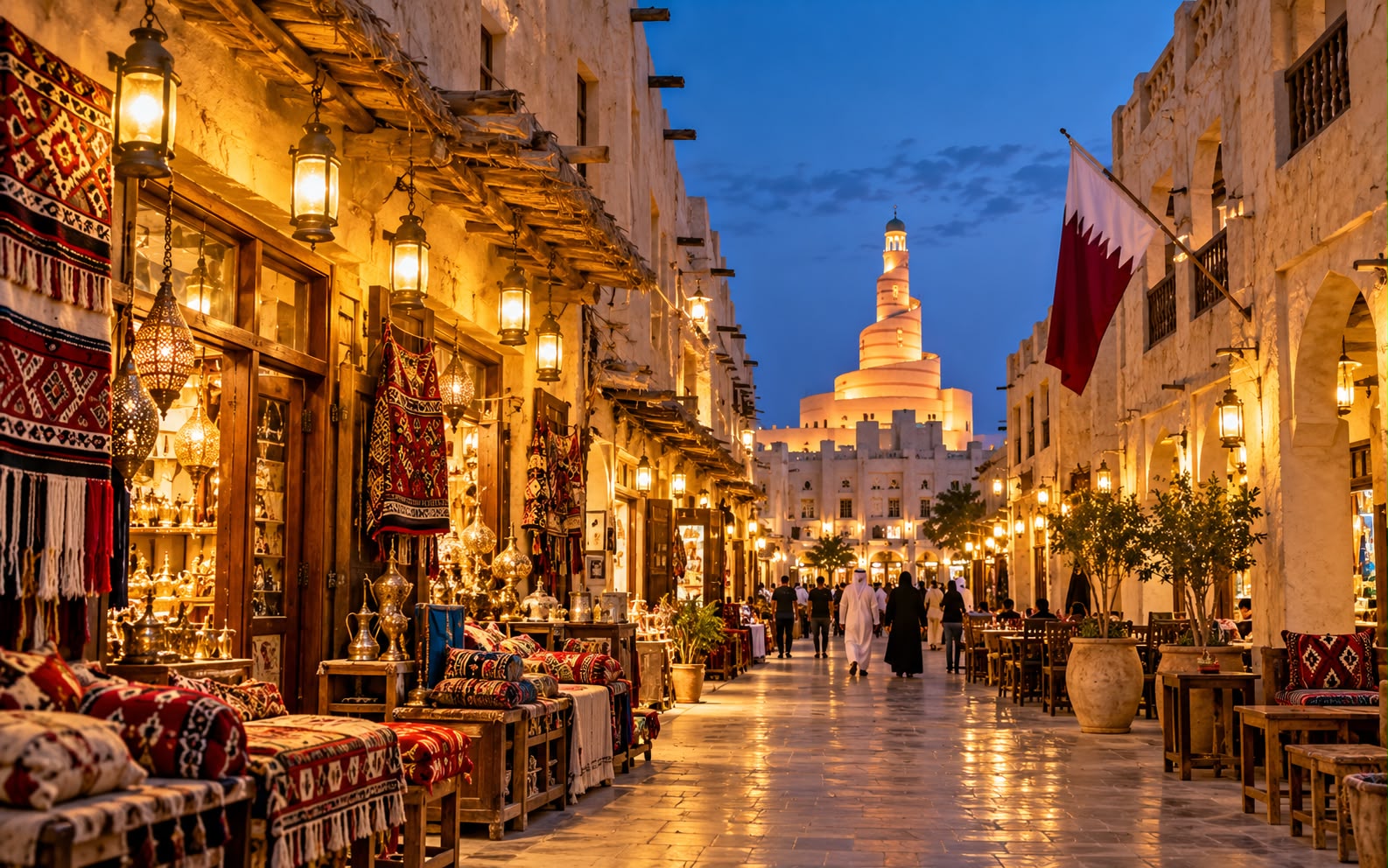
Doha in 2 days: the souq, the museums and the desert
The Museum of Islamic Art and the National Museum are the reason to stop here, and the souq is the reason to stay the evening. Plus the desert run to the inland sea — and why the Corniche walk is best at dusk.
- Middle East
- 2 days
- ≈ AED 750 / person
- Two days where the two best museums in the Gulf sit twenty minutes apart
Before you go
Doha rewards two days more than most Gulf cities, because its two major museums are genuinely world-class and they are twenty minutes apart. I. M. Pei’s Museum of Islamic Art and Jean Nouvel’s National Museum would each be the headline attraction of a larger city.
The rest of the plan is a souq that has been restored rather than rebuilt, a waterfront that is best walked at dusk, and — if you have the second day — the inland sea, where the desert runs directly into the Gulf, which is a genuinely rare piece of geography.
Part of a Qatar trip? See Qatar in 4 days.
Figure QAR 750 (≈ AED 757) per person for two days. November to March.
Before you go: the short version
Entry
- Over 100 nationalities enter visa-free, typically for 30 or 90 days, and the list is one of the broadest in the region.
- Others apply online through the Hayya platform, which also handles residence-linked entry.
- GCC nationals and GCC residents have their own route in.
Getting in and around
- Hamad International (DOH) is 15 minutes from the centre — one of the closest major airports to its own city anywhere.
- The Doha Metro is clean, cheap and new: QAR 2 a journey, QAR 6 for a day pass, and the Gold Line connects the airport to Msheireb in about 20 minutes.
- Karwa taxis are metered; Uber and Careem both work.
- The metro covers the museums, the souq and Katara. It does not cover the desert.
One thing worth knowing
- Qatar is the most conservative of the Gulf states on dress in public spaces. Shoulders and knees covered is the expectation in malls, museums and the souq, for everyone.
Day by day
Day 1 — The museums and the souq
Walking order: Museum of Islamic Art → MIA Park (5 min) → Corniche walk to Souq Waqif (25 min along the water, or 5 min by taxi) → souq on foot. About 3km, all flat, all along the bay.
- 09:00 — The Museum of Islamic Art, I. M. Pei’s last major building, on its own island at the end of the Corniche. He came out of retirement at 91 to design it and insisted on the artificial island so nothing could ever be built against it.
- The collection spans 1,400 years across three continents and is arranged to be read rather than admired. Two hours minimum.
- 12:00 — MIA Park behind it, for the skyline across the water and Richard Serra’s 24-metre steel sculpture at the point.
- 13:00 — Lunch, and out of the sun.
- 15:00 — The National Museum of Qatar, Jean Nouvel’s interlocking discs — modelled on a desert rose crystal, 539 discs, no two the same. The galleries are a 1.5km continuous loop with no straight walls, and the film work is extraordinary.
- 18:00 — Souq Waqif, which was restored in 2006 using traditional materials rather than demolished — mud-rendered walls, exposed timber, and the falcon souq at the back where birds change hands for serious money.
- 20:00 — Dinner in the souq. The Yemeni and Iranian places on the inner lanes are better than the terraces.
Day 2 — Katara, the Pearl, and the desert
Pick the desert if you have one clear day. It is the thing you cannot see anywhere else on this coast.
The desert and the inland sea
- 08:00 — Khor Al Adaid, the inland sea, 90 minutes south. UNESCO-recognised as a natural reserve, and one of very few places on earth where the sea runs into the heart of the desert.
- You go by 4x4 with an operator — dune driving, a camp stop, and usually a swim. It is not a drive you do yourself, and the Saudi border runs along the far shore.
- Dune bashing is the standard format; say in advance if you would rather not, and most operators will adjust.
- 16:00 — Back to the city.
Or the city’s other half
- 09:00 — Katara Cultural Village — an amphitheatre, galleries, two mosques (one gold-tiled, one blue) and a beach, built as a purpose-made cultural quarter.
- 12:00 — The Pearl-Qatar, the reclaimed island with the Venetian-styled Qanat Quartier, which is unapologetically what it is.
- 15:00 — Msheireb Downtown and the Msheireb Museums — four restored heritage houses, one of which deals directly and honestly with slavery in the Gulf, which almost nothing else in the region does.
- 17:30 — The Corniche at dusk, 7km along the bay, with the dhows moored off it and the West Bay towers lighting up.
Costs and practicalities
Getting around, and what it costs
| Metro, single journey | QAR 2 |
| Metro day pass | QAR 6 |
| Airport taxi to the centre | QAR 40–60 |
| Museum of Islamic Art | QAR 50 |
| National Museum of Qatar | QAR 50 |
| Msheireb Museums | free |
| Desert and inland sea tour, half day | QAR 250–400 |
- The metro does more than you expect and is the cheapest transport in the Gulf.
- Both big museums are free for residents and inexpensive for everyone else.
Best time to visit
- November to March — 18–26°C, which is the season, and December–February is the best of it.
- April and October — hot but workable, and quieter.
- May to September — 40–45°C with coastal humidity. The museums and malls function; the Corniche does not.
- Ramadan changes daytime hours and the evenings become the main event.
Travel tips
- Two hours minimum at the Museum of Islamic Art, and do not try to pair it with the National Museum in one morning.
- The souq is an evening place. By day it is half shut.
- Alcohol is only in licensed hotels, and is expensive.
- The desert trip must be booked — you cannot drive to the inland sea yourself.
- Dress more conservatively than elsewhere in the Gulf.
- Friday mornings are very quiet; most things open after midday prayers.
What this trip actually costs
Two people, 1 night, mid-range comfort, international flights excluded:
| Item | Cost |
|---|---|
| Hotel, 1 night | QAR 500 (≈ AED 504) |
| Food and drink, 2 days | QAR 400 (≈ AED 404) |
| Both museums, two people | QAR 200 (≈ AED 202) |
| Desert and inland sea tour, two people | QAR 300 (≈ AED 303) |
| Metro day passes, taxis and incidentals | QAR 100 (≈ AED 101) |
| Total for two | QAR 1,500 (≈ AED 1,513) |
- Roughly QAR 750 (≈ AED 757) per person. The desert tour is the single biggest line — skip it and this drops by a fifth.
- Doha is cheaper than Dubai on everything except alcohol, where it is markedly more expensive.
- Hotel picks here are chosen on location, not on commission — always check prices and recent reviews before booking.
What to pack
- Shoulders and knees covered for public spaces, which is a real expectation here rather than a suggestion.
- A layer for indoors — the air conditioning is severe.
- Closed shoes for the desert, and sand gets into everything.
- A Type G adapter, 240V.
Part of a bigger trip?
- Qatar in 4 days adds Al Zubarah, the north and a proper desert night.
- UAE in 7 days is the neighbouring version of this coast.
- Connecting through? See Doha in an 8–12 hour layover.
FAQ
Is Doha worth two days? Yes, largely on the strength of the two museums. One day covers the souq and the Museum of Islamic Art; the second earns its place through the National Museum and the desert.
Museum of Islamic Art or National Museum? MIA if you only do one — it is the finer collection and the better building. The National Museum is the more enjoyable hour.
Can I drive to the inland sea myself? No. It needs a 4x4, dune experience and local knowledge, and the area runs to the Saudi border. Go with an operator.
Is Doha strict? More conservative than Dubai on dress and alcohol, less so than Saudi Arabia. Cover shoulders and knees in public and you will not think about it again.
Is the metro enough to get around? For the museums, the souq, Katara and the airport, yes. For the Pearl and anything in the desert, no.
Prices and entry rules change, and what you need depends on your passport; last checked 2 November 2026, so confirm with the embassy or your airline before booking.


