 The Itinerary
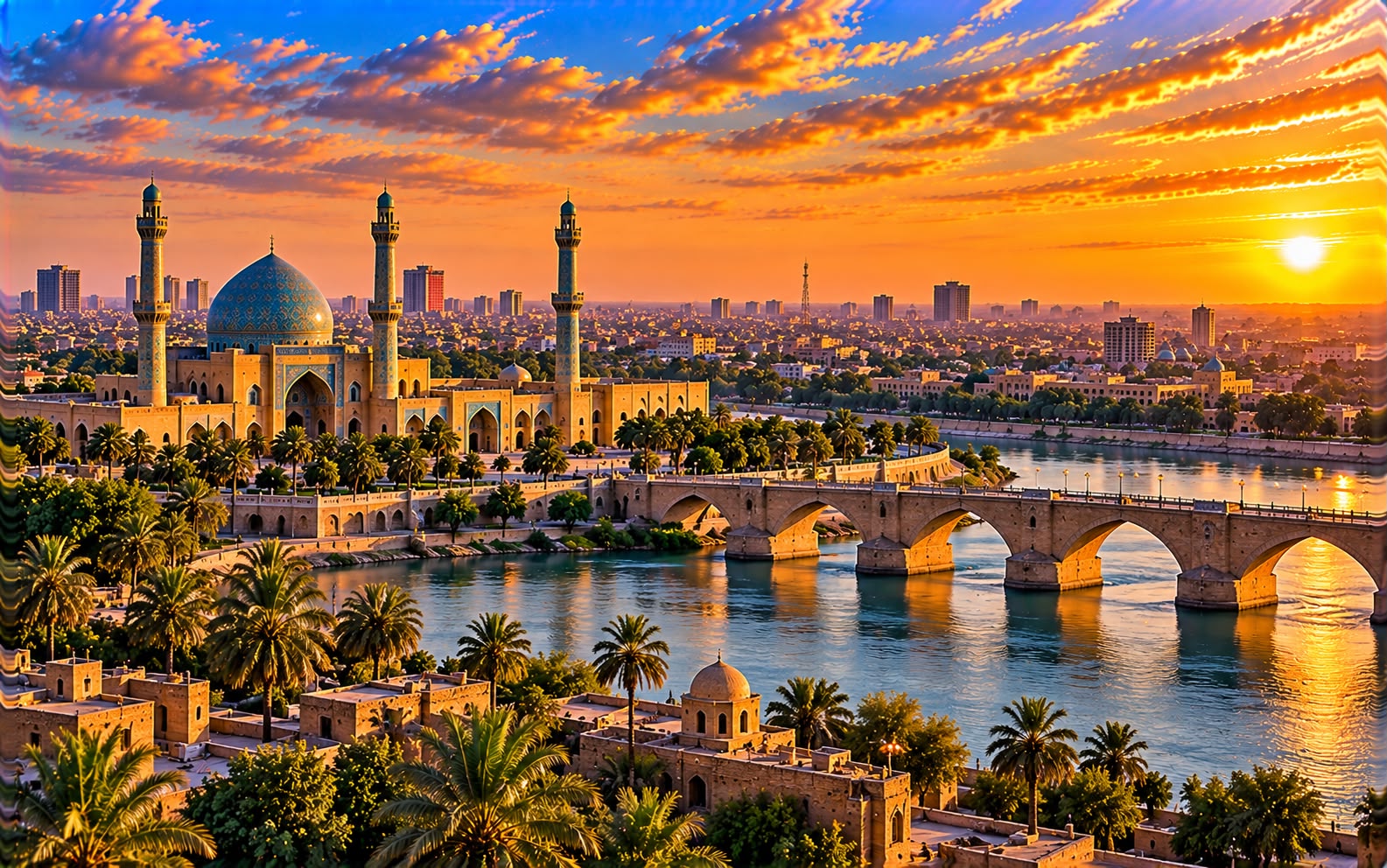
Iraq in 8 days: Erbil's citadel, Babylon and the marshes of the south
Six thousand years of continuous settlement on one mound, the walls Nebuchadnezzar built, and wetlands where people still live on floating reed islands — across a country where the north and the south carry very different warnings.
- Middle East
- 8 days
- ≈ AED 5,500 / person
- Where cities were invented — and the one region where visiting is now ordinary
Before you go
Read this first
Iraq’s travel advice is not one thing, and understanding the split is the most useful thing on this page.
- The Kurdistan Region — Erbil, Sulaymaniyah, Duhok — is treated separately and far less severely by most governments. It has its own government, its own visa regime, and has been materially calmer for two decades. Ordinary visitors do go, and tour operators run there routinely.
- Federal Iraq — Baghdad, Babylon, Basra, the south — carries advise-against-all-travel warnings from many governments. Terrorism, kidnapping, militia activity and unexploded ordnance are all cited.
- Some areas are unambiguous: the Syrian border region, parts of Anbar, Nineveh, Kirkuk and Salah al-Din, and anywhere near militia confrontation.
- Regional escalation has repeatedly closed Iraqi airspace at short notice.
- Insurance will not cover you for travel against government advice, and the gap between “Kurdistan” and “Iraq” in a policy’s wording matters — read it.
Read your own government’s advice and note which regions it names.
This guide covers both, because the archaeology that makes Iraq matter is in the federal south and the realistic trip for most people is in the north. It is not telling you to go to Babylon. It is telling you what is there and what the difference is.
This is where cities were invented. Sumer, Akkad, Babylon and Assyria all rose between the Tigris and the Euphrates, and writing, the wheel, the sexagesimal hour and the first law codes came out of it.
Erbil’s Citadel is a mound in the middle of the modern city that has been continuously inhabited for perhaps six thousand years — plausibly the longest anywhere — and is UNESCO-listed.
Babylon, UNESCO-listed since 2019, holds the Ishtar Gate’s foundations, the processional way, and Nebuchadnezzar’s walls — much of it rebuilt in the 1980s with bricks stamped with Saddam Hussein’s name, which is its own layer of history.
The Ahwar of southern Iraq — the Mesopotamian Marshes — are also UNESCO-listed: wetlands where the Ma’dan have lived on floating reed islands in mudhif houses for millennia. Saddam drained them in the 1990s as a reprisal; they have been partly reflooded since 2003 and are threatened again by upstream dams and drought.
Eight days. Figure USD 1,500 (≈ AED 5,509) per person excluding flights. Go October–April; summer in the south passes 50°C.
Before you go: the 15-minute admin
Two visa regimes
- The Kurdistan Region issues its own visa on arrival at Erbil and Sulaymaniyah for many nationalities, valid for the region only.
- A federal Iraqi visa on arrival has been available to many nationalities since 2021 at Baghdad and Basra, and covers the whole country.
- A Kurdistan visa does not automatically let you travel south. There are internal checkpoints between the region and federal Iraq, and the rules change. Confirm current practice before relying on it.
- An Israeli stamp will cause problems.
Getting around
- Fly between cities where you can — Erbil, Baghdad, Basra and Najaf all have airports.
- A local fixer or operator is how this is done. For the south in particular, independent travel is not realistic: checkpoints, permissions for archaeological sites, and knowing which roads are fine today are all things you cannot research from abroad.
- Expect many checkpoints. Carry your passport and visa at all times, and let the driver speak.
- Do not travel between cities at night.
Money
- The Iraqi dinar (IQD), with US dollars widely used for larger transactions.
- Bring US dollars in cash. Cards work at some Erbil hotels and essentially nowhere else.
- Costs are moderate, except for the fixer and the internal flights.
Conduct
- Do not photograph checkpoints, military, police, government buildings or militia. This is the most common cause of trouble.
- Dress conservatively, especially in the south and at shrines — women will need a headscarf at religious sites and often more.
- Ramadan changes everything about daytime movement and eating.
- Unexploded ordnance contaminates large areas. Do not walk off made paths anywhere outside cities.
Day by day
Day 1 — Erbil
- The Kurdistan Region issues its own visa on arrival at Erbil and Sulaymaniyah, and it is not valid for federal Iraq — the southern half of this route needs the federal visa, arranged in advance.
- 11:00 — The Citadel, on its mound above the city, UNESCO-listed for a settlement sequence that may run six thousand years unbroken. Much of the interior is under restoration; the Textile Museum is open and the perimeter walk is the thing.
- 14:00 — The Qaysari Bazaar below it.
- 16:30 — The tea houses around Shar Park, which is where Erbil actually sits in the afternoon.
- 19:00 — Dinner in Ainkawa, the Christian quarter, which is where most of the restaurants are.
Day 2 — The museum, and the plain
- 10:00 — The Erbil Civilization Museum for the Assyrian material.
- 13:00 — Lunch, and the Jalil Khayat mosque if you want the modern counterpoint to the citadel.
- 15:00 — The Erbil plain — this is Nineveh’s hinterland and the tells are everywhere once pointed out.
- 17:00 — The citadel walls at sunset, from the park below, which is when the mound reads properly.
- Agree tomorrow’s movements with your guide tonight. Lalish has its own rules and you want them explained before you arrive, not at the gate.
Day 3 — Lalish and Duhok
- 08:00 — Lalish, the holiest site of the Yazidi faith, in a valley north-west of Erbil — conical fluted spires over the tomb of Sheikh Adi, and a place you enter barefoot, including the approach.
- Do not step on a threshold anywhere in the sanctuary; step over it. Your guide will show you.
- The Yazidis were targeted for genocide by ISIS in 2014, and the community around Sinjar is still displaced. Visitors are welcomed; behave accordingly.
- 13:00 — Duhok and the surrounding mountains, if time allows.
- 16:00 — The Duhok dam and the valley, and the city is a university town with a normal evening.
- 18:30 — Back toward Erbil, or overnight in Duhok.
Day 4 — Sulaymaniyah
- 08:00 — Three hours east through the mountains, which is the best drive in the region.
- 11:00 — The Amna Suraka — the “Red Security” museum, the former Ba’athist intelligence headquarters left as it was found, with the cells intact and a hall of 182,000 mirror shards for those killed in the Anfal campaign. It is the hardest and most important place in the Kurdistan Region. Allow two hours and plan nothing after it.
- 15:00 — The Slemani Museum, second only to Baghdad’s for Mesopotamian material.
- 17:30 — The bazaar, and the tea houses where the poets sit.
- 19:30 — Dinner, and fly or drive to Baghdad tomorrow.
Day 5 — Baghdad
- From here the warnings change. Read the first section again.
- 09:00 — Fly to Baghdad, which is an hour and is the only sensible way; the road crosses contested ground.
- Movements in Baghdad are fixer-led and checkpoint-bound. Expect your day to be reordered on the morning.
- 12:00 — The Iraq Museum, which holds the Warka Vase, the Mask of Warka and the Nimrud treasures — and which was looted in 2003, with thousands of objects still missing. It reopened fully in 2015.
- 15:30 — Al-Mutanabbi Street, the booksellers’ street, rebuilt after the 2007 bombing, busiest on Fridays — so come on a Friday if you can choose.
- 17:30 — The Abbasid Palace and the Martyr’s Monument.
- 19:00 — Off the street. Photography of checkpoints and security forces is prohibited.
Day 6 — Babylon, Ctesiphon, Karbala
- 07:00 — Ctesiphon, closer to Baghdad, where the Taq Kasra arch still stands — the largest single-span brick vault in the world, built by the Sasanians.
- 10:00 — Babylon, ninety minutes south: the processional way, the Lion of Babylon, the reconstructed walls, and the Ishtar Gate replica — the original is in Berlin. Saddam’s reconstruction sits on top of the original courses and the joint is visible.
- 14:00 — Karbala and Najaf are among the holiest cities in Shia Islam and receive millions of pilgrims. Non-Muslims may visit the cities and in some cases the shrine courtyards; practice varies and you should be guided.
- Arbaeen, forty days after Ashura, brings tens of millions to Karbala — it is extraordinary and it is not a date to arrive on casually.
- 19:00 — Back to Baghdad.
Day 7 — South to the Marshes
- 07:00 — South to the Ahwar, the Mesopotamian Marshes, UNESCO-listed in 2016 both for nature and for culture. It is four to five hours.
- 14:00 — By mashoof, the long canoe, among reed beds taller than the boat, which closes over your head in the channels.
- 16:00 — To the mudhif — arched reed halls built without a single nail or post, a technique essentially unchanged since Sumer.
- The Ma’dan were driven out when Saddam drained the marshes in the 1990s; reflooding after 2003 brought some back, and drought and upstream dams now threaten them again — the water level you see will be lower than the photographs.
- 18:30 — Overnight at Chibayish or back toward Basra.
Day 8 — Ur, and out
- 08:00 — Ur on the way, with the restored ziggurat and the house traditionally identified as Abraham’s — it sits beside a former airbase, which is its own commentary.
- 12:00 — Into Basra, and the Shatt al-Arab waterfront.
- Fly out of Basra or back via Baghdad.
- Leave very wide margins. Internal flights are limited and the road north is not an alternative.
Costs and practicalities
Best time to visit
October–April. Mesopotamian summers reach 50°C in the south and are genuinely dangerous; the sites at Babylon, Ur and Uruk have no shade at all.
- October–November — warm, clear, and the best for the southern sites and the marshes.
- December–February — cool to cold, with rain in the north and snow in the Kurdish mountains. Baghdad is 10–16°C and pleasant.
- March–April — the best of the year. Wildflowers in Kurdistan, comfortable in the south, and Nowruz on 21 March is the biggest celebration in Iraqi Kurdistan — fires on the hillsides at Akre, and the whole region out.
- May–September — 45–50°C in Baghdad, Basra and the south. The marshes are hot and the air is still.
Erbil and Kurdistan run cooler and are comfortable a month longer at either end.
Travel tips
- Iraqi Kurdistan and federal Iraq have separate visa regimes. A Kurdistan Region visa does not admit you to Baghdad; check which you hold and where it is valid.
- Check current advice carefully. The position varies sharply between the Kurdistan Region, Baghdad and the south, and changes.
- Bring US dollars in cash. Cards barely function and ATMs are unreliable; dollars circulate alongside dinars.
- Checkpoints are constant and paperwork is checked properly. Carry your passport and permits; let your guide speak.
- Permits are required for several archaeological sites, arranged in advance by an operator.
- Do not photograph checkpoints, military, police or government buildings. Ask before photographing people, especially women.
- Friday is the weekend, with Saturday. Ashura in the Shia south draws millions to Karbala and Najaf and transforms travel across the whole country.
What this trip would cost
Two people, 7 nights, mid-range comfort, international flights excluded:
| Item | Cost |
|---|---|
| Hotels, 7 nights | USD 1,100 (≈ AED 4,040) |
| Fixer, driver and permissions | USD 1,200 (≈ AED 4,407) |
| Internal flights, two | USD 400 (≈ AED 1,469) |
| Site entries, guides, marsh boats | USD 300 (≈ AED 1,102) |
| Total for two | USD 3,000 (≈ AED 11,018) |
- Roughly USD 1,500 (≈ AED 5,509) per person, and the fixer is the largest line. In the south it is not optional.
- Kurdistan alone is considerably cheaper — you can travel there much more ordinarily, and many visitors do only that.
- Bring US dollars in cash.
- Food is inexpensive and is not a meaningful part of the budget.
- Hotel picks here are chosen on location, not on commission — always check prices and recent reviews before booking.
What to pack
- US dollars in cash, and copies of your passport and visa for the checkpoints.
- Conservative clothing, and a headscarf for women at shrines.
- Sun protection and far more water than you expect — the south is extreme.
- Shoes you can remove easily, for Lalish and the shrines.
FAQ
Is Iraqi Kurdistan the same as Iraq for travel advice? No, and that distinction is the practical heart of this page. Most governments treat the Kurdistan Region far less severely than federal Iraq, it has its own visa on arrival, and ordinary tourism operates there. Check how your own government words it.
Can I visit Babylon? It is open and it is in federal Iraq, under advise-against-all-travel warnings from many governments. People do go, with fixers, from Baghdad. That is a decision to take with current advice in front of you.
Does a Kurdistan visa let me go to Baghdad? Not automatically. There are internal checkpoints and the rules change. Confirm before you rely on it.
Are the marshes still there? Partly. Saddam drained them in the 1990s; reflooding after 2003 restored a fraction, and drought and upstream dams are shrinking them again. They are UNESCO-listed and genuinely endangered.
What language do they speak? Arabic and Kurdish, both official. Kurdish in the north, Arabic elsewhere; English is reasonably common in Erbil.
Prices and entry rules change, and what you need depends on your passport; last checked 29 October 2026, so confirm with the embassy or your airline before booking.


