 The Itinerary
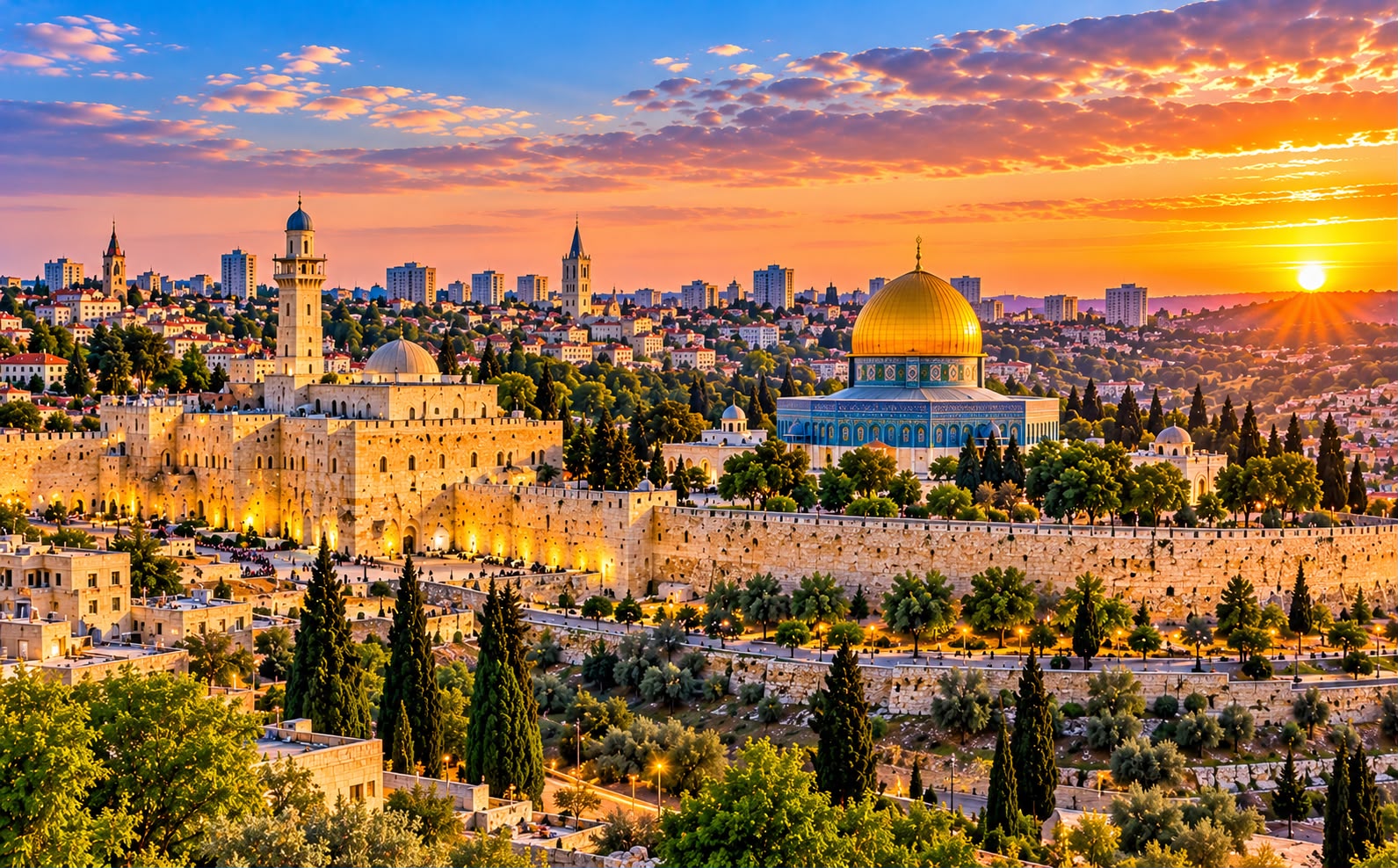
Israel in 7 days: Jerusalem, the Dead Sea, Galilee and Tel Aviv
A walled city holy to three religions, a fortress on a desert plateau reached before dawn, water you cannot sink in four hundred metres below sea level, and a Bauhaus beach city two hours away — plus the weekly shutdown that decides your itinerary and the advice to read before you book.
- Middle East
- 7 days
- ≈ AED 4,300 / person
- Four thousand years of layers, and the lowest point on earth
Before you go
Israel is small — you can drive its length in six hours — and denser in things worth stopping for than almost anywhere. It is also a place where the practical planning matters more than usual, in two specific ways that this guide leads with rather than buries.
Jerusalem is the centre of it. The Old City is a square kilometre divided into four quarters, holding the Western Wall, the Church of the Holy Sepulchre and the Temple Mount / Haram al-Sharif within a few hundred metres of each other, which is the whole history of the region compressed into a space you can walk across in twenty minutes.
Masada is the other image: a plateau above the Dead Sea with Herod’s palace cut into its northern cliff and a Roman siege ramp still visible against its flank. People climb it in the dark to be on top at sunrise, and they are right to.
The Dead Sea is four hundred and thirty metres below sea level, the lowest exposed land on earth, and so saline you float whether or not you intend to. The Galilee in the north is green, hilly and full of the places the gospels name. Haifa has the Bahá’í terraces stepping down the side of Mount Carmel. And Tel Aviv is a Mediterranean beach city with four thousand Bauhaus buildings and the best food in the region.
Seven days covers it without rushing. Figure USD 1,175 (≈ AED 4,315) per person excluding flights — this is not a cheap country. Go March–May or October–November; July and August are punishing in Jerusalem and worse at the Dead Sea.
Before you go: the 15-minute admin
Current conditions, and where to check them
- This is a region where the security picture changes, sometimes quickly. Any guide, including this one, is describing a place as it generally is, not as it is this week.
- Read your own government’s current travel advice before you book, and again before you fly. Advice is usually specific by area rather than blanket — the Gaza periphery and parts of the northern border are treated differently from Tel Aviv or the Galilee — so read the detail, not the headline.
- Check your travel insurance separately. Many policies exclude areas a government advises against travelling to, which can void cover for the whole trip rather than that area.
- Airlines suspend and resume routes here more than elsewhere. Book flexible fares where you can.
- None of this is a reason not to go. It is a reason to plan with current information rather than a guide written at some point in the past.
Shabbat decides your itinerary
- From Friday afternoon until Saturday after dark, the country changes gear. This is the single biggest practical fact about travelling here and it catches people out every week.
- Public transport stops nationwide — buses and trains — from mid-afternoon Friday until Saturday evening.
- Jerusalem closes: shops, most restaurants, many attractions. Tel Aviv does not, or not nearly as much; beaches, cafés and Jaffa stay busy.
- What still runs: hire cars, taxis, and sherut shared minibuses, which keep going between the main cities. Arab-majority areas — Nazareth, parts of Haifa, East Jerusalem — operate normally.
- Plan Friday evening and Saturday somewhere it suits. Tel Aviv, the Galilee with a car, or the Dead Sea. Jerusalem on a Saturday with no car is a quiet day, which is lovely once and frustrating if unplanned.
- Friday is a short day everywhere — things shut by early afternoon. Fridays are also the Muslim day of prayer, which affects access to the Temple Mount.
Visas, entry and your passport
- Many nationalities enter visa-free for up to 90 days. Check your own case officially before booking.
- Israel does not stamp passports. You are issued a paper entry card instead, and given an exit card on departure. Keep the entry card with your passport — hotels and car hire ask for it, and it is your proof of legal entry.
- Some countries refuse entry to anyone showing evidence of travel to Israel — Lebanon, Syria and Iran among them. The no-stamp policy helps, but a Jordanian or Egyptian land-border stamp can reveal the trip by implication. If this affects your future travel, plan the order of your trips deliberately.
- Expect security questioning on departure from Ben Gurion. It is thorough and normal. Arrive three hours early, more in peak season.
Money
- The new Israeli shekel (ILS), often written ₪.
- It is an expensive country — comparable to Western Europe for hotels and food, and dearer than you expect for small things.
- Cards work everywhere, including for tiny amounts. Contactless is universal.
- Tipping is expected in restaurants, usually around 10–12%, and often not included.
SIM and data
- Tourist eSIMs and physical SIMs are cheap and easy; buy before you land or at the airport.
- Coverage is complete. Wifi is everywhere, including on buses and at the beach.
- Electrical plugs are type H, a three-pin design used almost nowhere else. European two-pin plugs fit the sockets; bring an adapter if yours do not.
Getting around
- A hire car is the right answer for this itinerary — it is the only way to do the Galilee, the Dead Sea and Masada on your own schedule, and the only transport that runs on Shabbat.
- Check the rental terms about the West Bank. Most Israeli hire companies prohibit taking the car into Area A, and insurance will not cover you there.
- Do not drive in Jerusalem’s Old City area — park and walk. The light rail is good and the streets are not.
- Trains link Tel Aviv, Haifa, Jerusalem and Ben Gurion and are fast and cheap, outside Shabbat.
- Distances are short: Tel Aviv to Jerusalem is an hour, Jerusalem to the Dead Sea about the same.
The West Bank is a separate decision
- Bethlehem, Jericho and Ramallah are in the West Bank, under Palestinian Authority administration in Area A. Many visitors go to Bethlehem for the Church of the Nativity, usually on an organised half-day from Jerusalem.
- Entry is through checkpoints, your hire car probably may not go, and government advice on these areas is separate from advice on Israel — read it specifically.
- This itinerary does not route through it, so the choice stays yours rather than being made for you.
Travelling with kids?
- Floating in the Dead Sea is the trip’s guaranteed win. Keep the water out of eyes and off any cut — it stings badly — and do not shave that morning.
- Masada has a cable car, so the plateau is reachable without the Snake Path.
- Tel Aviv’s beaches and promenade are excellent, and the city is set up for families.
- Distances are short, which matters more than anything else on a family trip.
Day by day
Day 1 — Tel Aviv and Jaffa
- Morning — Land at Ben Gurion, train or taxi into Tel Aviv in 20 minutes.
- 11:00 — The White City: more than four thousand Bauhaus buildings put up by German-trained architects in the 1930s, the largest concentration anywhere, and on the UNESCO list. Rothschild Boulevard is the spine of it.
- 13:00 — Carmel Market for lunch, then Neve Tzedek, the first neighbourhood built outside Jaffa and now the prettiest streets in the city.
- 16:00 — Old Jaffa: a port used for four thousand years, a flea market, a hill of restored alleys and a view back along the beachfront.
- 19:30 — Dinner. Tel Aviv’s food is the best argument for the city and arguably for the country.
Where to stay in Tel Aviv (two nights, start and end)
- Mid-range: the streets behind the beach between Allenby and Gordon — walkable to everything and to the sand.
- Value: Florentin, south of the centre, younger and cheaper.
Day 2 — Caesarea, Haifa and Akko, then north
- 08:30 — Pick up the car and drive up the coast.
- 09:30 — Caesarea Maritima, the harbour city Herod built for Augustus: a Roman theatre still used for concerts, a hippodrome on the sea, and the aqueduct running along the beach north of it.
- 12:00 — Haifa and the Bahá’í Gardens: nineteen terraces stepping down Mount Carmel to the golden-domed Shrine of the Báb, immaculate, free, and on the UNESCO list. Access to the upper terraces is by timed tour — check before you arrive.
- 14:30 — Akko (Acre), 40 minutes on. A walled Ottoman port built on top of a Crusader city, with the Hospitaller fortress excavated underneath it and the Templars’ tunnel running out to the harbour. One of the most atmospheric places in the country and far less visited than it should be.
- 17:30 — Drive to the Sea of Galilee, about an hour.
Day 3 — The Galilee and Nazareth
- 09:00 — The north shore of the Sea of Galilee: Capernaum, where the synagogue’s white limestone stands on the black basalt of an earlier one; Tabgha, with its fifth-century loaves-and-fishes mosaic; and the Mount of Beatitudes looking down over the lake.
- 12:30 — Lunch in Tiberias — St Peter’s fish, by the water.
- 14:00 — Nazareth, 40 minutes west: the Basilica of the Annunciation, the largest church in the Middle East, built over the grotto. The old city around it is Arab, Christian and Muslim, and the best food in the north is in it.
- 16:30 — Safed (Tzfat) if there is time: a hill town of blue doors, sixteenth-century synagogues and the birthplace of Kabbalah, now full of galleries.
Day 4 — Down the Jordan valley to the Dead Sea
- 09:00 — Drive south along the valley, about two and a half hours, dropping below sea level most of the way.
- 12:00 — Qumran, where a shepherd found the Dead Sea Scrolls in a cliff cave in 1947. The site is modest; the caves above it are the thing.
- 14:00 — Check in by the shore and float. Twenty minutes is plenty — it is not swimming, it is lying on top of water that will not let you under. Rinse thoroughly afterwards.
- 16:30 — Ein Gedi, a freshwater canyon in the desert with waterfalls and ibex, half an hour north.
- Early night. Tomorrow starts before dawn.
Day 5 — Masada at sunrise, then Jerusalem
- 04:30 — Masada. The Snake Path takes about 45 minutes to an hour in the dark; the cable car runs from shortly before sunrise if you would rather. Herod built two palaces up here, one cut into three terraces on the northern cliff. The Roman siege ramp is still against the western side, two thousand years on.
- 07:30 — Breakfast back at the hotel.
- 10:00 — Drive to Jerusalem, about 90 minutes, climbing eight hundred metres from below sea level.
- 14:00 — Mount of Olives for the view across the Kidron valley onto the Old City and the Dome of the Rock — the photograph everyone takes, and the right introduction. Walk down past Gethsemane.
- 17:00 — Mahane Yehuda market, which turns from a food market into the city’s bar district after dark.
Where to stay in Jerusalem (three nights)
- Mid-range: the German Colony or Rehavia, quiet, walkable, with trams into the centre.
- Value: around Jaffa Street, central and on the light rail.
Day 6 — The Old City
- 07:30 — Temple Mount / Haram al-Sharif. Non-Muslim visiting hours are short, early and change often; entry is via the Mughrabi Bridge by the Western Wall, with a security check and a queue. Modest dress, no religious items, no non-Muslim prayer. Check the day’s hours the night before — Fridays and holy days are closed to visitors.
- 09:30 — The Western Wall, the surviving retaining wall of the Second Temple platform and the holiest place Jews may pray. Separate men’s and women’s sections; head covering provided.
- 11:00 — The Via Dolorosa through the Muslim Quarter to the Church of the Holy Sepulchre, built over the sites traditionally identified as Calvary and the tomb, and shared — tensely, and under a centuries-old arrangement — by six denominations.
- 14:00 — Lunch in the Jewish Quarter, then the Cardo, the Roman main street excavated below current ground level.
- 16:00 — The City of David and Hezekiah’s Tunnel, cut through rock in the eighth century BCE and still carrying water. You wade it; bring shoes you can soak and a torch.
Day 7 — Yad Vashem, the Israel Museum, and out
- 09:00 — Yad Vashem. The Holocaust history museum is a prism driven through the hillside and is one of the most affecting museums anywhere. Free. Allow three hours; the Hall of Names and the Children’s Memorial in particular.
- 13:00 — The Israel Museum, and in it the Shrine of the Book, which holds the Dead Sea Scrolls, and the model of Jerusalem as it stood in 66 CE.
- 16:00 — To Ben Gurion, about an hour. Three hours before the flight, minimum.
Costs and practicalities
Best time to visit
March–May and October–November. The summer is hot and the Dead Sea and Negev are extreme in it; winter is cool and rainy in the north but perfect in the south.
- March–May — the best of the year. Wildflowers in the Galilee, comfortable in Jerusalem, and the desert pleasant.
- June–September — 35°C in Tel Aviv with humidity, and the Dead Sea and Eilat reach 45°C. The coast is busy and the Galilee is hot.
- October–November — warm, clear, and the Jerusalem stone at its best.
- December–February — cool and wet in the north, with occasional snow in Jerusalem, while Eilat and the Dead Sea are at their most comfortable. The quietest months.
Jewish holidays reshape everything — Passover in spring and the autumn cluster of Rosh Hashanah, Yom Kippur and Sukkot. Transport stops entirely on Yom Kippur.
Travel tips
- Check current travel advice before booking. The regional situation changes quickly and advice varies sharply by area.
- Shabbat runs from Friday sunset to Saturday nightfall. Public transport stops nationwide, most shops and many restaurants close, and Jerusalem goes quiet entirely. Tel Aviv keeps more open; sheruts still run.
- Airport security is thorough and the questioning is long. Arrive three hours early, answer straightforwardly, and expect more questions if you have regional stamps.
- You get an entry card, not a passport stamp — keep it, as you need it at checkpoints and for VAT refunds.
- Dress for religious sites: shoulders and knees covered at the Western Wall, the Church of the Holy Sepulchre and Al-Aqsa. The Temple Mount has restricted hours for non-Muslims and no religious items.
- Cards work everywhere; carry some shekels for markets and sheruts.
- Tipping is 10–15% and often cash even on a card bill.
What this trip actually costs
Two people, 6 nights, mid-range comfort, flights excluded:
| Item | Cost |
|---|---|
| Hotels, 6 nights | USD 900 (≈ AED 3,305) |
| Car hire, 5 days + fuel | USD 450 (≈ AED 1,653) |
| Food and drink, 7 days | USD 700 (≈ AED 2,571) |
| Entrances and national parks | USD 180 (≈ AED 661) |
| Dead Sea spa, cable car, extras | USD 120 (≈ AED 441) |
| Total for two | USD 2,350 (≈ AED 8,630) |
- Roughly USD 1,175 (≈ AED 4,315) per person. Israel sits at Western European prices and food is where it adds up.
- A national parks pass pays for itself if you visit four or more sites — Masada, Caesarea, Qumran, Ein Gedi and Akko are all included.
- Yad Vashem and the Bahá’í Gardens are free, and are two of the best things on the list.
- Hotels jump sharply over Jewish holidays — Passover, Rosh Hashanah, Sukkot — when the whole country travels. Check the calendar before fixing dates.
- Hotel picks here are chosen on location, not on commission — always check prices and recent reviews before booking.
What to pack
- Modest clothing for the holy sites — shoulders and knees covered at the Western Wall, the Holy Sepulchre and the Temple Mount, for men and women both.
- Shoes you can soak for Hezekiah’s Tunnel, and proper shoes for Masada before dawn.
- A hat, sunglasses and far more sun protection than feels necessary. The Dead Sea basin is brutal.
- Flip-flops for the Dead Sea shore — the salt crust is sharp.
- Your entry card, kept with the passport for the whole trip.
FAQ
Is it safe to travel to Israel? It depends on when and where, which is why the first section says to read current government advice rather than trust a general answer. Advice is normally area-specific: the same document may treat Tel Aviv and the Gaza periphery completely differently.
Will I get a stamp in my passport? No. Israel issues a paper entry card instead, specifically so that travel here does not block entry elsewhere. Land borders with Jordan and Egypt can still leave a trail.
Can I visit Bethlehem? Usually yes, most easily on an organised half-day from Jerusalem. It is in the West Bank, so check your government’s separate advice for that area and leave the hire car behind.
Do I need a car? For this itinerary, yes. It is the only way to do the Galilee and the Dead Sea properly, and the only transport that runs on Shabbat.
What is there to do on a Saturday? Be in Tel Aviv, be at the Dead Sea, or have a car. In Jerusalem without one, Saturday is a very quiet day — which is worth experiencing once, deliberately.
Prices and entry rules change, and what you need depends on your passport; last checked 8 October 2026, so confirm with the embassy or your airline before booking.


