 The Itinerary
Israel and Jordan in 12 days: Jerusalem, Masada, the Dead Sea, Petra and Wadi Rum
A walled city holy to three religions, a fortress above the lowest point on earth, a rose-red city carved into a gorge, and a granite desert where Lawrence rode — two countries that share a border, a sea and four thousand years, with the planning advice this trip genuinely needs.
- Middle East
- 12 days
- ≈ AED 12,500 / person
- The two halves of the Holy Land, a Nabataean city cut into a cliff, and a desert you can sleep in
Before you go
These two are sold together because they belong together. The Dead Sea is the border, Jerusalem and Petra are ninety road miles apart with a river between them, and visiting either alone leaves half the story out.
Read this first, though, and read it properly. This is a region where conditions change faster than any page can be updated. Check your own government’s current travel advice before you book and again before you fly — including the specific areas it names, because advice here is almost never blanket and almost always regional. Confirm the land crossings are open, since they close at short notice and your whole routing depends on them. Travel insurance that covers the region is worth reading closely rather than assuming. None of that is a reason not to go; it is the reason to plan this trip with current information rather than a guidebook’s.
With that said: Jerusalem’s Old City is a square kilometre holding the Western Wall, the Church of the Holy Sepulchre and the Temple Mount / Haram al-Sharif within a few hundred metres of each other. Masada is Herod’s cliff-top palace above the Dead Sea with the Roman siege ramp still against its flank. The Dead Sea is 430 metres below sea level and you float whether you mean to.
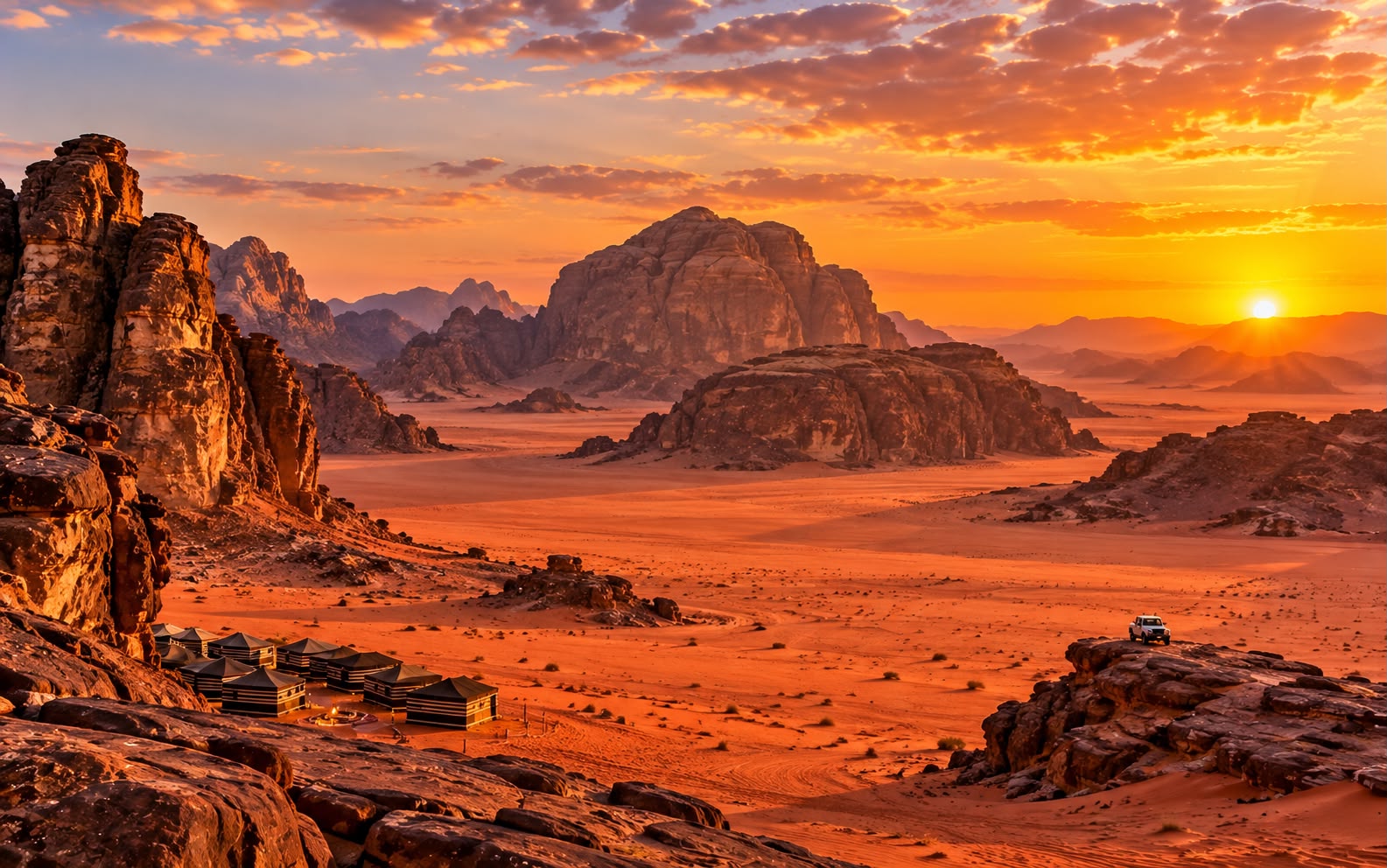
And across the water, Petra — a Nabataean capital carved into pink sandstone, entered through a 1.2-kilometre crack in the rock that opens onto the Treasury. Wadi Rum is the granite and sandstone desert T. E. Lawrence crossed, and you sleep in it.
Twelve days. Figure USD 3,400 (≈ AED 12,487) per person. March–May and September–November are the months.
Before you go: the admin
Entry, and the crossing
- Two countries, two entry processes. Israel admits many nationalities visa-free; Jordan issues visas on arrival and online.
- The Jordan Pass is the single best piece of planning on this trip. Bought online before you arrive, it waives the Jordanian visa fee and covers Petra and about forty other sites. It pays for itself if you spend two nights in Jordan and see Petra, which you will. It must be bought before you land.
- The Jordan Pass visa waiver requires you to arrive in Jordan by air or at certain crossings and to stay a minimum number of nights. Read its own terms — they are short and specific.
- Three land crossings exist between the two countries. Allenby / King Hussein Bridge near Jericho is the one this routing uses; Sheikh Hussein in the north and Wadi Araba at Aqaba are the others. Opening hours, closures and which crossings honour the Jordan Pass all change — confirm every one of these with your operator within days of travelling.
- Allenby has its own rules: it does not issue Jordanian visas on arrival for all nationalities, and it closes early and on certain holidays. This is the single most common thing to go wrong on this itinerary.
- An Israeli stamp is no longer routinely placed in passports — both countries issue paper slips — but several countries in the region refuse entry on evidence of an Israeli visit. Keep the slips and know your onward travel plans.
- Flying between Tel Aviv and Amman is the alternative to the land crossing. It is quick and removes the crossing risk entirely, at the cost of the Dead Sea-to-Madaba geography that makes the overland version elegant.
Getting around
- Distances are small. Tel Aviv to Jerusalem is an hour. Jerusalem to the Dead Sea is ninety minutes. Amman to Petra is three hours on the Desert Highway, or five on the spectacular King’s Highway.
- A driver-guide for the Jordanian half is how most people do it and is worth the money — the distances are longer, public transport is thin, and Petra and Wadi Rum both reward someone who knows them.
- Israel’s trains and buses are good and Tel Aviv to Jerusalem by fast train takes 25 minutes.
- Shabbat stops Israeli public transport from Friday afternoon to Saturday evening. This is not a minor inconvenience; it reshapes the week and you must plan the Friday and Saturday around it.
- Friday is the Muslim holy day in Jordan, when things open late and some sites close early.
Money
- Israeli new shekel and Jordanian dinar. The dinar is one of the stronger currencies in the world, so Jordan reads as expensive and largely is.
- Cards work widely in both; carry cash for Wadi Rum camps, Bedouin tea, and small sites.
- Jordan is more expensive than people expect — Petra’s entry alone is substantial without the Jordan Pass.
- Tipping is around ten per cent in both, and more for a driver-guide you have had for days.
Dress and conduct
- Both countries have serious religious sites with real dress codes. Shoulders and knees covered at the Western Wall, the Church of the Holy Sepulchre, the Haram al-Sharif and every mosque. Women need a head covering for some.
- The Temple Mount / Haram al-Sharif has restricted visiting hours for non-Muslims, closes to them on Fridays and Saturdays and during holidays, and non-Muslim prayer is not permitted there. Check the day’s position locally.
- Modest dress in Jordan generally, particularly away from the resorts.
- Ask before photographing people, and do not photograph military or border installations in either country.
Day by day
Day 1 — Tel Aviv
- Arrive at Ben Gurion and go to the sea first. Tel Aviv is the decompression chamber for this trip.
- 14:00 — The Mediterranean beach, which is the point of Tel Aviv and the reason it is nothing like Jerusalem an hour away.
- 17:00 — The White City — around 4,000 Bauhaus buildings, the largest concentration anywhere, UNESCO-listed, built by architects who left Germany in the 1930s. Rothschild Boulevard and the streets off it.
- 19:30 — Carmel Market and the food, which is the best in the region and the argument is only with Beirut.
- Shabbat runs Friday sunset to Saturday night. Transport largely stops; Tel Aviv keeps moving more than anywhere else and Jerusalem does not.
Day 2 — Jaffa, and the museums
- 09:00 — Old Jaffa, the ancient port at the southern end: flea market, stone alleys, and the view back along the beachfront to the towers. Go early for the market.
- 12:30 — Lunch in Jaffa — hummus at one of the old houses, which open at breakfast and sell out by two.
- 15:00 — The Tel Aviv Museum of Art, or ANU, the Museum of the Jewish People, which is the better one if you only do one.
- 18:00 — Neve Tzedek, the first neighbourhood built outside Jaffa, and the Suzanne Dellal Centre.
- 20:30 — Florentin for the evening, which is where the city drinks.
Day 3 — To Jerusalem, and the Old City
- 09:00 — An hour by road, 25 minutes by fast train, and the change in register is total.
- 11:00 — The Old City is a square kilometre inside Suleiman’s walls, divided into four quarters. Enter at Jaffa Gate and get lost deliberately.
- 14:00 — The Western Wall — the retaining wall of the Second Temple platform, and Judaism’s holiest accessible site. Modest dress, separate men’s and women’s sections.
- 16:00 — The ramparts walk along the walls, which gives you the geography in an hour better than any map.
- 19:00 — Mahane Yehuda market in the evening, which turns into bars after the stalls close.
Day 4 — The holy sites
- 06:00 — The Mount of Olives at sunrise for the view across the Kidron Valley to the Old City, which is the photograph everyone has seen. Walk down past Gethsemane.
- 08:30 — The Haram al-Sharif / Temple Mount with the Dome of the Rock, the third holiest site in Islam. Restricted hours for non-Muslims, closed to them Friday and Saturday, and the position changes — ask locally that morning. Entry is via the Mughrabi Bridge only.
- 11:00 — The Church of the Holy Sepulchre, built over the sites Christians identify as Calvary and the tomb, shared uneasily by six denominations under a status quo so delicate that a wooden ladder has sat on a ledge since the eighteenth century because nobody may move it.
- 14:00 — The Via Dolorosa, walked backwards from the church, which is easier to follow than forwards.
- 16:30 — The Armenian Quarter, the quietest of the four, and the Cathedral of St James if the hours allow.
Day 5 — Yad Vashem, and the museum
- 09:00 — Yad Vashem, the Holocaust memorial, which needs a long half day and nothing planned after it. The Hall of Names and the children’s memorial are the parts people carry out with them.
- Free entry, and under-tens are not admitted.
- 14:00 — A long lunch, and no monuments.
- 16:00 — The Israel Museum for the Dead Sea Scrolls and the model of Second Temple Jerusalem, which makes everything you walked through yesterday legible.
- 19:00 — The German Colony for a quiet dinner.
Day 6 — Masada and the Dead Sea
- 04:00 — Ninety minutes east, and 400 metres down.
- 05:00 — Climb the Snake Path before dawn — an hour, steep — to be on top for sunrise over the Moab mountains, or take the cable car, which opens later.
- 06:30 — Masada — Herod’s fortified palace on a plateau above the sea, where a Jewish garrison held out against a Roman siege and, by Josephus’s account, chose death over capture. The Roman ramp and the eight camp outlines are still visible from the top.
- 10:00 — Ein Gedi, the freshwater oasis and nature reserve next door, with ibex and waterfalls in a desert canyon.
- 14:00 — The Dead Sea: 430 metres below sea level, the lowest exposed land on earth, and about ten times as saline as the ocean.
- The float is the strangest physical sensation of the trip. Do not shave that morning, keep it out of your eyes, and do not stay in longer than fifteen minutes. The mud is sold everywhere and free on some beaches.
Day 7 — Cross to Jordan: Madaba and Mount Nebo
- 07:00 — Cross at Allenby / King Hussein Bridge. Allow most of a morning, confirm the hours the week before, and have your Jordan Pass and onward arrangements in hand.
- The Jordan Pass waives the visa fee if bought before arrival and covers Petra — buy it at home, not at the border.
- 13:00 — Madaba — the sixth-century mosaic map of the Holy Land on the floor of St George’s Church, the oldest surviving cartographic depiction of the region, with Jerusalem at its centre.
- 15:30 — Mount Nebo, where Moses is said to have been shown the promised land and died. On a clear day you can see back to Jericho and the hills of Jerusalem, which is the whole trip in one view.
- 17:30 — The Dead Sea from the Jordanian side if there is time, which is quieter and has the better resorts.
Day 8 — South to Petra
- 08:00 — Three hours south on the Desert Highway, or five on the King’s Highway past Wadi Mujib — the second is a proper drive and worth the extra two hours if you have them.
- 13:00 — Kerak or Shobak castle on the King’s Highway, Crusader fortresses on the ridge.
- 16:00 — Into Wadi Musa, and sleep early.
- 19:00 — Petra by Night runs three evenings a week — the Siq lit by 1,500 candles. Opinions differ; it is atmospheric and it is also crowded and silent-ish rather than silent.
- Wear real shoes. This is eight to twelve kilometres a day on sand, rock and steps.
Day 9 — Petra: the Siq and the Treasury
- 06:00 — Start at six when the gates open. By ten it is hot and full, and the Treasury’s light is best early.
- 06:30 — The Siq — a 1.2-kilometre fissure through the rock, three metres wide in places and two hundred high, with the Nabataean water channels still cut along its walls.
- 07:15 — It opens onto Al-Khazneh, the Treasury, and that moment is as good as travel gets.
- 09:00 — The Street of Facades, the Theatre and the Royal Tombs, which take the morning.
- 13:00 — The High Place of Sacrifice for the view down over the whole basin — about an hour up.
- 17:00 — Little Petra, fifteen minutes north, is free and almost empty.
Day 10 — Petra: the Monastery
- 06:30 — The Monastery — Ad Deir — up 800 rock-cut steps, which is larger than the Treasury and far quieter. Go first thing; the steps face the sun later.
- 09:00 — The viewpoints beyond it, ten minutes further, which look out over Wadi Araba.
- 12:00 — Down, and out. Two days is right for Petra and a third would not be wasted.
- 14:00 — Two hours south to Wadi Rum, and the landscape changes to granite and red sand.
- 16:00 — A 4x4 afternoon through the valley: Lawrence’s Spring, the Khazali Canyon petroglyphs, the sand dune at Um Sabatah, and the natural rock bridges.
- T. E. Lawrence operated here with the Arab Revolt, and Seven Pillars of Wisdom takes its name from a formation near the entrance.
Day 11 — Wadi Rum, and north to Amman
- Sleep in a Bedouin camp. The traditional ones are goat hair and mattresses; the newer “bubble” camps have transparent domes for the stars. Both are worth it and the sky is the reason — Wadi Rum has almost no light pollution.
- Zarb for dinner, cooked in a pit in the sand, and camel at sunset, which is twenty minutes of novelty and the right amount.
- 06:00 — Sunrise over the valley, which is the better of the two ends of the day here.
- 09:00 — Four hours north, or three and a half from Rum.
- 14:00 — The Amman Citadel on its hill: the Temple of Hercules, the Umayyad Palace, and the view over the city’s white stone.
- 16:30 — The Roman Theatre below it, cut into the hillside for 6,000 people.
- 19:00 — Rainbow Street and downtown for dinner, and kunafa at Habibah, which is the thing to eat in Amman.
Day 12 — Jerash, then out
- 08:00 — Jerash, 45 minutes beyond Amman — one of the best preserved Roman provincial cities anywhere, with a colonnaded cardo, two theatres, the oval forum and the Temple of Artemis. Most visitors give it two hours and it deserves four, so do it properly this morning rather than squeezing it in yesterday.
- 13:00 — Back to Amman, 45 minutes.
- Fly out of Amman, which is the clean ending to this routing.
- If you must return to Tel Aviv, allow a full day for the crossing and the drive, and do not plan it for the same day as your flight.
Costs and practicalities
Best time to visit
March–May and September–November, and the shoulder seasons here are not a compromise — they are decisively the right answer.
- March–May — the best of the year. Wildflowers in the Jordanian hills, comfortable in Jerusalem, and Petra and Wadi Rum warm rather than punishing. Easter and Passover fall in this window and Jerusalem is extraordinary and extremely full; book months ahead or dodge the dates deliberately.
- September–November — warm, clear and quieter, with the desert cooling through October. The best light at Petra.
- June–August — Petra and Wadi Rum regularly exceed 40°C with no shade, and the Dead Sea basin is worse. Jerusalem is bearable; the southern half is not, and people do get into trouble on the Monastery steps in August.
- December–February — cold, and colder than people expect. Jerusalem sits at 750 metres and gets occasional snow; Petra freezes at night and the Siq floods in heavy rain, which closes it. Wadi Rum nights are near zero. It is quiet and cheap and you must pack for winter.
Check the Jewish, Muslim and Christian calendars together before booking. Shabbat is weekly; Ramadan, the High Holidays, Easter and Passover all reshape opening hours, transport and prices, and they do not align with each other.
Travel tips
- Buy the Jordan Pass before you land. It waives the visa fee and covers Petra, and it cannot be bought on arrival. Read its minimum-stay and entry-point conditions.
- Confirm the land crossing within days of travelling. Hours, closures and which nationalities get visas at Allenby all change, and this is what most often goes wrong.
- Check current government travel advice before booking and again before flying, including the specific regions it names.
- Plan Friday and Saturday around Shabbat in Israel, when public transport stops from Friday afternoon.
- Start at Petra’s gate at six. Cooler, emptier, and the Treasury’s light is best in the early morning.
- Two days at Petra, not one. The Monastery alone is 800 steps and most of a morning.
- Do not shave the morning you swim in the Dead Sea, keep the water out of your eyes, and limit it to fifteen minutes.
- Carry a scarf for the religious sites in both countries.
- Keep your entry and exit slips rather than letting anyone stamp the passport, and know your onward travel.
- Drink far more water than feels necessary in the southern half. The dry heat hides how much you are losing.
What this trip actually costs
Two people, 11 nights, mid-range comfort, international flights excluded:
| Item | Cost |
|---|---|
| Hotels, 11 nights | USD 2,400 (≈ AED 8,814) |
| Guides, drivers and site entries | USD 1,700 (≈ AED 6,243) |
| Food and drink, 12 days | USD 1,200 (≈ AED 4,407) |
| Border crossing, transfers and the Wadi Rum camp | USD 900 (≈ AED 3,305) |
| Jordan Pass, visas and city transport | USD 600 (≈ AED 2,204) |
| Total for two | USD 6,800 (≈ AED 24,973) |
- Roughly USD 3,400 (≈ AED 12,487) per person, and this is an expensive region — Jordan in particular costs more than its neighbours and Israel is western European in price.
- The Jordan Pass saves a meaningful amount by bundling the visa fee with Petra’s two-day entry. Without it, those two lines alone run to most of the pass’s cost per person.
- A driver-guide for the Jordanian half is inside the guides figure. It is the line people query and the one most come back glad they paid.
- Flying Tel Aviv–Amman instead of crossing by land costs more than the border transfer and removes the single biggest risk to the itinerary. A fair trade for some.
- Hotel picks here are chosen on location, not on commission — always check prices and recent reviews before booking.
What to pack
- Shoulders and knees covered for the religious sites, in both countries, and a scarf or light shawl that solves it instantly.
- Proper walking shoes with grip. Petra is eight to twelve kilometres a day on rock and steps; Masada’s Snake Path is steep.
- A warm layer and a windproof. Jerusalem at 750 metres and Wadi Rum at night are both much colder than the daytime desert suggests.
- A hat, sunglasses and high-factor sun cream. There is no shade at Petra, Wadi Rum or Masada.
- A refillable water bottle and the discipline to keep filling it.
- Flip-flops for the Dead Sea — the salt crystals on the shore are sharp.
- Cash in dinars for Wadi Rum and small sites.
- Your Jordan Pass, e-visa confirmations and entry slips, printed as well as on the phone.
FAQ
Is it safe to do this as one trip? That depends on conditions at the time, which is why this guide leads with checking current government advice rather than answering it in the abstract. Advice for this region is almost always regional rather than blanket. Check it when you book and again before you fly, and confirm the crossings are open.
Which border crossing should I use? This routing uses Allenby / King Hussein Bridge, which is the geographically natural one from the Dead Sea. Sheikh Hussein in the north and Wadi Araba at Aqaba are the alternatives. Hours, closures and visa-on-arrival rules differ at each and change, so confirm with your operator close to the date.
Is the Jordan Pass worth it? Almost always. It waives the Jordanian visa fee and includes Petra plus around forty other sites, so it pays for itself on a two-night stay that includes Petra. It must be bought online before you arrive.
How many days do I need at Petra? Two. One day gets you the Siq, the Treasury and the Royal Tombs; the Monastery is 800 rock-cut steps and deserves its own morning. People who give Petra a single day regret it more than any other decision on this route.
Will an Israeli stamp cause problems later? Neither country routinely stamps passports now — both issue paper slips — but several countries in the region refuse entry on evidence of an Israeli visit. Keep the slips, and check the rules of anywhere you plan to travel afterwards.
Prices and entry rules change, and what you need depends on your passport; last checked 29 October 2026, so confirm with the embassy or your airline before booking.


