 The Itinerary
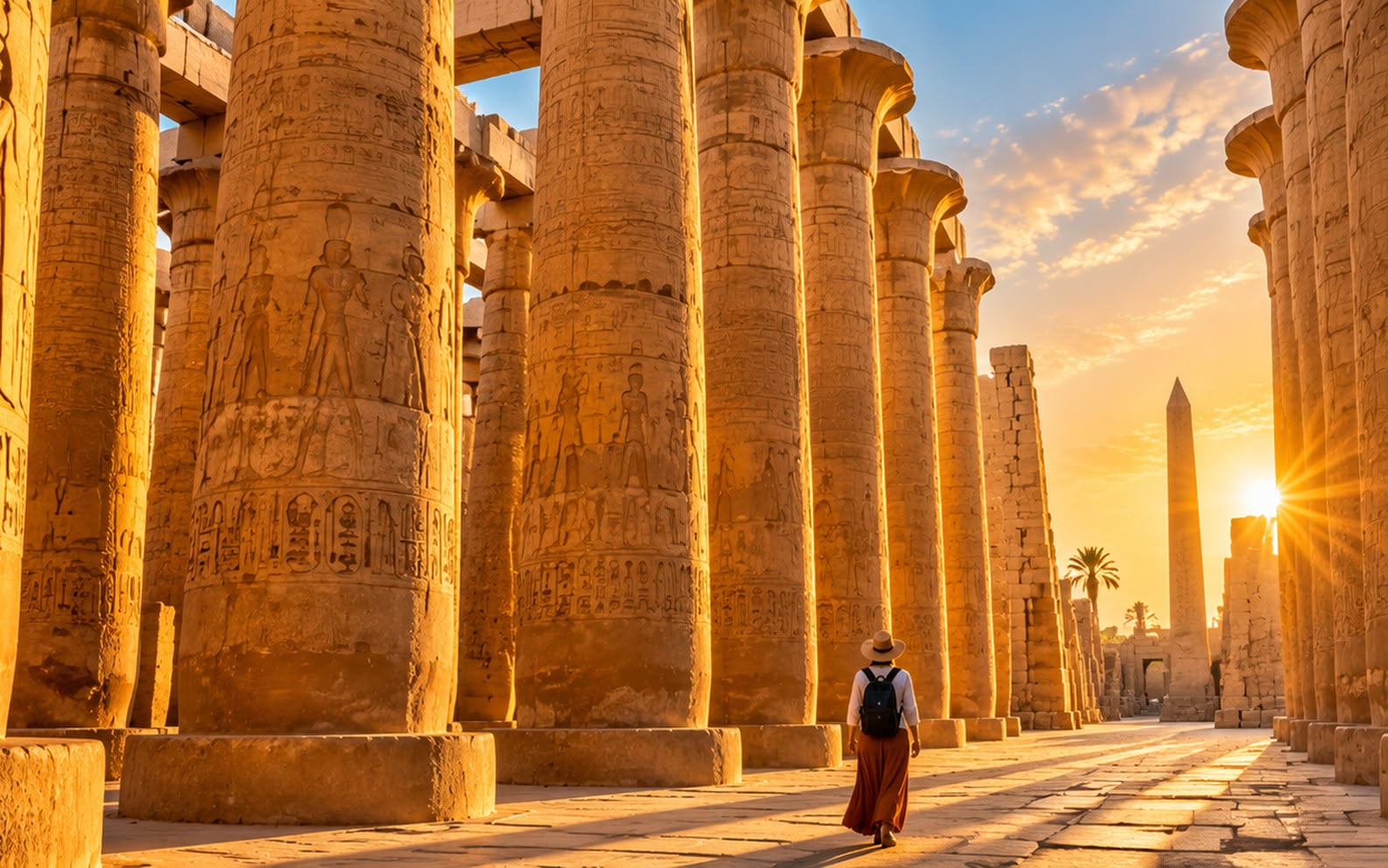
Jordan and Egypt in 12 days: Petra, Wadi Rum, the Pyramids and the Nile
A rose-red city cut into a gorge, a desert of sandstone islands slept in under the stars, the last of the seven wonders still standing, and three nights on the Nile between temples — the archaeology trip most people have in mind when they say they want one.
- Middle East
- 12 days
- ≈ AED 8,450 / person
- Two of the ancient world's great sites, and a river between them
Before you go
Before you go: the admin
Two entries, and the pass that pays for one
- The Jordan Pass is almost always worth buying. Bought before you arrive, it waives the visa fee and covers Petra plus forty other sites — and it pays for itself on Petra alone. The condition is that you stay at least three nights in Jordan, which this route does.
- Egypt issues an e-visa online in a few days, or a visa on arrival at Cairo bought in cash from a bank window before immigration. The e-visa removes the queue.
- An Israeli stamp is not a problem for either country.
- Both need six months’ passport validity.
Flights, and the awkward joint
- Fly into Amman and out of Cairo, or the reverse.
- Aqaba to Cairo is a short flight and is the clean way to switch countries. Amman to Cairo also works.
- The Taba land crossing into Sinai exists and the overland route through Sinai carries its own travel advice — check it before planning that way, and most itineraries do not.
- Cairo to Luxor is an hour by air or ten hours on the overnight sleeper train, which is a genuine option and a good one. Aswan back to Cairo by air.
Money
- The Jordanian dinar is pegged to the dollar at about 1.41 and is one of the stronger currencies in the region — Jordan is not a cheap country.
- The Egyptian pound has devalued heavily and Egypt is correspondingly cheap. Carry small notes; nobody has change.
- Cards work in hotels and better restaurants in both and nowhere else useful.
- Bring US dollars for the Egypt visa, tips and the Nile boat.
One gentle brief
- Tipping — baksheesh — runs Egypt and is expected for small services. Carry a thick wad of small notes; it smooths the entire country. Jordan is much less so.
- The two halves have different temperaments. Jordan is relaxed, orderly and low-pressure. Egypt is far more insistent, and the hassle at the major sites is real rather than imagined.
- Agree every price before the service in Egypt — camel rides, taxi fares, “free” help with a photograph.
Day by day
Day 1 — Land in Amman
- Buy the Jordan Pass before you fly. It waives the visa fee and covers Petra, Jerash and most sites — it only works if bought in advance.
- 14:00 — Arrive and go up to the Citadel — the Temple of Hercules, the Umayyad palace, and the whole white city spread below.
- 16:30 — The Roman theatre in the downtown bowl, still seating 6,000, directly below the Citadel hill.
- 18:30 — Rainbow Street and Hashem for falafel, and Habibah for kunafa, which is the thing to eat in Amman. Hashem has no menu and has fed kings.
Day 2 — Jerash and the Dead Sea
- 08:00 — Jerash, an hour north, is one of the best-preserved provincial Roman cities anywhere — the oval forum, the colonnaded cardo with chariot ruts, two theatres and the Temple of Artemis.
- 13:00 — Back through Amman and down to the Dead Sea, which is 1,200m of descent in under an hour.
- 15:00 — The Dead Sea in the afternoon, 430m below sea level and the lowest land on earth. Float, do not swim, keep the water out of your eyes, and do not shave the day before.
- The mud is the point and most resorts supply it.
- Fifteen minutes in the water is plenty. Longer and the salt starts to sting everywhere you did not know you had a cut.
Day 3 — The King’s Highway to Petra
- 08:00 — Take the King’s Highway, not the Desert Highway. It is two hours longer and it is the drive.
- 09:30 — Madaba for the sixth-century mosaic map of the Holy Land in St George’s church.
- 11:00 — Mount Nebo above it, where Moses is said to have seen the promised land — on a clear day you see the Dead Sea, Jericho and the hills of Jerusalem.
- 14:00 — Kerak Castle, the Crusader fortress, with its tunnels and the drop from the walls.
- 16:30 — Dana Biosphere Reserve if there is time, which is a village on the lip of a gorge and worth an hour.
- 19:00 — Arrive at Wadi Musa in the evening. Sleep early; tomorrow starts at six.
Day 4 — Petra
- 06:00 — Be at the gate at six. The Siq is a 1.2km crack in the sandstone and you want to walk it before the crowds and the horse carriages.
- 06:45 — The Treasury at the end of it, and then keep going — most people see the Treasury and leave, which misses the city.
- 08:30 — The Street of Facades, the theatre, the Royal Tombs.
- 11:00 — The 800 steps up to the Monastery, which is larger than the Treasury and has a fraction of the people.
- Decline the horse, donkey and camel rides if animal welfare matters — the conditions have been widely criticised, and the walk is the experience.
- 16:00 — Down, slowly, and the light on the way out is the best of the day.
Day 5 — Petra, the second day
- 07:00 — The Al-Khubtha trail to the Treasury overlook — about two hours return and the best view in Jordan, taken from above rather than in front. Several unofficial “viewpoints” are touted on the way; the trail from the Royal Tombs is the sanctioned one.
- 12:00 — Lunch back at the gate.
- 15:00 — Little Petra (Siq al-Barid) in the afternoon, eight kilometres north, with the painted Nabataean ceiling — it is free and usually empty.
- 20:30 — Petra by Night runs Monday, Wednesday and Thursday — the Siq lit by 1,500 candles. It is a separate ticket not covered by the Jordan Pass and opinions on it are divided.
Day 6 — Wadi Rum
- 09:00 — Two hours south into the desert. You leave the car at the village and transfer to a Bedouin 4x4.
- 12:00 — The sandstone jebels rise straight out of the sand — Khazali canyon with its inscriptions, the Burdah rock bridge, Lawrence’s spring.
- 16:00 — A dune for sunset, which every driver has his own favourite for.
- 18:00 — Sleep in a camp. The Martian bubble tents are the Instagram version; a traditional Bedouin goat-hair camp is better and cheaper.
- It is cold at night year-round. The camps supply blankets; take a layer anyway.
Day 7 — Aqaba, and fly to Cairo
- 06:30 — Sunrise over the valley, which is the better end of the day in Rum.
- 09:00 — A morning on the Red Sea — Aqaba’s reefs start a few metres offshore and the Cedar Pride wreck is a shore dive.
- 14:00 — Fly to Cairo in the afternoon, about an hour and a half.
- 18:00 — Arrive and do nothing ambitious. Cairo is 22 million people and takes a day to find your footing in.
- Sleep in Giza if you can — the morning start is much easier from that side of the river.
Day 8 — Giza and the Egyptian Museum
- 08:00 — Be at the Pyramids at opening. By ten the coaches and the heat have both arrived and there is no shade on that plateau.
- The Great Pyramid’s interior is a separate ticket and is a hot, bent, airless scramble up a low gallery. Worth it once; claustrophobes should not.
- Agree every camel and horse price in advance, and the “free” photograph is never free.
- 11:00 — The Sphinx and the valley temple.
- 14:00 — The Grand Egyptian Museum at the edge of the plateau, which now holds the Tutankhamun collection entire — all 5,000-odd objects together for the first time. Allow three hours and you will still be moving fast.
Day 9 — Saqqara, Dahshur, and south
- 08:00 — Saqqara — the Step Pyramid of Djoser, the oldest monumental stone building in the world, and the Serapeum with its granite bull sarcophagi.
- 12:00 — Dahshur nearby for the Bent and Red Pyramids, which are almost empty and let you see the engineering problem being solved in real time — the Bent one changed angle halfway up because it was starting to fail.
- 17:00 — Then to Luxor — the sleeper train overnight, or an hour by air. The train leaves around eight and the compartments are basic but fine.
Day 10 — Luxor: the east and west banks
- 06:00 — Karnak at opening — the hypostyle hall’s 134 columns, and it is the largest religious building ever constructed.
- 09:00 — The Valley of the Kings on the west bank. Three tombs on the standard ticket; Tutankhamun, Seti I and Nefertari in the Valley of the Queens are each separate and Seti I is the finest tomb in Egypt.
- 11:30 — Hatshepsut’s terraced temple at Deir el-Bahari and the Colossi of Memnon.
- 13:30 — Out of the sun. The west bank at midday is not negotiable.
- 19:30 — Luxor Temple after dark, lit, which is the best hour in the city.
Day 11 — The Nile to Aswan
- Board the boat. Three nights between Luxor and Aswan is the standard, and a dahabiya — a small sailing boat, six to twelve cabins — is a completely different experience from a 150-cabin cruiser.
- 08:00 — Esna lock, where the boats queue and the hawkers throw goods up onto the deck.
- 13:00 — Edfu’s temple of Horus — the most complete temple in Egypt, reached by caleche from the mooring.
- 17:00 — Kom Ombo on its bend in the river, best in the late light and lit after dark.
- The point of the Nile leg is the river itself: the green strip, the desert edge a few hundred metres back, and the feluccas. Sit on deck and do nothing.
Day 12 — Aswan, and out
- 08:00 — Philae temple on its island, moved stone by stone when the High Dam flooded the original.
- 11:00 — The Nubian village on Elephantine or the west bank, and the unfinished obelisk in its quarry.
- 17:00 — A felucca round Elephantine Island at sunset, which is the best hour in Egypt.
- Abu Simbel is a 3-hour drive or a short flight south and needs most of a day — add a day if you want it, because cutting Aswan to fit it in is a mistake.
- Fly back to Cairo for the international connection, and leave three hours at the far end.
Costs and practicalities
Best time to visit
October–April, and the summer in Upper Egypt and Wadi Rum is a hazard rather than a discomfort.
- October–November — the best of the year. Warm, clear, and the Nile at a comfortable temperature. Petra is pleasant and Wadi Rum’s nights are cool rather than freezing.
- December–February — peak season in Egypt and the cheapest in Jordan. Petra can get snow and the plateau is cold; Wadi Rum nights approach freezing. Luxor and Aswan are at their most comfortable, 20–25°C.
- March–April — the second good window, with wildflowers across northern Jordan. Sham el-Nessim after Coptic Easter empties Egyptian cities into the parks.
- May–September — Luxor, Aswan and Wadi Rum pass 40°C, and the Valley of the Kings tombs hold the heat. Aqaba and the Red Sea work year-round but the sea is bath-warm.
Ramadan shifts the day in both countries — restaurants closed until dusk, shorter hours, and quieter sites.
Travel tips
- Buy the Jordan Pass before you fly. It waives the visa fee and covers Petra, and it only works if purchased in advance and if you stay three nights.
- Petra needs two days. One day is the Treasury and the Monastery at a run; two lets you do the Al-Khubtha trail, which is the best view in the country.
- Carry a thick wad of small Egyptian notes. Baksheesh is woven into everything and having nothing small is the fastest way to an awkward exchange.
- Photography tickets are separate at many Egyptian sites, including inside the Valley of the Kings tombs. Buy at the gate rather than arguing inside.
- Hire a licensed Egyptologist for Giza and Luxor, not for the whole trip. The difference in what you see at Karnak is enormous.
- Cover shoulders and knees at mosques and in Islamic Cairo, and women should expect more attention in Egypt than in Jordan — a scarf helps.
- Bottled water only in Egypt, and be wary of salad and ice outside good restaurants. Jordan’s tap water is treated but most people still drink bottled.
What this trip actually costs
Two people, 11 nights, mid-range comfort, international flights excluded:
| Item | Cost |
|---|---|
| Hotels and the Wadi Rum camp, 8 nights | USD 1,100 (≈ AED 4,040) |
| Nile boat, 3 nights, two people | USD 900 (≈ AED 3,305) |
| Three internal flights, two people | USD 800 (≈ AED 2,938) |
| Jordan Pass, Egyptian site tickets and guides | USD 700 (≈ AED 2,571) |
| Drivers, transfers and the Wadi Rum 4x4 | USD 600 (≈ AED 2,204) |
| Food and drink, 12 days | USD 500 (≈ AED 1,836) |
| Total for two | USD 4,600 (≈ AED 16,894) |
- Roughly USD 2,300 (≈ AED 8,447) per person. Jordan is roughly twice Egypt’s cost for the same standard — the dinar is pegged to the dollar and the pound has devalued heavily.
- A dahabiya instead of a cruiser roughly doubles the Nile line and is, for most people, the best upgrade on the page.
- Abu Simbel adds a day and about $200 for two.
- Hotel picks here are chosen on location, not on commission — always check prices and recent reviews before booking.
What to pack
- Proper walking shoes. Petra is 8–10km on rock in a day and the Monastery is 800 steps.
- A sun hat and SPF 50. Giza, Karnak and the Valley of the Kings have no shade whatsoever.
- A warm layer for Wadi Rum and Petra at night, in any month.
- Modest clothing — shoulders and knees for everyone, and a scarf for women.
- Small notes in Egyptian pounds, a lot of them.
- A torch for the tombs, where the lighting is deliberately low.
- Rehydration salts. The dry heat dehydrates faster than it feels like it should.
FAQ
Is the Jordan Pass worth it? Almost always. It waives the visa fee and covers Petra plus forty sites, and pays for itself on Petra alone. It must be bought before arrival and requires a minimum three-night stay.
How many days does Petra need? Two. One day gets the Treasury and the Monastery; the second gets the Al-Khubtha trail, Little Petra and the parts of the city most visitors never reach.
Should I take the night train or fly to Luxor? The train is ten hours, comfortable enough in a sleeper, and saves a hotel night. The flight is an hour. Either works; the train is the better story.
Is a Nile cruise worth it? Yes, and the boat matters more than the itinerary. A dahabiya of six to twelve cabins is a different holiday from a 150-cabin cruiser doing the same stops.
Can I add Abu Simbel? Yes, with an extra day. Do not try to fit it into the Aswan day — it is a 3am start by road or a short flight, and most of a day either way.
Prices and entry rules change, and what you need depends on your passport; last checked 29 October 2026, so confirm with the embassy or your airline before booking.


