 The Itinerary
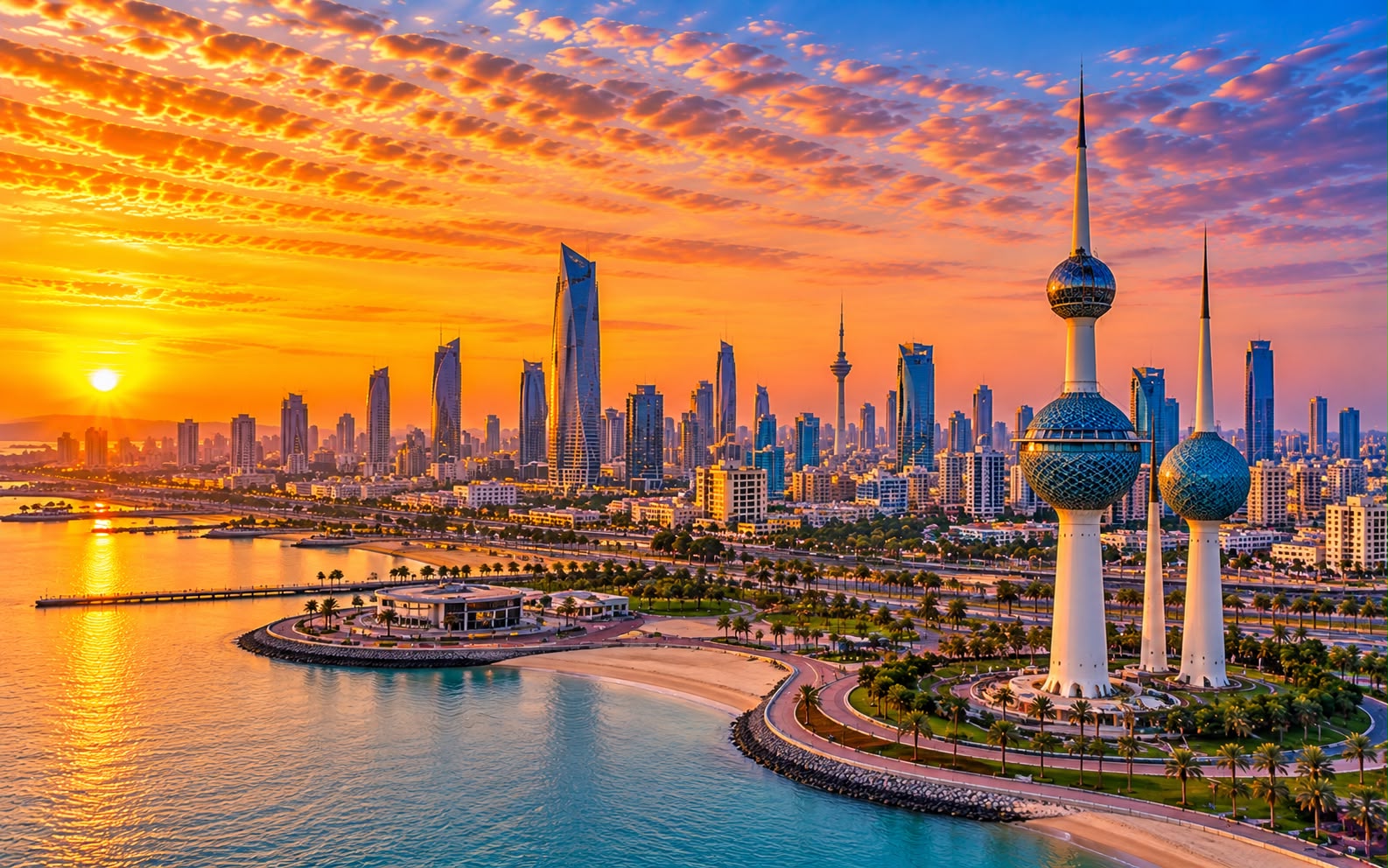
Kuwait in 4 days: towers, souqs and Failaka island
Three towers clad in eight thousand enamelled discs, the oldest working souq on the Gulf, an island with a Greek temple and an abandoned town, and a suburban house left exactly as the 1991 fighting finished with it.
- Middle East
- 4 days
- ≈ AED 2,300 / person
- A Gulf capital almost nobody visits
Before you go
Kuwait gets fewer leisure visitors than any of its neighbours, which is most of its appeal. There is no manufactured attraction here and nobody is trying to sell you a desert safari. What there is instead is a capital that was a serious port long before oil — the dhows that ran to India and East Africa were built here — and a country that remembers 1990 very precisely.
The Kuwait Towers are the image: three towers from 1979, the two largest clad in 41,000 enamelled steel discs in eight shades of blue and green, with a viewing sphere that rotates. Souq Al-Mubarakiya has been trading for over two centuries and still is, at night, loudly, with the best food in the country in its alleys.
Then two things that are harder. Failaka Island, two hours out by ferry, has a Hellenistic temple built by Alexander’s successors — they called it Ikaros — beside a town abandoned since the Iraqi occupation and never reoccupied. And the Al Qurain Martyrs Museum is a suburban house preserved exactly as the fighting left it in February 1991, down to the holes.
Four days is right. Figure KWD 195 (≈ AED 2,311) per person excluding flights. Go November–March — Kuwait records some of the highest temperatures on earth in summer, well past 50°C.
Before you go: the 15-minute admin
Visas
- Most nationalities use the eVisa, applied for online before travel; some get a visa on arrival. Check the official portal, which is the only place to apply.
- Alcohol is completely prohibited. Not restricted to licensed venues as in Bahrain or Dubai — prohibited, with real penalties, and that includes bringing any in. This is the single most important practical difference between Kuwait and its neighbours.
Money
- Kuwaiti dinar, the highest-valued currency in the world — about three and a quarter dollars to one. Prices look tiny and are not.
- Cards are taken almost everywhere. Keep small notes for the souq and the Failaka ferry.
- Tipping is not expected; rounding up is normal.
SIM and data
- Tourist SIMs at the airport from Zain, Ooredoo or stc. Coverage is strong in the city, thinner on Failaka.
Getting around
- Ride-hailing is the way around. Public buses exist but are built for commuters, not visitors.
- Distances are deceptive. The city sprawls along the bay and a cross-town trip can be 30–40 minutes.
- The Failaka ferry leaves from Ras Salmiya and takes about 1h30 each way. Check the schedule the day before — it varies by season and weather, and it is the one fixed point in this itinerary.
- Friday mornings are very quiet; plan indoor things.
Travelling with kids?
- The Scientific Center aquarium on the Gulf Road is the reliable winner, with a dhow harbour outside it.
- Al Shaheed Park is large, green and has two museums built under it — unusual and well done.
- The Al Qurain Martyrs Museum is a bullet-marked house about a siege in which people died. Judge it for your own children; it is not softened.
- Everything outdoors needs early mornings or evenings.
Day by day
Day 1 — The towers and the old souq
- Afternoon — Land, taxi in, check in. Most hotels sit along the Gulf Road or in Sharq.
- 16:00 — Kuwait Towers. Go up the main sphere for the view over the bay and the city; the upper sphere rotates slowly, taking about half an hour for a full turn. Damaged in the occupation and reopened since.
- 18:00 — Walk or drive the Gulf Road corniche as the heat drops — it runs for kilometres along the bay and is where the city exercises.
- 19:30 — Souq Al-Mubarakiya. Over two hundred years old and still the real thing: spices, oud, perfumes, dates, antiques, and open-air restaurants in the middle where you order grilled fish and sit outside. This is the best evening in Kuwait and it costs almost nothing.
Where to stay in Kuwait City (three nights)
- Luxury: the bay-front towers in Sharq and along the Gulf Road, most with pools and views over the water.
- Mid-range: Salmiya, dense with hotels, restaurants and malls, and close to the Failaka ferry terminal.
- Value: Fahaheel or inland Salmiya, cheaper and still a 20-minute ride from the centre.
Day 2 — Mosque, park and the cultural centre
- 09:00 — The Grand Mosque, the largest in the country. Free guided tours run on weekday mornings and must usually be arranged in advance; the main hall holds ten thousand and the lighting is the thing to look up at.
- 11:30 — Kuwait National Museum and, if it is open, the Tareq Rajab Museum — a private collection of Islamic calligraphy, jewellery and manuscripts in a basement in Jabriya, built by one family over decades and hidden from looting in 1990. It is the best museum in the country.
- 14:00 — Lunch, then Al Shaheed Park: the largest urban park in the city, with the Habitat Museum and the Memorial Museum built underneath it. The memorial covers the invasion and liberation.
- 18:00 — Sheikh Jaber Al Ahmad Cultural Centre, one of the largest cultural complexes in the world. Check what is on — the opera house programmes seriously — and even the building at night is worth the drive.
Day 3 — Failaka Island
- 07:30 — Ferry from Ras Salmiya to Failaka, about 1h30. Confirm the return sailing before you board; there are few per day.
- 10:00 — The Hellenistic site: a Greek temple and fortress from the third century BC, built by the successors of Alexander the Great, who named the island Ikaros. There is a Bronze Age Dilmun layer under that.
- 12:00 — The abandoned town. Failaka was populated until 1990, evacuated during the occupation, and never resettled — houses, a school and a mosque stand empty with blast and bullet damage. It is open to walk through and it is extremely quiet.
- 14:00 — Lunch at the heritage village, then the beach on the north shore if there is time before the boat.
- 17:00 — Ferry back. Dinner in Salmiya.
Day 4 — 1991, a last museum, and home
- 09:30 — Al Qurain Martyrs Museum. A house in a suburban street where a group of young resistance fighters was besieged over ten hours in February 1991. It has been left as it finished — walls shot through, a tank round’s entry hole, the cars outside. There is no narration beyond a short film. Forty minutes, and the most affecting thing in Kuwait.
- 11:30 — The Scientific Center on the Gulf Road for the aquarium and the dhow harbour, or The Avenues, among the largest malls in the world, if the weather has other ideas.
- 14:00 — Last run at Souq Al-Mubarakiya for dates and oud, both of which are better and cheaper here than at the airport.
- Afternoon — Kuwait International is about 20 minutes from the centre.
Costs and practicalities
Best time to visit
November–March is the only comfortable window, and Kuwait’s summer is among the hottest recorded anywhere on earth.
- November–March — 15–25°C, dry, and pleasant. The best months for the waterfront, the Towers and the desert camps.
- December–February — the coolest, with occasional rain and cold nights. Kuwaitis camp in the desert through this season and the whole city decamps at weekends.
- Late February — National Day and Liberation Day, 25 and 26 February, with the Gulf Road closed and the city celebrating for days.
- April–May — rapidly heating, with the toz dust storms.
- June–September — Kuwait has recorded over 53°C, among the highest reliable readings on the planet. Everything happens indoors and after dark.
Travel tips
- Alcohol is completely prohibited. There is no hotel exception, unlike the rest of the Gulf, and the penalties are serious.
- Dress conservatively. Shoulders and knees covered for everyone in public; Kuwait is more conservative than Dubai or Doha.
- Friday is the weekend, with Saturday, and Friday mornings are very quiet.
- Ramadan is enforced in public — eating, drinking or smoking in daylight is an offence for everyone, including non-Muslims.
- There is almost no public transport worth using. Taxis, Careem and Uber are how you move; agree a fare or use the app.
- The dinar is the world’s highest-valued currency at about 3.25 US dollars. Prices look small; they are not.
- Public displays of affection are not acceptable and have led to arrests. This includes between married couples.
What this trip actually costs
Two people, 3 nights, mid-range comfort, flights excluded:
| Item | Cost |
|---|---|
| Hotel, 3 nights | KWD 150 (≈ AED 1,778) |
| Ride-hailing around the city | KWD 45 (≈ AED 533) |
| Failaka ferry and island entry, two people | KWD 30 (≈ AED 356) |
| Food and drink, 4 days | KWD 120 (≈ AED 1,422) |
| Museums and the towers | KWD 45 (≈ AED 533) |
| Total for two | KWD 390 (≈ AED 4,622) |
- Roughly KWD 195 (≈ AED 2,311) per person. Museums are cheap or free; hotels and taxis are the cost.
- No alcohol means no bar bill, which makes eating out here substantially cheaper than in Dubai or Bahrain for the same standard of restaurant.
- The souq is the best value meal in the country and also the best one.
- Hotel picks here are chosen on location, not on commission — always check prices and recent reviews before booking.
What to pack
- Modest dress, more so than in Bahrain or the UAE. Covered shoulders and knees for men and women in public, and long sleeves for the Grand Mosque.
- A layer for air conditioning, which is set aggressively everywhere indoors.
- Sun protection. There is no shade at the Failaka ruins and very little anywhere outdoors.
- Closed shoes for Failaka — the abandoned town has broken glass and rubble.
FAQ
Is there enough for four days? Yes, if Failaka is one of them. Without the island it is a two-day city, and Failaka is the most unusual thing in the country.
Is it safe? Kuwait is a stable, low-crime country and ordinary tourism is straightforward. The usual advice applies: check your government’s current guidance before travelling, as you would anywhere in the region.
Really no alcohol? Really. There is no licensed venue, no duty-free on arrival, and attempting to bring any is a serious offence. Plan the trip on that basis.
How does it compare with Qatar or Bahrain? Less polished than Qatar, less relaxed than Bahrain, and far less visited than either. Come for the souq, the island and the honesty about 1990 rather than for a resort.
Prices and entry rules change, and what you need depends on your passport; last checked 8 October 2026, so confirm with the embassy or your airline before booking.


