 The Itinerary
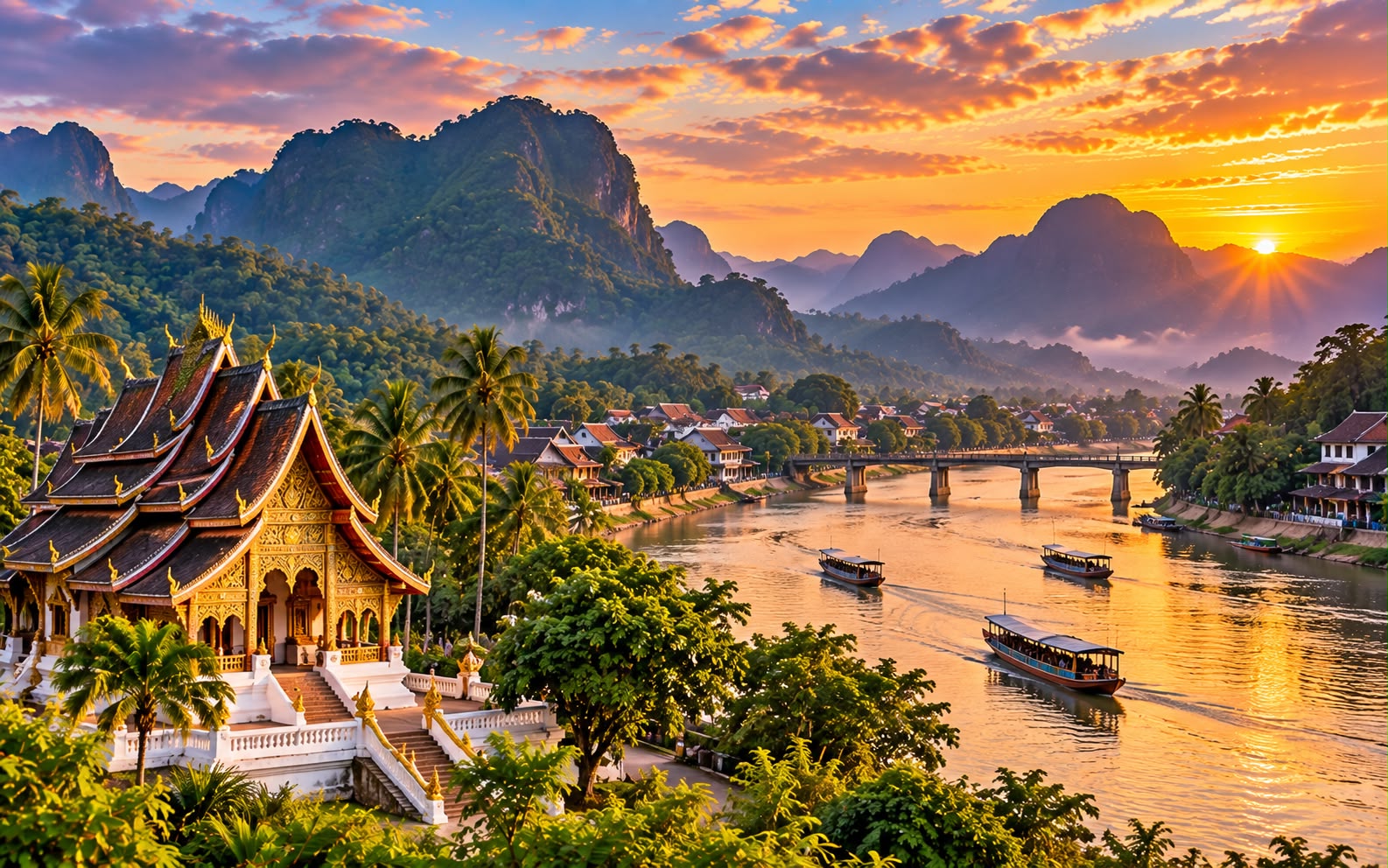
Laos in 8 days: Luang Prabang, Vang Vieng and Vientiane
The quiet one, and the last in the region to stay that way: saffron-robed alms at dawn in a UNESCO river town, turquoise waterfalls, limestone karsts over a lazy river, and a fast new railway that turned a nine-hour bus into two hours — Southeast Asia at half the pace and most of the price.
- Southeast Asia
- 8 days
- ≈ AED 1,800 / person
- Slow Southeast Asia
Before you go
Every traveller who has done Thailand and Vietnam asks the same question eventually, and Laos is the answer. It is the one country in mainland Southeast Asia that never quite got busy: fewer people than most single Thai provinces, a river that organises the whole country, and a pace that is genuinely slower rather than marketed as such.
Luang Prabang is the reason to come — a peninsula of French colonial shophouses and thirty-odd gilded temples where every morning at dawn, hundreds of monks walk the streets to collect alms. Vang Vieng has spent a decade rebuilding its reputation from river-tubing infamy into something much better: limestone karsts, lagoons and balloons at sunrise. Vientiane is the most relaxed capital in Asia, which is a low bar it clears easily.
The trip changed recently. The Laos–China Railway, opened in 2021, turned the grim nine-hour mountain bus between Luang Prabang and Vang Vieng into a two-hour train — and made this route genuinely comfortable for the first time.
Before you go: visas, the train and the river
Entry
- Visa on arrival, or eVisa, for most nationalities. Laos issues a 30-day visa on arrival at the main airports and land borders to most passports, and an eVisa online avoids the queue. Fees vary by nationality and are usually payable in US dollars cash at the counter.
- A small number of nationalities — most of ASEAN, Japan, Korea, Russia and a few others — enter visa-free. Check your own case.
- Bring clean US dollar notes for the visa fee and a passport photo; both are asked for and neither is reliably available on arrival.
- Passport valid six months, one blank page.
The railway changed this trip
- Book the train in advance. Seats sell out, particularly in high season, and foreign bookings often need a passport at purchase. Hotels and agents book it routinely for a small fee.
- Stations are well outside the towns — allow 30–45 minutes and a shared van at each end. This is the part people miss and then miss the train.
- Luang Prabang → Vang Vieng is about an hour; Vang Vieng → Vientiane about another hour. The old bus route took most of a day.
- Minivans still run and cost less. The road is winding and the train is worth the difference.
Money, and the zeros
- The kip (LAK), and the numbers are large — prices run into the hundreds of thousands. Take a moment on arrival to fix a mental conversion, and expect to feel briefly wealthy.
- Cash country. Cards work at hotels and better restaurants in the three towns on this route and nowhere else. ATMs exist in all three but have low withdrawal limits and per-transaction fees.
- US dollars and Thai baht are accepted in tourist places, at a poor rate. Pay in kip.
- This is the cheapest country on this site by some distance — which is why the budget below looks alarming in kip and is not.
The alms, and how to behave
- The morning alms round is a religious observance, not a performance. If you watch: stand well back on the opposite side of the street, stay silent, do not use flash, and do not block the monks’ path.
- Do not buy alms food from street vendors to join in unless you understand what you are doing — poor-quality food handed to monks is a real and documented problem.
- Dress modestly at temples: shoulders and knees covered, shoes off before entering, and never point your feet at a Buddha image.
- Touching anyone’s head, including children’s, is impolite.
When to go
- November to February is the dry, cool season and the best time — clear skies, comfortable days, cool nights.
- March and April bring heat and, in the north, agricultural burning that can leave the air genuinely poor for weeks.
- May to October is the wet season: green, lush, quiet, with waterfalls at their most dramatic and afternoon rain most days.
Day by day
Day 1 — Land in Luang Prabang
- 14:00 — Land at Luang Prabang (LPQ), ten minutes from town. Visa on arrival is straightforward for most nationalities — bring USD cash and a passport photo.
- 15:00 — Drop bags. The old town sits on a peninsula between the Mekong and the Nam Khan, and the whole of it is a UNESCO site — which is why there are no high buildings and the traffic is motorbikes.
- 16:30 — Walk the peninsula: French shutters, gold temple roofs, frangipani, and the two rivers meeting at the tip.
- 17:30 — Mount Phousi, 328 steps up the hill in the middle of town, for sunset over the Mekong. It is crowded at the top and worth it anyway; the temples on the way up are quieter.
- 19:00 — The night market along Sisavangvong: textiles, paper lanterns and silver, mostly made by the people selling it — this is handicraft rather than souvenir tat. Bargain gently and without heat; hard haggling reads badly here.
- 20:00 — Dinner, and set an alarm for 05:15.
Day 2 — Alms at dawn, temples after
- 05:30 — The tak bat: several hundred monks walk the streets in a silent line at first light and receive sticky rice from kneeling residents. Watch from across the road, stand back, do not use flash, do not block the line, and do not buy rice from a street vendor to join in unless you understand what you are doing. It is a daily religious act, not a show, and it is the thing most often done badly by visitors.
- 06:30 — The morning market two streets away for breakfast — noodle soup, grilled river fish, Lao coffee thick with condensed milk.
- 08:00 — Back to sleep, honestly.
- 10:30 — Wat Xieng Thong, 1560, and the finest temple in Laos: the sweeping roof almost to the ground, the tree-of-life mosaic on the rear wall, and the funeral carriage house.
- 12:00 — Lunch, then the Royal Palace Museum — the last king’s residence until 1975, left as it was, with the Prabang Buddha the city is named for.
- 16:00 — A Mekong sunset boat, two hours, with a beer.
- 19:00 — Dinner on the riverfront.
Day 3 — Kuang Si waterfalls
- 08:00 — Kuang Si, 30 km out. Go early — the tour groups arrive by eleven and the pools stop being swimmable in any peaceful sense.
- 08:45 — The bear sanctuary at the entrance, run by Free the Bears: Asiatic black bears rescued from bile farms, and worth the twenty minutes.
- 09:30 — The falls: limestone shelves stacked down a hillside, water an opaque turquoise from the dissolved calcium carbonate, and most of the pools are swimmable. The path climbs to the top of the main 60 m drop and is slippery in the wet season.
- 12:30 — Back to town, lunch.
- 15:00 — Traditional Arts and Ethnology Centre — a small, excellent museum on Laos’s 50-odd ethnic groups and their textiles, which makes sense of everything in the night market.
- 16:30 — Ban Xang Khong across the river for weaving and saa paper, by the bamboo footbridge if the season allows it.
- 19:00 — Dinner.
Day 4 — Luang Prabang slow
- 08:30 — Pak Ou caves by slow boat up the Mekong, two hours each way: two limestone caverns in a cliff above the river holding thousands of Buddha images, left by pilgrims over four centuries.
- 11:00 — The boat usually stops at Ban Xang Hai, the whisky village, on the way back.
- 13:00 — Lunch.
- 14:30 — Alternative, or as well: a cooking class. They start at the market with your teacher explaining what everything is, which is the useful half, then laap, mok pa steamed in banana leaf, and sticky rice.
- 17:00 — Nothing scheduled. Luang Prabang is the town for this and you should let it happen — a book by the Nam Khan, a massage, the sunset again.
- 19:30 — Dinner, and book the morning transfer to the station.
Day 5 — Train to Vang Vieng
- 08:00 — Van to Luang Prabang station, which is 12 km out of town — allow 30 minutes plus the queue, and have the ticket already. The China–Laos railway opened in 2021 and turned a six-hour mountain road into a one-hour ride.
- 09:30 — The train south, one hour, mostly through tunnels — this line is 60% tunnel and bridge — with karst valleys in the gaps.
- 11:00 — Vang Vieng, and the limestone towers rising straight out of rice paddy either side of the Nam Song.
- 13:00 — Lunch, check in.
- 15:00 — The Blue Lagoons. Lagoon 1 is the famous one, closest, and busiest; 2 and 3 are 20 minutes further on a dirt road, quieter, and better. Rent a scooter or a buggy.
- 18:00 — Sunset from a riverside bar as the karsts go pink, which is what the town is actually for now that its party era is over.
Day 6 — Karsts, caves and the river
- 05:30 — Hot-air balloon at sunrise if the budget stretches — up over the karsts with mist still in the valleys. It is the image people bring home from Laos, it runs roughly October to April, and it is booked the day before.
- 08:30 — Breakfast.
- 09:30 — Tham Chang cave, lit and easy, above a spring you can swim in — or Tham Phu Kham by the Blue Lagoon, which is a steeper scramble to a reclining Buddha in a cavern.
- 12:30 — Lunch.
- 14:00 — Kayak the Nam Song, two to three hours downstream between the karsts, or tubing, which is now a gentle float with a few riverside bars rather than the thing it was a decade ago.
- 17:30 — The Nam Xay viewpoint for the classic photograph — a 40-minute climb, steep, and better at sunset than sunrise.
- 19:30 — Early night.
Day 7 — Train to Vientiane
- 09:00 — Train south, one hour, to Vientiane.
- 10:30 — The capital is low-rise, quiet and does not feel like one — a riverfront town of under a million.
- 11:30 — Pha That Luang, the golden stupa that is the national symbol and appears on the currency.
- 13:00 — Lunch, then Patuxai — the victory arch built in the 1960s with cement the Americans donated for an airport runway, a fact the plaque on it states with some relish. Climb it for the view.
- 15:00 — Wat Si Saket, the oldest temple in the city and the only one the Siamese did not destroy in 1828, with over 6,800 Buddha images in wall niches.
- 18:00 — The Mekong riverfront night market, and dinner looking across the water at Thailand.
Day 8 — Fly home
- 09:00 — COPE Visitor Centre, and make time for it. Laos is the most heavily bombed country per capita in history — more ordnance dropped on it between 1964 and 1973 than on Europe in the whole of the Second World War — and around 30% of it did not explode. COPE makes prosthetics for people still being injured by it today. It is small, free, and the most important hour in the country.
- 11:00 — Lunch, then Wattay airport, which is ten minutes from the centre and very small.
- Note — Spend your kip. It is difficult to change outside Laos and effectively worthless once you leave.
Costs and practicalities
Best time to visit
November–February is the cool dry season and the best of the year by a clear margin.
- November–February — dry, 20–28°C, clear skies. This is also when the Mekong is high enough for the slow boat and low enough to be safe. Peak season in Luang Prabang.
- March–April — the hot season, over 35°C, and the burning season: agricultural fires fill the northern valleys with smoke for weeks, which ruins visibility and is genuinely bad for breathing. Avoid March if at all possible.
- Mid-April — Pi Mai, Lao New Year, three days of water-throwing that shut the country down.
- May–October — the monsoon. Heavy afternoon rain, the countryside luminous, the waterfalls at Kuang Si at full volume, and some roads difficult.
Kuang Si is turquoise in the dry season and brown in the wet — the limestone colour depends on low sediment.
Travel tips
- The alms-giving ceremony in Luang Prabang is a religious act, not a show. If you watch, do so from a distance in silence; if you participate, do it respectfully and buy from a monastery rather than a street vendor. The mass-tourism version has become a problem the monks have spoken about.
- March’s burning season is a real health issue. Air quality in Luang Prabang and the north regularly reaches hazardous levels.
- Unexploded ordnance remains across eastern and southern Laos — Laos is the most heavily bombed country per capita in history. Stay on paths and marked ground, especially in Xieng Khouang.
- The slow boat from Huay Xai to Luang Prabang takes two days with an overnight at Pakbeng. The speedboats are dangerous and should be avoided.
- Cash dominates. ATMs in the towns; carry kip, and US dollars and Thai baht are accepted in places.
- Cover shoulders and knees at temples, and never touch a monk if you are a woman.
- The railway to Vientiane and Vang Vieng has transformed travel — fast, cheap, and tickets sell out, so book ahead.
What this trip actually costs
Two people, 7 nights, mid-range, excluding international flights:
| Item | Cost |
|---|---|
| Hotels, 7 nights | LAK 9,000,000 (≈ AED 1,481) |
| Trains ×2, station transfers, airport transfers | LAK 2,200,000 (≈ AED 362) |
| Kuang Si, Pak Ou, museums, kayaking, lagoons | LAK 2,600,000 (≈ AED 428) |
| Food and drink, 8 days | LAK 5,200,000 (≈ AED 856) |
| Visas ×2, eSIM, extras | LAK 3,000,000 (≈ AED 494) |
| Total for two | LAK 22,000,000 (≈ AED 3,620) |
- Roughly LAK 11,000,000 (≈ AED 1,810) per person — among the lowest totals on this site, and that includes comfortable rooms rather than hostels.
- The balloon is the one big optional line. Skip it and the trip gets noticeably cheaper; take it and you will not regret it.
- Laos rewards spending slightly up on accommodation — the gap between basic and lovely is small in absolute terms.
What to pack
- Modest clothing for temples — shoulders and knees, in both towns.
- Slip-on shoes. You will remove them constantly.
- Cash in clean US dollars for the visa, plus a card as backup.
- Type A, B, C and F sockets all appear — bring a universal adapter.
- A warm layer for November to February evenings, especially in Luang Prabang, which sits higher than you expect.
- Insect repellent; dengue is present year-round.
FAQ
Is Laos worth it if I have done Thailand and Vietnam? That is precisely when it is worth it. It offers the same landscapes and food traditions at a fraction of the pace and the crowd, and Luang Prabang has no equivalent in either country.
Is the train really better than the bus? Yes, decisively. It converts a winding nine-hour mountain journey into an hour, for a modest fare. Book ahead and allow time to reach the stations, which are well out of town.
Is it safe? On this route, yes. Laos is one of the region’s calmer countries. The genuine hazard is unexploded ordnance in rural areas from the war — stay on marked paths outside towns, which is sound advice here in a way it is not elsewhere.
How many days do I need? Eight covers this route well. Add three if you want Nong Khiaw or the 4,000 Islands in the far south, which are long journeys from this loop.
Prices and entry rules change, and what you need depends on your passport; last checked 8 October 2026, so confirm with the embassy or your airline before booking.


