 The Itinerary
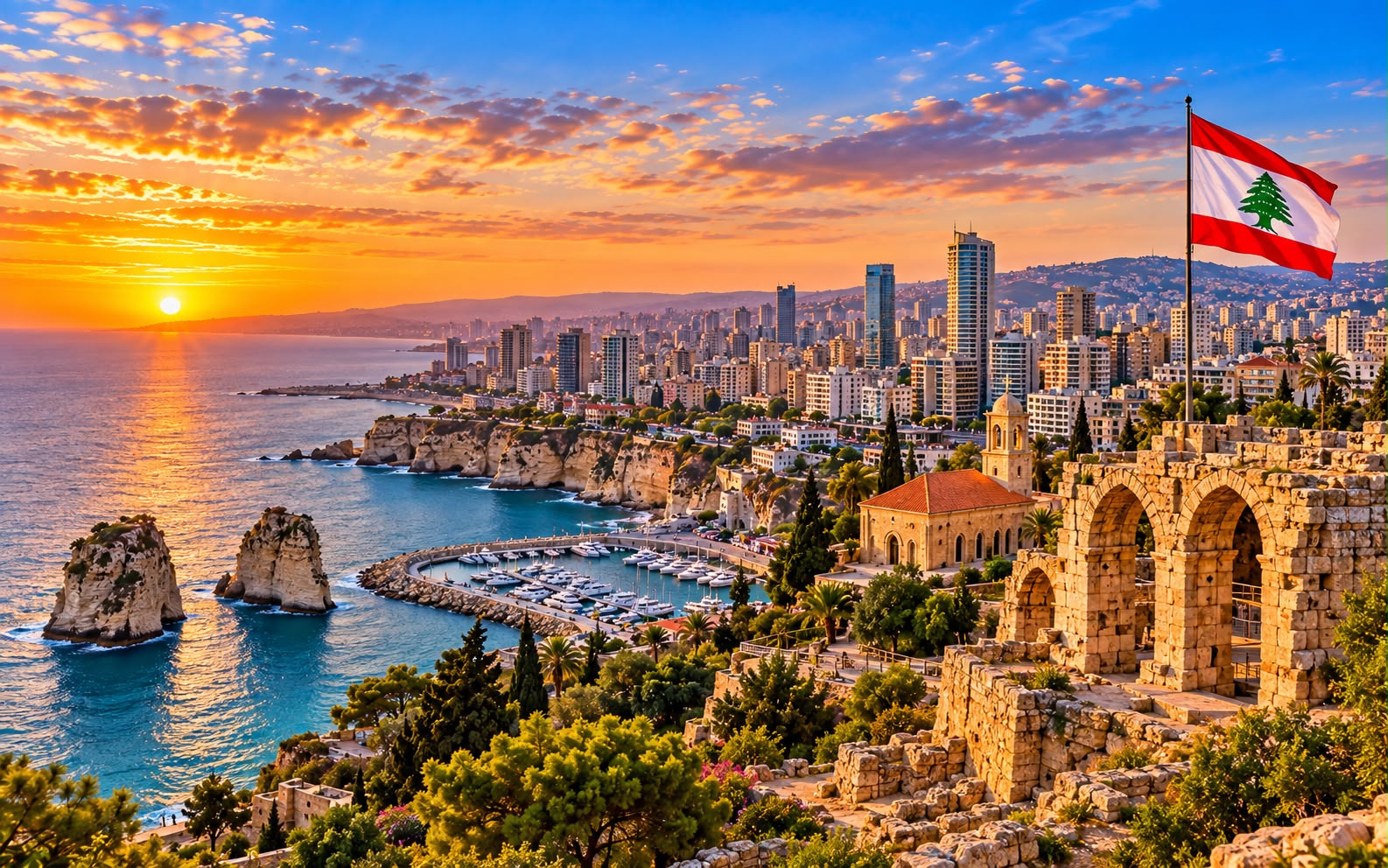
Lebanon in 6 days: Beirut, Baalbek, the Qadisha valley and the cedars
A Roman temple complex with columns twenty metres tall, a gorge of cliff-face monasteries under a grove of ancient cedars, one of the oldest continuously inhabited towns anywhere — and two practical realities, the travel advice and the cash-only economy, that decide whether the trip works.
- Middle East
- 6 days
- ≈ AED 2,400 / person
- The best-preserved Roman temple on earth, and cedars older than the Bible
Before you go
Lebanon is ten thousand square kilometres with a Roman temple complex, a Crusader coast, a UNESCO gorge full of cliff-face monasteries, a mountain range you can ski, and a capital that has been destroyed and rebuilt more often than almost any city on earth.
It is also a country going through a prolonged economic crisis and sitting in a volatile neighbourhood. Both of those shape a visit in concrete ways, and both are dealt with first below rather than left to the end — because the money situation in particular will ruin a trip planned without knowing about it.
Baalbek is the single most impressive thing in the country and arguably in the region. The Temple of Jupiter has six columns standing out of an original fifty-four, each about twenty metres high — the tallest Roman columns anywhere. Next to it, the Temple of Bacchus is more complete than any Roman temple left in the world, Rome included.
The Qadisha valley is the other one: a deep gorge in the north, on the UNESCO list, where Maronite communities cut monasteries into the cliff faces to survive persecution. Above it stands the Cedars of God, a surviving grove of the trees that the Phoenicians sold to Egypt and that are on the national flag.
Byblos has been lived in for something like seven thousand years, with a Crusader castle, Phoenician ruins and a small harbour stacked on top of each other. And Beirut is the argument for the whole country — the National Museum alone is worth the flight.
Six days does it. Figure USD 650 (≈ AED 2,387) per person excluding flights. Go April–June or September–November.
Before you go: the 15-minute admin
Current advice, and the areas it names
- Read your own government’s current travel advice before you book, and again before you fly. This is not a formality here. Advice changes, and it has changed sharply more than once in recent years.
- The advice is normally area-specific, and the areas usually named are southern Lebanon, the Syrian border region, Palestinian refugee camps, and Baalbek and Hermel in the Beqaa valley. Several governments advise against all travel to some of these and against all but essential travel to the country as a whole at different times.
- Baalbek is on this itinerary and is frequently named in that advice. That is a decision you should make deliberately, with current information, and the day is written so it can be dropped without unravelling the rest of the trip.
- Check your insurance. Cover is commonly void in areas your government advises against, and sometimes for the whole trip.
- Evidence of travel to Israel means refused entry. Lebanon does not admit travellers whose passports show an Israeli stamp or an obvious Israeli land-border crossing. If both countries are on your list, the order matters.
Money: bring US dollars, in cash
- The Lebanese pound collapsed from 2019, losing the overwhelming majority of its value, and the economy dollarised in response. Most things are priced and paid in US dollars.
- Bring enough US cash for the whole trip. ATMs are unreliable, dispense limited amounts, and may not work with foreign cards. Card acceptance is patchy outside larger hotels and restaurants.
- Bring clean, undamaged, recent notes. Worn or marked dollars are routinely refused. A mix of small denominations is far more useful than hundreds.
- You will get Lebanese pounds in change at a rate that moves. Spend them rather than hoarding them.
- Keep cash secure and split between bags. Carrying a trip’s worth of money is not normal travel practice, and it needs the obvious precautions.
- Prices in dollars are reasonable rather than cheap: hotels and restaurants have largely re-priced to international levels, while transport and entrance fees remain low.
Visas and entry
- Visa on arrival is free for many nationalities for a one-month stay, issued at Beirut airport. Others need one in advance.
- Check your own case on the official site — and check the Israeli-stamp rule above, which is absolute.
- A hotel booking and a return ticket may be asked for.
Electricity, water and the practicalities of a crisis
- The state grid supplies only part of the day. Buildings run on private generators, which is why hotels quote a generator surcharge and why lifts occasionally stop.
- Ask your hotel directly whether it has 24-hour generator backup. The better ones do; the cheaper ones may not.
- Carry a power bank, and charge things when you can rather than when you need to.
- Petrol supply has been intermittent at times. If you are driving, fill up when you pass a station with fuel.
SIM and data
- Alfa and touch sell tourist SIMs at the airport. Data is expensive by regional standards.
- Coverage is good on the coast and in the mountains, and thinner in the Beqaa.
Getting around
- Hire a car with a driver. This is the normal way to travel here, costs roughly $80–120 a day including fuel, and solves navigation, parking, the language and the checkpoints in one go.
- Self-driving is legal and not recommended for a first visit. Beirut traffic has its own rules and signage is inconsistent.
- Shared taxis (service) run fixed routes cheaply between towns, and intercity buses exist, but neither reaches the Qadisha valley or Baalbek usefully.
- Expect army checkpoints on intercity roads. Carry your passport, be polite, and have your driver do the talking.
- Distances are tiny: Beirut to Byblos is 40 minutes, to Baalbek under two hours.
Travelling with kids?
- Jeita Grotto — a cave system you walk through and then boat through — is the obvious hit.
- The Harissa cable car climbs from the coast to the statue above Jounieh and is a ride as much as a journey.
- Ruins everywhere are unfenced and unsupervised, which is part of the charm and needs watching.
- Consider carefully whether the cash-only, generator- dependent, advisory-sensitive situation suits a family trip right now. It is a judgement, not a rule.
Day by day
Day 1 — Beirut
- Morning — Land at Beirut, 20 minutes into the city.
- 11:00 — The National Museum of Beirut. Start here. Phoenician sarcophagi, Roman mosaics, and a collection that was walled into concrete during the civil war to protect it and survived. The basement film about that is the best twenty minutes in the city.
- 14:00 — Downtown: the Mohammad Al-Amin Mosque with its blue domes and, immediately beside it, St George’s Maronite Cathedral — the two sharing a square, which is Lebanon in one photograph. Martyrs’ Square and the Roman baths nearby.
- 16:00 — Gemmayzeh and Mar Mikhael, the nineteenth-century streets that hold the city’s bars and galleries. These neighbourhoods were badly damaged by the 2020 port explosion and much of the restoration has been done by residents. The blast site is visible from the ring road.
- 18:00 — The Corniche at sunset, west to the Raouché sea stacks.
Where to stay in Beirut (three nights across the trip)
- Mid-range: Hamra or Achrafieh — central, walkable, plenty of food.
- Ask every hotel about generator backup before you book. It matters more than the view.
Day 2 — Jeita, Harissa and Byblos
- 09:00 — Jeita Grotto, 30 minutes north. Two limestone cave systems: an upper gallery walked on a gantry past some of the largest stalactites known, and a lower one crossed by boat on an underground river. Cameras and phones are not allowed inside — they are checked at the entrance.
- 12:00 — Harissa, up the téléphérique from Jounieh: a cable car over the bay to Our Lady of Lebanon, a white statue on a spiral ramp with the coast spread out below.
- 14:00 — Byblos (Jbeil), 20 minutes on. Lunch in the restored harbour, then the site: a Crusader castle standing over Phoenician temples, Roman colonnades and neolithic foundations, all in one enclosure. The old souk around it is genuinely old.
- 18:00 — Back to Beirut, or stay in Byblos.
Day 3 — Tripoli, the Qadisha valley and the Cedars
- 08:00 — North to Tripoli, about an hour. The Citadel of Raymond de Saint-Gilles above the town, and underneath it the best-preserved Mamluk quarter in the country — khans, hammams, madrasas and a souk that is a working market rather than a tourist one. The sweets here are famous nationally.
- 11:30 — Climb into the Qadisha valley. The road winds up to Bcharré with the gorge below you.
- 13:00 — Lunch in Bcharré, then the Gibran Museum — the monastery where Khalil Gibran, author of The Prophet, is buried, holding his paintings and his rooms.
- 15:00 — The Cedars of God (Horsh Arz el-Rab), above the town at around 2,000 metres. A few hundred trees survive of the forest the Phoenicians traded and Solomon is said to have used; the oldest are counted in thousands of years. UNESCO-listed, and in winter there is snow and a ski lift beside them.
- 17:00 — Down to the valley floor to see the cliff-face monasteries — Qannoubine and Mar Lichaa — cut into the rock, or view them from the road above if time is short.
Day 4 — The Beqaa: Baalbek, Anjar and Ksara
Read the advice section first. Baalbek is regularly named in government travel advisories. If that rules it out, this day becomes the Chouf (below) and Day 5 becomes the coast south to Sidon.
- 08:30 — Over the mountains into the Beqaa valley, about two hours.
- 10:30 — Baalbek. The Temple of Jupiter: six columns left standing of fifty-four, twenty metres tall, on a platform built of stone blocks so large their transport is still argued about. Then the Temple of Bacchus, essentially intact — better preserved than anything comparable in Rome — and the small round Temple of Venus. Allow three hours; it is bigger than photographs suggest.
- 14:00 — Anjar, 40 minutes south: an Umayyad city from the early eighth century, laid out on a Roman grid, unusual because the Umayyads rarely built cities from nothing. UNESCO-listed and almost always empty.
- 16:00 — Château Ksara, the oldest winery in the country, founded by Jesuits in 1857, with Roman caves underneath it used to age the wine. The tasting is good and the tour is cheap.
- 18:30 — Back to Beirut.
Day 5 — The Chouf and the coast
- 09:00 — Into the Chouf mountains, an hour south-east.
- 10:00 — Beiteddine Palace, built over thirty years from 1788 by Emir Bashir II: courtyards, a hammam, and a collection of Byzantine mosaics in the stables.
- 12:30 — Deir el-Qamar, a seventeenth-century village of ochre stone with a silk khan and a synagogue, and lunch in it.
- 14:30 — The Chouf Cedar Reserve if you want more cedars and a walk, or down to the coast for Sidon (Saida): a thirteenth-century Sea Castle on an island joined by a causeway, a covered souk, and the Soap Museum.
- 17:30 — Back to Beirut.
Tyre is an hour further south and holds a Roman hippodrome and necropolis on the UNESCO list. It also sits in the part of the country most often named in travel advice. Check before you plan it in.
Day 6 — Beirut, and out
- Morning — The Sursock Museum in Achrafieh, a Lebanese-Italianate mansion turned modern art gallery, itself rebuilt after the port explosion. Or the Beirut Souks and a last manousheh.
- Afternoon — Airport, 20 minutes.
Costs and practicalities
Best time to visit
April–June and September–November. Lebanon’s great quirk is that it is small enough to ski and swim on the same day in spring, which is a real thing people do in March.
- April–June — the best of the year. Wildflowers in the Qadisha and the Beqaa, warm on the coast, and the cedars accessible.
- July–August — hot and humid on the coast, 32°C with it, and the mountains are the escape. The Baalbeck and Byblos festivals run in July and August and are the cultural high point of the year.
- September–November — warm sea into October, the grape harvest in the Beqaa in September, and the clearest light.
- December–March — skiing at Faraya and the Cedars, with the coast mild and wet. Mountain roads close with snow and the Qadisha can be cut off.
Travel tips
- Check current travel advice carefully. The position changes quickly and differs sharply between Beirut, the south and the Beqaa.
- The currency situation is extraordinary. The lira collapsed and the economy has substantially dollarised — bring US dollars in cash, in small denominations, and expect to pay in them. Cards and ATMs are unreliable.
- Electricity is intermittent. Private generators cover the gaps and most hotels have one, but power cuts are a daily fact.
- An Israeli stamp means refusal of entry, and so does evidence of travel there.
- Hire a driver rather than self-driving. Lebanese traffic is assertive, signage is limited, and a driver who knows the checkpoints is worth the cost.
- Dress varies enormously by neighbourhood. Beirut is cosmopolitan; the south and parts of the Beqaa are conservative. Carry a layer.
- Baalbek is in the Beqaa near the Syrian border and carries separate advice. Check before going; the ruins are the finest Roman temples in the world.
What this trip actually costs
Two people, 5 nights, mid-range comfort, flights excluded:
| Item | Cost |
|---|---|
| Hotels, 5 nights | USD 450 (≈ AED 1,653) |
| Car with driver, 4 days | USD 400 (≈ AED 1,469) |
| Food and drink, 6 days | USD 300 (≈ AED 1,102) |
| Entrances and museums | USD 100 (≈ AED 367) |
| Winery tour and tasting | USD 50 (≈ AED 184) |
| Total for two | USD 1,300 (≈ AED 4,774) |
- Roughly USD 650 (≈ AED 2,387) per person — and bring it in cash, in dollars, in good condition. This is the single most important line in this guide.
- Entrance fees are very cheap in dollar terms. Baalbek, Byblos and Jeita together come to less than a restaurant meal.
- The driver is the best money you will spend and is roughly a third of the budget. Split between four people it is negligible.
- Add a generator surcharge at some hotels — ask whether the quoted rate includes it.
- Hotel picks here are chosen on location, not on commission — always check prices and recent reviews before booking.
What to pack
- US dollars in cash, clean and in small denominations, enough for the entire trip plus margin.
- A power bank, and a charger for it.
- Layers. The coast is Mediterranean and the Cedars are at two thousand metres; the same day can need both.
- Modest clothing for mosques and monasteries — shoulders and knees, and a scarf for women’s heads.
- Your passport on you, for checkpoints.
- Walking shoes for Baalbek, which is a large site on uneven stone.
FAQ
Is Lebanon safe to visit? It depends on when and where, and this is a case where the honest answer is to read your own government’s current advice rather than trust any guide. Much of that advice is area-specific — Beirut, the coast and the north are treated differently from the south and parts of the Beqaa.
Can I use my credit card? Sometimes, in larger hotels and restaurants. Plan as though you cannot. US dollars in cash is how the country currently works.
Will I be refused entry if I have been to Israel? Yes, if there is evidence of it — an Israeli stamp, or a Jordanian or Egyptian stamp from a crossing that only makes sense via Israel. This is strictly enforced.
Is Baalbek worth the risk? That is genuinely your call, made with current advice in front of you. It is one of the great Roman sites in the world and it is in an area regularly named in advisories. The itinerary is built so the day can be swapped out.
What language do they speak? Arabic is official, and French and English are both widely spoken — often in the same sentence. You will not struggle.
Prices and entry rules change, and what you need depends on your passport; last checked 8 October 2026, so confirm with the embassy or your airline before booking.


