 The Itinerary
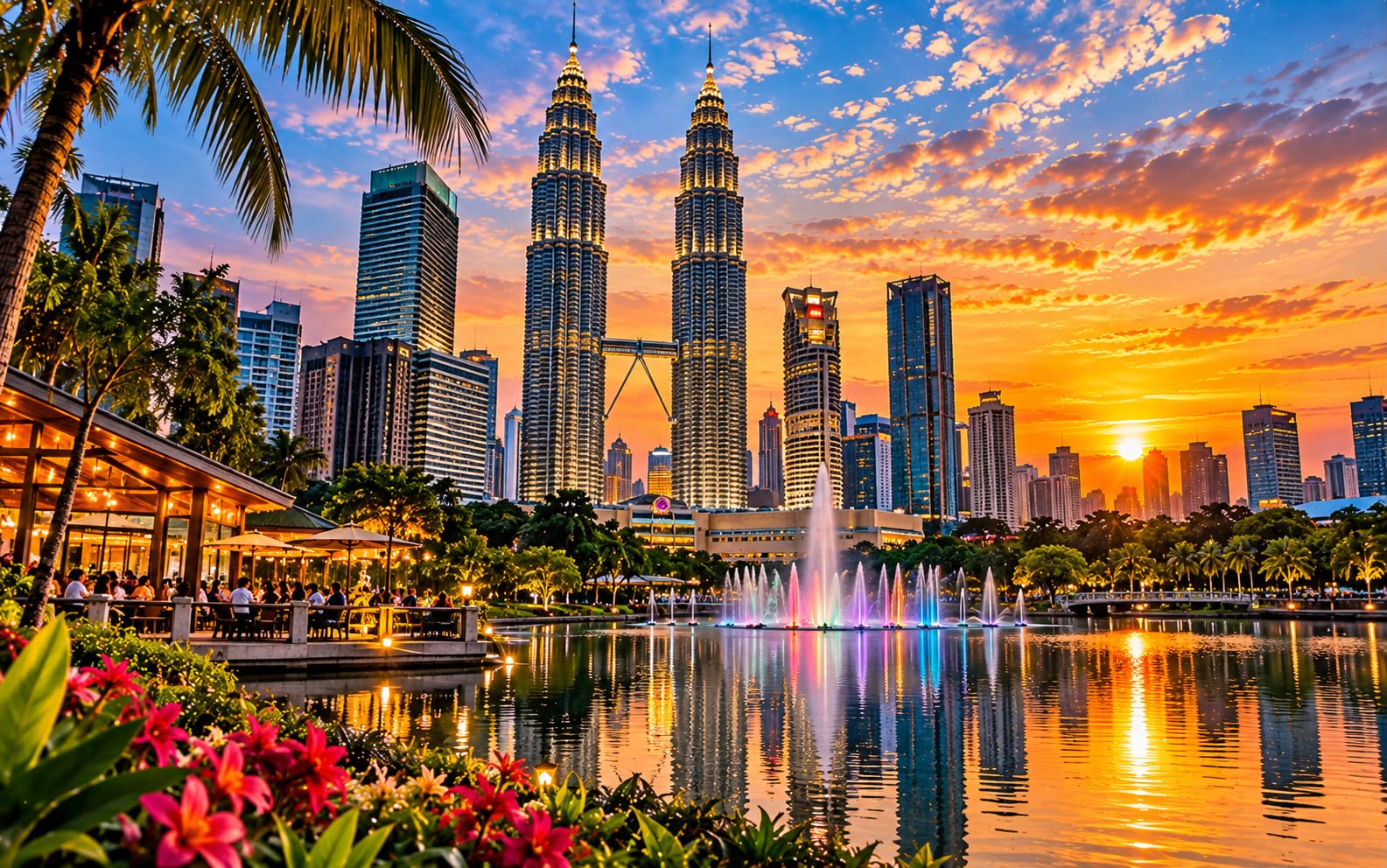
Malaysia in 10 days: Kuala Lumpur, Penang and Langkawi
The gentlest great trip in Asia: twin towers and rainbow cave-steps in KL, George Town — street-food capital of the continent — by heritage train-and-ferry, then Langkawi's cable-car cliffs and duty-free beaches. Visa-free for most passports, halal by default, and priced like a rumour.
- Southeast Asia
- 10 days
- ≈ AED 3,600 / person
- Food + beach
Before you go
Malaysia is the trip that removes every excuse. Visa-free for a long list of passports (a two-minute online arrival card the only admin), well connected from almost anywhere, English everywhere, Grab-tap logistics — and food so good UNESCO should list the hawker centres. Kuala Lumpur is the glossy capital with 88-storey bragging rights; Penang’s George Town is where Chinese, Malay, Indian and colonial Malaysia collided into the best eating city in Asia; Langkawi is the palm-fringed decompression chamber, cable car included.
And for our readers specifically: Malaysia is the easiest halal destination on this entire site — a Muslim-majority country where halal is the default, not the hunt.
Go December–April for the west-coast dry season (this route is all west coast). September–October is the wettest window — trips still work between downpours, but beach days gamble. Ramadan is a feature, not a bug: tourist restaurants run normally and the evening Ramadan bazaars are a food-lover’s jackpot. All costs are in Malaysian ringgit (MYR).
Before you go: the two-minute admin, and the small print
Most visitors need nothing
- Check whether you need anything: most visitors don’t. Malaysia admits a long list of nationalities visa-free, Indian passports among them for 30 days, under an exemption currently running through the end of 2026 (check for extension news before late bookings; the e-visa remains the fallback if policy shifts). Passport valid 6+ months, return ticket and hotel bookings carried.
- The MDAC (Malaysia Digital Arrival Card) is mandatory for everyone: free, on the official imigresen-online portal, filed within 72 hours before arrival (the system rejects earlier submissions — set a reminder for 2–3 days out). Anyone charging for this free form is a scam.
- The exemption follows your passport, not where you live.
Grab, tipping and eSIMs
- Grab runs the country — cars, food, even Langkawi (thinner there; more below). Cards and e-wallets work in cities; hawker stalls and night markets are cash — carry RM100–200 in small notes.
- Tipping: not expected. Prices include tax at hawkers; restaurants add ~10% service.
- eSIM ~US$5–10; Hotlink/CelcomDigi tourist SIMs at airports. English is a working national language — the lowest language-barrier trip on this site.
Halal, alcohol and kids
- Halal, formally: look for the JAKIM logo, but in practice Malay food is halal by definition and most Chinese kopitiams are clearly marked when not. The one navigation note runs the other way: pork-serving Chinese stalls coexist in mixed hawker centres — signage is honest.
- Alcohol is taxed into rarity — except Langkawi, a duty-free island (this explains the chocolate-and- perfume shops too; stock up there, not at the airport).
- Kids: Malaysia is effortless — hawker centres have something for every child, distances are short, malls have play zones for the 3pm heat, and Langkawi is one big shallow-water sandpit.
Day by day
Day 1 — Land in KL, towers by night
Stay around KLCC (tower views, park) or Bukit Bintang (food streets, malls, monorail).
- Afternoon — Land KUL, a major hub with non-stops from Europe, the Gulf and across Asia. KLIA Ekspres to KL Sentral (RM55, 28 min), Grab to the hotel.
- 19:30 — KLCC Park for the Petronas Towers lit up — the stainless-steel rocket ship pair, still the tallest twins on earth — with the Lake Symphony fountain shows (free, 20:00/21:00).
- 21:00 — First food lesson on Jalan Alor: the neon hawker street — grilled chicken wings, satay, hokkien mee (RM15–30 each, halal stalls clearly marked among the mix).
Where to stay in Kuala Lumpur (three nights)
- Luxury: EQ Kuala Lumpur — 4.9/5 on TripAdvisor (~1,700 reviews), rooftop pool and bar staring straight at the Petronas Towers. ~RM650–900.
- Boutique mid: KLoe Hotel — 4.9/5 (~1,200 reviews), design-cool calm off Bukit Bintang. ~RM350–480.
- Value: Hotel Royal Signature — 4.9/5 (~1,000 reviews), TripAdvisor’s #1 value in the city. ~RM220–320.
Day 2 — Up the towers, down the old city
- 09:00 — Petronas Twin Towers (RM98 adult / RM50 child, timed slots — book online ahead; closed most Mondays): the Skybridge between the towers, then the 86th-floor deck. Thirty airborne minutes, KL at your feet.
- 11:00 — Suria KLCC’s air-conditioning, then Grab to Merdeka Square: the Sultan Abdul Samad building’s copper domes, the 100-m flagpole where the Union Jack came down in 1957, and the confluence that named the city at Masjid Jamek (visitor hours outside prayers).
- 13:00 — Lunch at a nasi kandar institution — the line-of-curries poured over rice that Malaysians argue about like football (~RM12–20).
- 15:00 — Central Market (batik, crafts, blessedly cool) and Petaling Street’s Chinatown theatre; kopi at a 1950s kopitiam.
- 18:30 — Golden hour with the skyline: the Heli Lounge Bar helipad (mocktails count) or KL Tower’s deck — the view of the Petronas that the Petronas can’t give you.
- 20:30 — Kampung Baru for dinner: the Malay village the skyscrapers grew around — nasi lemak under the towers (~RM10–18).
Day 3 — Rainbow steps and museum calm
- 08:00 — KTM Komuter to Batu Caves (30 min, ~RM3): the 42-metre golden Murugan and the 272 rainbow-painted steps into the temple cavern (free; dress modestly — sarongs lent; hold phones tight, the macaques are professionals). Go early: heat and coaches arrive at 10.
- 11:30 — Back in town: the Islamic Arts Museum (~RM20 — the world-class one nobody tells you about; domes, calligraphy, the miniature Masjid al-Haram) beside the serene National Mosque.
- 14:00 — Long lunch + mall hour (Pavilion/TRX) — the 3pm heat is for air-conditioning, not heroics.
- 17:00 — Thean Hou Temple’s six tiers at sunset (free; lantern-strung terraces), or families swap for KLCC’s Aquaria/Petrosains.
- 20:00 — Farewell-KL dinner: banana-leaf rice in Brickfields (Little India) — the pre-Penang warm-up (~RM15–25). Pack for the 9am train.
Day 4 — The ETS north, the ferry across
- 09:00 — ETS train, KL Sentral → Butterworth (~4 h, RM59–79 booked ahead on KTMB’s app — palm plantations, limestone hills, tea in your seat).
- 13:30 — The classic arrival: the RM2 passenger ferry across the channel, George Town’s shophouse skyline growing off the bow. Ten perfect minutes.
- 15:00 — Check in, then first wander: Armenian Street, the Kids on Bicycle mural and its street-art siblings (grab the free art map — the hunt is the tour).
- 18:00 — Chew Jetty at sunset: the century-old Chinese clan villages on stilts over the harbour.
- 19:30 — Dinner verdict, round one: char kway teow and Penang asam laksa at a Chulia Street or Kimberley Street hawker cluster (~RM8–15 per plate; halal versions at Malay stalls and Padang Kota’s food court).
Where to stay in George Town (three nights)
- Grand colonial: Eastern & Oriental Hotel — 4.5/5 (~5,300 reviews), the 1885 seafront dame where Kipling and Hermann Hesse signed in. ~RM650–900.
- Heritage boutique: Cheong Fatt Tze — The Blue Mansion — 4.7/5 (~1,700 reviews), sleep inside the indigo courtyard mansion itself. ~RM550–750.
- Modern value: G Hotel Kelawai — 4.5/5 (~1,150 reviews), rooftop infinity pool by Gurney Drive. ~RM300–420.
Day 5 — George Town: the world’s best eating day
- 08:30 — Kopitiam breakfast: kaya toast, half-boiled eggs, white coffee (~RM8).
- 09:30 — Heritage core on foot: Khoo Kongsi (~RM15) — the most opulent clan house in Malaysia — Little India’s flower stalls and dosa smoke, Kapitan Keling Mosque, and the Pinang Peranakan Mansion (~RM25 — the jade-green world of the Straits Chinese).
- 13:00 — The Blue Mansion tour (~RM25, timed — book) even if you’re not sleeping there: feng shui, rainwater courtyards, and the story of Cheong Fatt Tze, the “Rockefeller of the East”.
- 15:30 — Cendol break (Penang Road’s famous stall, RM4) — mandatory, non-negotiable, correct.
- 17:00 — Love Lane and Muntri Street’s shutter-and- lantern hour; trishaw ride if the legs vote no.
- 19:00 — The main event: Gurney Drive hawker centre (or New Lane on its nights) — grilled stingray, otak-otak, rojak, won ton mee, the halal Malay row doing mee goreng mamak — RM40 feeds two royally.
Day 6 — Penang Hill and the temple of a million Buddhas
- 08:30 — Penang Hill funicular (~RM30 return foreigner rate; fast-lane upgrades exist) up to 800 m of colonial-cool air: the island-and-bridge panorama, and The Habitat’s treetop canopy walk (~RM60) for the nature hour.
- 12:30 — Descend to Kek Lok Si — Malaysia’s grandest Buddhist temple, tier upon tier to the seven- storey pagoda and the giant Kuan Yin (small pagoda/lift fees); laksa lunch in Air Itam village below (~RM8).
- 15:30 — Slow option menu: batik workshop, the Tropical Spice Garden, or beach hour at Batu Ferringhi.
- 19:30 — Farewell-Penang dinner: nasi kandar at a century-old original (Line Clear, queue and all) — ~RM15–25 and you’ll dream about it.
Day 7 — Fly to the island
- 10:00 — Penang → Langkawi: the 35-minute hop (~RM100–180 booked ahead) wins on reliability; a direct ferry (~3 h) has operated on-and-off in recent years — check current status, but don’t build the plan on it.
- 12:00 — Land LGK, pick up the rhythm change: Pantai Cenang base, flip-flops on.
- 15:00 — Beach afternoon: Cenang’s long white curve, parasails optional, jet-skis resistible.
- 19:00 — Cenang sunset (the island’s daily main event), then the night market (it rotates villages by weekday — ask your hotel which town has it tonight): RM1–5 Malay snacks, whole grilled fish, air kelapa.
Where to stay in Langkawi (three nights)
- The legend: The Datai — 4.8/5 (~3,400 reviews), villas in 10-million-year-old rainforest above a private bay; one of Asia’s great hotels. ~RM2,500+.
- Beachfront family: Pelangi Beach Resort & Spa — kampung-style wooden chalets directly on Cenang sand, two big pools. ~RM550–750.
- Value: Berjaya Langkawi Resort — TripAdvisor’s #1 value here: rainforest-and-sea chalets on the quiet west, five minutes from the cable car. ~RM350–500.
Day 8 — The SkyCab and the bridge in the clouds
- 09:00 — Langkawi SkyCab at opening (RM80 adult / RM63 child foreigner rate; Wednesday mornings closed for maintenance — plan around it): the steepest cable-car runs in the region, up Mat Cincang’s cliffs with the Andaman glittering below.
- 10:30 — The SkyBridge — the curved 125-m pedestrian bridge hanging off the mountaintop (small separate entry; the SkyGlide funicular ~RM16 saves the steep path down to it). Sea eagles at eye level.
- 13:00 — Lunch back at Oriental Village, then the 3D museum/SkyRex silliness if kids demand.
- 15:30 — Pool-or-beach recovery; five-in-one spa-by-the-sea massage (~RM100–150/hour).
- 19:30 — Seafood night on Cenang (Orkid Ria-style: pick your fish by weight, ~RM80–150 for two) — and a duty-free chocolate reconnaissance run.
Day 9 — Boats: lakes, eagles and mangroves
Two great mornings — choose (or greedy families do the first, then fly home a day later):
- The classic island-hop (shared boat ~RM40–60 pp, 4 h): Dayang Bunting — the freshwater “Lake of the Pregnant Maiden” inside a marble island (swim it) — eagle-watching bay, and Beras Basah’s sandbar beach. Cheap, cheerful, splashy.
- The Kilim Geoforest mangrove tour (private boat ~RM250–350, shared options less): limestone karst channels, bat caves, mudskippers, eagles — the UNESCO-geopark nature version, and the better choice for wildlife-minded families.
- 16:00 — Final beach hours; the duty-free run (chocolate, perfume — Langkawi’s prices beat the airport’s).
- 19:30 — Farewell dinner barefoot-ish on the sand.
Day 10 — Home via KUL
- Morning — LGK’s international links are thin, so route home via a Kuala Lumpur connection on one ticket (90-min hop, then your long-haul leg). Last roti canai at the gate. Triangle complete: towers, shophouses, sandbars.
Costs and practicalities
Best time to visit
Malaysia has two coasts with opposite monsoons, which is the single most important thing to know before booking islands.
- The west coast (Penang, Langkawi, Melaka) — best December–April, dry and calm. The southwest monsoon brings its wetter months from May to September.
- The east coast (Perhentians, Tioman, Redang) — the reverse. The northeast monsoon from November to February closes most east-coast island resorts entirely and the boats stop. The season runs roughly March to October.
- Borneo (Sabah, Sarawak) — wettest November to February; best March to September, and Sipadan’s diving is good year-round with April to August the clearest.
- The highlands (Cameron, Kinabalu) — cool all year, with cloud most afternoons.
Haze from regional land-clearing can affect the peninsula from June to October in bad years.
Travel tips
- Check which coast your islands are on before booking. Arriving at the Perhentians in December means finding everything shut.
- Grab is the universal app for taxis and food, and removes the fare argument everywhere.
- Malaysia is multi-religious and the rules shift by state. Kelantan and Terengganu are conservative; Penang and KL are not. Cover shoulders and knees at mosques and in the east-coast states.
- Alcohol is expensive and restricted in some states; it is freely available in KL, Penang and Sabah.
- Cash for hawker stalls and small towns; cards and e-wallets in cities. Hawker food is the best eating in the country and almost all of it is cash.
- Mount Kinabalu requires a permit booked months ahead and the climb is a two-day, 8,500ft affair with a mandatory guide.
- Tap water is treated but most people drink bottled or boiled. Ice in established places is factory-made and fine.
What this trip actually costs
Two people, 9 nights (3+3+3), mid-range comfort, international flights excluded:
| Item | Cost |
|---|---|
| Hotels, 9 nights | MYR 4,100 (≈ AED 3,710) |
| Intercity: ETS train + ferry to Penang, flight to Langkawi | MYR 500 (≈ AED 452) |
| Local transport: KLIA Ekspres, Grabs, island taxis | MYR 600 (≈ AED 543) |
| Entries: Petronas, Islamic Arts, Penang mansions & hill, SkyCab + SkyBridge, island-hopping boat | MYR 650 (≈ AED 588) |
| Food, 10 days (hawker-royalty budget) | MYR 1,400 (≈ AED 1,267) |
| eSIM, MDAC (free), extras | MYR 100 (≈ AED 90.48) |
| Buffer: the mangrove upgrade, Habitat walk, duty-free chocolate gravity | MYR 650 (≈ AED 588) |
| Total for two | MYR 8,000 (≈ AED 7,239) |
- Roughly MYR 4,000 (≈ AED 3,619) per person (~US$950) — the cheapest full-length trip on this site, and nothing about it feels cheap: that food line buys the best eating of the year. Guesthouse beds and shared boats pull it near MYR 3,200 (≈ AED 2,895); a Datai splurge night alone can double the total (and be worth it).
- Book in this order: flights (into KUL, home from LGK via KUL on one ticket) → hotels free-cancel → ETS train seats (KTMB app, opens ~a month out) → Penang→ Langkawi flight → Petronas slot (and mind its Monday closures) → MDAC exactly 1–3 days before flying → SkyCab, tours and every hawker stall: walk up.
- Hotel and restaurant picks here are unsponsored — no affiliate links in this article. Chosen on location and current ratings; always check prices and recent reviews before booking.
What to pack
- Lightest clothes you own + one mall/mosque layer (air-con arctic, shoulders covered for mosques — robes lent at the big ones).
- Folding umbrella — equatorial showers keep their own schedule.
- Modest swimwear works everywhere; a rash vest doubles for boat days.
- Reef-safe sunscreen, repellent for mangrove dusk, water shoes for the lake swim.
- Small-note cash habit for hawkers and night markets; the duty-free allowance space in your bag.
- Batu Caves knees: light sarong in the daypack solves every temple dress code on the route.
FAQ
How long is Malaysia visa-free? 30 days, currently gazetted through the end of 2026 — with extension widely expected but not guaranteed; check close to booking (the e-visa is the painless fallback). The MDAC stays mandatory either way: free, official portal, inside 72 hours before arrival.
Is this really the easiest halal trip on the site? Yes. Malay cuisine is halal by definition, certification (JAKIM) is formal and everywhere, five-times-daily azan is the national soundtrack, and prayer rooms (surau) are in every mall, airport and highway stop. The only “navigation” is mixed hawker centres, where non-halal stalls are clearly signed. Vegetarians thrive too — banana-leaf Brickfields, thosai everywhere, Chinese vegetarian kopitiams.
Train or flight to Penang? Ferry or flight to Langkawi? KL→Penang: the ETS train wins — four scenic hours, city-centre to almost-island (the RM2 ferry finish is the best arrival in Malaysia). Penang→Langkawi: fly — 35 minutes; the ferry’s history of suspensions makes it a bonus if running, not a plan.
Should we combine this with Singapore? Beautifully: our Singapore guide bolts on at either end (KL↔Singapore: 1-hour flight or the comfortable 5-hour cross-border coach/train combo) for a 14–16 day Peninsula mega-trip. Do check Singapore’s entry rules for your own passport first — most nationalities go visa-free, but those who need a visa can only apply through an authorised agent.
When exactly is beach season? West coast (this whole route): December–April is prime, May–August fine with showers, September–October the gamble months. Langkawi’s sea stays swimmable year-round; it’s the boat tours and sunsets that rain disrupts.
What’s Malaysia guide #2? Borneo: Kota Kinabalu, Sepilok’s orangutans, Kinabalu Park and island snorkels — wilder Malaysia, one more flight. It’s on the list.
Prices and entry rules change, and what you need depends on your passport; last checked 8 October 2026, so confirm with the embassy or your airline before booking.


