 The Itinerary
Myanmar in 9 days: Bagan, Inle Lake and Shwedagon — and why not to go
Thousands of brick temples on a bend of the Irrawaddy, a gilded stupa that has stood for a millennium, and a lake where fishermen row with one leg — in a country under military rule, in civil war, where tourism money reaches the junta.
- Southeast Asia
- 9 days
- ≈ AED 4,400 / person
- A plain of three thousand temples — in a country at war with itself
Before you go
Read this first
Most governments advise against all travel to Myanmar. There is also an ethical question here that safety advice does not cover, and this guide states both.
The safety position:
- The military seized power in a coup on 1 February 2021, detaining the elected government. Armed conflict has spread across much of the country since, including areas that were peaceful for decades.
- Airstrikes on civilian areas, artillery and ground fighting affect many states and regions. Rakhine, Chin, Kachin, Kayah, Karen, Shan and Sagaing have all seen sustained fighting.
- A conscription law was activated in 2024, and young people have been seized off the streets. This affects local staff you would travel with.
- Landmines contaminate a growing area; Myanmar has among the highest casualty rates in the world.
- Arbitrary arrest of foreign nationals occurs, including over social media posts.
- Insurance will not cover you, and evacuation would be extremely difficult.
The ethical position, which is the reason many people who could go do not:
- Significant parts of the tourism economy are owned by, or pay directly to, the military and its conglomerates — hotels, airlines, entry fees, zone fees and ground transport among them.
- The National Unity Government and many Myanmar civil society organisations have asked foreign visitors not to come, on the grounds that tourism legitimises and funds the regime.
- Local people who host, guide or drive for you can be endangered by association, by what you post, or by conversations overheard.
This guide is not telling you to go. It is explaining what is there and why most people should not. If conditions change, it describes one of the most remarkable countries in Asia.
Check your own government’s current advice.
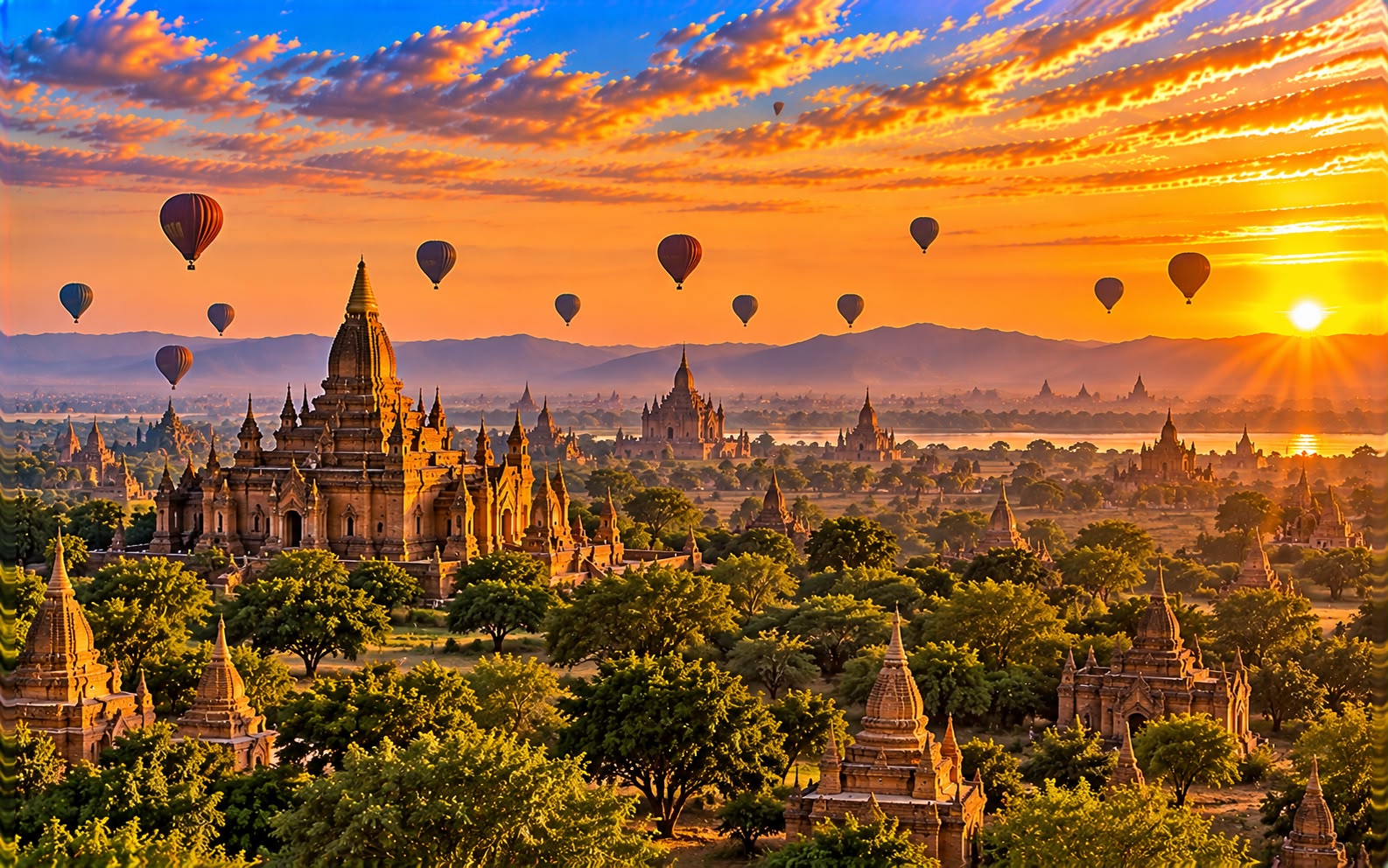
Bagan is the reason the country is on anyone’s list. On a bend of the Irrawaddy, kings of a Burmese dynasty built more than ten thousand temples between the eleventh and thirteenth centuries, of which over two thousand survive across forty square kilometres of plain. It was UNESCO-listed in 2019, decades later than it should have been, after earlier restorations were judged to have done more harm than good.
Shwedagon Pagoda in Yangon is a gilded stupa nearly a hundred metres high on a hill above the city, said to enshrine relics of four Buddhas, and plated with tonnes of gold leaf applied by worshippers over centuries.
Inle Lake is shallow, twenty kilometres long, with stilt villages, floating tomato gardens and the Intha fishermen who row standing with one leg wrapped round the oar so their hands stay free for the net.
Nine days, when it is possible. Figure USD 1,200 (≈ AED 4,407) per person excluding flights. Historically November–February.
Before you go: the 15-minute admin
If you go anyway, the things that matter most
- Where your money lands. Military-linked conglomerates own hotels, an airline and much else. Independent research on specific businesses is the only way to reduce this, and it is imperfect.
- Do not photograph soldiers, police, checkpoints, government buildings or protests. People have been jailed for photographs and for posts.
- Assume your phone may be inspected. Social media activity critical of the military is a criminal matter.
- Do not discuss politics with anyone. The risk is theirs, not yours. A conversation you forget can cost someone their liberty.
- Large areas are closed to foreigners and permits are required for others. The list changes constantly.
- Internet is restricted and shutdowns are common; VPN use is itself restricted.
Visas and money
- An e-visa system operates for tourists. Entry is normally by air into Yangon or Mandalay; land borders have been variously closed.
- The kyat (MMK) has depreciated sharply and there are official and parallel rates.
- International cards largely do not work. Bring US dollars in cash — clean, unmarked, unfolded notes, which is enforced to an unusual degree; a crease can get a note refused.
- ATMs are unreliable.
Health
- Malaria and dengue are present outside the main cities.
- Medical facilities are poor and have deteriorated since 2021. Evacuation is difficult.
Day by day
Day 1 — Yangon
- Bring crisp, unmarked US dollars. Foreign cards largely do not work and notes with a fold or a mark are refused outright.
- 11:00 — Sule Pagoda and the colonial downtown — one of the largest surviving collections of British colonial architecture in Asia, much of it decaying.
- 14:00 — Bogyoke Aung San Market, which is closed Mondays and on public holidays.
- 17:30 — Shwedagon Pagoda, best at dusk when the gold holds the last light and the platform fills with people. Barefoot, shoulders and knees covered — and the stone is hot until the sun is properly down.
- Stay on the platform an hour. The light changes twice and the second change is the one people remember.
Day 2 — The circular train, and out
- 07:00 — The circular train round the city’s edge, which takes about three hours and is ordinary commuter transport — vendors, schoolchildren, market produce on the floor.
- 11:00 — Kandawgyi Lake and the Karaweik barge, or the Bogyoke market if you skipped it.
- 14:00 — The National Museum for the Lion Throne, which is the one object worth the entry.
- 17:00 — Fly to Bagan, about 80 minutes.
- Domestic flights are the practical way to move here, and schedules change — reconfirm the day before, every time.
Day 3 — Bagan at dawn
- 05:00 — The plain at dawn, from a terrace permitted for the purpose — climbing the temples themselves was banned after damage and injuries, and the ban is enforced.
- The balloons fly October to March only, and they are booked months out.
- 08:00 — Ananda, which is the best preserved of the great ones and holds four standing Buddhas that change expression as you walk toward them.
- 11:00 — Thatbyinnyu and Dhammayangyi, the second the largest and the one with the bricks fitted so tightly a needle will not pass between them.
- 15:00 — Sulamani, and the frescoes inside it.
- 17:30 — A sunset terrace, which your driver will know the current permitted ones for.
Day 4 — The small temples
- 07:00 — The hundreds of small brick shrines nobody visits, which is where Bagan actually gets you. Take an e-bike and get deliberately lost on the dirt tracks.
- The 2016 earthquake damaged several hundred structures and the repairs are ongoing — some are scaffolded and a few are closed.
- 11:00 — Lacquerware workshops at Myinkaba, where the craft is genuinely local — a good piece takes months and the layers are visible at the rim.
- 14:00 — Out of the heat. Bagan is a dry plain and April touches 43°C.
- 16:30 — Shwezigon, the gilded one, which is a working pilgrimage site rather than a ruin.
Day 5 — Mount Popa, or the river
- 08:00 — Mount Popa, an hour out — a monastery on a volcanic plug, 777 steps up, with macaques the whole way and the nat shrines at the bottom.
- Or a boat on the Irrawaddy, which is the slower and better half-day.
- 14:00 — Back to Bagan, and the afternoon free.
- 17:00 — A last sunset, from a different terrace.
- 19:00 — Confirm tomorrow’s flight.
Day 6 — Mandalay
- 09:00 — Fly to Mandalay, 30 minutes.
- 12:00 — Kuthodaw Pagoda — 729 marble slabs in 729 shrines, carved with the entire Pali canon and called the world’s largest book.
- 15:00 — The gold-leaf workshops and the Shwenandaw monastery, which is teak and is the only surviving building of the old palace.
- 17:30 — Mandalay Hill at sunset, by car to the top or up the covered stairway barefoot.
- 19:30 — Dinner near the moat, with the palace walls lit.
Day 7 — The old capitals
- 07:00 — Sagaing, across the river, a hillside of white and gold stupas and monasteries — go early, and the Soon U Ponya Shin terrace has the view.
- 10:00 — Inwa (Ava) by ferry and pony cart, which is the right way round a flat island of ruins.
- 13:00 — Mingun, upriver, where an unfinished stupa meant to be the world’s largest cracked in an earthquake and sits as an enormous brick ruin — and the Mingun bell beside it, the largest uncracked hung bell in the world.
- 17:00 — U Bein Bridge at Amarapura, 1.2 kilometres of teak across Taungthaman Lake, built from the dismantled palace of a former capital. Sunset from a rowing boat beneath it is the photograph.
Day 8 — Inle Lake
- 08:00 — Fly to Heho, then an hour by road down to Nyaungshwe.
- 12:00 — The Intha villages on stilts, the floating gardens staked into the lake bed, and the leg-rowing fishermen — a genuine technique, though the ones posing for photographs near the jetties are doing exactly that.
- 15:00 — The weaving workshops, including lotus-stem silk, which is made almost nowhere else — it takes thousands of stems for a scarf.
- 17:30 — Sunset on the water, and the boats come in across a lake the colour of the sky.
Day 9 — Indein, and out
- 07:00 — Indein, a hillside of hundreds of weathered stupas reached up a covered stairway — go first thing, by boat up the narrow creek, before the day boats.
- 10:30 — A market village if it is the right day — the five-day rotating market moves around the lake and your boatman knows where it is.
- 13:00 — Back to Heho, and fly out via Yangon.
- Leave margin. Domestic schedules here move and the international connection will not wait.
Costs and practicalities
Best time to visit
November–February is the cool dry season and historically the only sensible window — though the current situation makes the question of when secondary to whether.
- November–February — dry, 20–30°C, clear. The only comfortable months, and the best for the Bagan plain and Inle Lake.
- March–May — the hot season, with Bagan and Mandalay reaching 40°C and above. Thingyan, the water festival, falls in mid-April and shuts the country for a week.
- June–October — the southwest monsoon. Heavy rain, green countryside, and Inle Lake at its fullest. Roads in Shan and Rakhine become difficult.
- The Phaung Daw Oo festival on Inle Lake, in September or October, is the largest in Shan State.
Balloon flights over Bagan run roughly October to March and not at all in the wet.
Travel tips
- Check current advice before anything. The military seized power in February 2021; conflict affects large parts of the country, conscription has been introduced, and most governments advise against all or most travel.
- Where your money goes is a live ethical question here. Military-linked businesses own much of the tourism infrastructure; if you go, community-run guesthouses and independent guides are the way to avoid funding the junta.
- Banking is severed. International cards do not work and ATMs are unreliable — bring clean, crisp US dollars, and old or marked notes will be refused.
- Internet is restricted and VPNs are needed for most services, and have themselves been targeted.
- Remove shoes and socks at every pagoda — this is absolute, including on the hot Bagan terraces.
- Climbing on Bagan’s temples has been banned since 2018. Use the designated viewing mounds.
- Do not photograph military, police or checkpoints, and be careful what you say and write.
What this trip would cost
Two people, 8 nights, mid-range comfort, international flights excluded:
| Item | Cost |
|---|---|
| Hotels, 8 nights | USD 800 (≈ AED 2,938) |
| Domestic flights and transfers | USD 700 (≈ AED 2,571) |
| Guides, boats, balloon or entries | USD 600 (≈ AED 2,204) |
| Zone fees and site permits | USD 200 (≈ AED 735) |
| Food and drink, 9 days | USD 100 (≈ AED 367) |
| Total for two | USD 2,400 (≈ AED 8,814) |
- Roughly USD 1,200 (≈ AED 4,407) per person. Myanmar was inexpensive and has become more so as the kyat has fallen.
- The zone fees go to the state. That is the line to think hardest about.
- Bring every dollar in cash, clean and uncreased. Cards do not work.
- Hotel picks here are chosen on location, not on commission — always check prices and recent reviews before booking.
What to pack
- US dollars in cash, flawless notes, in a hard envelope.
- Modest clothing — shoulders and knees covered at every religious site, and you go barefoot at all of them.
- Mosquito repellent and malaria advice.
- A torch, for power cuts, which are routine.
FAQ
Should I go to Myanmar? Most governments advise against all travel, the country is in civil war, and the National Unity Government and many Myanmar civil society groups have asked visitors to stay away because tourism funds and legitimises the military. The honest answer for almost everyone is no.
Does my money really reach the military? Some of it, unavoidably — zone fees and many permits are state revenue, and military-linked conglomerates own a substantial share of hotels, transport and aviation. Careful choices reduce it; nothing eliminates it.
Is Bagan damaged? It was hit by an earthquake in 2016 and hundreds of structures were affected. Repairs continue. Climbing the temples has been banned since then.
Can I visit the whole country? No. Large areas are closed to foreigners and the list changes with the fighting. Rakhine, Chin, Kachin, Kayah, Karen, Shan and Sagaing have all seen sustained conflict.
What language do they speak? Burmese, with over a hundred other languages across the ethnic states. English is limited and declining.
Prices and entry rules change, and what you need depends on your passport; last checked 29 October 2026, so confirm with the embassy or your airline before booking.


