 The Itinerary
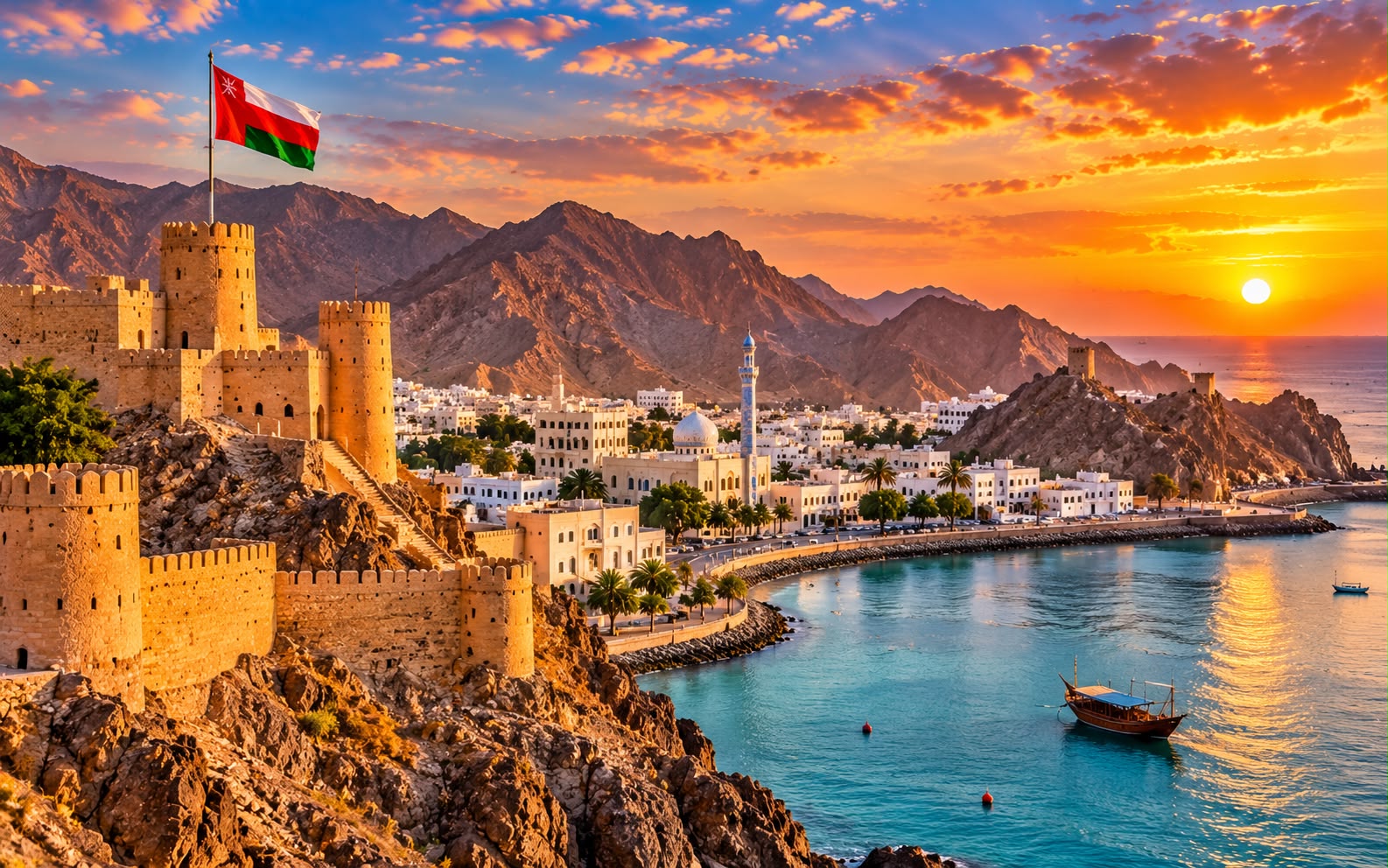
Oman in 8 days: Muscat, mountains, desert and turtles
The Gulf's gentlest adventure: a marble mosque for 20,000, forts and Friday goat auctions, the Grand Canyon of Arabia, a night among apricot dunes, emerald wadi swims and green turtles nesting by red torchlight — one easy self-drive loop, an entry route to suit whatever passport you hold, and petrol so cheap it feels like a typo.
- Middle East
- 8 days
- ≈ AED 4,700 / person
- Road trippers
Before you go
Oman is what happens when a country has the Gulf’s landscapes and none of its hurry. An hour from Dubai (or one border post, for the road-trippers this guide especially serves), you’re in a sultanate of real mountains and real history: forts that never fell, canyon rims a kilometre deep, wadis the colour of gemstones, and a coastline where sea turtles have nested since before the pyramids.
The whole classic circuit — Muscat, Nizwa, the jebels, the Wahiba dunes, the turtle coast — is one relaxed self-drive loop on immaculate roads, with the friendliest souq culture in the region: in Oman, nobody chases you, the tea is a gift, and the price is nearly the price.
Go October–March — 25–30°C perfection. April and September are warm shoulders; June–August is 45°C+ inland and for another guide entirely (Salalah’s monsoon-green khareef — see the FAQ). All costs are in Omani rials (OMR; 1 OMR ≈ US$2.60 — the decimal briefing below matters).
Before you go: visas, borders and the decimal trap
Getting in
- Many nationalities enter visa-free for up to 14 days — the EU and UK, the US, Canada, Australia, Japan and others. Check yours before assuming you need anything.
- GCC residents of any nationality can get a visa on arrival, ~OMR 5, ~14 days, at airports and land borders: carry a passport with 6+ months, your residence card and a residence visa with 3–6 months left. Eligibility checks have loosened but still surface.
- Everyone else, and the certainty play for anyone: the e-visa at evisa.rop.gov.om (24–72 h, ~OMR 5–20 by duration) before you travel.
- Indians without GCC residence: Oman’s e-visa via the same ROP portal (hotel booking + return ticket; ~OMR 20 for 30 days) or visa-included packages. GCC nationals: no visa at all.
- Overstays bite: ~OMR 10/day — respect the stamp.
Driving in from the UAE
- Crossings: Al Wajajah/Hatta (E44 — the Muscat workhorse), Khatmat Malaha (E99, via Fujairah), Mezyad (Al Ain), plus the two Musandam posts.
- The kit: UAE exit fee AED 35; Orange Card cross-border insurance (~AED 106+ for 5 days, from your insurer or at-border brokers); vehicle mulkiya; and — the one that catches people — rental or borrowed cars need a notarised, Arabic NOC from the owner with chassis details (most UAE rental firms sell an Oman-package; confirm before booking).
- Muscat is ~4.5 h from Dubai via Hatta. Fly-in (1 h, multiple daily) + rent in Muscat is this guide’s default; the drive is the weekender’s classic.
The decimal trap (read twice)
The rial divides into 1,000 baisa, not 100 — so menus and taxi quotes mix units: “500” means 500 baisa (half a rial, ~US$1.30), while “5” means five rials (~US$13). Until it’s instinct, confirm: “rial or baisa?” It’s the only financial hazard in a country where haggling is gentle and hassle is near zero.
Rules of the road (and wadi)
- Roads are superb and speed cameras are everywhere and sincere — Omani fines arrive with Swiss punctuality. Petrol: ~OMR 0.23/litre (yes, really).
- The wadi rule that keeps you alive: never enter a wadi when it’s raining anywhere upstream — flash floods are Oman’s one real danger. Blue sky above you isn’t enough; check the mountains.
- Modesty basics: shoulders/knees in towns; at wadis, swim in shorts + t-shirt/rash guard (both sexes — it’s respectful and sun-smart). Alcohol: licensed hotel venues only. Friday mornings run on prayer time.
Day by day
Day 1 — Land in Muscat, Mutrah by evening
- Afternoon — Land MCT (1 h from Dubai, ~2.5 h from most Gulf points), collect the car (compact 4WD/SUV recommended — see FAQ; 2WD works with two tweaks).
- 17:00 — Mutrah Corniche: gold-stone merchant houses, the harbour fort, the Sultan’s improbably gigantic yacht.
- 18:00 — Mutrah Souq — the Gulf’s loveliest: frankincense smoke, silver khanjars, sandalwood halls. Haggling here is a polite waltz, not combat — 20–30% movements, tea offered meaning tea.
- 20:00 — Dinner on the corniche or grilled mishkak skewers + fresh juice (~OMR 3–6 pp). Early night — the mosque keeps morning hours.
Where to stay in Muscat (three nights + one at the end)
- The icon: The Chedi Muscat — 4.6/5 on TripAdvisor (~4,700 reviews), Zen-Omani serenity and the famous 103-m pool. ~OMR 180+.
- Family luxury: Kempinski Hotel Muscat — 4.8/5 (~3,600 reviews), beachfront at Al Mouj. ~OMR 110–160.
- Value: ibis/Golden Tulip tier, Ruwi–Qurum — clean, cheap, central. ~OMR 25–40.
Day 2 — The Grand Mosque, then Old Muscat
- 08:00 — Sultan Qaboos Grand Mosque (free; non-Muslim visiting hours Sat–Thu 08:00–11:00 only, closed Fridays; women cover hair/arms/ankles — abayas lent at the gate): the 4,200 m² single-piece carpet, the eight-tonne Swarovski chandelier, marble courtyards for 20,000 — the Gulf’s most beautiful building, and it’s not close.
- 11:30 — Royal Opera House (exterior always; morning tours ~OMR 3) — the Sultanate’s marble music box.
- 13:00 — Lunch: Omani majboos or the excellent Turkish/Lebanese row in Qurum (~OMR 3–6).
- 15:00 — Old Muscat: the ceremonial Al Alam Palace gates flanked by Portuguese forts Jalali and Mirani, then the superb National Museum (OMR 5).
- 17:30 — Qurum Beach sunset walk; karak from a kiosk (200 baisa — deploy the decimal knowledge).
- 20:00 — Seafood grill dinner (~OMR 6–10 pp).
Day 3 — Forts and oases: Nizwa
Aim to sleep in Nizwa Thursday night if you can — the Friday goat market is the reason.
- 09:00 — Drive inland (1.5 h on a motorway through the Hajar wall) via Birkat Al Mouz: abandoned mud-brick terraces and a UNESCO falaj channel running since antiquity.
- 11:30 — Nizwa Fort (OMR 5): the great round cannon tower — climb past murder holes and date-honey chutes to the palm-oasis panorama that explains everything about interior Oman.
- 13:00 — Date-and-kahwa tasting in the souq arcades; lunch nearby (~OMR 3–5).
- 15:00 — Side-trip: Bahla Fort (UNESCO, exterior grandeur) and Jabreen Castle (OMR 3 — painted ceilings, the connoisseurs’ favourite), 40 min west.
- 18:00 — Nizwa souq at dusk: pottery, silver, Omani halwa (saffron-rose, sold warm).
- Friday bonus, 06:30: the goat market — a centuries-old auction circle of bleating commerce, utterly ungentrified. Best free show in Arabia.
Where to stay in Nizwa (one night): the Antique Inn tier of restored old-town guesthouses (~OMR 35–50) or Falaj Daris’ garden-pool classic (~OMR 45–60).
Day 4 — A kilometre of canyon, then the dunes
Two mountains, one choice (both need the early start):
- Jebel Shams — “the Grand Canyon of Arabia”: drive to the 2,000-m rim (last stretch gravel — 4WD advised, careful 2WDs make it in dry weather) for Wadi Ghul’s sheer kilometre drop, and walk a stretch of the Balcony Walk (W6) to the abandoned cliff village. Free, staggering, uncrowded.
- Jebel Akhdar — the Green Mountain’s rose terraces and rim viewpoints (Diana’s Point): strictly 4WD-only — a police checkpoint at the base turns 2WDs around, no exceptions. April = rose harvest.
- 14:30 — Descend and cross to the Wahiba Sands edge (~2.5 h): meet your camp’s 4WD at the tarmac (standard pickup — the 2WD driver’s friend) or deflate-and-drive if experienced.
- 16:30 — Dune evening: sunset from the ridge (camps run dune-bashing and camels; sandboards free), then dinner under a sky with no light pollution within 80 km — the Milky Way performs.
The camps (one night, half-board): the 1000 Nights / Desert Nights Camp tier runs ~OMR 35–60 pp HB in standard tents, ~OMR 70–100+ for ensuite “luxury” — book direct, confirm pickup point.
Day 5 — Emerald pools, dhows, then turtles by torchlight
- 06:30 — Dune sunrise, Omani breakfast, out of the sands.
- 09:30 — Wadi Bani Khalid (free): palm-lined emerald pools between ochre cliffs — the classic swim (shorts-and-shirt rule; little fish provide a free pedicure whether requested or not).
- 13:00 — Coast road to Sur: lunch, then the dhow yards (free) — the last place on earth hand-building ocean-going wooden dhows — and the Ayjah lighthouse across the lagoon.
- 17:00 — On to Ras Al Jinz; check in, early dinner.
- 21:00 — The turtle tour (~OMR 8–9, reserve-guided): green turtles hauling ashore to nest — laying, covering, and hatchlings scrambling seaward in season. The rules are the magic: no phones, no white light, guide’s red torch only, whisper distance. Peak nesting June–September, but this beach hosts arrivals essentially year-round; the 04:00 dawn tour is the photographers’ (soft-light) alternative.
Stay: the Ras Al Jinz Turtle Reserve lodge itself (~OMR 60–90 — you’re steps from the briefing room) or Sur’s hotels 40 min back.
Day 6 — Wadi Shab: the swim of the year
- 08:30 — North up the coast to Wadi Shab (arrive by 9:30 to beat tour buses): the 1-OMR ferry across the lagoon, then a 45-minute canyon walk past falaj channels and plantations to the pools.
- 10:30 — The main event: swim three linked turquoise pools, then through the rock crack (a metre wide, swim-only) into the hidden waterfall cave — the single best adventure hour in the Gulf. Water shoes and a dry-bag; confident swimmers only for the cave (the outer pools suit everyone).
- 13:30 — Fishing-village lunch in Tiwi (~OMR 3–5).
- 15:00 — Bimmah Sinkhole (free): the turquoise collapse crater with its swimming staircase — 30 refreshing minutes.
- 17:30 — Motorway home to Muscat (90 min); farewell-eve shawarma or hotel-beach dinner.
Day 7 — Muscat finale, sea optional
- 08:00 — Dolphin watching from Marina Bandar Al Rowdha (~OMR 12–15, 2 h — spinner superpods most mornings; Oct–Mar sea-state kindest) — or a lazy Qantab beach morning.
- 11:30 — Amouage perfume factory tour (the Gulf’s great fragrance house; visitor centre) or the Bait Al Zubair museum.
- 14:00 — Last souq run: frankincense (Hojari grade, with a burner), Omani halwa, a khanjar for the wall — checked luggage, as ever.
- 19:00 — The farewell feast: shuwa if you find it (festival lamb, banana-leaf-and-sand-oven slow-cooked) or lobster majboos on the water (~OMR 8–15 pp), kahwa and dates to close — the ritual that started every Omani welcome all week.
Day 8 — Home
- Morning — Return the car (fuel bill: a comedy), fly out of MCT — or point the bonnet at Hatta with the Orange Card in the glovebox and the halwa tub sweating gently in the boot.
Costs and practicalities
Best time to visit
October–March. Oman’s summer is Gulf summer — 45°C on the coast and in the interior — and the one great exception is in the far south.
- October–March — the whole country is comfortable: 25–30°C, dry, and the best for the Wahiba Sands, the Hajar wadis and Muscat.
- December–February — the coolest, with genuinely cold nights at altitude on Jebel Shams and Jebel Akhdar, close to freezing.
- March–April — the rose harvest on Jebel Akhdar, which is brief and worth timing.
- June–September — 45°C and humid on the coast. But the khareef, the monsoon, turns Salalah and Dhofar green from late June to early September — mist, waterfalls and a landscape nothing like the rest of Arabia. Gulf visitors come in their thousands for it.
Turtle nesting at Ras al Jinz is year-round, peaking July to October.
Travel tips
- Oman is the easiest Gulf country to self-drive — good roads, light traffic and clear signage. A 4x4 is needed only for the wadis, the sands and the Jebel Akhdar road, where it is legally required.
- Wadi flash floods are the real hazard. Never camp in a wadi bed and never drive through moving water, however shallow it looks.
- Wild camping is permitted and widespread, which is one of the pleasures of the country. Leave nothing.
- Dress modestly: shoulders and knees covered for everyone away from hotel pools, and swim in a T-shirt at the wadis where locals swim.
- Alcohol is available in hotels only and is expensive. Do not carry it around.
- Friday is the weekend, with Saturday, and Friday morning is very quiet.
- Omanis are notably hospitable and an offer of coffee and dates is sincere. Accept; take an odd number of dates and the cup is refilled until you tilt it.
What this trip actually costs
Two people, 7 nights (4 Muscat area + 1 Nizwa + 1 dunes + 1 turtle coast), mid-range, self-drive, international flights excluded:
| Item | Cost |
|---|---|
| Visas on arrival ×2 (GCC-resident route) | OMR 10 (≈ AED 95.51) |
| Car hire, 8 days (compact 4WD) + a full loop of ~OMR-0.23 petrol | OMR 255 (≈ AED 2,436) |
| Hotels, 6 nights (Muscat, Nizwa, turtle lodge) | OMR 320 (≈ AED 3,056) |
| Wahiba desert camp, half-board for two | OMR 80 (≈ AED 764) |
| Entries & tours: Nizwa fort, Jabreen, National Museum, turtle tour, Wadi Shab boat, opera tour | OMR 40 (≈ AED 382) |
| Food, 8 days (mishkak-to-lobster range) | OMR 190 (≈ AED 1,815) |
| eSIM | OMR 8 (≈ AED 76.41) |
| Buffer: dolphins, Amouage counter, frankincense gravity | OMR 77 (≈ AED 735) |
| Total for two | OMR 980 (≈ AED 9,360) |
- Roughly OMR 490 (≈ AED 4,680) per person (~US$1,275) — and notice the shape: entries barely register (the mosque, canyon, wadis and sinkhole are free), fuel is pocket change, and the money sits in beds and the camp. Guesthouse-and-2WD discipline lands near OMR 380 (≈ AED 3,630); a Chedi-and-luxury-camp version doubles it happily. Driving in from the UAE swaps the car-hire line for the border kit (~AED 250 all-in) and saves further.
- Book in this order: visa route confirmed (VoA eligibility or the e-visa 3–4 days out) → flights or the border kit (NOC lead-time if renting in the UAE!) → the desert camp and turtle-reserve lodge (few rooms each — first to sell out) → Muscat/Nizwa hotels free-cancel → car with Akhdar plans = 4WD confirmed in writing → the mosque, forts, wadis and goat market: turn up (Thursday night for the Friday goats).
- Hotel and restaurant picks here are unsponsored — no affiliate links in this article. Chosen on location and current ratings; always check prices and recent reviews before booking.
What to pack
- Wadi kit: water shoes, quick-dry shorts + rash-guard/t-shirt swimwear, dry-bag for the cave swim, microfibre towel.
- Mosque/fort modesty: light long layers; women a headscarf for the Grand Mosque (lent, but yours fits better).
- A warm layer — desert nights drop to 10–14°C in winter, and Jebel Shams’ rim runs 15°C below Muscat.
- Sun kit at full Gulf strength; a cheche/scarf for the dunes.
- Torch with a red mode if you own one (turtle beach), power bank, car phone-mount.
- The decimal mantra: rial or baisa? — practised aloud once, saved daily.
FAQ
Do I really need a 4WD? Honest answer: 2WD completes 90% of this loop — motorways reach Nizwa, Sur and the wadis, desert camps collect you from the tarmac, and careful 2WDs manage Jebel Shams’ gravel in dry weather. The two hard exceptions: Jebel Akhdar’s police checkpoint (4WD or turned around) and driving into the sands yourself. A compact 4WD (~OMR 10–15/day extra) simply deletes every asterisk.
Which visa route am I, exactly? Most European, UK, US, Australian and many other passports: visa-free up to 14 days, nothing to arrange. GCC nationals: none either. GCC residents of any nationality: visa-on-arrival ~OMR 5 with the residence permit — with the honest caveat that eligibility screening still occasionally surfaces, so the ROP e-visa 3–4 days ahead is the zero-drama option. Everyone else: the ROP e-visa (~OMR 20/30 days) with hotel + return proof. All roads run through evisa.rop.gov.om — no agent needed.
Will we actually see turtles? At Ras Al Jinz, near-certainly in June–September (dozens nightly) and very probably in any month — the reserve tracks arrivals and won’t march you out to an empty beach. The dawn tour adds hatchling odds and photographable light. The contract: red light, silence, distance — the guides enforce it because it works.
Is Oman safe? What’s the hassle level? Among the safest countries on earth, full stop — solo women road-trippers routinely rate it the easiest Middle East trip they’ve made. The souq hustle famous elsewhere simply doesn’t exist here; your risks are sunburn, speed cameras and over-purchasing frankincense.
Oman with kids? Superb: short drives, forts with cannons, sinkhole swims, dune-sledding, turtle hatchlings — and Omani restaurants treat children as honoured guests. The two watch-items: wadi currents after rain (the rule above) and the canyon rim’s unfenced edges — hold hands at Shams.
What about Salalah and Musandam? Both are their own trips and both are coming: Salalah’s khareef (June–September, when the desert turns Kerala-green under monsoon mist) is the seasonal special candidate, and Musandam’s fjords the long-weekend dhow trip. This loop is Oman’s spine; those are its wings.
Prices and entry rules change, and what you need depends on your passport; last checked 8 October 2026, so confirm with the embassy or your airline before booking.


