 The Itinerary
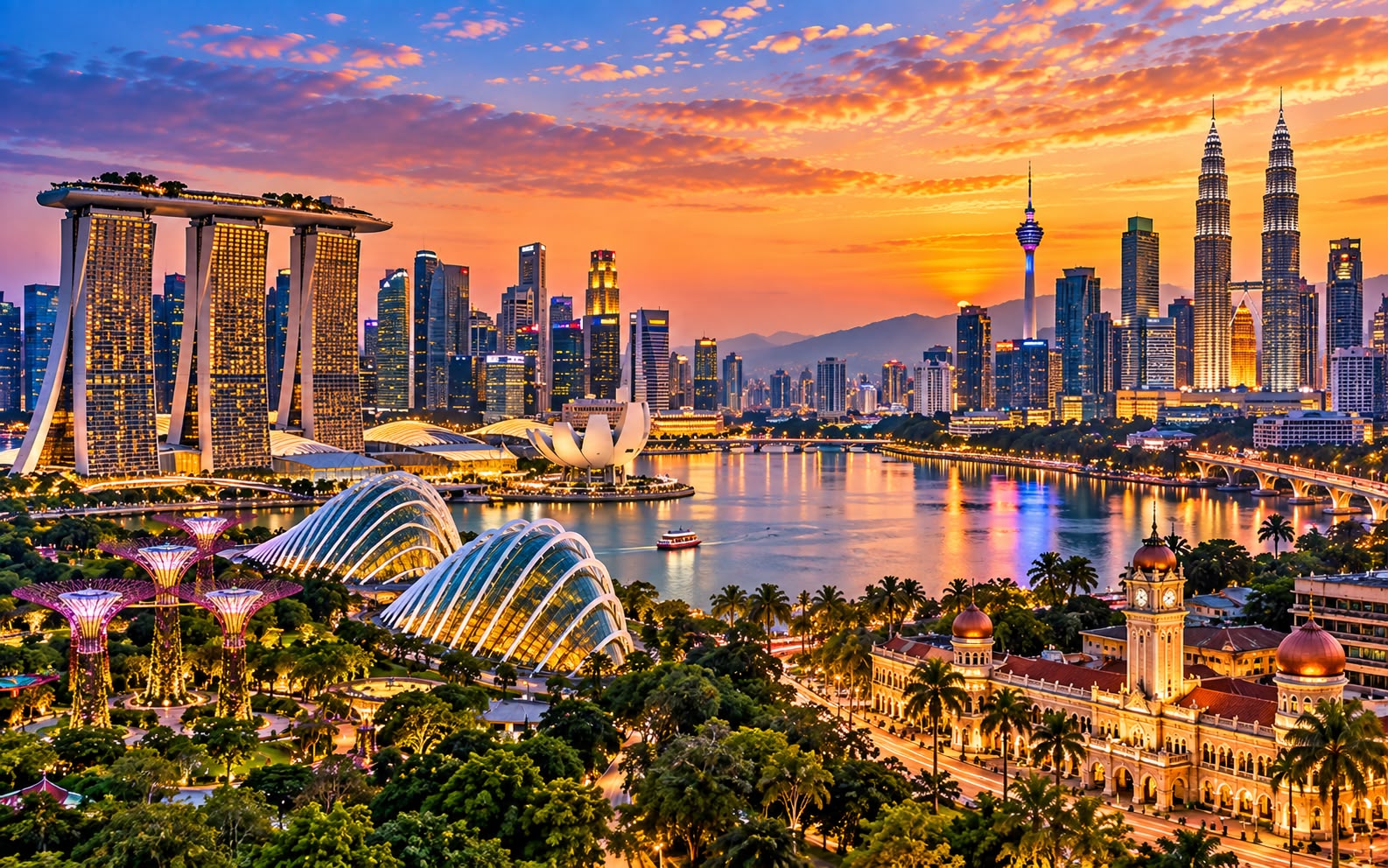
Singapore and Malaysia in 10 days: two countries, one easy border
The gentlest introduction to Asia there is, and it happens to span two countries: Singapore's hawker stalls and Supertrees, a Dutch-red colonial port, Kuala Lumpur's towers, and Penang's street-food streets — two currencies, one land border you can cross before lunch, and almost no paperwork for most passports.
- Southeast Asia
- 10 days
- ≈ AED 6,850 / person
- First-time Southeast Asia
Before you go
Most people pick one and wonder about the other. They sit two hours apart, they share a border you can cross overland, and together they make the easiest first trip to Asia you can plan: English everywhere, drinkable tap water at one end, and food that is the reason to come.
Singapore is the soft landing — a city that works, where the best meal of your trip costs about the same as a coffee. Malaysia is the one with the texture: a Dutch-red colonial port at Melaka, Kuala Lumpur’s towers and cave temples, and Penang, which is arguably the finest eating city in Southeast Asia.
Ten days splits cleanly: three nights in Singapore, one in Melaka, two in KL, three in Penang. Fly into Singapore, home from Penang and you never double back.
Before you go: two countries, two arrival cards
Neither needs much, and both need a form
- Most passports need no visa for either country. Singapore admits most visitors visa-free, and Malaysia’s exemption covers most nationalities for 30–90 days. Check yours; the exemption follows your passport, not where you live.
- Two free arrival cards, both mandatory, both online. Singapore wants the SG Arrival Card, filed within three days of arriving. Malaysia wants the MDAC, filed within three days of arriving. Neither costs anything, and the copycat sites that charge for them are the only expensive part.
- File the Malaysian one before you leave Singapore, not at the border. It takes two minutes on hotel wifi and saves an argument.
- If you do need a Singapore visa, the base fee is small but agent totals run higher — and you must apply through an authorised agent rather than directly.
Two currencies, and they are not close
- Singapore dollars (SGD) and Malaysian ringgit (MYR) — and the ringgit is worth roughly a third of the Singapore dollar, which catches people out on day four. A meal that felt cheap in Singapore is startling in Penang.
- Cards work everywhere in both. Singapore is effectively cashless; Malaysia less so — carry ringgit for hawker stalls, markets and small-town taxis.
- Tap your contactless card on every MRT gate and bus in Singapore — no ticket needed, no card to buy.
- Grab runs Malaysia — cars, food, everything. It also works in Singapore, where taxis are honest anyway.
- Alcohol is heavily taxed in both, and rare in conservative parts of Malaysia. Budget for it or plan around it.
Crossing the border
- The land crossing at Johor Bahru is the classic route and the cheapest, but the causeway queues are legendary at weekends and on public holidays. Cross midweek and mid-morning, never on a Friday evening.
- The simpler alternative is to fly. Singapore to Kuala Lumpur is among the busiest air routes in the world — hourly departures, an hour in the air, and fares that often beat the bus once you value the day you get back.
- This itinerary goes overland to Melaka (about four hours by coach, and Melaka is worth the stop), then KL to Penang by train on the electrified line, which is comfortable and fast.
- You clear immigration twice at a land crossing — out of one country, into the other. Keep passports accessible and expect the coach to wait for everyone.
The things each country expects
- Singapore’s rules are real, not folklore: no eating on the MRT, no durian in hotels, and littering fines that are enforced.
- The chope: a packet of tissues on a hawker table means the seat is taken. It is not litter, and moving it is rude.
- Halal is the default in Malaysia rather than a request — look for the JAKIM logo if it matters to you, and note that non-halal food is clearly separated rather than absent.
- Dress modestly for mosques and temples in Malaysia; most lend robes at the door.
Day by day
Day 1 — Land in Singapore, Marina Bay switches on
- 14:00 — Land at Changi. See Jewel now, on the way in — the 40 m indoor waterfall and the forest around it are in the public landside area — because you fly home from Penang and will not pass through here again.
- 16:00 — The MRT reaches the city in 35 minutes and costs about two dollars. Buy a contactless-enabled card or just tap a bank card.
- 17:00 — Drop bags. Chinatown, Kampong Glam or Tiong Bahru are the interesting places to sleep; Marina Bay is the expensive one.
- 19:00 — Marina Bay after dark. Walk the waterfront from the Merlion round to the Helix Bridge, with the Sands hotel and the whole skyline across the water.
- 19:45 — The Supertree light-and-sound show at Gardens by the Bay — 19:45 and 20:45 nightly, free — watched lying on the grass underneath, which is how everyone does it.
- 21:00 — Supper at a hawker centre.
Day 2 — Gardens, and three cultures in three stops
- 09:00 — Gardens by the Bay: the Cloud Forest first, before the heat — a 35 m indoor mountain with a waterfall and a cloud walk — then the Flower Dome, which is cooler and calmer. The OCBC Skyway between the Supertrees is cheap and worth it.
- 12:30 — Lunch, then the MRT.
- 14:00 — Chinatown: the Buddha Tooth Relic Temple, the Sri Mariamman Hindu temple two streets away, and the Maxwell Food Centre.
- 15:30 — Little India: Tekka Centre, the Sri Veeramakali- amman temple, and the sensory jolt of going from one to the other in four MRT stops.
- 17:00 — Kampong Glam: the gold-domed Sultan Mosque, Arab Street’s textile shops, and Haji Lane’s murals and bars.
- 19:30 — A hawker centre, properly. Several stalls here hold Michelin mentions and charge a few dollars. The queue is the review — join the longest one. Chilli crab, Hainanese chicken rice, char kway teow, carrot cake (which is neither).
Day 3 — Singapore your way
- Option A — Sentosa, 09:00. The island day: beaches, cable car, Universal Studios, and the SkyHelix. Good with children, skippable otherwise.
- Option B — the quiet one, 09:00. The Botanic Gardens, a UNESCO site and free, with the National Orchid Garden inside it; then the MacRitchie TreeTop Walk, a suspension bridge over primary rainforest with macaques and monitor lizards, 20 minutes from the financial district.
- Option C — the museums. The National Gallery in the old Supreme Court, or the Peranakan Museum, which sets up everything you will see in Melaka.
- 19:30 — The Night Safari, which is better than it sounds — a proper zoo run after dark, when the animals are actually awake. Book ahead.
- 21:30 — Two things before bed: book tomorrow’s coach, and file your Malaysian Digital Arrival Card (MDAC) — it is required within three days of entry and the border is slow without it.
Day 4 — Overland to Melaka
- 08:00 — Coach to Melaka, roughly four to five hours including the border. Two passport queues — Singapore exit at Woodlands, Malaysia entry at Johor — and you get off the bus with your luggage at both. It is tedious and entirely straightforward.
- 13:00 — Arrive. Drop bags around Jonker Street.
- 14:30 — Dutch Square: the red Stadthuys (1650, the oldest Dutch building in Asia) and Christ Church.
- 15:30 — St Paul’s Hill above it, and this is the whole history of the place in ten minutes of walking — a Portuguese gate (A Famosa, 1511), a Dutch church, and a British lighthouse, with St Francis Xavier’s empty tomb at the top.
- 17:00 — The river walk, which is nicer than it has any right to be and covered in murals.
- 19:00 — Jonker Street, and it is best on a Friday, Saturday or Sunday night when the night market closes the road. Eat: chicken rice balls, cendol, satay celup.
Day 5 — Melaka slow, then north to KL
- 09:00 — The Baba-Nyonya Heritage Museum — three terrace houses knocked together, the home of a Peranakan family, whose culture grew where Chinese traders married local Malay women and which exists because of exactly this port. Guided only, and the guides are descendants.
- 11:00 — Cheng Hoon Teng temple, the oldest functioning Chinese temple in Malaysia, and Kampung Kling mosque with its pagoda-shaped minaret, on the same street.
- 13:00 — Lunch — asam pedas, or Nyonya laksa.
- 14:30 — Coach to Kuala Lumpur, about two hours.
- 17:00 — Arrive. Drop bags around Bukit Bintang or KLCC.
- 19:00 — The Petronas Towers from KLCC Park below, where the fountain show runs after dark and the view costs nothing. The Skybridge tickets sell out days ahead; the park is the better photograph anyway.
- 20:30 — Dinner.
Day 6 — Caves, towers and the old quarter
- 07:30 — Batu Caves early, before the heat and the coaches — 30 minutes by KTM Komuter train. 272 steps, repainted in rainbow colours in 2018, up to a limestone cavern with a Hindu shrine inside and a 43 m gold Murugan statue at the bottom. The macaques will take anything you are holding, including sunglasses and phones.
- 10:30 — Back into town.
- 11:30 — Merdeka Square, the Sultan Abdul Samad building, and the old railway station — Moorish-revival colonial architecture that looks like nothing else in Asia.
- 13:00 — Central Market for lunch and crafts, then Petaling Street in Chinatown.
- 15:00 — The Islamic Arts Museum, which is excellent and air-conditioned, or the Thean Hou temple.
- 19:30 — Jalan Alor’s street-food strip — plastic stools, smoke, satay and grilled fish — which is a better meal than any rooftop. Heli Lounge Bar, a helipad that becomes a bar at sunset, is the drink before it.
Day 7 — The train north to Penang
- 08:30 — KL Sentral → Butterworth on the ETS electric train: about four hours, reserved seats, comfortable, and genuinely one of the nicest journeys in Southeast Asia. Book ahead; it sells out.
- 12:30 — Butterworth, then the ferry across to George Town — 15 minutes, and the approach to the waterfront is the right way to arrive.
- 13:30 — Drop bags in the old quarter.
- 15:00 — Walk with no plan. George Town’s core is a UNESCO site of shophouses, clan temples, mosques and godowns, and it is small enough that getting lost is the method.
- 19:00 — Your first Penang meal. Ask anyone where they eat and go there — this is the food capital of the trip and everyone has a strong opinion.
Day 8 — George Town properly
- 08:30 — The clan jetties — stilt villages over the water, each built by one Chinese clan, with Chew Jetty the largest and still lived in. Go early, before the day crowds.
- 10:00 — The street art: Ernest Zacharevic’s 2012 murals — the children on the bicycle, the boy on the chair — plus the wrought-iron caricatures. There are maps; wandering works better.
- 11:30 — The Blue Mansion (Cheong Fatt Tze), indigo and perfectly feng-shui’d, by guided tour only.
- 13:00 — Lunch — char kway teow, assam laksa, cendol.
- 15:00 — Penang Hill by funicular to 833 m, for the view over the strait and five degrees of relief. The Habitat rainforest walk at the top is worth the extra hour.
- 19:00 — Gurney Drive hawker centre, or a neighbourhood one, which will be better. Plan two dinners if you can — an early and a late — because one is not enough here.
Day 9 — Penang at your pace
- Option A — temples, 09:00. Kek Lok Si, the largest Buddhist temple in Malaysia, built up a hillside in tiers with a seven-storey pagoda combining Chinese, Thai and Burmese styles.
- Option B — green, 09:00. The Tropical Spice Garden on the north coast, or the Botanic Gardens.
- Option C — beach, 10:00. Batu Ferringhi, which is pleasant rather than exceptional — the sea here is not the reason to come to Penang.
- Option D — more food. Entirely legitimate, and what most people actually do.
- 19:30 — Last meal. Make it char kway teow, cooked over charcoal, from a stall with a queue.
Day 10 — Fly home from Penang
- Morning — Penang (PEN) is 30 minutes from George Town and small and quick — 90 minutes is enough.
- Direct flights reach the Gulf, Singapore, Bangkok and much of Asia; most other routings connect through KL, so check whether yours needs a terminal change there.
- Last stop — Nutmeg oil and tau sar pneah biscuits from a shop in the old town, which are the two things Penang sends home.
Costs and practicalities
Best time to visit
December–April works for the whole route, because it is dry on Malaysia’s west coast — where this itinerary runs — and Singapore has no season to speak of.
- December–April — the driest on the peninsula’s west side: Melaka, Kuala Lumpur, Penang and Langkawi are all at their best. Singapore is at its sunniest February to April.
- May–September — the southwest monsoon brings wetter months to the west coast, though rain comes as afternoon bursts rather than all day. Regional haze can affect both countries from June to October.
- November–February — the northeast monsoon closes Malaysia’s east-coast islands entirely, which is why this route stays west.
- Chinese New Year in January or February and Hari Raya at the end of Ramadan both move millions of people — transport sells out and many businesses close for days.
Travel tips
- The land border at Johor is one of the busiest in the world. Crossing on a Friday evening or a public holiday can take hours; the train from Woodlands or an early-morning bus is far better.
- Two currencies, and Malaysia is much cheaper. Draw ringgit in Malaysia rather than changing Singapore dollars at the border.
- Grab works in both countries and is the simplest way around in each.
- Singapore’s rules are enforced — no eating on the MRT, fines for littering, and drug offences carry the death penalty, including for people in transit.
- Malaysia’s modesty expectations vary by state and are stricter in the northeast. Cover shoulders and knees at mosques in both countries.
- Hawker food is the point in both — Singapore’s hawker centres and Penang’s street food. Almost all of it is cash.
- The KL–Singapore train no longer runs through. Change at Johor Bahru, or fly, or take the coach.
What this trip actually costs
Two people, 9 nights, mid-range, excluding international flights:
| Item | Cost |
|---|---|
| Hotels, 9 nights across four cities | SGD 2,100 (≈ AED 6,012) |
| Coaches, the KL–Butterworth train, ferries | SGD 220 (≈ AED 630) |
| Gardens by the Bay, Sentosa, Batu Caves, Penang Hill, museums | SGD 480 (≈ AED 1,374) |
| City transport, Grab, MRT | SGD 260 (≈ AED 744) |
| Food and drink, 10 days | SGD 1,400 (≈ AED 4,008) |
| eSIMs ×2 countries, extras | SGD 340 (≈ AED 973) |
| Total for two | SGD 4,800 (≈ AED 13,741) |
- Roughly SGD 2,400 (≈ AED 6,870) per person, and the split is lopsided: Singapore is roughly twice Malaysia’s daily cost. Three nights there and six in Malaysia is what makes the average work.
- Hawker food keeps the food line honest in both countries. Eat at restaurants every night and this budget stops being true.
What to pack
- UK-style Type G plugs in both — one adapter, the whole trip.
- Light, modest clothing. It is hot and humid year-round in both countries, and shoulders and knees matter at temples and mosques.
- A real umbrella. Tropical rain arrives fast, hard and briefly.
- Two eSIMs or a regional plan — a Singapore-only eSIM stops working the moment you cross.
FAQ
Is the land border worth it, or should I just fly? Take the coach if you are stopping in Melaka, which this itinerary does — it is on the way and the flight is not. If you are going straight to Kuala Lumpur, fly: it is an hour, it is cheap, and the causeway can eat an afternoon.
Which country should get more days? Malaysia. Singapore is compact and expensive; three nights covers it properly. Malaysia has more ground and costs less to cover it.
Is this a good first trip to Asia? It is the one I would pick. English is widely spoken in both, the transport works, the tap water is drinkable in Singapore, and nothing about it requires improvisation.
Do I need two SIM cards? One regional eSIM covering both is simplest. A country-specific plan will stop at the border, usually on the coach, usually when you want a map.
Prices and entry rules change, and what you need depends on your passport; last checked 8 October 2026, so confirm with the embassy or your airline before booking.


