 The Itinerary
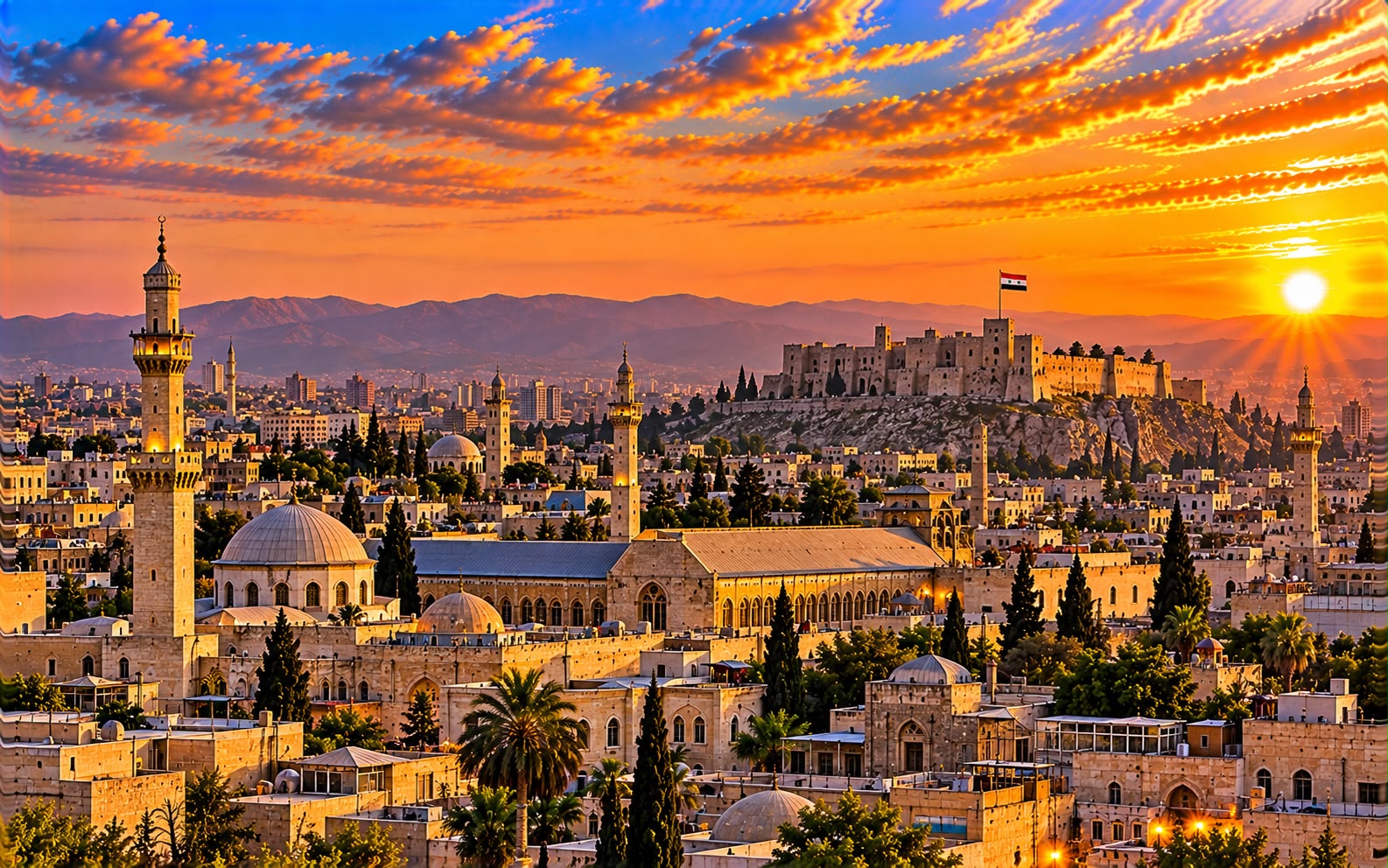
Syria in 8 days: Damascus, Krak des Chevaliers and Palmyra — and the warnings
One of the oldest continuously inhabited cities on earth, the Crusader castle T. E. Lawrence called the finest in the world, and a desert city ISIS dynamited — in a country emerging from fourteen years of war where every government still advises against all travel.
- Middle East
- 8 days
- ≈ AED 4,750 / person
- Six World Heritage sites, every one of them on the danger list
Before you go
Read this first
Most governments advise against all travel to Syria, and several state that they cannot provide any consular assistance there at all.
- Fourteen years of civil war followed the 2011 uprising. The Assad government fell in December 2024 and the country is in a transitional period — which has reduced some risks and created others.
- The situation is volatile and changes quickly. Sectarian violence, armed groups outside government control, and localised fighting have all continued in the transition.
- Unexploded ordnance and landmines contaminate enormous areas, including inside cities and around every site mentioned below. Do not step off made surfaces anywhere.
- Several areas carry stronger warnings still — the north-east, the Turkish border region, the south-west and anywhere near the Golan.
- Kidnapping of foreign nationals has been a persistent feature of the conflict.
- Most Western embassies have been closed since 2012. If something happens to you, there may be no one to call.
- Sanctions affect banking, insurance and what you may legally buy. No card works. Travel insurance will not cover you.
This guide does not tell you to go. A small number of visitors have returned since 2024 with Syrian operators. That is their judgement, made with current information. Check your own government’s advice, which is the only thing that reflects this week rather than this year.
Syria has six UNESCO World Heritage sites and all six are on the List of World Heritage in Danger, where they were placed in 2013.
Damascus has a reasonable claim to being the oldest continuously inhabited city in the world. The Umayyad Mosque was a temple of Hadad, then of Jupiter, then a cathedral of St John the Baptist — whose shrine is still inside it — and has been a mosque since 705. The Old City inside its Roman walls is UNESCO-listed, and Straight Street is the one named in Acts.
Krak des Chevaliers is the best-preserved Crusader castle anywhere. T. E. Lawrence called it “perhaps the best preserved and most wholly admirable castle in the world”, and he had seen most of them. It was shelled during the war and has been partly repaired.
Aleppo was the other oldest city, and its souq — kilometres of covered medieval market — burned in 2012. The citadel was damaged and the minaret of the Great Mosque, standing since 1090, was destroyed in 2013. Restoration is under way and it is slow.
Palmyra, the caravan city of Queen Zenobia in the Syrian desert, was held by ISIS twice. They dynamited the Temple of Bel, the Temple of Baalshamin and the Monumental Arch, and murdered Khaled al-Asaad, the archaeologist who had cared for the site for forty years and would not say where the antiquities were hidden. Much of Palmyra still stands. Access depends entirely on current conditions and demining.
Eight days, if and when it is possible. Figure USD 1,300 (≈ AED 4,774) per person. Historically March–May or September–November.
Before you go: the 15-minute admin
Entry
- A visa is required and is generally arranged through a Syrian tour operator, who sponsors it. Independent application is difficult.
- Entry is normally overland from Lebanon or Jordan, or by air into Damascus, with the airport’s status having changed repeatedly.
- An Israeli stamp means refusal.
- Journalists need separate accreditation and should not travel on a tourist visa.
Money
- No international card functions. Sanctions and the banking collapse mean you bring every dollar you will spend, in cash.
- The Syrian pound has lost almost all its value; prices are frequently quoted in dollars and the rate moves constantly.
- Bring more than you think. There is no way to get more.
On the ground
- Nobody travels here independently. Visitors go with Syrian operators who hold the permissions, know which roads are open, and know which areas are cleared.
- Checkpoints are constant. Carry your passport and let the guide speak.
- Do not photograph military, checkpoints, government buildings or damage without asking. Rules on photographing destruction vary and are enforced unpredictably.
- Power and water are intermittent across the country.
- Do not go off paved surfaces. This is the single most important practical instruction on this page.
Day by day
Day 1 — Damascus, the Old City
- Entry is by prearranged visa through a licensed operator, and sanctions mean no foreign cards, no international banking and no transfers. Bring every dollar you need in cash.
- 11:00 — The Umayyad Mosque, which is the point of Damascus: a courtyard the size of a square, Byzantine mosaics of a river and a city along the western wall, and the shrine of John the Baptist inside the prayer hall. Shoulders, knees and hair covered; robes are lent.
- 14:00 — The Hamidiyah Souq with its bullet-holed roof letting through shafts of light — the holes are from French strafing in 1925, not the recent war.
- 16:00 — Straight Street, which runs the length of the old city and is the one the Romans laid out.
- 18:30 — The courtyard houses, several of which are now restaurants, and that is the best way to see inside one.
Day 2 — The Azem Palace, and the museum
- 09:00 — The Azem Palace, the eighteenth-century governor’s house, with the black basalt and white limestone banding that is the Damascene style.
- 12:00 — The National Museum, which reopened in 2018 after the collections were hidden for six years. The Ugarit alphabet tablet is the single most important object in it.
- 15:00 — The Christian quarter — Bab Touma, the Ananias chapel underground, and the lanes behind it.
- 17:30 — Mount Qasioun above the city, for the view people have been taking since the Umayyads. Access has been restricted at times; check that morning.
- 20:00 — Dinner in Bab Touma.
Day 3 — Saydnaya, and the city’s edges
- 09:00 — Saydnaya, forty minutes north, with the convent of Our Lady and an icon attributed by tradition to St Luke.
- 13:00 — Back for lunch, and the Tekkiye Suleymaniye complex by Sinan on the river.
- 15:00 — The Midhat Pasha souq and the Hanabila mosque in Salihiyya.
- Damage is uneven and local. Some quarters are untouched and others are rubble a street away; do not wander outside what your guide has cleared.
- 18:00 — An early night. Tomorrow is a long day north.
Day 4 — Maaloula and the Qalamoun
- 08:00 — Maaloula, a village built into a cliff north of Damascus and one of the last places where Western Aramaic — the language of Jesus — is still spoken.
- 10:00 — The Mar Takla and Mar Sarkis monasteries have been partly restored. It was held by Jabhat al-Nusra in 2013, its monasteries looted and nuns abducted.
- 12:00 — The cleft between the two, which is the walk everyone does and is the village’s reason for being where it is.
- 14:00 — The Qalamoun road, and stay on the main routes — this was front line and the shoulders are not cleared everywhere.
- 17:00 — Back to Damascus, or on toward Homs.
Day 5 — Krak des Chevaliers and the coast
- 08:00 — Krak des Chevaliers, UNESCO-listed, held by the Knights Hospitaller from 1142. Two concentric curtain walls, a glacis, a vaulted hall of real architectural quality, and a position that made it essentially untakeable — it fell by a forged order, not a siege.
- Shelling in 2013 and 2014 damaged the interior; repairs continue and parts may be closed on the day.
- 12:00 — Qalaat Salah El-Din nearby is listed with it, and the rock-cut needle that carried its drawbridge is the thing to see.
- 15:00 — Tartus or the coast, which saw less destruction than anywhere else — the Crusader cathedral at Tartus is intact and is now the museum.
- 18:00 — The corniche, which is an ordinary Syrian evening and is worth having.
Day 6 — Hama and the Dead Cities
- 08:00 — Hama’s norias, the enormous wooden waterwheels on the Orontes, some seventeen metres across, which have turned since the Byzantines and groan audibly. They turn only when the river is up — spring is when to hear them.
- 11:00 — The Dead Cities — the Ancient Villages of Northern Syria, UNESCO-listed: forty-odd Byzantine settlements abandoned in the eighth century and standing roofless ever since, including Serjilla.
- 14:00 — The Church of Saint Simeon Stylites, built round the pillar he lived on for decades — what is left of the pillar is a boulder, worn down by relic-hunters.
- Many were used as shelter and as positions during the war and are damaged.
- 17:00 — North to Aleppo, about an hour.
Day 7 — Aleppo
- 09:00 — The Citadel, on its mound, one of the oldest and largest castles in the world. The entrance bridge and towers were damaged; it has reopened in part.
- 12:00 — The Great Mosque, whose 1090 minaret was destroyed in 2013. Reconstruction from the fallen stones has been under way since 2017 and the numbered blocks are laid out in the courtyard.
- 14:00 — The souq, parts of which have reopened after the fire — the Souq al-Saqatiyya was the first section restored.
- 16:00 — Aleppo is a city where the damage is the history now, and a guide from it will tell you what stood where. That walk is the reason to be here.
- 19:00 — Dinner in Jdeideh, the Christian quarter, where several of the old houses are open again.
Day 8 — Out
- 09:00 — A last hour in the souq, and Aleppo soap — laurel and olive oil, cured for months — is the thing to carry home.
- 12:00 — The road south to Damascus, four hours, or fly if the schedule allows.
- Palmyra is three hours into the desert from Damascus. Whether it can be visited at all depends on demining and the security position that week. Ask your operator; do not assume.
- Leave wide margins for the border or the flight.
Costs and practicalities
Best time to visit
March–May and September–November were the comfortable windows, and they remain the right months if and when it becomes possible.
- March–May — the best of the year. Wildflowers across the Dead Cities plateau, comfortable in Damascus and Aleppo, and the desert at Palmyra still bearable.
- June–August — 40°C in Damascus and far hotter at Palmyra, which has no shade at all. The coast at Tartus is the escape.
- September–November — warm, clear, and the best light on the Umayyad Mosque and Krak des Chevaliers.
- December–February — cold and wet, with snow in Damascus and on the Dead Cities plateau some years. Krak des Chevaliers in cloud is atmospheric and bitterly cold.
Ramadan reshapes the day across the country, and the Christian and Muslim calendars both matter here.
Travel tips
- Most governments advise against all travel and several can provide no consular assistance at all. A small number of visitors have gone with Syrian operators since the transition in December 2024; it is a decision to take with current advice in front of you.
- Do not go off paved surfaces, anywhere. Unexploded ordnance and landmines contaminate enormous areas including inside cities. This is the single most important practical instruction.
- No international card functions. Sanctions and the banking collapse mean you bring every dollar you will spend, in cash, and there is no way to get more.
- Nobody travels independently. Syrian operators hold the permissions and know which roads are open and which areas are cleared.
- Checkpoints are constant. Carry your passport and let the guide speak.
- Rules on photographing destruction vary and are enforced unpredictably. Ask before raising a camera.
- Power and water are intermittent across the country; carry a torch and a power bank.
What this trip would cost
Two people, 7 nights, mid-range comfort, flights excluded:
| Item | Cost |
|---|---|
| Hotels, 7 nights | USD 900 (≈ AED 3,305) |
| Operator, driver and permissions | USD 1,200 (≈ AED 4,407) |
| Site entries and local guides | USD 300 (≈ AED 1,102) |
| Food and drink, 8 days | USD 200 (≈ AED 735) |
| Total for two | USD 2,600 (≈ AED 9,549) |
- Roughly USD 1,300 (≈ AED 4,774) per person. The operator is the largest line and is not optional.
- Every dollar of it in cash. No card works anywhere in Syria.
- Figures are indicative. The exchange rate and the security surcharge both move.
- Insurance does not appear because no standard policy covers travel against government advice.
- Hotel picks here are chosen on location, not on commission — always check prices and recent reviews before booking.
What to pack
- US dollars in cash, clean notes, for the entire trip.
- Modest clothing, and a headscarf for women at mosques.
- Sturdy shoes — and the discipline to stay on made surfaces.
- A torch and a power bank, for the outages.
- Any medication you need. Pharmacies are depleted.
FAQ
Can I visit Syria now? Most governments advise against all travel and several can offer no consular help at all. A small number of visitors have gone with Syrian operators since the transition in December 2024. It is a decision to take with current advice in front of you, not on the basis of a guide.
Is Palmyra accessible? It depends on demining and the security position at the time. Much of the site survives despite ISIS destroying the Temple of Bel, the Temple of Baalshamin and the Monumental Arch. Ask an operator rather than assuming.
How badly was Aleppo damaged? Severely. The souq burned in 2012, the Great Mosque’s 1090 minaret was destroyed in 2013, and the citadel was hit. Restoration is under way and parts have reopened.
Will my cards work? No. Sanctions and the banking collapse mean cash only, in US dollars, brought with you.
What language do they speak? Arabic. Western Aramaic survives in Maaloula and two neighbouring villages. English and French are spoken by some older and educated Syrians.
Prices and entry rules change, and what you need depends on your passport; last checked 29 October 2026, so confirm with the embassy or your airline before booking.


