 The Itinerary
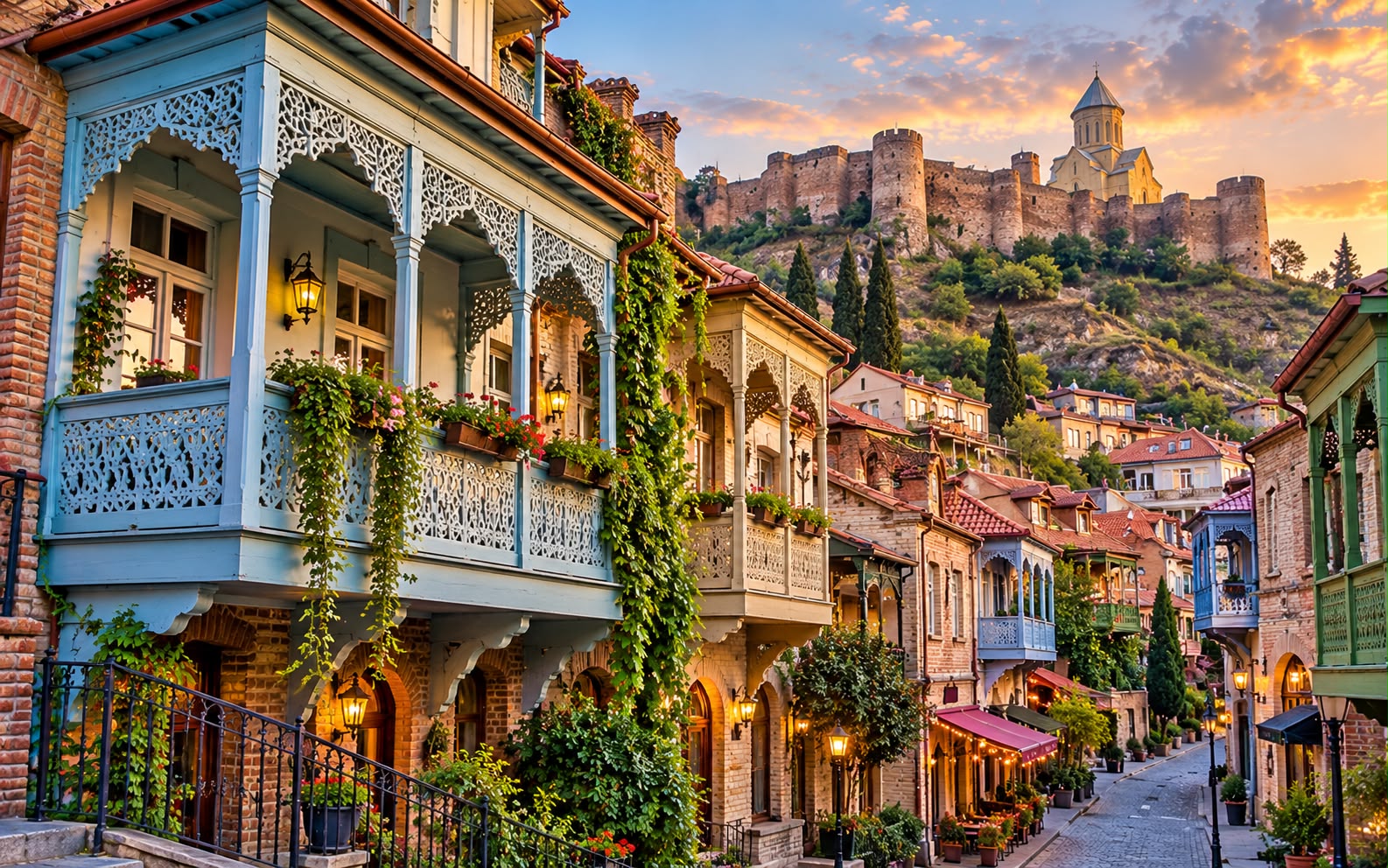
Tbilisi in 3 days: the old town, the baths and Mtskheta
Three days in a city built on hot springs: the old town and Narikala, a private bath with the scrub, the day trip to Georgia's old capital, and where to find amber wine that tastes like nothing in a supermarket.
- Caucasus
- 3 days
- ≈ AED 750 / person
- A sulphur bath, a supra, and two UNESCO churches half an hour away
Before you go
Tbilisi is a small capital with an outsized number of good days in it. The old town is walkable end to end in an afternoon, the sulphur baths it is named for still work, and two UNESCO-listed churches sit twenty minutes up the road at the old capital.
Three days: one for the old town, one for Mtskheta and the Chronicle, and one for either Kakheti’s wine country or the city’s Soviet and modern layers — depending on whether you would rather drink or walk.
Part of a Georgia trip? See Georgia in 5 days, which builds from here to Kazbegi.
Figure GEL 540 (≈ AED 765) per person for three days. May–June and September–October.
Before you go: the short version
Entry
- Georgia is one of the most open countries in the world for entry — over 90 nationalities enter visa-free for a full year, which is unusual enough to be worth saying twice.
- No visa, no registration, no exit formalities for most visitors.
Getting in and around
- Tbilisi International (TBS) is 20 minutes from the centre. A taxi is GEL 30–50; Bolt is cheaper and everywhere.
- Bus 37 runs airport to Rustaveli for GEL 1, and the airport train runs a few times a day.
- The metro is two lines, GEL 1 a ride, and needs a Metromoney card bought at any station — you cannot pay with cash on the gate.
- Bolt is the default. A cross-city ride is GEL 5–10.
Money
- The lari is cash-friendly but cards work widely. ATMs are everywhere.
- Tipping is not expected, though 10% is appreciated in restaurants.
Day by day
Day 1 — The old town, Narikala and a bath
Walking order: Liberty Square → Sioni and Anchiskhati (8 min) → Bridge of Peace (5 min) → cable car up to Narikala → walk down the ridge past Mother Georgia (20 min) → Abanotubani (10 min). About 3km, and the only climb is the one the cable car does for you.
- 10:00 — The Old Town on foot — carved wooden balconies, crumbling courtyards, and Sioni Cathedral and Anchiskhati, the oldest surviving church in the city at sixth century.
- 12:00 — The Bridge of Peace, the glass-and-steel footbridge Tbilisi argued about and kept, and Rike Park on the far bank.
- 13:00 — The cable car up to Narikala from Rike — GEL 2.50 each way on the Metromoney card — for the fortress and the whole city in its gorge.
- 14:00 — Walk the ridge down past Mother Georgia, who holds a sword in one hand and a bowl of wine in the other, which is the national character stated in bronze.
- 16:00 — A sulphur bath at Abanotubani, under the brick domes. Take a private room, which is how Georgians use them and costs GEL 50–100 an hour for the room, not per person.
- Pay for the kisi scrub. It is brutal, it takes ten minutes, and it is the point.
- 19:00 — The Leghvtakhevi waterfall in the gorge behind the baths, five minutes’ walk and inside the city.
- 20:30 — A supra, the Georgian feast, which is led by a tamada — a toastmaster — and you do not drink ahead of him. Beer is for toasting your enemies; wine is for everything else.
Day 2 — Mtskheta, and the Chronicle
Walking order: Mtskheta is a village — Svetitskhoveli to the market and back is 1km flat. Jvari is a drive up.
- 09:30 — Mtskheta, 20 minutes out, the old capital and the religious heart of Georgia.
- 10:00 — Svetitskhoveli Cathedral, UNESCO-listed, eleventh-century, where the robe of Christ is said to be buried under the pillar at the centre.
- 11:30 — Jvari Monastery, on the hill above the confluence — sixth century, and the view down over the town with the Aragvi and the Mtkvari running side by side in different colours before they mix.
- 13:00 — Lunch in Mtskheta, and the churchkhela strung up at every stall is walnuts in grape must, not candles.
- 15:30 — The Chronicle of Georgia on the way back — sixteen black pillars 35 metres high, carved with the national history, built in the 1980s and almost empty of visitors. It is the strangest and most photographed-by-nobody thing in the city.
- 18:00 — Fabrika, a Soviet sewing factory turned courtyard of bars and workshops in Marjanishvili, which is the version of the evening Tbilisians actually use.
Day 3 — Kakheti, or the city’s other layers
Pick one.
Kakheti, the wine country
- 09:00 — Two hours east, into vines with the Caucasus along the northern horizon.
- 11:00 — Sighnaghi, the walled hill town over the Alazani valley. Walk a stretch of the 4km wall — 23 towers, and almost nobody climbs one.
- 12:30 — Bodbe Monastery below it, where St Nino, who converted the kingdom, is buried.
- 14:00 — A family winery rather than a commercial one. Qvevri wine is fermented underground in clay, skins and all, and the method is UNESCO-listed as intangible heritage. Amber wine tastes like nothing in a European supermarket.
- 19:00 — Back to Tbilisi.
Or the city, properly
- 10:00 — The Georgian National Museum for the Soviet occupation hall and the prehistoric goldwork — and the 1.8-million-year-old Dmanisi skulls, the oldest hominins found outside Africa.
- 13:00 — Dry Bridge Market for Soviet badges, cameras and genuine junk, and Dezerter Bazaar for the food market, which tells you more about how people eat than any restaurant.
- 16:00 — The Botanical Garden behind Narikala — 100 hectares in the gorge with a waterfall, which almost no visitor finds.
- 19:00 — A wine bar in Vera or Sololaki.
Costs and practicalities
Getting around, and what it costs
| Metro or bus, single | GEL 1 |
| Bolt across the city | GEL 5–10 |
| Airport taxi | GEL 30–50 |
| Narikala cable car, each way | GEL 2.50 |
| Private sulphur bath, per hour per room | GEL 50–100 |
| Mtskheta day by Bolt, both ways | GEL 60–80 |
| Kakheti day with a driver | GEL 200–280 |
- Bolt is cheap enough to replace planning. A day trip to Mtskheta by Bolt costs less than two museum tickets in western Europe.
Best time to visit
- May–June and September–October — warm, dry, and the autumn is harvest season in Kakheti, which is the best of the year.
- July–August — 35°C in the city, which sits in a bowl and holds heat. Georgians leave for the mountains.
- November–March — cold, grey, cheap, and the baths make more sense than ever.
- Rtveli, the grape harvest in late September and October, is worth planning around if Kakheti appeals.
Travel tips
- Take a private room at the baths, not the public hall, and pay for the scrub.
- Buy a Metromoney card on arrival — the metro gates take nothing else.
- Use Bolt rather than hailing. Street taxis quote tourist prices.
- Do not drink ahead of the tamada at a supra.
- Mtskheta is a half day, not a full one — pair it with the Chronicle.
- Georgian is written in its own alphabet and signage outside the centre often is too; the Bolt app removes the problem.
What this trip actually costs
Two people, 2 nights, mid-range comfort, international flights excluded:
| Item | Cost |
|---|---|
| Hotel, 2 nights in the old town or Vera | GEL 360 (≈ AED 510) |
| Food and drink, 3 days | GEL 240 (≈ AED 340) |
| Kakheti day with a driver | GEL 240 (≈ AED 340) |
| Baths, cable car, museums, two people | GEL 120 (≈ AED 170) |
| Bolt, metro and the Mtskheta run | GEL 120 (≈ AED 170) |
| Total for two | GEL 1,080 (≈ AED 1,529) |
- Roughly GEL 540 (≈ AED 765) per person, which makes Tbilisi one of the cheapest capitals in this part of the world.
- The Kakheti driver is the biggest single line — doing day three in the city instead takes about GEL 240 off.
- Hotel picks here are chosen on location, not on commission — always check prices and recent reviews before booking.
What to pack
- Shoes for cobbles and a steep ridge path.
- A swimsuit for the baths if you want one; private rooms do not require it and the public halls are single-sex.
- A layer — the city is 400m up and evenings cool fast.
- A Type C/F adapter, 220V.
Part of a bigger trip?
- Georgia in 5 days adds Kazbegi and the Military Highway.
- Georgia in 7 days and 10 days add the west and the Black Sea.
- The Caucasus in 12 days runs Baku to Yerevan through here.
- Yerevan in 3 days is six hours south and the natural pairing.
FAQ
Do I need a visa for Georgia? Most likely not. Over 90 nationalities enter visa-free for a year, which is among the most generous policies anywhere.
Are the sulphur baths worth it? Yes, and take a private room rather than the public hall. The water is genuinely sulphurous, the scrub is genuinely rough, and it is the thing the city was founded on.
Is Mtskheta a full day? No — half a day covers both churches comfortably. Pair it with the Chronicle of Georgia on the way back.
Is three days enough? For the city and one day trip, yes. Kazbegi needs an overnight and does not fit; that is what the five-day country route is for.
What is a supra actually like? Long. Expect two to three hours, a great deal of food arriving at once, and formal toasts led by one person. It is the most Georgian thing you can do and worth arranging deliberately.
Prices and entry rules change, and what you need depends on your passport; last checked 29 October 2026, so confirm with the embassy or your airline before booking.


