 The Itinerary
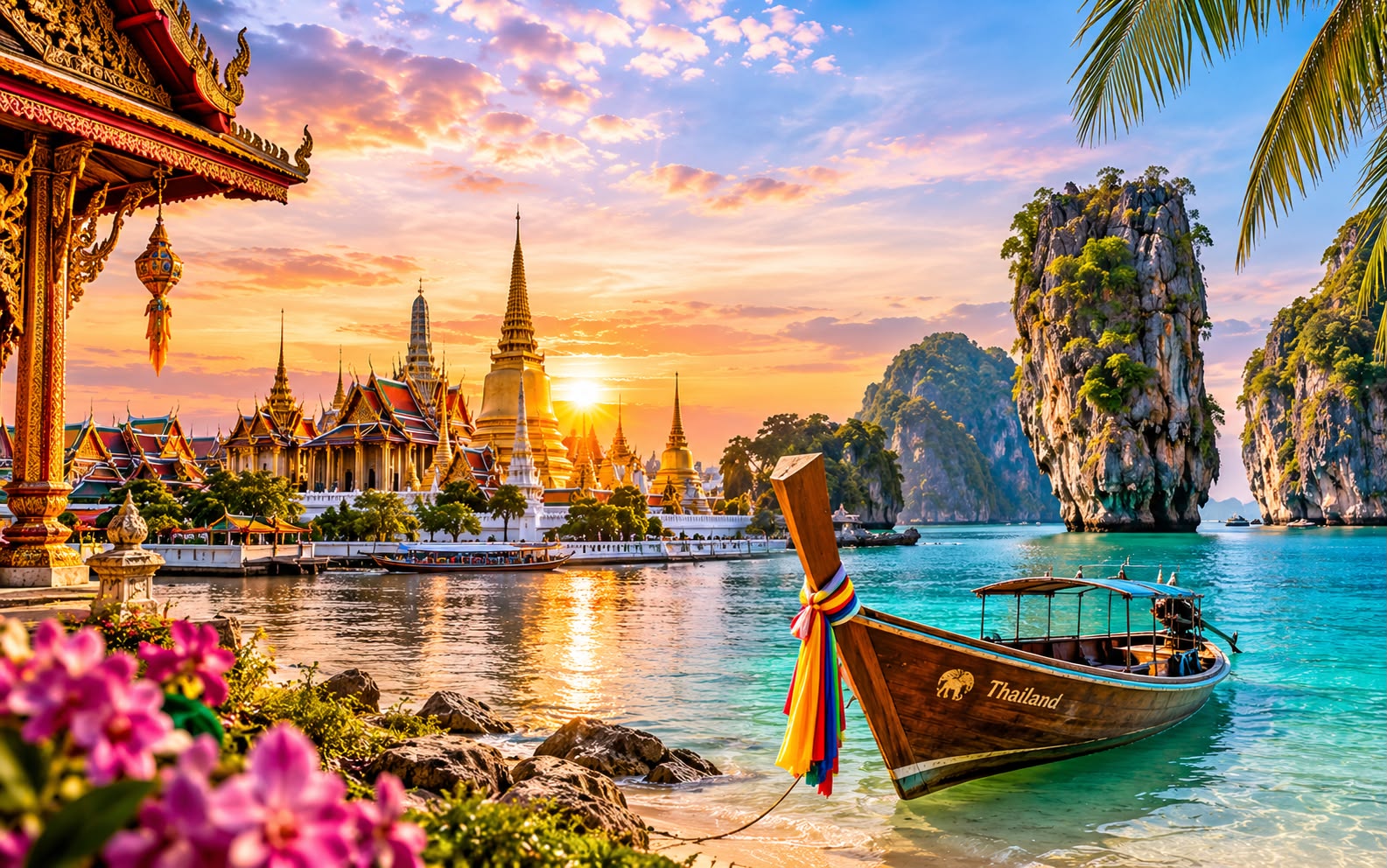
Thailand in 10 days: Bangkok, Chiang Mai and Phuket
The kingdom's classic triangle: golden Bangkok and its street-food galaxy, Chiang Mai's temple town with a day among rescued elephants (the ethical way), then Phuket's turquoise island-hopping — plus the September 2026 visa change worth knowing before you book, and the scam-proofing that keeps the trip charmed.
- Southeast Asia
- 10 days
- ≈ AED 3,600 / person
- First-time visitors
Before you go
Thailand is the easiest great trip in Asia — that’s not faint praise, it’s the engineering. Well connected from almost anywhere, visa-free for most tourist passports, US$1 street food that outclasses most restaurants, and an internal flight network that turns a three-Thailand itinerary — capital, mountains, islands — into three easy hops.
Bangkok is sensory theatre: golden spires, boat-crossed rivers, Michelin-starred woks on plastic stools. Chiang Mai is the calm north: 300 temples inside a moated old town, and the best place on earth to meet elephants without harming them. Phuket is the Andaman playground — and the launchpad for the Phi Phi islands’ absurd turquoise.
Go November–February (the cool, dry, glorious season — book ahead, everyone knows). March–May is hot; February–April is smoky-season in Chiang Mai (crop burning — AQI apps don’t lie; more below); May–October is the Andaman monsoon: green, cheap, with rough seas some days and boat cancellations possible. All costs are in Thai baht (THB).
Before you go: the visa just changed — read this first
The allowances changed
- The allowances changed on 15 September 2026, so check yours. Thailand admits most tourist nationalities without a visa, and several allowances were shortened at the same time — Indian passports now get 30 days, down from the 60-day exemption of 2024–2026. Still free, still no paperwork beyond the arrival card, and 30 days swallows this trip whole. Need longer? A 30-day extension costs ~฿1,900 at any immigration office.
- Passport valid 6+ months; an onward/return ticket isn’t strictly mandatory but immigration may ask — carry the booking anyway. The exemption follows your passport, not where you live.
- Frequent Thailand-hoppers note: back-to-back visa-exempt entries now attract scrutiny — a tourist pattern is fine, a living-there pattern isn’t.
The TDAC is mandatory
- The TDAC (Thailand Digital Arrival Card) is mandatory for everyone — a free online form (passport, flight, first-night address) completed within 3 days before departure; the QR code is scanned at immigration and airlines can ask for it at check-in. Use only the official tdac.immigration.go.th — paid “agents” for this free form are the trip’s first scam.
Money, scams and the respect rules
- Cash still rules street Thailand: cards work in malls and hotels, but stalls, songthaews, boats and massage shops are cash-first — carry ฿2,000–3,000 in small notes. Yellow-and-green 7-Elevens (every 200 metres, a national institution) top up everything.
- Tipping: not expected; rounding up or ฿20–50 for good service is warm. Massage therapists: ฿50–100 is kind.
- The scam playlist, pre-heard: anyone at the Grand Palace saying “it’s closed today” is steering you to a gem shop — walk on, it’s open. Tuk-tuk “฿20 city tours” end at tailor shops. Meter-refusing taxis are solved by Grab/Bolt (Thailand’s Ubers — use them everywhere). Phuket’s jet-ski damage scam is dodged by not renting jet skis. That’s 95% of Thai crime against tourists: theatre, not violence.
- The respect rules are real law: Thailand reveres its monarchy — never joke about or disrespect the royal family (lèse-majesté carries prison); stand for the royal anthem (cinemas, 08:00/18:00 in parks). Temples: shoulders and knees covered, shoes off, never point feet at Buddhas, women don’t touch monks. Buddha-image souvenirs are technically restricted — buy amulets, not statues.
- eSIM ~US$8–15 or airport SIMs; Grab, Google Maps and Translate cover the rest. Tap water no; ice in establishments is factory-made and fine.
Day by day
Day 1 — Land in Bangkok, eat in Chinatown
Stay on the riverside (ferries, sunsets, old Bangkok) or along the BTS Skytrain (Sukhumvit/Siam — fastest city logistics).
- Afternoon — Land BKK, a hub with non-stops from most of the world. Rail Link or Grab in (~฿350–500 by car, 45–60 min).
- 18:30 — Straight into the deep end: Yaowarat (Chinatown) after dark — neon Cantonese signs, wok fire, the ฿60–150 stalls with Michelin Bib stickers. Eat in sequence: guay jub pepper soup, mango sticky rice, kanom buang crêpes. This is the best first evening in Asia.
Where to stay in Bangkok (three nights)
- Luxury: The Okura Prestige — 4.8/5 on TripAdvisor (~5,800 reviews), Japanese-precision tower with a cantilevered infinity pool, BTS-linked. ~฿6,500–9,000.
- Mid-range: Eastin Grand Hotel Phayathai — 4.9/5 (~1,500 reviews), TripAdvisor’s #1 value in the city, direct BTS access, skyline pool. ~฿3,000–4,500.
- Budget/old-town: Rambuttri Village Inn — the Khao San district’s long-serving courtyard cheapie with a rooftop pool; simple, social, ~฿800–1,200.
Day 2 — The golden day: palace, reclining Buddha, dawn temple
Dress for temples all day (covered shoulders/knees — light cotton, not shorts-plus-scarf improvisation).
- 08:00 — The Grand Palace & Wat Phra Kaew at opening (฿500, kids under 120 cm free): the Emerald Buddha in its gilded cosmos, the mosaic guardians, the murals. Two hours before the heat and coaches. (Rehearse the scam response: it is not closed.)
- 10:30 — Walk 10 minutes to Wat Pho (฿300, includes a water bottle): the 46-metre gold Reclining Buddha, mother-of-pearl feet, and the courtyard stupas. This is also Thai massage’s birthplace — the on-site school charges ~฿320/30 min for the real curriculum.
- 12:30 — Riverside lunch at Tha Tien pier stalls (~฿80–150).
- 13:30 — Cross-river ferry (฿5!) to Wat Arun (฿200) — the porcelain-encrusted Temple of Dawn; climb the steep central prang terraces.
- 15:30 — Long-tail or Chao Phraya Express back; ice coffee; optional Jim Thompson House (฿250 — the silk king’s teak mansion and Thailand’s best small museum).
- 18:30 — Golden hour: Wat Arun viewed from across the river at a Tha Tien rooftop (the photo), dinner around Khao San/Rambuttri’s calmer lanes or a proper riverside restaurant (~฿200–450).
Day 3 — Markets and choices
Pick by day-of-week and appetite:
- Weekend? — Chatuchak Market (free): 15,000 stalls, planet-scale — go at 09:00, exit by heat-stroke o’clock with coconut ice cream inside you.
- The rails-and-boats day: the Maeklong Railway Market (stalls fold back for the train, eight times daily) + Damnoen Saduak floating market combo tours (~฿1,300–1,800 pp, morning) — touristy, undeniably fun with kids.
- The history day: DIY train to Ayutthaya (from ~฿20–50!): the ruined 14th-century capital by bicycle — Buddha head in the banyan roots at Wat Mahathat, ฿50 per major temple.
- 19:00 — Back for the modern-Bangkok evening: ICONSIAM’s food floor and light fountain, or muay thai at Rajadamnern (from ~฿1,500–2,500 — the real thing, electric even for non-fans).
Day 4 — Fly north, temple dusk in Chiang Mai
- 09:30 — BKK → Chiang Mai (1h15; Thai/AirAsia/Nok from ~฿1,200–1,800 with a bag — book ahead, fares crawl upward).
- 12:30 — Check into the old city (the moated square mile) or riverside; lunch = your first khao soi (curried noodle soup with crispy nest — ฿60–90 — the north’s dish and possibly Thailand’s best).
- 15:00 — Old-city temple walk: Wat Phra Singh’s gilded Lanna hall → Wat Chedi Luang — the massive ruined chedi that once held the Emerald Buddha; stay for the 17:00-ish monk chat/evening chanting (free; genuinely moving).
- 19:00 — North Gate (Chang Phueak) night market: the cowboy-hat khao kha moo (braised pork leg) queue is famous; halal and veg carts share the block (~฿50–120 dinner).
Where to stay in Chiang Mai (three nights)
- Luxury: Na Nirand Romantic Boutique Resort — 4.9/5 (~1,800 reviews), Lanna teak colonial under a riverside rain tree. ~฿4,500–6,500.
- Mid-range: 99 The Heritage Hotel — 4.8/5, colonial courtyard calm inside the old city. ~฿1,800–2,800.
- Budget: the old city’s guesthouse economy is Thailand’s best — spotless family-run rooms at ฿600–1,000; pick by current reviews and stay inside the moat.
Day 5 — The elephants, done right
- 07:30 — Pickup for Elephant Nature Park — the sanctuary that rewrote Asia’s elephant tourism: ฿2,500 per person for the day visit (transport from the city and a huge vegetarian buffet included; book weeks ahead — it’s non-refundable and sells out). You’ll walk with rescued herds, feed the old ladies watermelon, and hear each elephant’s logging-or-trekking-camp backstory.
- The ethics box, plainly: if a camp offers riding, shows, or tricks — it’s exploitation, full stop (breaking an elephant to carry humans is exactly what it sounds like). Even bathing-with-elephants programmes have been phased out by the best sanctuaries as stressful. Watching giants be giants is the premium experience — this is the one booking on the site we’ll be preachy about.
- 17:30 — Back in town, spectacularly happy. Massage (฿300–450/hour — the Women’s Correctional Institution Vocational Centre’s programme is famous and superb), dinner in a riverside garden (~฿150–350).
Day 6 — The mountain temple, then knives out (cooking class)
- 07:30 — Red songthaew (shared truck-taxi, ~฿50–80 each way from the zoo stop) winding up to Wat Phra That Doi Suthep (entry ~฿50): 306 naga-flanked steps to the gold chedi with the whole valley below — mornings beat both haze and crowds. Optional add-on: Bhubing Palace gardens or a Hmong village further up.
- 12:30 — Back down for Nimman’s café district — the north grows Thailand’s coffee, and it shows (~฿70–120 a cup, worth it).
- 15:00 — Thai cooking class (~฿1,200–1,500, 4 hours with a market tour): you will make khao soi and pad thai better than your hotel’s, and the recipe booklet is the trip’s most-used souvenir. (Sunday instead? The Sunday Walking Street market swallows the old city whole from 16:00 — do that.)
- 20:00 — Night Bazaar wander or rooftop farewell to the north.
Day 7 — Fly to the island
- 10:00 — CNX → Phuket direct (~2 h; AirAsia/Thai from ~฿1,900–2,600 with a bag).
- 13:00 — Check in at Kata or Karon (this guide’s base: real beaches, family-calm, 20 minutes from the circus). Patong is the nightlife capital — visit by choice, sleep elsewhere.
- 15:00 — Beach afternoon: Kata’s surf-school waves (seasonal), Karon’s three white kilometres. Flag rule is law: red flag = no swimming, monsoon rips are Phuket’s real danger, not sharks.
- 18:30 — Karon Viewpoint for the three-bays sunset shot, then grilled seafood dinner — Muslim-owned beachfront grills around Kata/Rawai are both excellent and halal (~฿300–600 for two, pick your snapper by weight).
Where to stay in Phuket (three nights)
- Beachfront luxury: Phuket Marriott Resort & Spa, Merlin Beach — 4.7/5 (~8,000 reviews), private-bay seclusion with three pools. ~฿6,000–9,000.
- Mid-range: Chanalai Flora Resort — 4.9/5 (~4,000 reviews), pools-and-views hillside steps from Kata Beach. ~฿2,500–4,000.
- Value: Hotel Clover Patong — 4.9/5 (~3,200 reviews), TripAdvisor’s #1 value on the island, rooftop pool (choose it if Patong’s buzz is a feature for you). ~฿1,500–2,500.
Day 8 — Phi Phi: the turquoise day
- 07:30 — Speedboat day tour to the Phi Phi islands (~฿2,000–2,600 pp including hotel pickup, buffet lunch and national-park fees — verify the park fee’s inclusion when booking): Maya Bay (The Beach’s bay — viewing platforms and shallows only, no swimming, and it typically closes August–September for reef recovery), the cliff-walled Pileh Lagoon swim, Viking Cave, snorkelling over parrotfish at Khai or Bamboo Island.
- The honesty: it’s a conveyor-belt of longtails and speedboats because it’s that beautiful — book the earliest departure, and choose operators capping ~30 guests. Monkey Beach’s macaques bite; feed nothing.
- 17:00 — Back; recovery massage (฿400ish); night market dinner (Chillva or Karon Temple market on its nights).
Day 9 — Big Buddha, Old Town, last beach
- 09:00 — The Big Buddha (free; 45 m of white marble on the ridge, island-wide views; dress modestly) and Wat Chalong, Phuket’s grandest temple (free, donations).
- 11:30 — Phuket Old Town: Sino-Portuguese shophouses in crayon colours along Thalang and Soi Romanee, third-generation Hokkien coffee shops, the ฿80 local lunch (try Hokkien mee or roti at a Muslim canteen — the Old Town’s halal heritage runs deep).
- 15:00 — Final beach hours; parents alternate massage shifts; kids build the last sandcastle.
- 19:00 — Farewell dinner: Rawai seafood grills or a Kata cliffside table (~฿400–900 for two). (Bangla Road, for the curious: one loud neon street in Patong — adults-only energy; families lose nothing by skipping.)
Day 10 — Home, directly
- Morning — HKT flies non-stop to several long-haul hubs (Emirates, Etihad, flydubai) — the open-jaw (into Bangkok, out of Phuket) that makes this triangle effortless. Last mango sticky rice at the gate.
Costs and practicalities
Best time to visit
November to February is the cool dry season and the best of the year — Bangkok around 32°C instead of 38°C, and the humidity finally off. It is also peak: book Chiang Mai and the islands well ahead over Christmas and New Year.
- November–February — dry, clear, busiest, dearest.
- March–May — the hot season, 35–40°C inland, and genuinely draining by April. Songkran, 13–15 April, turns the whole country into a water fight and is worth planning around in either direction.
- June–October — the southwest monsoon. Rain arrives as a hard afternoon hour rather than all day, the country is green, and prices drop by a third.
The two coasts have opposite weather, which catches people out. The Andaman side — Phuket, Krabi, Phi Phi — is at its best November to April. The Gulf side — Koh Samui, Koh Phangan, Koh Tao — has its wettest spell October to December and is good February to September. A trip in November doing both will find one of them grey.
Loy Krathong and Yi Peng, the lantern festivals, fall on the November full moon and are the one date worth building a trip around.
Travel tips
- Vapes are illegal. Possession can mean confiscation, a fine, and in principle worse — this is the single most common way visitors get into trouble, and the ban is enforced at airports. Leave them at home.
- Cannabis is legal but regulated, and the rules have tightened since 2022. Buying is easy; carrying any across a border, in either direction, is not.
- Dual pricing is normal at national parks — foreigners pay several times the Thai rate, posted openly. It is not a scam; budget for it.
- Overnight trains are better than they look. Bangkok–Chiang Mai in a second-class sleeper is comfortable, and books out days ahead in high season. Domestic flights are often cheaper than the train.
- Street food is safe where there is a queue. High turnover is the whole test. Point at what you want; “mai phet” means not spicy and will still be spicier than you expect.
- Vegetarians should learn “jay” (เจ) — it means vegan in practice. “Mangsawirat” is vegetarian but fish sauce often still appears.
- Dog and monkey bites need immediate attention. Rabies is present; Lopburi’s monkeys in particular bite. Thai hospitals are excellent and cheap for this.
- Put paper in the bin, not the bowl. The spray hose beside the toilet is the local method and works better than it looks.
What this trip actually costs
Two people, 9 nights (3+3+3), mid-range comfort, international flights excluded:
| Item | Cost |
|---|---|
| Hotels, 9 nights | THB 22,000 (≈ AED 2,408) |
| Domestic flights BKK→CNX and CNX→HKT, two seats with bags | THB 7,000 (≈ AED 766) |
| Local transport: Grab, BTS, ferries, songthaews, airport runs | THB 6,000 (≈ AED 657) |
| Entries & activities: Grand Palace, Wat Pho, Wat Arun, river boats, Elephant Nature Park, Doi Suthep, Phi Phi speedboat day | THB 12,000 (≈ AED 1,313) |
| Food, 10 days (street-stall powered) | THB 14,000 (≈ AED 1,532) |
| eSIM, TDAC (free), extras | THB 800 (≈ AED 87.55) |
| Buffer: massages (plural — this is Thailand), cooking class, muay thai, markets | THB 4,200 (≈ AED 460) |
| Total for two | THB 66,000 (≈ AED 7,223) |
- Roughly THB 33,000 (≈ AED 3,611) per person (~US$1,000) — the best value-per-wonder on this site: the food budget above assumes eating brilliantly twice a day for the price of one airport coffee. Guesthouse beds and ferry-not-speedboat choices pull it toward THB 25,000 (≈ AED 2,736); beachfront villas and daily spa treatments still struggle past THB 55,000 (≈ AED 6,019).
- Book in this order: flights (open-jaw BKK in / HKT out — direct both ways) → hotels free-cancel (Nov–Feb fills early) → Elephant Nature Park weeks ahead (non-refundable, capped) → domestic flights → TDAC in the 3 days before departure (free, official site only) → cooking class and Phi Phi tour a few days out → everything else — temples, markets, massages — walks up with cash.
- Hotel and restaurant picks here are unsponsored — no affiliate links in this article. Chosen on location and current ratings; always check prices and recent reviews before booking.
What to pack
- Temple kit: covered-shoulder layers, slip-on footwear (you’ll de-shoe ten times a day), a sarong solves everything.
- Reef-safe sunscreen (the Andaman’s reefs need it), after-sun, and a rash vest for snorkel day.
- A dry bag for boats + waterproof phone pouch.
- Mosquito repellent (dusk, everywhere), rehydration salts, and the stomach kit you’ll probably never open — street food from busy stalls has better turnover than hotel buffets.
- Light rain shell (any month can shower); one warmer layer for over-air-conditioned flights and malls.
- Room in the bag for the return: elephant-pants gravity affects everyone eventually.
FAQ
The visa change — does 30 days affect this trip? Not this one: 10 days sits comfortably inside the new 30-day exemption (in force 15 September 2026; it was 60 days before). Just don’t skip the TDAC — filled in the 72 hours before departure, free, official site only — airlines increasingly check it at the counter.
Is Thailand safe? What actually goes wrong? Violent crime against tourists is rare; what goes wrong is scripted: gem-shop tuk-tuks, “closed today” touts, meterless taxis (Grab kills this), jet-ski deposits, red-flag swimming, and scooter rentals — the true #1 tourist injury. No licence + no helmet + first-ever scooter + Phuket hills is the accident recipe; this itinerary simply never needs one.
Elephant riding — really that bad? Yes. The training that makes an elephant rideable is brutal, and reputable sanctuaries (Elephant Nature Park first among them) exist precisely as the alternative. Watch, feed, walk alongside — the experience is better and kinder. If a place offers rides or shows, spend your baht elsewhere.
Which months for which coast? November–February: everything works (book early). Andaman side (Phuket/Phi Phi/Krabi): best Nov–Apr, monsoon swells May–Oct. Gulf side (Samui/Tao) runs roughly opposite (driest Jan–Aug). Chiang Mai’s smoky season (late Feb–mid Apr) is real — asthmatics and families should aim north-time at Nov–Jan. Songkran (13–15 April) is the national water fight: chaos, joy, everything wet.
Halal and vegetarian food? Easier than almost anywhere in this series: Thailand’s south is heavily Muslim — Phuket’s Old Town and beach grills have deep halal roots — Bangkok clusters halal kitchens around Sukhumvit/Nana and Chinatown’s edges, and Chiang Mai’s famous Khao Soi Islam serves the signature dish halal by default. Vegetarians ride the “jay” (เจ) vegan tradition, tofu pad thai and mango sticky rice — but fish sauce hides everywhere: “mai sai nam pla” (no fish sauce) is the phrase to screenshot.
Phuket or Krabi for the island leg? Phuket wins this itinerary on pure logistics (direct CNX flights in, long-haul out of HKT) and family infrastructure. Krabi (Railay’s cliffs, Ao Nang’s laid-back strip, closer Phi Phi runs) is arguably more beautiful and 20% cheaper — the perfect swap for second-timers, and a pillar of our next Thailand guide.
What’s Thailand guide #2? Either Krabi + the Gulf islands (Railay, Koh Samui, snorkel-diving Koh Tao) or the northern deep-cut (Chiang Rai’s White Temple, the Golden Triangle, Pai). The beaches are currently winning the argument.
Prices and entry rules change, and what you need depends on your passport; last checked 8 October 2026, so confirm with the embassy or your airline before booking.


