 The Itinerary
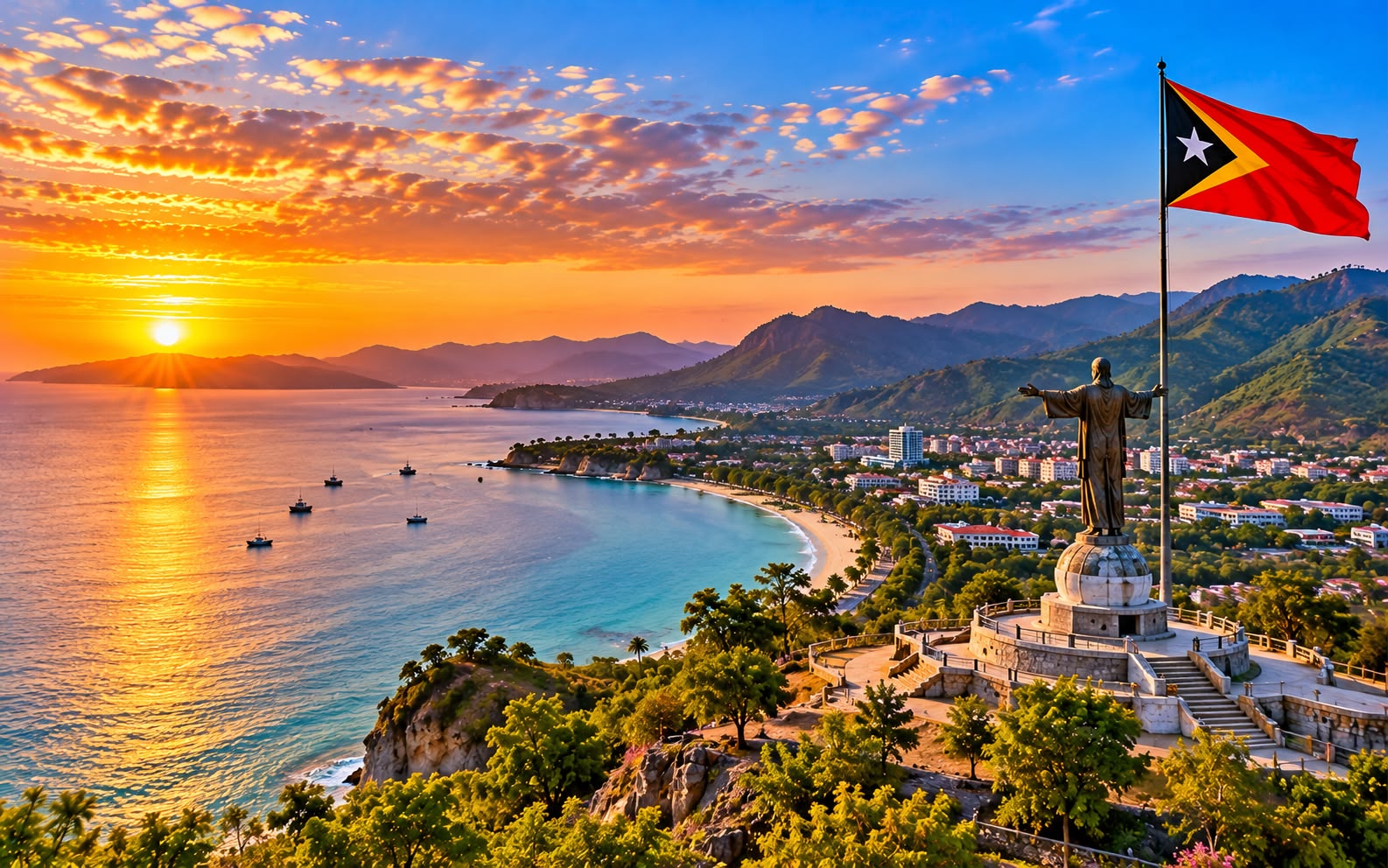
Timor-Leste in 7 days: Atauro's reefs, Dili and the Ramelau highlands
An island whose surrounding water was found to hold the highest average reef fish diversity on record, a three-thousand-metre peak climbed in the dark for sunrise, and a country that restored its independence in 2002 — reached by a road network where a hundred kilometres is most of a day.
- Southeast Asia
- 7 days
- ≈ AED 2,750 / person
- The richest reef fish counts ever surveyed, and Asia's newest country
Before you go
Timor-Leste occupies the eastern half of an island at the bottom of the Indonesian archipelago, plus an exclave on the other side of it. It was Portuguese for four centuries, occupied from 1975, and restored its independence in 2002, making it one of the youngest countries in the world. Almost nobody goes, which is most of the appeal and some of the difficulty.
Atauro Island is the headline, and it is a serious one. A 2016 reef survey found the waters around it held the highest average reef fish diversity ever recorded — higher than anywhere in the Coral Triangle, which is saying something. The drop-offs start a few metres from shore, the visibility is routinely enormous, and there are perhaps a handful of dive operations on the whole island.
Mount Ramelau is the other. At 2,986 metres it is the high point of the country, climbed before dawn from the village of Hato Builico, with a statue of Our Lady on the summit and, on a clear morning, both coasts visible at once.
Dili itself is low-rise, hot and strung along a bay, with Cristo Rei standing on a headland at the eastern end and a set of museums about the occupation and the resistance that are among the most affecting anywhere. They are not an easy afternoon and they are the reason to spend time in the capital.
Seven days covers the north coast and the mountains properly. Figure USD 750 (≈ AED 2,754) per person excluding flights. Go May–November, the dry season, with September–December best for diving and for whales in the strait.
Before you go: the 15-minute admin
Distances lie, and the boat runs to a timetable
- This is the thing that wrecks itineraries here. The map shows a small country. The roads do not behave like one.
- Dili to Baucau is about 120 kilometres and takes three to four hours. Mountain roads are worse. Landslides in the wet season close them outright.
- A 4WD is not optional once you leave the coast road, and a driver is strongly advised — they know which routes are passable this week, which you cannot find out any other way.
- The Atauro ferry runs only a couple of times a week on the government boat, takes around three hours, and is cheap. Fast private boats run most days in good weather, take 60–90 minutes, and cost considerably more.
- Build the trip around the boat, not the other way round. Confirm the schedule with your lodge before you fix any other day — it changes, and it is the hinge of this itinerary.
- Leave slack before your flight home. Weather cancels boats, and being stuck on Atauro is delightful right up until it is not.
Visas and arrival
- Most nationalities get a visa on arrival at Dili airport for US$30, valid 30 days. Bring it in cash, in clean US dollars.
- Some nationalities must apply in advance — check your own case officially before booking.
- Arriving overland from Indonesian West Timor has different rules from arriving by air; confirm before you plan that route.
- Passport valid six months, onward ticket sometimes requested.
Money
- The US dollar is the official currency. There is no separate national note; local centavo coins circulate for small change.
- Bring cash. ATMs exist in Dili and are unreliable elsewhere; cards are accepted at a handful of Dili hotels and essentially nowhere else.
- Small, clean notes. Breaking a fifty outside the capital is genuinely difficult.
- Costs are moderate: guesthouses and food are cheap, while transport and diving are not, because both are imported in effect.
SIM and data
- Telkomcel and Timor Telecom sell SIMs at the airport and in Dili. Cheap, and worth having.
- Coverage is decent in Dili and along the north coast, patchy in the mountains, and limited on Atauro — where most lodges have no wifi at all and say so proudly.
Crocodiles, honestly
- Saltwater crocodiles live here and attacks happen. This is not a footnote; it is a real hazard on the south coast, in river mouths, estuaries and mangroves, and occasionally elsewhere.
- Ask locally before entering any water that is not a known, used swimming beach or a dive site. The answer is reliable and freely given.
- The north coast beaches used by divers and the Atauro sites are generally regarded as safe, and are where this itinerary swims.
- Crocodiles are culturally revered — the national origin story has the island formed from one — which means they are not removed. Respect the advice.
Getting around
- Dili is walkable along the waterfront and small enough for taxis, which are cheap and should be agreed in advance.
- Microlets — minibuses — run fixed numbered routes in the capital for a few cents.
- Outside Dili: hire a 4WD with a driver. Around $100–140 a day including fuel. This is the single best decision on the trip.
- Fuel stations are sparse in the interior. Fill up when you can.
Travelling with kids?
- Snorkelling straight off the beach on Atauro is world-class and needs no boat, which suits children well.
- The road days are long and rough, and that is the limiting factor rather than anything else.
- Ramelau is a pre-dawn climb of two to three hours on a rocky path — judge honestly.
- Medical facilities are limited outside Dili. Travel insurance with evacuation cover is not optional here.
Day by day
Day 1 — Dili
- Morning — Land, visa on arrival, into town in 15 minutes.
- 11:00 — Get your bearings along the waterfront, and the Tais Market — hand-woven textiles, each pattern specific to a district, and the best thing to take home.
- 14:00 — Cristo Rei, on the headland at the eastern end of the bay. Around six hundred steps up past Stations of the Cross to a statue on a globe, with the coast on both sides from the top. Go late afternoon; there is no shade.
- 16:30 — Down the back of the headland to Dollar Beach and the long strand beyond it for a swim.
- 19:00 — Dinner on the seafront. Dili eats Portuguese, Indonesian and Timorese, often in the same restaurant.
Where to stay in Dili (three nights across the trip)
- Mid-range: the waterfront near the Palácio do Governo, walkable to most of this.
- Value: guesthouses in Lecidere and Bidau, a short microlet ride out.
Day 2 — The occupation, the resistance, and the coffee
- 09:00 — The Chega! Exhibition at the former Balide prison (Comarca), used as a detention centre during the occupation and now the archive of the truth commission that took its name. It is small, plainly presented and extremely hard going. It is also the most important hour in the country.
- 11:30 — The Timorese Resistance Archive and Museum, which tells the other half — the clandestine network, the diplomatic campaign, and the referendum.
- 14:00 — Santa Cruz cemetery, where the 1991 massacre was filmed by a British journalist and the footage changed international opinion of the occupation. Quiet, ordinary, and worth standing in.
- 16:00 — Lighter: a coffee roastery in town. Timorese arabica, much of it organic by default, grows in the Ermera highlands and is the country’s main agricultural export.
- Evening — Confirm tomorrow’s boat.
Day 3 — To Atauro
- 07:00 — Boat to Atauro, 25 kilometres north across the Wetar Strait. The government ferry takes about three hours; a fast boat takes half that.
- Watch the water on the crossing. The strait is deep and on the migration route; blue whales, pilot whales, spinner dolphins and melon-headed whales are all seen here, most reliably October to December.
- 11:00 — Arrive at Beloi or Vila, settle into a lodge. Accommodation is simple, built of local materials, and usually full board because there is nowhere else to eat.
- 14:00 — Snorkel straight off the beach. The reef shelves within swimming distance of the shore and drops away sharply. This is the easiest world-class snorkelling you will ever do.
- Evening — No wifi, no traffic, and a lot of stars.
Day 4 — Atauro diving
- 08:00 — Two boat dives. The sites along the east coast are walls and slopes with coral in excellent condition and fish counts that are the reason researchers came here in the first place.
- Non-divers: the snorkelling over the same sites is outstanding, and the Discover Scuba day is a good first dive if you have never been.
- 14:00 — Walk inland. Atauro is steep and dry, and the villages up the hill — Makadade and the paths between them — are a different country from the shore.
- Alternatively, the women’s cooperatives in Vila sell dolls and crafts that fund a large share of the island’s income.
Day 5 — Back to Dili, and up to Maubisse
- 07:00 — Boat back to Dili.
- 11:00 — Collect the 4WD and head south into the mountains.
- 13:30 — Maubisse, around 70 kilometres and most of three hours, climbing the whole way through coffee terraces. The old Portuguese pousada on the hill above the town is the place to stop even if you do not stay.
- 16:00 — Continue to Hato Builico, the village at the foot of Ramelau. Basic guesthouses, cold at night, and an early start tomorrow.
Day 6 — Mount Ramelau at sunrise
- 03:30 — Up Ramelau. Two to three hours on a rocky path to 2,986 metres, in the dark, with a guide from the village.
- 05:30 — The summit, the statue of Our Lady of Ramelau placed there in the 1990s, and — on a clear morning — the north coast and the south coast both visible from one spot.
- 08:00 — Back down for breakfast.
- 11:00 — Drive to Dili, three to four hours with stops.
- 16:00 — A last swim, and dinner on the waterfront.
Day 7 — Fly out
- Morning — The Archive and Museum of Timorese Resistance if you missed it, or the Sunday market.
- Midday — Airport, 15 minutes. Flights go to Bali, Darwin and Singapore.
If you have a second week, go east instead of repeating the capital: Baucau for the Portuguese town and the coast below it, Com and Tutuala, and Jaco Island at the far tip — an uninhabited island considered sacred, which fishermen will row you to and on which nobody is permitted to stay the night.
Costs and practicalities
Best time to visit
May–November is the dry season and the practical window for the mountain roads and for diving Atauro.
- May–November — dry, and the best for the Baucau road, Mount Ramelau and the south coast. Diving visibility off Atauro and Dili is at its best from September to November.
- December–April — the wet season, with heavy rain and landslides closing mountain roads. The south coast has a second, longer wet season than the north.
- Mount Ramelau is climbed before dawn to reach the 2,986m summit for sunrise, and the trail is clearest in the dry.
- Whale and dolphin migration through the Wetar Strait peaks October to December, and the strait’s deep water makes it one of the best cetacean corridors in Asia.
Independence Day on 20 May and Restoration Day on 28 November are the national dates.
Travel tips
- Timor-Leste is one of the least visited countries in Asia and infrastructure is limited. Expect basic accommodation outside Dili and build slack into every plan.
- The US dollar is the official currency, with local centavo coins. Bring small notes; ATMs are in Dili and a few district capitals.
- Tetum and Portuguese are official; Indonesian and some English are widely understood.
- A 4x4 is needed for most of the country. The coastal road east to Baucau is paved; almost everything else is not, and journey times are long.
- Atauro Island is reached by ferry or fast boat from Dili — the ferry runs on limited days, so check before planning.
- Malaria and dengue are both present. Prophylaxis and repellent.
- The resistance history is recent and personal. The Chega! exhibition and the Santa Cruz cemetery deserve a guide and a serious manner.
What this trip actually costs
Two people, 6 nights, simple comfort, flights excluded:
| Item | Cost |
|---|---|
| Dili and Maubisse, 4 nights | USD 320 (≈ AED 1,175) |
| Atauro lodge, 2 nights, full board | USD 240 (≈ AED 881) |
| Boats to Atauro and back, two | USD 100 (≈ AED 367) |
| 4WD with driver, 3 days | USD 360 (≈ AED 1,322) |
| Diving and snorkelling, two | USD 220 (≈ AED 808) |
| Food and drink in Dili, 5 days | USD 200 (≈ AED 735) |
| Visas on arrival, two | USD 60 (≈ AED 220) |
| Total for two | USD 1,500 (≈ AED 5,509) |
- Roughly USD 750 (≈ AED 2,754) per person. Accommodation and food are cheap; transport and diving are not, and together they are over half the budget.
- The 4WD and driver split well. Four people pay the same as two, which changes the per-person figure substantially.
- Skip the fast boat and take the government ferry if the schedule suits — it is a fraction of the price and the crossing is part of the trip.
- Bring all of it in cash. This is not a country where you can top up from an ATM when you run short.
- Hotel picks here are chosen on location, not on commission — always check prices and recent reviews before booking.
What to pack
- US dollars in cash, clean and in small notes, including the $30 each for the visa.
- Your own snorkel and mask if you have them. Rental exists and is tired.
- A warm layer and a hat. Ramelau before dawn is near freezing, which is hard to believe from Dili.
- Reef-safe sun cream, and far more sun protection than you think.
- A head torch for the Ramelau climb and for Atauro after the generator goes off.
- Any medication you need, plus a basic first-aid kit. Pharmacies outside Dili are thin.
FAQ
Is Timor-Leste safe? Ordinary travel is straightforward and Timorese hospitality is genuine. The real risks are practical rather than criminal: road conditions, limited medical facilities outside Dili, and saltwater crocodiles in the wrong water. Insurance with evacuation cover matters here.
Do I need to dive to make Atauro worth it? No. The reef starts a few metres off the beach, so the snorkelling alone justifies the crossing.
How do I get there? Flights into Dili from Bali, Darwin and Singapore, all short. There is also a land border with Indonesian West Timor.
What language do they speak? Tetum and Portuguese are official; Indonesian and English are working languages. English gets you through Dili and the dive operations, and much less in the mountains.
Why is it so little visited? Flights are limited, roads are slow, and it has no marketing budget. None of those is a reason not to go, and all of them are why the reefs are in the condition they are.
Prices and entry rules change, and what you need depends on your passport; last checked 8 October 2026, so confirm with the embassy or your airline before booking.


