 The Itinerary
UAE and Oman in 9 days: Dubai, Abu Dhabi, Muscat and the Wahiba Sands
Two neighbours that went in different directions: towers, malls and a mosque of inlaid marble on one side of the Hajar mountains, and mud forts, wadis you swim in and a sand sea you sleep in on the other — and the contrast is the reason to do them together.
- Middle East
- 9 days
- ≈ AED 5,900 / person
- The Gulf's two opposite answers to the same desert, a two-hour flight apart
Before you go
Before you go: the admin
Two entries, both easy
- The UAE admits most nationalities visa-free or on arrival. GCC, EU, UK, US, Japanese, Korean and many more get 30 to 90 days at the counter.
- Oman issues an e-visa online in a day or two, and several nationalities now enter visa-free for up to 14 days. Check yours — Oman has liberalised this repeatedly.
- Passports need six months’ validity for both.
- An Israeli stamp is no longer a problem for either country, which is a recent change.
Flights, and the overland option
- Fly into Dubai and out of Muscat, or the reverse. Both are major hubs and an open-jaw costs much the same as a return.
- Dubai to Muscat is 75 minutes in the air and the simplest way to switch countries.
- The overland crossing at Hatta or Al Ain works and takes five to six hours Dubai to Muscat, but most UAE hire-car contracts prohibit taking the car into Oman, and those that allow it charge a cross-border fee and separate insurance. Check before you plan to drive across.
- Hire separately in each country. It is usually cheaper and always simpler than the cross-border paperwork.
Money
- The dirham and the rial are both pegged to the US dollar — AED at 3.67 and OMR at 0.385. The rial is one of the highest-value currencies in the world, so Omani prices look small and are not.
- Cards work almost everywhere in both. Carry some cash for Nizwa’s souq, the wadi car parks and the desert camp.
- Alcohol is in licensed hotels only in Oman and in licensed venues in the UAE. Neither sells it in supermarkets to visitors.
One gentle brief
- The two countries are not variations of each other. Dubai is a built thing, done at speed, and spectacular on its own terms. Oman is old, low-rise and deliberately so — it has a building height limit and no skyscrapers in Muscat at all.
- Oman is the driving half. The roads are excellent, the traffic is light, and the country is best seen from behind a wheel.
- Dress modestly in both, more so in Oman. Shoulders and knees covered in public for everyone, and swim in a T-shirt at the wadis where Omanis swim.
Day by day
Day 1 — Land in Dubai
- Arrive, and take the Metro. It is cheap, clean, air-conditioned and goes to most of what you want. Get a Nol card at the station.
- 16:00 — The Dubai Mall and the Burj Khalifa — book the At the Top slot online, and the 124th floor at sunset is the one worth paying for.
- 18:30 — The aquarium wall, which is visible from the mall floor without a ticket.
- 20:00 — The fountain show on the hour after dark, from the bridge rather than the mall terrace.
- 21:00 — Souk Al Bahar for dinner facing the water.
Day 2 — Old Dubai, which most visitors skip
- 09:00 — Al Fahidi (Bastakiya) in the morning — wind-tower houses, the Coffee Museum, and the Sheikh Mohammed Centre for Cultural Understanding, which runs a question-anything lunch that is the best hour in the city. Book the sitting ahead; they are small and fixed.
- 13:00 — An abra across the Creek for one dirham, which is still the best value in the UAE.
- 14:00 — The gold and spice souqs in Deira on the far bank. Haggle; the first price is not the price.
- 17:00 — The Dubai Frame or Alserkal Avenue in the afternoon, depending on whether you want the view or the galleries.
- 20:00 — Al Seef in the evening, along the creek.
Day 3 — Abu Dhabi, and the mosque
- 07:30 — Ninety minutes down the E11. Go early.
- 09:30 — Sheikh Zayed Grand Mosque is the reason — 82 domes, the largest hand-knotted carpet in the world, and inlaid floral marble that took a decade. Abayas are provided for women at the entrance; men need long trousers and sleeves. Book a free timed slot online.
- 13:00 — Louvre Abu Dhabi in the afternoon, under Jean Nouvel’s perforated dome and its “rain of light”.
- 16:30 — Qasr Al Watan if there is time, which is the presidential palace and more impressive than it sounds.
- 19:00 — Back to Dubai for the evening, or stay and fly from Abu Dhabi tomorrow.
Day 4 — Fly to Muscat
- 10:00 — A short flight, and a different country immediately. Low white buildings, mountains behind the airport, and no towers.
- 14:00 — Settle in Mutrah or Old Muscat, which puts everything tomorrow within reach.
- 17:00 — The Mutrah Corniche in the late afternoon, with the dhows at anchor and the Hajar behind.
- 18:30 — Mutrah Souq at dusk — frankincense, silver khanjars and halwa, and far less hard-sell than Deira.
- Sultan Qaboos Grand Mosque: non-Muslims may visit mornings only, 8am to 11am, Saturday to Thursday, which is why it sits on tomorrow and not today.
Day 5 — Muscat: the mosque, the opera house, the forts
- 08:00 — The Grand Mosque at 8am, which is the only window. The prayer-hall chandelier and the Persian carpet are the things; dress code is strict and headscarves are required for women.
- 11:00 — The Royal Opera House, which is worth the daytime tour even if there is nothing on.
- 14:00 — Al Jalali and Al Mirani forts flanking the Al Alam palace in Old Muscat — the forts are Portuguese and mostly viewed from outside.
- 16:00 — The Bait Al Zubair museum for the khanjar and jewellery collections.
- 18:00 — The Corniche again, and pick up the 4x4 this evening so tomorrow starts early.
Day 6 — Nizwa, Jabreen and the mountain road
- 07:00 — Head inland. Nizwa is 90 minutes. The Friday cattle market is the thing to time — early morning, loud, and entirely unstaged, so shape the week around a Friday here if you can.
- 09:00 — Nizwa Fort, with its enormous round tower and the murder holes above the stair, and the souq beside it.
- 12:00 — Jabreen Castle and Bahla Fort, UNESCO-listed, twenty minutes on. Jabreen has the painted ceilings; Bahla is the walls.
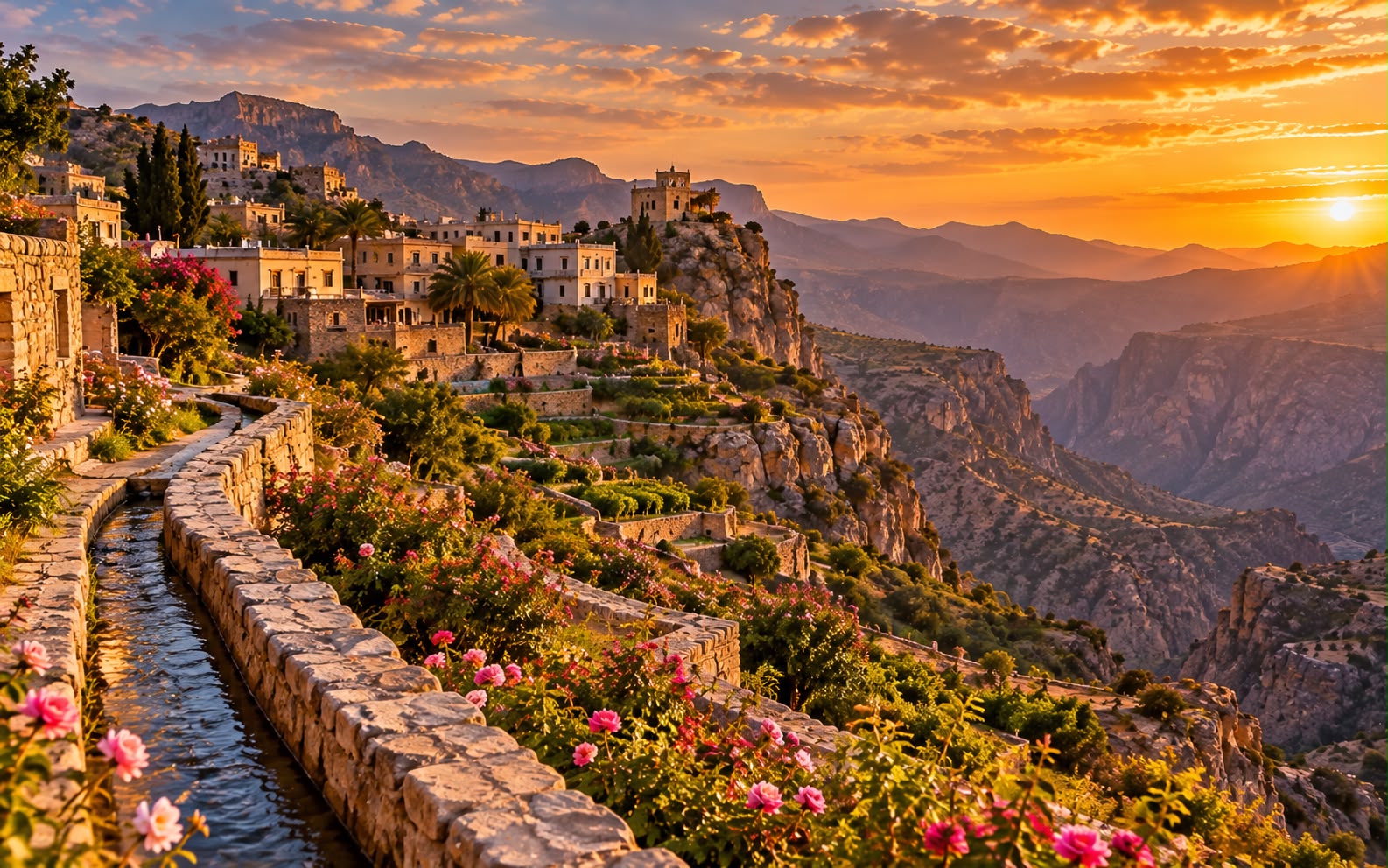
- 15:00 — Up Jebel Akhdar in the afternoon — a 4x4 is legally required at the police checkpoint and they check. The rose terraces, the abandoned villages and the Diana’s Point viewpoint.
- 18:30 — It is 2,000m up here and cold at night — a different climate from the coast entirely.
Day 7 — Wadi Bani Khalid and the Wahiba Sands
- 08:00 — Down off the mountain and east.
- 11:00 — Wadi Bani Khalid on the way east — emerald pools in a gorge, swimmable, and busy at weekends. Swim in a T-shirt and shorts out of respect; Omani families are there too.
- 15:30 — Into the Wahiba in the late afternoon. Deflate the tyres at the edge to around 15–18 psi; the camp will tell you where and will usually guide you in.
- 17:00 — A desert camp for the night — dunes up to 100m, a fire, and the clearest sky of the trip.
- Do not drive the dunes alone or at night. Recovery out here is slow and expensive.
Day 8 — Sur, the turtles, and back to Muscat
- 06:00 — Dawn on a dune is the reason you came out here.
- 09:00 — Sur on the coast for the dhow yards, where they still build them by eye without plans.
- 12:00 — The coast road back to Muscat via Bimmah Sinkhole and Wadi Shab, which is a 45-minute walk and a swim through a slot canyon to a waterfall in a cave. Take a dry bag; the last stretch is swum.
- Allow the whole day. It is four hours of driving plus the stops.
- 18:30 — Ras Al Jinz turtle reserve — green turtles nest here year-round, peaking July to October, and visits are by booked guided group at dusk or dawn only. No flash, no torches.
- If you do the turtles, sleep at Ras Al Jinz and do the coast road tomorrow instead — it does not fit in one day with Wadi Shab.
Day 9 — Fly out of Muscat
- 07:00 — Mutrah fish market early, which is a working market and the best photograph in the city.
- 10:00 — Buy frankincense — the real Boswellia sacra from Dhofar, graded by colour, and the silver burners to go with it.
- The airport is 20 minutes from Mutrah and is calm by Gulf standards — two hours is genuinely enough here.
Costs and practicalities
Best time to visit
November–March is the only comfortable window for both countries, and the Gulf summer is not a matter of discomfort but of genuine hazard.
- November–March — 20–28°C, dry, and the season for everything outdoors: the desert camps, the wadis, Jebel Akhdar and the Dubai beaches. Desert nights are genuinely cold, and the Wahiba in January needs a fleece.
- December–February — the coolest and busiest, with peak UAE rates over Christmas and New Year.
- March–April — the rose harvest on Jebel Akhdar, which is brief and worth timing.
- May–September — 45°C with Gulf humidity on both coasts. Everything that can be indoors is, and the wadis are the only outdoor relief.
- The khareef exception — Oman’s far south at Salalah turns green and misty from late June to early September, which is a different trip entirely and 1,000km from this route.
Ramadan shifts the rhythm in both countries: daytime eating in public is restricted and the evenings become the day.
Travel tips
- The Grand Mosque in Muscat admits non-Muslims mornings only, 8–11am, Saturday to Thursday. Build the itinerary around it; people arrive at two in the afternoon and are turned away.
- Check whether your UAE hire car may enter Oman. Most may not, and the cross-border insurance and fee make flying simpler.
- A 4x4 is legally required for Jebel Akhdar and the police checkpoint turns away saloons. It is also needed for the Wahiba and useful for the wadi tracks.
- Never drive through moving water in a wadi, however shallow. Flash floods are the real hazard in Oman and they kill people every year.
- Deflate the tyres before entering the sand and reinflate at the edge. Driving soft sand at road pressure is how people get stuck.
- Some common prescription medicines are controlled in the UAE, including codeine and some ADHD medications. Check the list and carry a prescription.
- Public displays of affection are an offence in both, and this has led to arrests.
What this trip actually costs
Two people, 8 nights, mid-range comfort, international flights excluded:
| Item | Cost |
|---|---|
| Hotels, 7 nights | USD 1,200 (≈ AED 4,407) |
| Desert camp, 1 night, two people | USD 320 (≈ AED 1,175) |
| 4x4 hire in Oman, 5 days | USD 600 (≈ AED 2,204) |
| Dubai–Muscat flights, two people | USD 300 (≈ AED 1,102) |
| Entries, guides, mosque and forts | USD 220 (≈ AED 808) |
| Food and drink, 9 days | USD 560 (≈ AED 2,057) |
| Total for two | USD 3,200 (≈ AED 11,752) |
- Roughly USD 1,600 (≈ AED 5,876) per person, and the UAE half is where the money goes — Dubai hotels cost roughly double Muscat’s for the same standard.
- The 4x4 is not an upgrade. It is required for Jebel Akhdar and the Wahiba, and the police enforce it.
- Alcohol will add noticeably in both countries if you drink — it is hotel-only and taxed heavily.
- Hotel picks here are chosen on location, not on commission — always check prices and recent reviews before booking.
What to pack
- Modest clothing for public spaces — shoulders and knees covered for everyone, and a headscarf for women at the mosques.
- A T-shirt and shorts you will swim in for the wadis.
- A warm layer for the desert night. This surprises people every year.
- Proper shoes for Wadi Shab — the walk in is rocky and the last stretch is a swim, so sandals that stay on.
- A dry bag for the wadi swim and the sinkhole.
- Serious sun protection and far more water than you think, in the car at all times.
FAQ
Can I drive from Dubai to Muscat? Yes, in five to six hours via Hatta or Al Ain — but most UAE hire cars are contractually barred from entering Oman. Check first; flying is usually simpler and not much dearer.
Which country should I give more days to? Oman, if you like landscape and history. The UAE’s highlights are concentrated and can be covered properly in three days; Oman’s are spread across a country the size of Italy.
Do I need a guide? No. Both countries are easy to self-drive, well signed and safe. A guide for one Muscat morning adds context and is cheap.
Is alcohol available? In licensed hotels and restaurants in both, and nowhere else. Public drinking and intoxication are offences.
When is the mosque in Muscat open to visitors? 8am to 11am, Saturday to Thursday. Closed to non-Muslims on Fridays and every afternoon.
Prices and entry rules change, and what you need depends on your passport; last checked 29 October 2026, so confirm with the embassy or your airline before booking.


