 The Itinerary
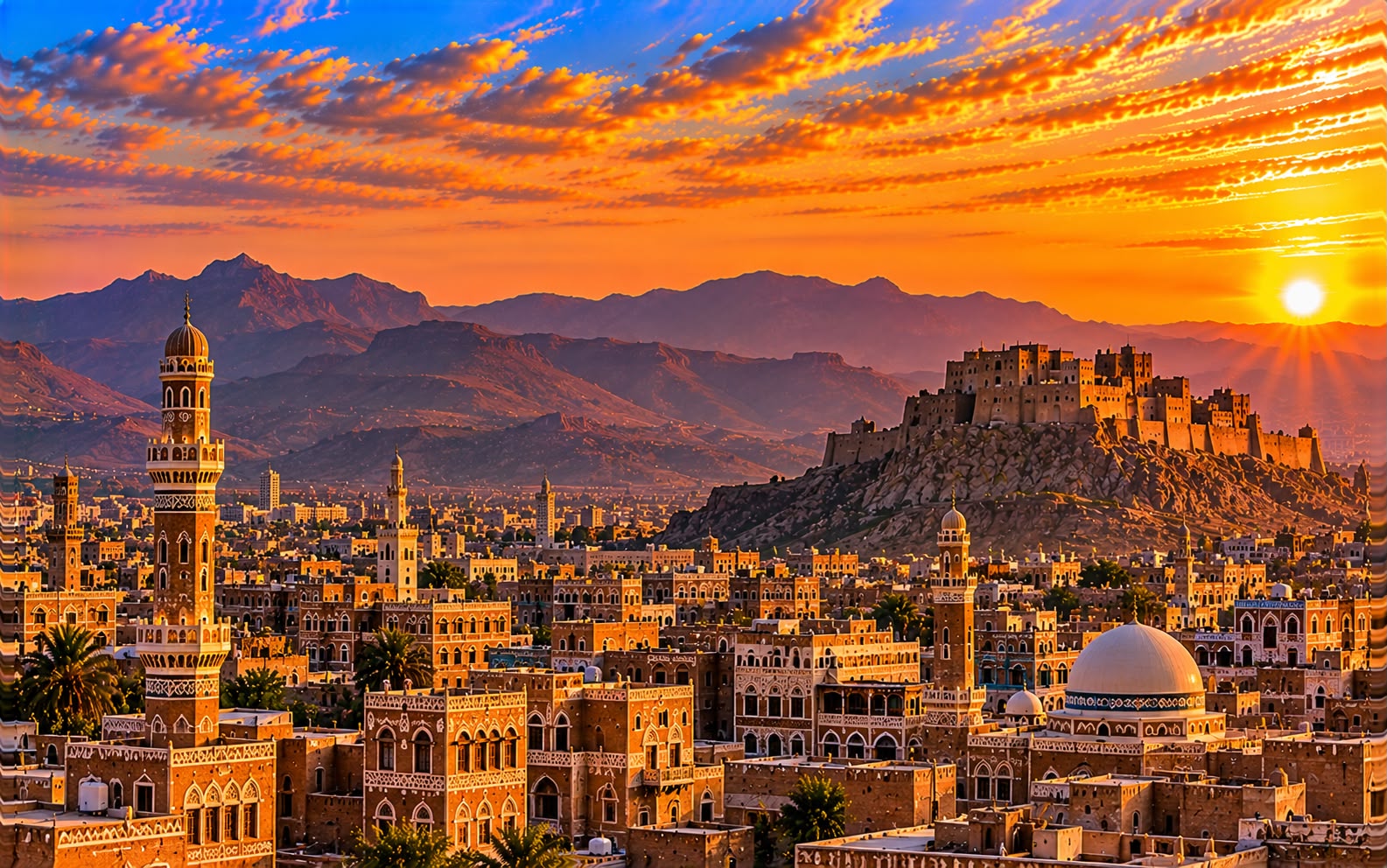
Yemen in 8 days: Socotra's dragon's blood trees — and a mainland you cannot visit
An island of umbrella-shaped trees that bleed red resin, reached by charter from the Gulf — and a mainland holding three more World Heritage sites that is in the middle of a humanitarian catastrophe and cannot responsibly be visited.
- Middle East
- 8 days
- ≈ AED 7,000 / person
- An island where a third of the plants grow nowhere else on earth
Before you go
Read this first
Yemen is two completely different propositions, and conflating them is dangerous.
The mainland. Every government advises against all travel, and many advise their nationals already there to leave immediately.
- Civil war since 2014, with the country divided between the Houthi authorities in the north and west and the internationally recognised government and others in the south and east.
- The United Nations has described the humanitarian situation as among the worst in the world — famine conditions, cholera outbreaks, a collapsed health system, and millions displaced.
- Airstrikes, shelling and ground fighting continue in multiple governorates.
- Kidnapping of foreign nationals is a well-established risk and has included long captivities.
- Landmines and unexploded ordnance contaminate wide areas.
- Almost no embassies operate. There is effectively no consular help.
There is no responsible mainland itinerary and this guide does not offer one. Sana’a, Shibam and Zabid are described at the end because they are World Heritage of the first rank and because people should know what is at stake — not as a suggestion.
Socotra is the exception, and genuinely a different case.
- It lies 350 kilometres off the Horn of Africa, has been largely removed from the mainland fighting, and a small tourism industry operates with charter flights from the UAE.
- It is still Yemen. Travel advice covers it, insurance will generally not, there is minimal medical capability, and the political situation on the island has its own complications.
- Check your own government’s advice, which in some cases distinguishes Socotra and in others does not.
Socotra is one of the most biologically distinct places on earth. Isolated for some twenty million years, it has around 825 plant species of which roughly a third exist nowhere else — a proportion matched by few islands anywhere. It was UNESCO-listed in 2008.
The dragon’s blood tree is the emblem: an umbrella of upturned branches on a thick trunk, which bleeds a dark red resin used since antiquity as dye, medicine and varnish. The groves on the Dixam plateau look like nothing else on the planet.
There are also bottle trees swollen like flasks, cucumber trees that are the only arborescent cucumber in existence, white dunes running up against limestone cliffs, and a lagoon at Detwah where the water goes through every colour there is.
Eight days, which is what the charter schedule gives you. Figure USD 1,900 (≈ AED 6,978) per person excluding the flight to Abu Dhabi. Go October–April; the summer monsoon closes the island, with winds that historically cut it off for months.
Before you go: the 15-minute admin
Getting to Socotra
- Charter flights from Abu Dhabi are the practical route, generally weekly, operated in connection with tour packages. There have also been services via Cairo and Seiyun.
- You will fly in and out on the same weekly rotation, which is why trips are a week long whatever you want.
- A visa is arranged by the operator, and the paperwork for Socotra has its own process distinct from mainland Yemeni visas.
- Flights are cancelled and rescheduled routinely. Do not book a tight onward connection from Abu Dhabi.
What the trip is actually like
- You camp. There are a small number of basic guesthouses in Hadibo, the main town, and almost everything else is tents on beaches and plateaus, with your operator providing everything.
- There is very little infrastructure. Limited electricity, intermittent phone signal, no banking.
- Bring all your money in US dollars, in cash. Nothing else works.
- Medical facilities are minimal. Evacuation would be a charter flight at best. Insurance that actually covers you is the thing to solve before you book, and most policies will not.
Behaviour
- Socotra is conservative. Cover shoulders and knees; women should dress modestly and bring a headscarf for villages.
- Ask before photographing people, particularly women.
- Do not take plant material, shells or anything else. This is a World Heritage site with an extraordinarily fragile endemic flora, and goats have already done it enormous damage.
- Leave no waste. There is no disposal system; what you bring in comes out with you.
Day by day
Day 1 — Arrive, Hadibo
- Socotra is reached on a weekly charter from Abu Dhabi, and that flight is the whole schedule — everything here is built around it.
- Bring all the cash you need in US dollars. There are no working ATMs, no cards and effectively no mobile data.
- 12:00 — Fly in and transfer to camp. Hadibo is a small, dusty administrative town and is not the attraction; most itineraries pass through it quickly.
- 15:00 — The last supplies — water, anything you forgot — because there is nothing outside Hadibo.
- 17:00 — First night on the north coast, usually at Delisha or Qalansiyah side.
- Everything is camping. There are a handful of basic rooms in Hadibo and nobody uses them.
Day 2 — Up onto Dixam
- 08:00 — Up onto Dixam, the limestone plateau in the island’s interior, where the dragon’s blood trees stand in groves against the rock.
- They are dying out — the grazing goats eat seedlings, so most of the trees you see are centuries old with almost nothing replacing them.
- 11:00 — The Dirhur canyon below, with freshwater pools you can swim in.
- 15:00 — Firmihin holds the densest surviving forest of them — several thousand trees, and it is the one place the species still looks like a forest rather than a remnant.
- 18:00 — Camp on the plateau, which is cold at night and has a sky most people have never seen. It is around 700m and the temperature drop surprises everyone.
Day 3 — The plateau, and down
- 06:00 — Dawn among the trees, which is the hour they were photographed for.
- 09:00 — The Shibhon plateau viewpoint over the canyon, which is the one with the drop.
- 13:00 — Down the escarpment, and the road is a switchback the drivers take slowly.
- 16:00 — Dihamri for the snorkelling — the marine protected area, and the reef starts a few metres out.
- 18:30 — Camp on the beach.
Day 4 — Homhil
- 08:00 — The Homhil protected area in the north-east: bottle trees (Dorstenia gigas) growing out of bare rock, frankincense and myrrh trees, and an infinity pool on the escarpment edge looking down to the sea.
- The walk up takes a couple of hours and is the best of the island’s easy hiking.
- 13:00 — The pool, which is the photograph and is worth the climb.
- 16:00 — The frankincense — your guide will cut a trunk and let the resin bead, which is how it has always been harvested.
- 18:00 — Camp, or down to the coast.
Day 5 — Arher
- 09:00 — Arher, where a white sand dune runs several hundred metres up a limestone cliff and a freshwater spring comes out at the bottom — you swim in cold fresh water metres from the sea.
- 12:00 — Climb the dune, which is an hour up and four minutes down.
- 16:00 — The spring in the afternoon, when the sun is off the cliff.
- 18:30 — Camp on the beach at the dune’s foot, which is the best campsite on the island.
Day 6 — Hoq Cave
- 07:00 — Hoq Cave, a long limestone cavern with formations and inscriptions left by sailors — Indian, South Arabian, Ethiopian, Greek — from the first centuries AD, proof of the island’s place on the monsoon trade routes.
- The walk up is a steep hour and a half in the heat, so early is not optional.
- 10:00 — Inside, which is 3km of cave and you go in perhaps 700m with torches.
- 14:00 — Back down, and the pools at Killisan in the afternoon.
- 18:00 — West along the north coast toward Qalansiyah.
Day 7 — Detwah and Shuab
- 08:00 — Shuab beach, reached by boat round the headland past dolphins, with the island’s largest colony of nesting seabirds. The boat is open and the crossing is wet.
- 13:00 — Back to Qalansiyah, the second town, and the fishermen.
- 16:00 — Detwah Lagoon on the west end: a shallow lagoon behind a sand spit that shifts through turquoise, jade and white depending on tide and light. It is the image of Socotra that circulates.
- Walk out across the sand flat at low tide, which is when the colours separate.
- 18:30 — Last night, camping above the lagoon.
Day 8 — Out
- 09:00 — Back to Hadibo and the airstrip.
- 12:00 — The weekly charter back to Abu Dhabi.
- If it is cancelled, you wait a week. Build that into your thinking — and into your onward booking, which should not be the same day.
Costs and practicalities
The mainland, which this guide does not route
Recorded because it matters, not as a suggestion.
- Old Sana’a, UNESCO-listed and on the danger list since 2015: tower houses of rammed earth and burnt brick, some six storeys and several centuries old, decorated with white gypsum tracery. One of the oldest continuously inhabited cities on earth. Airstrikes have destroyed houses within the old city.
- Shibam, UNESCO-listed, also in danger: a walled town of five-hundred-year-old mud-brick tower blocks up to eight storeys, called the Manhattan of the Desert. Mud architecture of that height exists nowhere else.
- Zabid, UNESCO-listed and in danger since 2000: a town that was the centre of Arab and Islamic learning for centuries, with a university that predates most of Europe’s.
Best time to visit
October–April on Socotra, and the season there is absolute rather than a matter of preference — the island is cut off for months by the monsoon.
- October–April — the only window. Calm seas, flights operating, and temperatures of 25–30°C. December to February is the best, with the clearest skies and the most comfortable walking in the Dixam plateau.
- May–September — the southwest monsoon makes Socotra effectively unreachable: winds up to 70km/h, boats cannot run, flights are suspended, and most camps close entirely.
- The dragon’s blood trees are evergreen and look the same year-round; the island greens briefly after the winter rains.
Mainland Yemen has no visiting season. It is in the middle of a humanitarian catastrophe and cannot responsibly be visited in any month.
Travel tips
- Socotra is reached by charter from Abu Dhabi, and occasionally via Cairo or Seiyun. The flights are weekly at best and change; build buffer days at both ends.
- You need a permit arranged by a Socotri operator along with the visa. There is no independent option.
- Bring every dollar in cash. There are no banks, no ATMs and no card acceptance anywhere on the island.
- Accommodation is camping. There are no hotels worth the name; the operators run fixed camps and tents on the beaches and the plateau.
- The endemic flora is fragile and much of it is found nowhere else. Do not cut, climb or take anything — the dragon’s blood trees are slow-growing and many are centuries old.
- Water is scarce. Bring what you need between camps and do not wash in the freshwater pools.
- Mainland Yemen is not part of this. Do not treat a Socotra permit as access to anywhere else in the country.
What this trip would cost
Two people, 7 nights on Socotra, excluding flights to Abu Dhabi:
| Item | Cost |
|---|---|
| Socotra charter flights, two return | USD 2,000 (≈ AED 7,345) |
| Camping package — guide, driver, cook, food | USD 1,400 (≈ AED 5,142) |
| Permits, park fees and community charges | USD 300 (≈ AED 1,102) |
| Visa and administration | USD 100 (≈ AED 367) |
| Total for two | USD 3,800 (≈ AED 13,956) |
- Roughly USD 1,900 (≈ AED 6,978) per person, and the charter is more than half of it. There is no cheaper way in.
- Almost everything is included because there is nothing to buy on the island.
- Bring cash in US dollars for tips, handicrafts and the unexpected.
- Use a Socotri operator with Socotri guides and drivers. The money staying on the island is most of the argument for the tourism existing at all.
- Hotel picks do not really apply — you are camping.
What to pack
- US dollars in cash, enough for everything.
- A sleeping bag and a mat if your operator does not supply them — ask.
- Warm layers. The plateau is cold at night.
- Sun protection, a hat, and more water capacity than you think.
- A head torch, and spare batteries.
- Everything medical you might need, including rehydration salts.
- Reef shoes for the lagoon and the rocky shores.
FAQ
Can I visit mainland Yemen? No. Every government advises against all travel, the humanitarian situation is among the worst in the world, and kidnapping of foreigners is a real and documented risk. There is no responsible itinerary and this guide does not offer one.
Is Socotra genuinely different? Yes, practically — it is 350 kilometres offshore, has been largely removed from the fighting, and has a small functioning tourism industry with charters from the UAE. It is still Yemen for the purposes of travel advice and insurance, which is the catch.
Why are the dragon’s blood trees dying? Grazing goats eat the seedlings, so almost nothing is replacing the old trees. Combined with more intense cyclones in recent years, the groves are shrinking.
How long do I have to stay? A week, because the charter runs weekly. You fly in and out on the same rotation.
What language do they speak? Arabic, and on Socotra the unwritten Soqotri language, which is South Semitic and unrelated to Arabic in any close way. Guides speak English.
Prices and entry rules change, and what you need depends on your passport; last checked 29 October 2026, so confirm with the embassy or your airline before booking.


