 The Itinerary
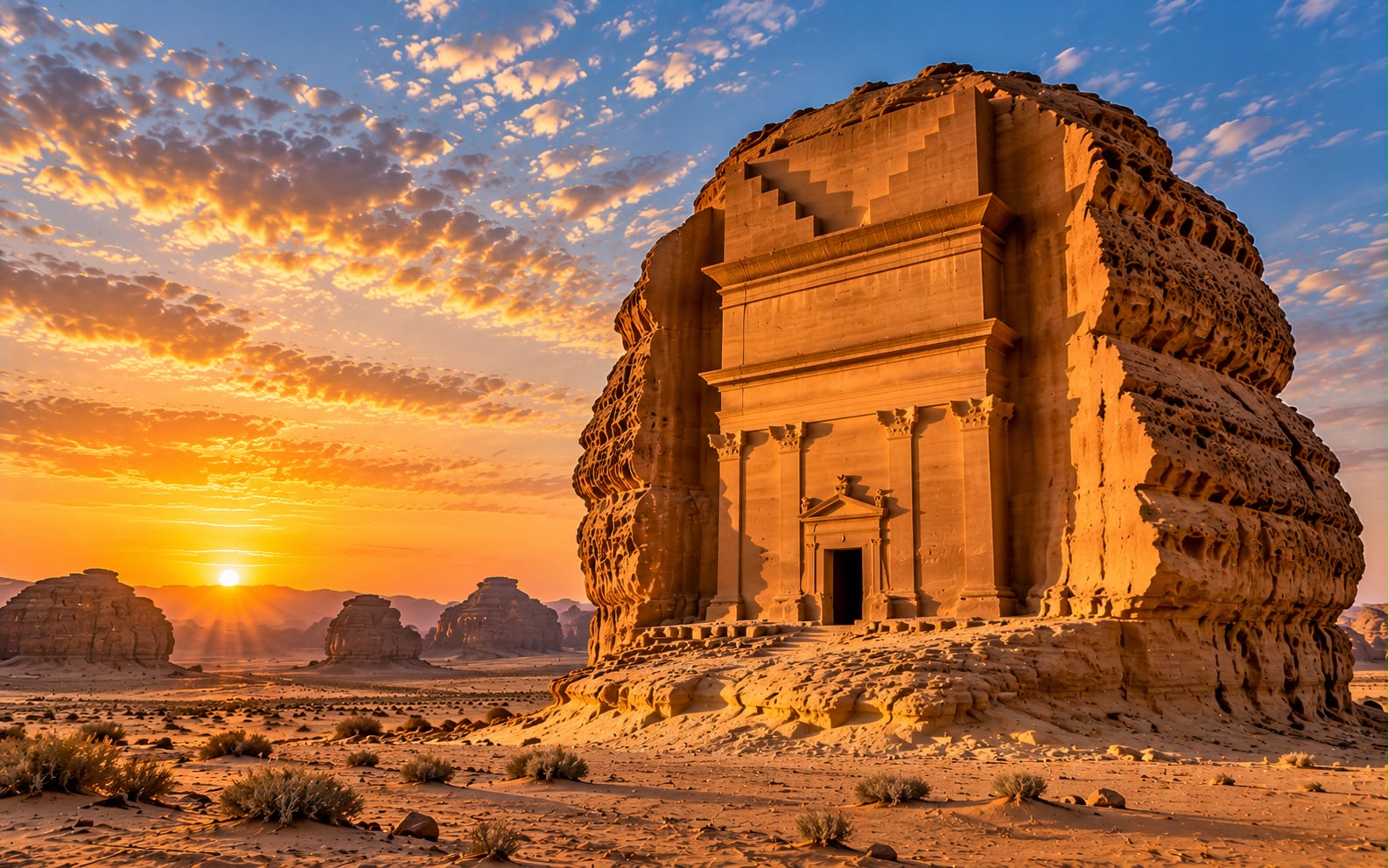
AlUla in 3 days: Hegra, Elephant Rock and the old town
Saudi Arabia's first UNESCO site, 500km of sandstone valley, and the tombs Petra's builders cut here first — with far fewer people. How the rawi guide system works, when the season actually runs, and why you need a car.
- Middle East
- 3 days
- ≈ AED 1,650 / person
- Nabataean tombs with no queue, in a country that was closed until 2019
Before you go
Hegra is Petra’s sister city, cut by the same Nabataeans, and Saudi Arabia’s first UNESCO World Heritage Site. It has 111 monumental tombs across a desert valley — and, for now, a fraction of the visitors Petra gets in an hour.
That is the case for coming. The caveat is that AlUla is a managed destination: you see Hegra with an official rawi guide on a scheduled tour, not by wandering in. It works well and it is not the same as being let loose.
Three days covers Hegra, the oasis and old town, the rock formations, and the pre-Nabataean sites at Dadan — which are older and which almost nobody visits.
Part of a Saudi trip? See Saudi Arabia in 7 days.
Figure SAR 1,700 (≈ AED 1,665) per person for three days. November to March.
Before you go: the short version
Entry
- Saudi Arabia opened to tourism in 2019 and now issues an e-visa online in minutes to around 60 nationalities — a one-year multiple-entry visa.
- Others apply through an embassy, and GCC residents have their own route.
- Women travel independently without a guardian, which changed in 2019 and is now unambiguous.
Getting there and around
- AlUla has its own airport (ULH) with domestic flights from Riyadh and Jeddah, and some seasonal international ones. It is 35 minutes from the town.
- Hire a car. The sites are 10–30 minutes apart across a large valley, and the free AlUla shuttle buses run a fixed loop that does not cover everything.
- Careem works but supply is thin outside the centre.
How the site visits work
- Hegra is seen on a booked tour with a rawi — a storyteller guide — departing from the Winter Park visitor centre. Book online before you travel; the slots sell out in season.
- Several sites are seasonal. AlUla’s main season runs roughly October to April, and some experiences close entirely in summer. Check what is actually open for your dates before committing.
Dress and conduct
- Modest dress is expected: shoulders and knees covered for everyone, and loose clothing.
- Women are not required to wear an abaya and most visitors do not. A headscarf is not required outside mosques.
- Alcohol is illegal throughout the country.
Day by day
Day 1 — Hegra
Walking order: the rawi tour moves you by bus between four tomb clusters. Walking at each is 300–600m on sand. Total on foot, about 2km.
- 08:30 — Hegra (Mada’in Salih). 111 monumental tombs cut into sandstone outcrops across a desert plain, carved by the Nabataeans between roughly 1st century BC and 1st century AD — the same people, and the same period, as Petra.
- Qasr al-Farid, “the Lonely Castle”, is the one on every photograph: a single enormous tomb cut from one freestanding rock, and never finished — the chisel marks stop partway down.
- Jabal Ithlib and the Diwan, a chamber cut for meetings and feasts, with a narrow siq beside it — a miniature of Petra’s.
- The inscriptions are the real distinction. Hegra’s tombs carry dated, named ownership texts, which Petra’s largely do not — so we know who was buried where and when.
- 13:00 — Lunch at the visitor centre or back in town.
- 16:00 — AlUla Old Town, a mudbrick settlement of some 900 houses abandoned in the 1980s, now partly restored, with a lantern-lit lane of shops and cafés.
- 18:00 — The Old Town citadel at sunset for the oasis below — 2,000 years of continuous farming in a green strip in the desert.
Day 2 — Dadan, Jabal Ikmah and the oasis
Walking order: Dadan is viewed from a platform and a short trail; Jabal Ikmah is a 500m walk into a canyon. Easy, and the oasis trail is flat.
- 09:00 — Dadan, which is older than Hegra — the capital of the Dadanite and Lihyanite kingdoms from around the 9th century BC, with lion tombs cut high into the red cliff face.
- 11:00 — Jabal Ikmah, a canyon that functions as an open-air library — hundreds of inscriptions in Dadanitic, Thamudic, Minaic and Nabataean cut into the walls over centuries. UNESCO added it to the Memory of the World register in 2023.
- 13:30 — Lunch in the oasis.
- 15:00 — The Oasis Heritage Trail — a walking path through date palms and citrus along the old irrigation channels, which is the coolest place in AlUla and the only shade for miles.
- 18:00 — Elephant Rock (Jabal AlFil) at sunset — a 52-metre sandstone arch weathered into the obvious shape, with sunken firepit lounges around it and a bar serving no alcohol.
Day 3 — The wider valley
- 08:00 — Harrat Uwayrid, the volcanic plateau above the valley, for the drive and the viewpoints.
- Or Maraya, the world’s largest mirrored building — a concert hall clad entirely in mirror so it disappears into the valley. It is open to visitors between events; check the schedule.
- 11:00 — Hiking or cycling the valley trails, which are marked and genuinely good, or a hot-air balloon at dawn if your dates fall in the festival season.
- 14:00 — Back to the Old Town for the shops and a final walk.
- 16:00 — A second Hegra visit if the first left you wanting one — the afternoon light on the tombs is better than the morning.
If you have a fourth day
- Khaybar, two hours north, with its basalt lava fields and the ruins of a fortified oasis — far less visited and the landscape is extraordinary.
Costs and practicalities
Getting around, and what it costs
| Hire car, per day | SAR 150–250 |
| Airport transfer | SAR 80–120 |
| Hegra rawi tour, per person | SAR 95 |
| Dadan and Jabal Ikmah tour, per person | SAR 95 |
| Elephant Rock | free |
| AlUla Old Town | free |
| Oasis Heritage Trail | free |
- A car is close to essential. The free shuttle loop is useful but partial, and the sites are spread over a wide valley.
- Several of the best things — Elephant Rock, the Old Town, the oasis trail — cost nothing.
Best time to visit
- November to March — 15–28°C and the full programme running. December and January are the best of it, and nights are cold.
- The AlUla season broadly runs October to April, with festivals, concerts and balloon flights concentrated in winter.
- May to September — 40–45°C. Several experiences shut entirely and the ones that remain are dawn-only.
- Check what is open for your exact dates. This is a managed destination and its calendar genuinely varies.
Travel tips
- Book the Hegra rawi tour online before you fly. It is the one thing that sells out.
- Hire a car. The shuttle does not go everywhere.
- Go to Hegra in the afternoon if you can choose — the light on the tombs is better.
- Elephant Rock is a sunset place, not a midday one.
- Dadan and Jabal Ikmah are the underrated half and almost nobody books them.
- No alcohol anywhere, and modest dress throughout.
- Carry water constantly. This is genuine desert.
What this trip actually costs
Two people, 2 nights, mid-range comfort, international flights excluded:
| Item | Cost |
|---|---|
| Hotel, 2 nights | SAR 1,400 (≈ AED 1,371) |
| Hegra and Dadan tours, two people | SAR 700 (≈ AED 686) |
| Food and drink, 3 days | SAR 600 (≈ AED 588) |
| Hire car, three days with fuel | SAR 500 (≈ AED 490) |
| Airport transfer and incidentals | SAR 200 (≈ AED 196) |
| Total for two | SAR 3,400 (≈ AED 3,330) |
- Roughly SAR 1,700 (≈ AED 1,665) per person. AlUla is not a budget destination — accommodation is the controlling cost and there is little at the cheap end.
- The free sites are genuinely good, so a tighter trip is possible: Hegra plus Elephant Rock, the Old Town and the oasis trail covers most of it.
- Hotel picks here are chosen on location, not on commission — always check prices and recent reviews before booking.
What to pack
- Modest, loose clothing that also works at 30°C.
- Real sun protection and more water than you think.
- A warm layer — desert nights in winter drop close to freezing.
- Shoes for sand and rock, not sandals.
- A Type G adapter, 230V.
Part of a bigger trip?
- Saudi Arabia in 7 days adds Riyadh, Jeddah and the Red Sea.
- Jordan in 7 days is the other half of the Nabataean story — Petra and Hegra were the same kingdom.
- Amman in 3 days if you are doing both.
FAQ
Is Hegra as good as Petra? Different. Petra has the Siq, the Treasury and the scale; Hegra has better-preserved tomb facades, dated inscriptions, and almost nobody there. Seeing both, in either order, is the real answer.
Can I visit Hegra on my own? No. Entry is on a booked tour with a rawi guide. It works well, but you cannot wander.
Do I need a car in AlUla? Effectively yes. There are free shuttles on a fixed loop, but the sites are spread across a wide valley and the shuttle does not reach all of them.
Do women need to wear an abaya? No. Modest dress — shoulders and knees covered, loose clothing — is the expectation, and most visitors wear ordinary clothes. A headscarf is not required outside mosques.
Is three days enough? Yes for Hegra, Dadan, the old town and the rock formations. A fourth day buys Khaybar or a second, slower pass at the valley.
Prices and entry rules change, and what you need depends on your passport; last checked 27 October 2026, so confirm with the embassy or your airline before booking.


