 The Itinerary
Benin in 7 days: Ganvié, Ouidah and the palaces of Dahomey
A lake town where twenty thousand people live above the water and trade from canoes, the port a million captives were shipped from, the palaces of a kingdom whose army included a regiment of women — and the January festival that is the single best week to see any of it.
- West Africa
- 7 days
- ≈ AED 2,400 / person
- The birthplace of Vodun, and a city of twenty thousand people built on stilts
Before you go
Benin is a narrow strip of West Africa running a hundred kilometres of coast and six hundred inland. It is calm, it is compact, and it holds three things that are hard to see anywhere else.
Ganvié sits on Lake Nokoué: a town of perhaps twenty thousand people living in houses on stilts, reached only by canoe, with a floating market, a school, a church and a mosque all standing in the water. It was founded in the seventeenth or eighteenth century by the Tofinu, who settled where they did because the Dahomey slave raiders were forbidden by custom from entering the water.
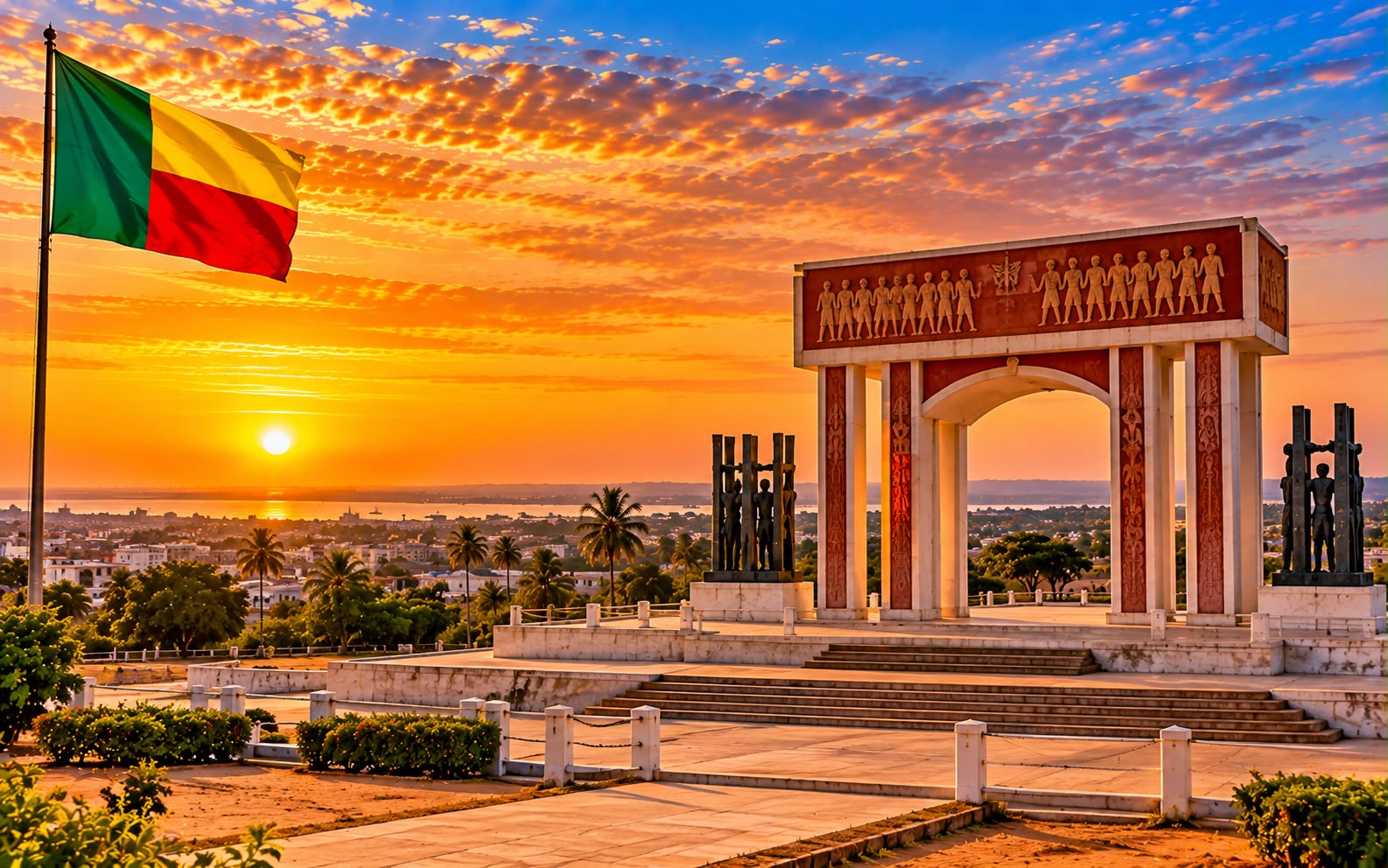
Ouidah was the port those raids fed. Hundreds of thousands of people were shipped from this beach, and the Route des Esclaves runs four kilometres from the old auction square to the Door of No Return on the sand, past the tree captives were walked around to make them forget. It is unsparing, and it is the reason to come.
Abomey was the capital of the kingdom that ran it. The Royal Palaces are on the UNESCO list — twelve kings over two and a half centuries, each building his own compound, with painted bas-reliefs recording what they did and a throne that tradition says stood on the skulls of enemies. Dahomey’s army included a regiment of women soldiers, the Agojie, who are the most famous thing about it outside the country.
And Benin is the birthplace of Vodun — the religion carried across the Atlantic that became voodoo in Haiti and candomblé in Brazil. It is an official religion here, not a curiosity, and on 10 January the national Vodun Days holiday fills Ouidah.
Seven days does the south properly. Figure USD 650 (≈ AED 2,387) per person excluding flights. Go November–February, the dry season — and around 10 January if you can.
Before you go: the 15-minute admin
Visas and vaccinations
- An e-visa is applied for online before you travel, and the process is genuinely straightforward by regional standards — days rather than weeks. Apply through the official government portal.
- Yellow fever vaccination is compulsory and the certificate is checked on arrival. No certificate, no entry.
- Malaria is present year-round. Take prophylaxis and take advice early, because some regimes need starting before you fly.
Money
- The West African CFA franc (XOF), which is pegged to the euro at a fixed rate — so the exchange rate is stable and easy to work out, which is unusual and welcome.
- Bring euros in cash to change. Cards work at larger Cotonou hotels and essentially nowhere else; ATMs in Cotonou are reasonably reliable and thin beyond it.
- The same franc is used in Senegal, Togo, Côte d’Ivoire and elsewhere in the bloc — useful if you are combining.
- Costs are low. A good meal is a few dollars.
SIM and data
- MTN and Moov sell SIMs cheaply; bring your passport. Coverage along the south is good.
Getting around
- Hire a car with a driver. Around $90–110 a day. The distances are short but the roads, the language and the checkpoints all make a driver the sensible answer.
- Zemidjans — motorcycle taxis, in yellow shirts — are how Cotonou actually moves. Cheap, quick, no helmets as standard. Judge for yourself.
- Everything on this itinerary is within three hours of Cotonou.
- Pendjari National Park, the big wildlife draw, is ten hours north and needs three or four days of its own. It is not a day trip and this itinerary does not pretend otherwise.
Vodun, and how to behave around it
- Vodun is a living religion practised by a large share of the population, not a performance. Shrines, fetishes and ceremonies are ordinary parts of the landscape.
- Always ask before photographing a shrine, a ceremony or a person. The answer is often yes, sometimes for a small fee, and sometimes no.
- A local guide is worth it at Ouidah and Abomey, not just for the explanation but because they will know what is appropriate to approach.
- Ceremonies are not scheduled for visitors. If you are invited to one, that is luck; treat it accordingly.
Travelling with kids?
- Ganvié by pirogue is the obvious hit — an hour on the water and a whole town on stilts at the end of it.
- Short drives throughout the south.
- The slavery sites at Ouidah are harrowing and unsentimental. Judge whether that is right for your children; there is no softened version.
- Heat and humidity are constant. Shade and water matter.
Day by day
Day 1 — Cotonou
- Afternoon — Arrive. The airport is in the city.
- 16:00 — Dantokpa market, one of the largest in West Africa — twenty hectares of it, including a fetish section selling the ingredients of Vodun practice. Go with a guide, go in the late afternoon, and keep your valuables close.
- 18:30 — The Place de l’Amazone and the statue of the Dahomey woman soldier, and dinner by the water.
Where to stay in Cotonou (two nights across the trip)
- Mid-range: Haie Vive or the Marina area, quiet and central.
- Value: guesthouses in Akpakpa, over the lagoon bridge.
Day 2 — Ganvié
- 08:00 — Drive to Abomey-Calavi, half an hour, and take a pirogue out across Lake Nokoué — about 45 minutes each way.
- 09:30 — Ganvié. Houses on hardwood stilts, a floating market where women trade fish from one canoe to another, a cathedral, a mosque and a school all standing in the shallows. People live and work here; the lake is farmed with acadja, fenced brush enclosures that act as fish nurseries.
- 13:00 — Back to the shore and lunch.
- 15:00 — Porto-Novo, the official capital, forty minutes east: the Da Silva Museum on Afro-Brazilian returnee history, the Great Mosque built in the shape of a Brazilian baroque church, and the royal palace museum.
- 18:00 — Cotonou.
Day 3 — Ouidah
- 09:00 — West to Ouidah, about an hour.
- 10:00 — The Portuguese fort, now the Museum of History, which tells the trade from the inside of the building it was run from.
- 11:30 — The Temple of Pythons, facing the basilica across the street — a juxtaposition that explains Benin better than any paragraph can. The pythons are royal pythons, sacred to Dangbé, and are handled by the keepers.
- 13:30 — The Route des Esclaves: four kilometres from the auction square to the beach, past the Tree of Forgetting, the Zomaï hut where captives were held in darkness, the mass grave, and the Tree of Return.
- 16:00 — The Door of No Return on the sand. Take the time.
- 18:00 — The Sacred Forest of Kpasse if there is light, and back to Ouidah for the night.
On 10 January, all of this is Vodun Days — the national holiday, with processions, drumming, Egungun masqueraders and ceremonies along the same route. Rooms in Ouidah book out months ahead.
Day 4 — Grand-Popo
- 09:00 — West again to Grand-Popo, an hour, where the Mono river meets the Atlantic.
- 10:30 — A slow day on purpose. The beach is long, empty and has a serious undertow — swim only where you are told it is safe, and preferably in the lagoon.
- 14:00 — A pirogue trip into the Mono delta and the mangroves, or across to the Bouche du Roy where the river breaks through the sand bar.
- Evening — Dinner on the sand. This is the rest day the rest of the week needs.
Day 5 — Abomey
- 08:00 — North to Abomey, about three hours inland.
- 11:00 — The Royal Palaces of Abomey, UNESCO- listed. Twelve kings of Dahomey from 1625, each required by custom to build his own palace and leave his predecessor’s standing. The bas-reliefs are the record: each king’s symbol and the events of his reign, modelled in clay on the walls. The museum holds the thrones, the appliqué banners and the regalia.
- 14:00 — Lunch, then the appliqué workshops in town, where the same families have made the banners for generations.
- 16:00 — The Vodun shrines around Abomey with a local guide.
- Night in Abomey, or drive back if you would rather.
Day 6 — Back south, slowly
- 09:00 — Return towards the coast via Bohicon and the villages of the plateau.
- 12:00 — Allada, the earlier capital the Dahomey dynasty came from, and reputedly the birthplace of Toussaint Louverture’s father.
- 15:00 — Cotonou. The Fondation Zinsou if it is open — contemporary African art, free, and one of the best small galleries on the continent.
- 19:00 — Last dinner.
Day 7 — Fly out
- Morning — Dantokpa again for cloth, or the artisan centre for appliqué and bronze.
- Afternoon — Airport, which is fifteen minutes from anywhere in the city.
Costs and practicalities
Best time to visit
November–February, the dry season between the rains and before the worst of the heat.
- November–February — dry, with the harmattan hazing the light in December and January. The coolest and most comfortable months.
- March–May — the first rains and rising humidity; hot.
- June–July — the main wet season on the coast, with Ganvié at its fullest.
- August — a short dry break.
- September–October — the second rains.
The Vodun Festival on 10 January is the single best reason to time a trip to Benin. It is a national holiday centred on Ouidah, it is a living religious event rather than a display, and accommodation in Ouidah is taken months beforehand.
Travel tips
- Vodun is a practised religion here, not folklore. Ask before photographing a ceremony, shrine or fetish priest, and accept that the answer is sometimes no and sometimes a fee.
- The CFA franc is pegged to the euro, so euros change cleanly and dollars do not.
- Cash throughout. ATMs exist in Cotonou and are unreliable elsewhere.
- Zémidjans — motorcycle taxis — are the way Cotonou moves. Agree the fare first; helmets are rare and worth insisting on.
- A yellow fever certificate is required and checked at the airport. Malaria prophylaxis is essential.
- French is the working language and very little English is spoken outside hotels.
- The road east to Lagos is notorious for delays and informal checks at the border. Fly if Nigeria is also on the itinerary.
What this trip actually costs
Two people, 6 nights, mid-range comfort, flights excluded:
| Item | Cost |
|---|---|
| Hotels, 6 nights | USD 420 (≈ AED 1,542) |
| Car with driver, 5 days | USD 500 (≈ AED 1,836) |
| Food and drink, 7 days | USD 210 (≈ AED 771) |
| Pirogues, guides, museum entries | USD 170 (≈ AED 624) |
| Total for two | USD 1,300 (≈ AED 4,774) |
- Roughly USD 650 (≈ AED 2,387) per person, which makes Benin one of the cheaper weeks in West Africa.
- The driver is the biggest line and the one not to cut. Split four ways it is negligible.
- Local guides at Ouidah and Abomey cost a few dollars and are the difference between a walk and an understanding.
- Vodun Days in January raises Ouidah room rates sharply and fills them months ahead. Worth planning for in either direction.
- Hotel picks here are chosen on location, not on commission — always check prices and recent reviews before booking.
What to pack
- Your yellow fever certificate, which is checked at the airport, and malaria prophylaxis.
- Euros in cash to change, plus small CFA notes.
- Light, modest clothing — covered shoulders and knees for shrines, palaces and villages.
- Strong insect repellent, used from dusk.
- Shoes for sand and dust; the Route des Esclaves ends on a beach.
FAQ
Is Benin safe? The south, which is where this itinerary goes, is calm and straightforward. The far north near the Burkina Faso and Niger borders is a different matter and carries travel advisories — check your own government’s current position if you are considering Pendjari.
Can I see a Vodun ceremony? Possibly, with a good local guide and some luck, and certainly around 10 January in Ouidah. Ceremonies happen on their own calendar, not a tourist one.
Is Ganvié a tourist attraction or a real town? A real town of around twenty thousand people, which also receives visitors. Go early, take a local guide, and ask before photographing anyone.
Should I combine it with Togo? It is easy and common — Lomé is two hours from Cotonou by road, and the border is straightforward. Ghana beyond that.
What language do they speak? French is official, with Fon, Yoruba and others widely spoken. English is rare outside hotels.
Prices and entry rules change, and what you need depends on your passport; last checked 8 October 2026, so confirm with the embassy or your airline before booking.


