 The Itinerary
Mali in 7 days: Bamako, Ségou and the mosque at Djenné — and the three-quarters you cannot reach
A mosque of hand-moulded earth that its whole town replasters in a single morning, the river that made three empires rich, and the music this country exports to the world — alongside Timbuktu, Gao and the Dogon cliffs, which are UNESCO-listed, extraordinary, and currently unreachable.
- West Africa
- 7 days
- ≈ AED 4,050 / person
- The largest mud-brick building on earth, and an honest account of what is now out of reach
Before you go
Read this first
Most governments advise against all travel to Mali, including Bamako, and several state that their ability to help you there is severely limited or nil.
- The north and centre are held or contested by armed groups — JNIM, the Islamic State in the Sahel, and others. Timbuktu, Gao, Kidal and the Mopti region all fall inside this.
- Kidnapping of Westerners for ransom is a specific, repeated and current risk. Foreigners have been taken from Bamako itself, not only from the north.
- The military has governed since the coups of August 2020 and May 2021. Elections have been repeatedly postponed.
- Russian forces operate alongside the Malian army, and the UN mission MINUSMA withdrew entirely at the end of 2023. The security architecture that existed a few years ago no longer does.
- Attacks have reached the capital, including the military academy and the gendarmerie school in September 2024.
- Fuel shortages and blockades on the supply roads have disrupted Bamako repeatedly.
This guide does not tell you to go. It exists because Mali’s heritage is among the most important in Africa and deserves to be described accurately, including the part about not being able to see it. Check your own government’s advice, which reflects this week rather than this year.
Mali has four UNESCO World Heritage sites. Three of them are on the List of World Heritage in Danger, and three of them you cannot currently visit.
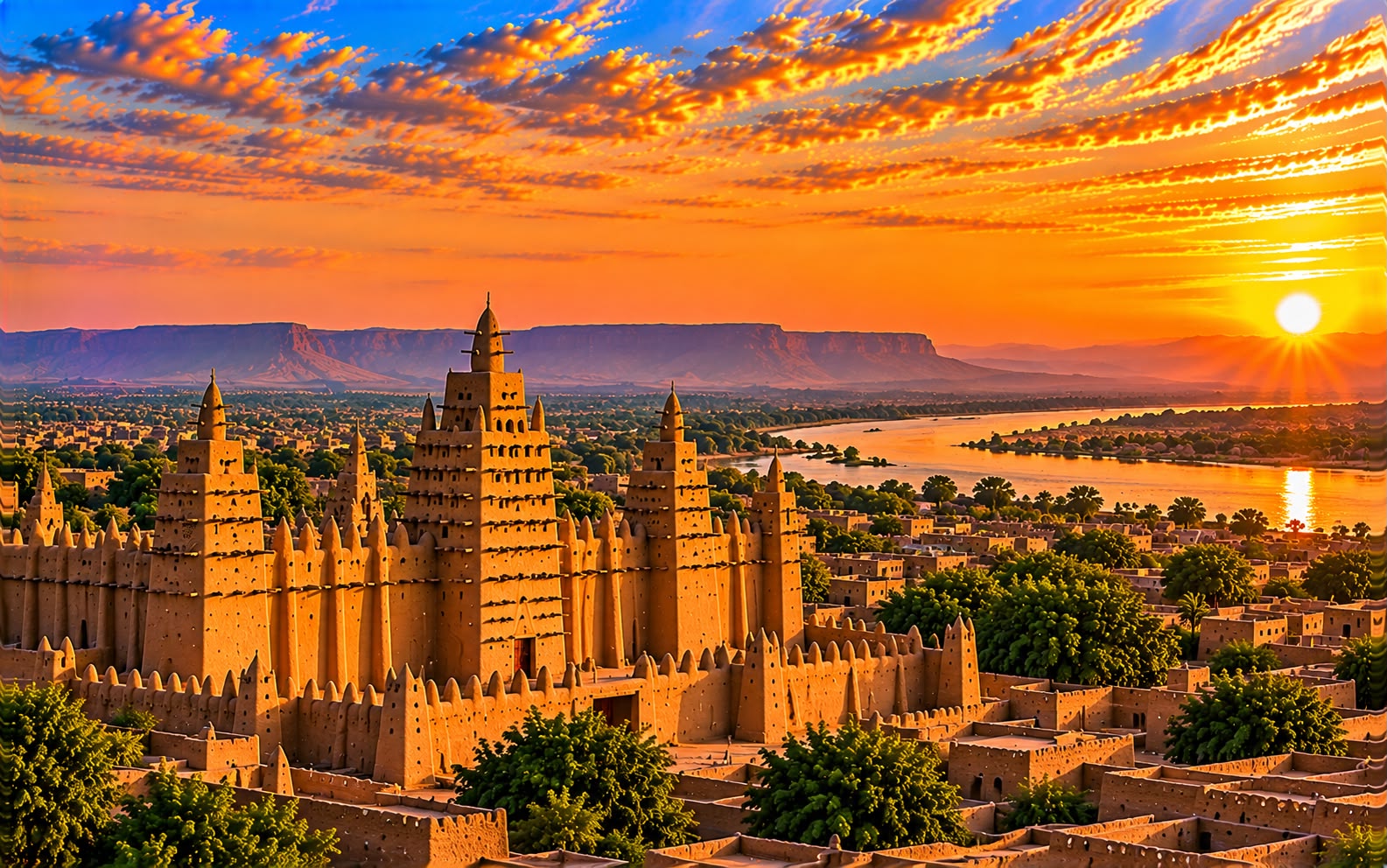
Djenné is the one that still, conditionally, receives visitors. The Great Mosque is the largest mud-brick building in the world, rebuilt in 1907 on a thirteenth-century foundation, bristling with palm-wood toron. Every spring the entire town replasters it in a single morning — the crépissage, organised by age-grade societies, part festival and part structural maintenance. The old town around it is listed with it. Djenné sits in the Mopti region, which carries the strongest warnings in the country.
Timbuktu is listed and in danger. In 2012 Ansar Dine destroyed fourteen of its sixteen mausoleums; they were rebuilt by Timbuktu’s own masons by 2015. The International Criminal Court convicted Ahmad al-Faqi al-Mahdi in 2016 — the first ICC conviction for the destruction of cultural heritage. The Djinguereber, Sankoré and Sidi Yahia mosques stand, and the city’s manuscript libraries were smuggled out to Bamako by the thousand. It cannot be visited.
The Bandiagara Escarpment — Dogon Country — is a mixed site: 150 kilometres of cliff with villages built into it, Tellem granaries in the rock face above them, and a living cosmology. It cannot be visited. The Mopti and Bandiagara areas have seen massacres of civilians on a scale that makes tourism unthinkable.
The Tomb of Askia at Gao, a seventeen-metre pyramid of earth built in 1495 for the Songhai emperor, is listed and in danger. It cannot be visited.
What remains reachable is Bamako and the stretch of the Niger up to Ségou — which is not a consolation prize. It is where the music is.
Seven days, if and when it is possible. Figure USD 1,100 (≈ AED 4,040) per person. November to February.
Before you go: the 15-minute admin
Entry
- A visa is required by most nationalities and is best arranged through a Malian operator, who also sponsors the movement permissions you will need.
- Yellow fever vaccination is mandatory and checked on arrival.
- Bamako–Sénou is the only sensible way in. Overland routes cross contested ground.
Money
- The West African CFA franc (XOF) is pegged to the euro.
- Cash, in euros. ATMs in Bamako work sometimes; outside it, do not plan on any.
- Cards are close to useless beyond two or three hotels in the capital.
On the ground
- Independent travel is not a reasonable option. A Malian operator holds the permissions, knows the roads, and knows which of them changed status overnight.
- Register with your embassy if it is still open. Several are not.
- No night travel between towns, at all.
- Do not photograph anything military, official, or near a bridge.
- Keep a low profile. Avoid routine — the same café at the same hour is exactly what the advisories warn against.
Day by day
Day 1 — Bamako
- Movement outside Bamako is the whole question on this route. Your operator decides the day’s roads that morning, and overland travel is daylight-only.
- 10:00 — The Musée National du Mali, which is genuinely one of the best museums in West Africa: terracottas from Djenné-Djenno, textiles, and the masks in context rather than on a wall.
- 14:00 — The Maison des Artisans and the Marché de Médine for the everyday version of the same crafts.
- 18:00 — The Niger from the Pont des Martyrs at dusk, and the fishing pirogues working the shallows below it.
- 21:00 — The music. Bamako is where Ali Farka Touré, Toumani Diabaté, Salif Keita, Oumou Sangaré and Amadou & Mariam came from or came through. Ask your guide which club has something on; it will not be listed anywhere you can read.
Day 2 — Bamako, and the hill
- 09:00 — The Grand Mosque and the Marché Rose, which is the everyday market rather than the craft one.
- 12:00 — The Point G escarpment above the city for the whole bend of the river.
- 15:00 — The Musée du District or a textile workshop, where bogolan is dyed with fermented mud and the pattern is painted on in reverse.
- 18:00 — The riverside at Badalabougou.
- 20:00 — A second night of music, which is not a repeat — the clubs change what they do nightly.
Day 3 — Up to Ségou
- 07:00 — Ségou, the old Bambara capital, four hours upriver. Leave early; the day has to finish in daylight.
- 12:00 — Colonial buildings in ochre along the bank, a working port, and a pace entirely unlike Bamako’s.
- 15:00 — The Office du Niger irrigation scheme, if the agricultural history interests you; it is the reason this stretch of river looks the way it does.
- 18:00 — The riverbank at sunset, which at Ségou is the evening activity.
- Ségou Art / Festival sur le Niger takes place in February when conditions allow, and has run in reduced form through the worst of the last decade.
Day 4 — Kalabougou
- 07:30 — A pirogue to Kalabougou, where the women fire pottery in open bonfires on the riverbank — a half-day and the single best thing to do here.
- The firing happens on set days, not daily; your guide will know which and it is worth shaping the stop around.
- 12:00 — Back across the river for lunch.
- 15:00 — The potters’ quarter in Ségou itself, and the weavers’ street.
- 17:30 — A last Ségou evening on the bank.
- Decide tonight whether Djenné is on. It is not a decision to leave to the morning.
Day 5 — Djenné, if it is possible
- Whether you reach Djenné at all depends on the road and the week. Ask your operator. Do not treat it as booked until you are there.
- 05:00 — If it runs, leave in the dark only as far as the edge of town and on the road at first light.
- 09:00 — The Monday market, which fills the square in front of it and is one of the great sights of West Africa — which is why Monday is the day to aim for.
- 11:00 — The Great Mosque, from the square. Non-Muslims have not been admitted since 1996, after a magazine photoshoot inside it caused lasting offence. The exterior is the point regardless.
- The whole building is replastered every year by the town in a single day, the crépissage, usually in April.
- 14:00 — Djenné-Djenno, the archaeological mound two kilometres away, occupied from 250 BC and the reason the listing says “and its archaeological sites”.
- 16:00 — Back toward Ségou in daylight.
Day 6 — Back toward Bamako
- 07:00 — The return drive, broken rather than pushed.
- 11:00 — A village stop on the way — pottery, smithing, or a weekly market if the day lands right.
- 15:00 — Into Bamako, and the afternoon free.
- 17:00 — The Monument de l’Indépendance and the Tour de l’Afrique.
- 20:00 — One more night of music before the airport, which is the right way to end a trip to this country.
Day 7 — Out
- 09:00 — The Grand Mosque of Bamako, and a last pass through the Maison des Artisans for anything you did not buy.
- 12:00 — Bogolan and silver are the things to carry home, bought from the makers rather than the stalls.
- Fly out of Bamako. Leave wide margins — the airport road and the formalities both take longer than you expect.
Costs and practicalities
Best time to visit
November–February, the cool dry season, and in Mali the margins are narrow because the alternatives are a punishing hot season and rains that cut the roads.
- November–February — the best months. Dry, with the harmattan in December and January hazing the light and cooling the nights.
- March–May — the hot season. Over 40°C and genuinely draining; the Niger drops to its lowest.
- June–October — the rains. The river rises, the Bani and Niger flood, and the laterite roads soften.
- The Djenné crépissage — the replastering of the Great Mosque — falls in the spring, usually April, and is the single most remarkable event in the Malian calendar. Whether it can be reached is a different question entirely.
The Niger is navigable roughly August to December, which is when the pinasse to Mopti and Timbuktu historically ran.
Travel tips
- Independent travel is not a reasonable option. A Malian operator holds the permissions, knows which roads changed status overnight, and is the difference between a trip and an incident.
- No night travel between towns, at all.
- Bring euros in cash. The CFA franc is pegged to the euro; ATMs in Bamako are unreliable and there is nothing beyond it.
- Non-Muslims have not been admitted inside the Great Mosque at Djenné since 1996. The exterior and the Monday market are the point.
- Ask before photographing people, and expect a fee at Djenné and in the markets. Photographing officials, military or government buildings is prohibited.
- A yellow fever certificate is mandatory and malaria prophylaxis is essential.
- Keep a low profile and avoid routine. The same café at the same hour is exactly what the advisories warn against.
What this trip would cost
Two people, 6 nights, mid-range comfort, flights excluded:
| Item | Cost |
|---|---|
| Hotels, 6 nights | USD 540 (≈ AED 1,983) |
| Operator, vehicle, driver and permissions | USD 1,200 (≈ AED 4,407) |
| Food and drink, 7 days | USD 240 (≈ AED 881) |
| Pirogues, guides and entries | USD 220 (≈ AED 808) |
| Total for two | USD 2,200 (≈ AED 8,080) |
- Roughly USD 1,100 (≈ AED 4,040) per person. The operator line carries the permissions and the security planning and is not optional.
- All of it in cash, in euros.
- Figures are indicative. Fuel shortages have moved transport costs sharply and more than once.
- Insurance does not appear because no standard policy covers travel against government advice.
- Hotel picks here are chosen on location, not on commission — always check prices and recent reviews before booking.
What to pack
- Euros in cash for the entire trip, in clean notes.
- A yellow fever certificate.
- Malaria prophylaxis.
- Modest, light, long clothing — this is a conservative Muslim country and the sun is punishing.
- A power bank and a head torch.
- Rehydration salts. The heat does more damage here than anything in the headlines.
FAQ
Can I visit Timbuktu? No. It is held or contested and every government advises against all travel to it. The mausoleums destroyed in 2012 were rebuilt by Timbuktu’s own masons, and the manuscripts were evacuated to Bamako — both facts are worth knowing even though you cannot go.
Can I visit Dogon Country? No. The Bandiagara Escarpment is UNESCO-listed and extraordinary, and the Mopti and Bandiagara areas have seen repeated massacres of civilians.
Is Djenné reachable? Conditionally, and that condition changes. It sits in the Mopti region, which carries the country’s strongest warnings. Ask a Malian operator rather than assuming.
Can I go inside the Great Mosque? Non-Muslims have not been admitted since 1996.
What language do they speak? French is official; Bambara is what people actually speak in Bamako and Ségou, along with Fula, Songhai and Tamasheq elsewhere.
Prices and entry rules change, and what you need depends on your passport; last checked 29 October 2026, so confirm with the embassy or your airline before booking.


