 The Itinerary
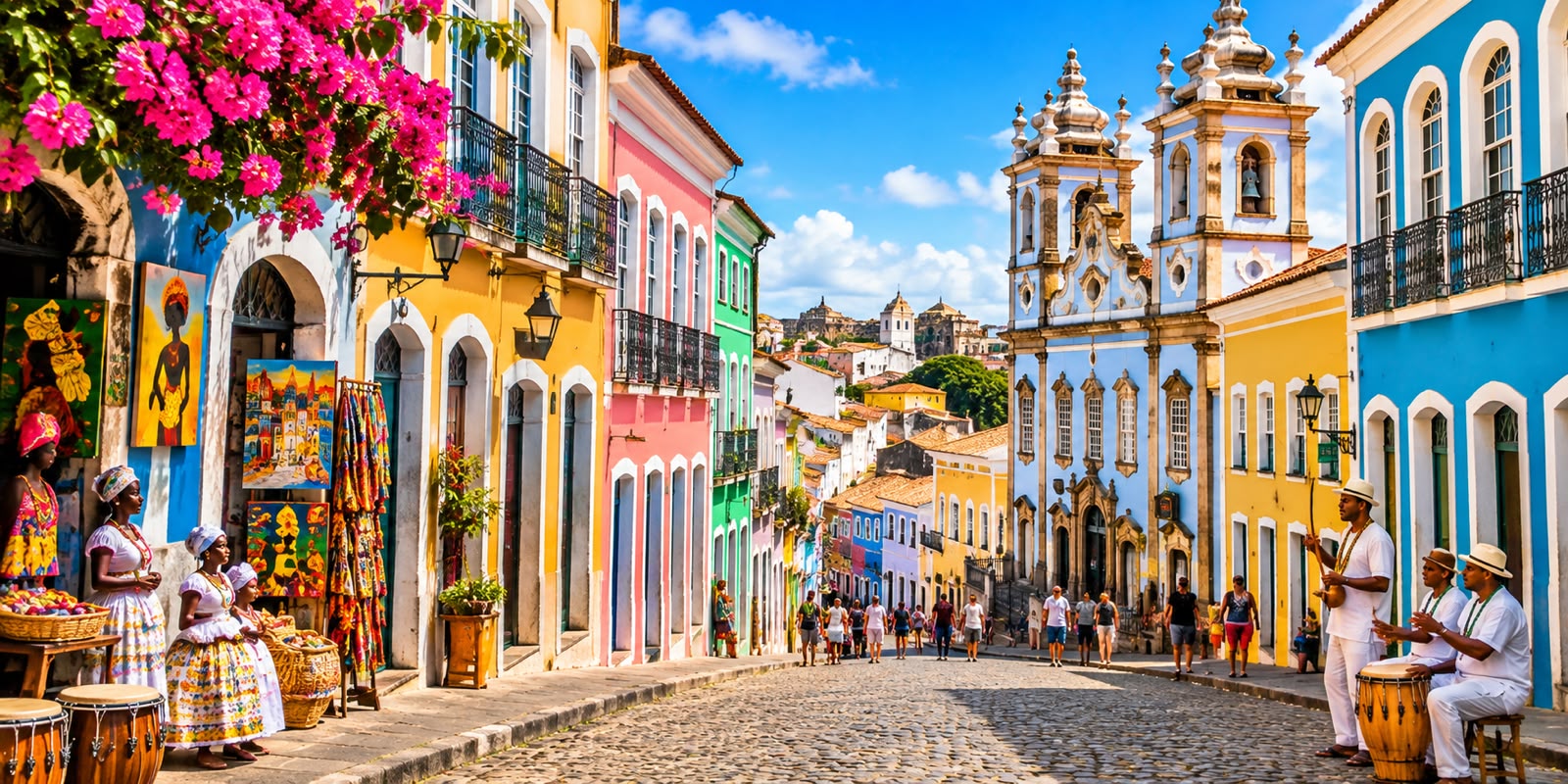
Bahia in 9 days: Salvador, the turtles and Morro de São Paulo
Four days of Salvador's Pelourinho, capoeira and candomblé, a turtle project on the coast north, then two car-free islands reached by catamaran. The crossing that makes people sick, the safety rules locals actually follow, and why Carnival here is nothing like Rio's.
- Brazil
- 9 days
- ≈ AED 6,250 / person
- Afro-Brazilian Salvador, then islands with no cars on them
Before you go
Brazil’s one guide on this site is Rio, Paraty and Iguaçu — the south-east. Bahia is the north-east, and it is the most African part of the Americas.
Salvador was the first capital of Brazil and the main port of the slave trade in the Atlantic world. What came out of that is candomblé, capoeira, the berimbau, acarajé and a musical tradition that fed everything else Brazil is known for. The old city is a UNESCO site and it is not a museum — people live in it.
Then the islands. Morro de São Paulo and Boipeba have no cars at all — luggage moves by wheelbarrow and tractor — and they are two hours from the city by catamaran.
This is a good family trip, which is rarer in South America than it should be: short transfers, calm water, and a turtle project that children remember for years.
Figure BRL 9,400 (≈ AED 6,271) per person. September to March for the driest weather; Carnival is in February or March.
Before you go: the admin
Entry and money
- Visa requirements for Brazil have changed more than once in recent years, and the position differs by nationality. Check the official position for your passport before booking — some nationalities that were visa-free now need an e-visa.
- Proof of yellow fever vaccination is required by some countries on arrival from Brazil, and is recommended for parts of the country. Take travel health advice several weeks ahead.
- Cards are widely accepted, and Pix — the instant bank transfer system — is used everywhere, though it needs a Brazilian account. Carry some cash in small notes for beach vendors, the islands and tips.
- Last checked: 3 November 2026.
Salvador, and safety without the melodrama
- Salvador has real street crime and locals take real precautions. This is not a reason to skip it; it is a reason to behave like a resident.
- The rules people here actually follow: nothing visible — no phone in hand on the street, no camera round the neck, no jewellery. Carry a small amount of cash and leave the rest at the hotel.
- Taxis or ride apps after dark, always, even for short distances.
- Stay in Pelourinho, Santo Antônio, Barra or Rio Vermelho. Avoid walking the Lower City and the areas around the Lacerda lift at night.
- The islands and Praia do Forte are a different world — small, quiet and relaxed.
Portuguese
- Spanish will not get you far and English even less so outside hotels. Bahia speaks Portuguese and little else.
- A translation app and a few phrases make an enormous difference, and the warmth you get back is disproportionate.
The catamaran, and when it does not run
- Salvador to Morro de São Paulo is about two hours by catamaran across the Baía de Todos os Santos and then open sea.
- The open stretch is genuinely rough and a significant number of passengers are sick. Take something before you board, sit at the back and in the middle, and stay on deck if you can.
- Crossings are cancelled for sea state, more often from June to August. The alternative is the land-and-boat route via Valença, which is longer and much calmer.
- Build a buffer day before your flight home.
Carnival
- Salvador’s Carnival is one of the largest street parties in the world and is nothing like Rio’s. There is no sambadrome and no ticketed parade — instead, trios elétricos, lorries carrying full bands, move through the streets for days with crowds following.
- Blocos are the ticketed groups that get you a roped-off area and an abadá shirt; the pipoca — “popcorn” — is the free crowd outside the ropes, and is more fun and more chaotic.
- Prices triple and rooms sell out months ahead.
- If you are not coming for it, avoid the week entirely.
Day by day
Day 1 — Salvador, the Upper City
- Stay in Pelourinho or Santo Antônio, which is the old town immediately north of it and quieter.
- Afternoon — The Elevador Lacerda, a 1873 art-deco lift connecting the Lower and Upper cities, which costs almost nothing and is the city’s front door.
- 16:00 — Pelourinho on foot: pastel colonial houses on steep cobbles, and the Igreja de São Francisco, whose interior is carved wood covered in gold leaf to a degree that is difficult to describe.
- 18:00 — Acarajé from a baiana stall — black-eyed-pea fritters fried in dendê palm oil, split and filled with vatapá and shrimp. This is the city’s signature food and it is street food.
- Evening — Live music in Pelourinho, which happens most nights and especially on Tuesdays.
Where to stay in Salvador (three nights)
- Grand: a converted colonial mansion in Santo Antônio with a view over the bay.
- Mid-range: a pousada in Pelourinho, inside the historic centre.
- Simple: guesthouses in Barra or Rio Vermelho — further out, calmer at night, and where the city eats.
Day 2 — Candomblé, capoeira and the Bonfim
- 09:00 — The Igreja do Senhor do Bonfim, with thousands of coloured ribbons tied to its railings — three knots, three wishes. It is also a candomblé site, sacred to Oxalá, and the syncretism is the whole history of Bahia in one building.
- 11:00 — The Afro-Brazilian Museum for the orixás and the carved panels by Carybé.
- 14:00 — A capoeira class or a roda. Capoeira is a martial art disguised as a dance because it had to be, and watching a real roda — circle, berimbau, call and response — is better than any staged show. Children can join in.
- 17:00 — The Mercado Modelo for crafts, then the bay at sunset.
- Evening — Moqueca, the Bahian fish stew with dendê and coconut milk, which is distinct from the Espírito Santo version and locals will tell you so.
Day 3 — Praia do Forte and the turtles
- A day trip north, about an hour and a half.
- 10:00 — Projeto Tamar at Praia do Forte. Brazil’s sea turtle conservation programme, running since 1980, with open tanks, rescued animals and a research station. Between roughly September and March there are nests on the beaches, and hatchling releases happen when nests are ready rather than on a schedule — ask on the day.
- 13:00 — The village, which is a single sandy street of restaurants, and the beach.
- 15:00 — The Castelo Garcia d’Ávila, a ruined sixteenth- century fortified house on the hill behind.
- Evening — Back to Salvador, or stay at Praia do Forte if you would rather trade a city night for a beach one.
Day 4 — To Morro de São Paulo
- Morning — The catamaran, about two hours. Take the seasickness tablet before boarding, not after.
- Arrive at the jetty and a wheelbarrow takes your bags. There are no cars on the island — the only vehicles are tractors and quad bikes.
- Afternoon — The beaches are numbered. Primeira has the zip line and the chapel above it; Segunda is the busy one with the bars; Terceira is calmer and has the best snorkelling pools at low tide; Quarta is long, quiet and where to walk to.
- 18:00 — The Farol and the Fortaleza for sunset over the mainland.
- Evening — Segunda Praia, which is where the island’s evening is.
Where to stay on Morro de São Paulo (two nights)
- Grand: a pousada on Terceira or Quarta with a pool above the sand.
- Mid-range: a pousada between Segunda and Terceira — close to the evening, far enough from the speakers.
- Simple: guesthouses in the village above the jetty, which is a short walk and much cheaper.
Day 5 — The island, slowly
- Morning — Low tide at Terceira, when the reef forms natural pools you can stand in with fish around your ankles. Check the tide table; it is the whole plan.
- Midday — Walk to Quarta and beyond, which empties out within twenty minutes of walking.
- 15:00 — A boat round the island, or the Gamboa mangroves and the clay cliff, where people cover themselves in grey mud and let it dry.
- Evening — Dinner on the sand.
Day 6 — Boipeba
- The reason to come this far. Boipeba is the next island south, an hour by boat, and is what Morro was twenty years ago.
- No cars, no banks, intermittent signal. Bring cash.
- Morning — The boat down, through mangrove channels and along the coast.
- Afternoon — Praia de Moreré, where low tide opens natural pools over the reef — again, check the tide.
- Evening — Velha Boipeba, the village, which has perhaps a dozen restaurants and no nightlife to speak of. That is the point.
Where to stay on Boipeba (two nights)
- Grand: a small eco-pousada at Moreré, right on the sand.
- Mid-range: a pousada in Velha Boipeba with a garden.
- Simple: village guesthouses, which are simple and very cheap.
Day 7 — Boipeba, and nothing
- This is the day the trip is built around.
- A boat to Cueira or Tassimirim, both long and almost empty.
- Or walk — the beaches connect at low tide and you can spend a whole day moving between them on foot.
- Fresh fish and a hammock. There is no second plan.
Day 8 — Back to Salvador
- Morning — Boat to Morro, then the catamaran back, or the Valença land route if the sea is up.
- Afternoon — Salvador. Rio Vermelho for the evening — it is the neighbourhood where the city eats and drinks, and Tuesday nights at Largo de Santana are an institution.
- Buffer: if the crossing is cancelled, this is the day that absorbs it.
Day 9 — Out
- Morning — A last acarajé, or the Dique do Tororó with its orixá sculptures standing in the water.
- Salvador’s airport is about 40 minutes from the centre, and longer in traffic.
Costs and practicalities
Best time to visit
September to March is the driest and brightest. Bahia’s rain comes in the southern winter, not the summer.
- September to November — the best window. Warm, dry, turtle nesting under way at Praia do Forte, and before the high-season prices.
- December to March — hot, bright and busy. Brazilian summer holidays fill the islands in January, and Carnival falls in February or March and transforms Salvador entirely.
- April to June — the wettest months on this coast. Warm rain in bursts rather than all day, very few visitors, lowest prices.
- July and August — cooler, drier than autumn, and Brazilian winter holidays in July fill the islands again. The sea is at its roughest for the catamaran.
Travel tips
- Take seasickness tablets before the catamaran, not after.
- Buffer a day in Salvador before your flight home in case the crossing is cancelled.
- Nothing visible on the street in Salvador — no phone in hand, no jewellery.
- Taxis or ride apps after dark, always.
- Bring cash to Boipeba. There are no banks.
- Check the tide before Terceira and Moreré. The pools only exist at low water.
- Acarajé is sold by baianas in white — buy from a busy stall.
- Dendê oil is heavy and does not suit everyone the first time.
- Learn five words of Portuguese. Spanish will not do.
- Avoid Carnival week unless you are coming for it — prices triple.
What this trip actually costs
Two people, 8 nights, mid-range throughout, international flights excluded:
| Item | Cost |
|---|---|
| Pousadas and hotels, 8 nights | BRL 6,400 (≈ AED 4,270) |
| Food and drink, 9 days | BRL 4,600 (≈ AED 3,069) |
| Catamaran, island boats and transfers | BRL 3,400 (≈ AED 2,268) |
| Projeto Tamar, a capoeira class, museums | BRL 2,000 (≈ AED 1,334) |
| A boat day, beach extras | BRL 1,600 (≈ AED 1,067) |
| Tips and extras | BRL 800 (≈ AED 534) |
| Total for two | BRL 18,800 (≈ AED 12,543) |
- Roughly BRL 9,400 (≈ AED 6,271) per person for nine days.
- Bahia is cheaper than Rio for the same standard, and the islands are cheaper still once you are on them.
- Boipeba is the budget surprise in the right direction — small pousadas, fresh fish, and nothing to spend money on.
- Carnival roughly triples the Salvador nights and books out months ahead.
- Hotel picks here are chosen on location, not on commission — always check prices and recent reviews before booking.
What to pack
- Light cotton and linen. It is hot and humid most of the year.
- Reef shoes for the tidal pools at Terceira and Moreré, which are sharp.
- Reef-safe sunscreen and a hat — this is 13 degrees south and the sun is vertical.
- Insect repellent, for the mangroves and the evenings.
- Seasickness tablets for the catamaran.
- Cash in small notes, especially for Boipeba.
- A dry bag for the boat transfers, which get spray.
- A Type N adapter, 127V in Salvador — Brazil uses its own plug and the voltage varies by region.
Part of a bigger trip?
- Brazil in 10 days is Rio, Paraty and Iguaçu — the two make a very strong three weeks.
- Argentina and Brazil in 13 days crosses to Buenos Aires and Iguazú.
- Add Chapada Diamantina, six hours inland from Salvador, for tablelands, waterfalls and caves — four days minimum.
- Add Itacaré or Trancoso further south down the Bahian coast for more beach and more surf.
FAQ
Is Salvador safe? It has real street crime and locals take real precautions, which is the honest answer rather than either extreme. Follow what residents do: nothing visible on the street, a small amount of cash, taxis or ride apps after dark, and stay in Pelourinho, Santo Antônio, Barra or Rio Vermelho. Do that and the city is one of the most rewarding in the Americas. The islands are a different world and essentially worry-free.
How rough is the catamaran? Rough enough that a notable share of passengers are sick on it. The first stretch across the bay is calm; the open sea afterwards is not. Take a tablet before boarding, sit low and central, and stay where you can see the horizon. If the sea is up the crossing is cancelled, so keep a buffer day before your flight home — or take the longer land-and-boat route via Valença.
When can I see turtles? Nesting on this coast runs roughly September to March, and Projeto Tamar at Praia do Forte is open year-round with tanks and rescued animals regardless. Hatchling releases depend on which nests are ready, so they cannot be booked ahead — ask at the project on the day you visit.
Is this a good trip with children? Yes, and better than most South American routes. The transfers are short, the island beaches are calm and shallow at low tide, there are no cars at all on Morro or Boipeba, and Projeto Tamar is the kind of thing children talk about afterwards. The one thing to manage is the catamaran, which is where small passengers suffer.
Is Carnival worth planning around? If you want it, Salvador’s is one of the great street parties on earth — trios elétricos, no sambadrome, millions of people, and the free pipoca crowd is where the energy is. It needs booking months ahead at triple the normal rate. If you do not want it, avoid the week entirely rather than arriving in the middle by accident.
Prices and entry rules change, and what you need depends on your passport; last checked 3 November 2026, so confirm with the embassy or your airline before booking.


