 The Itinerary
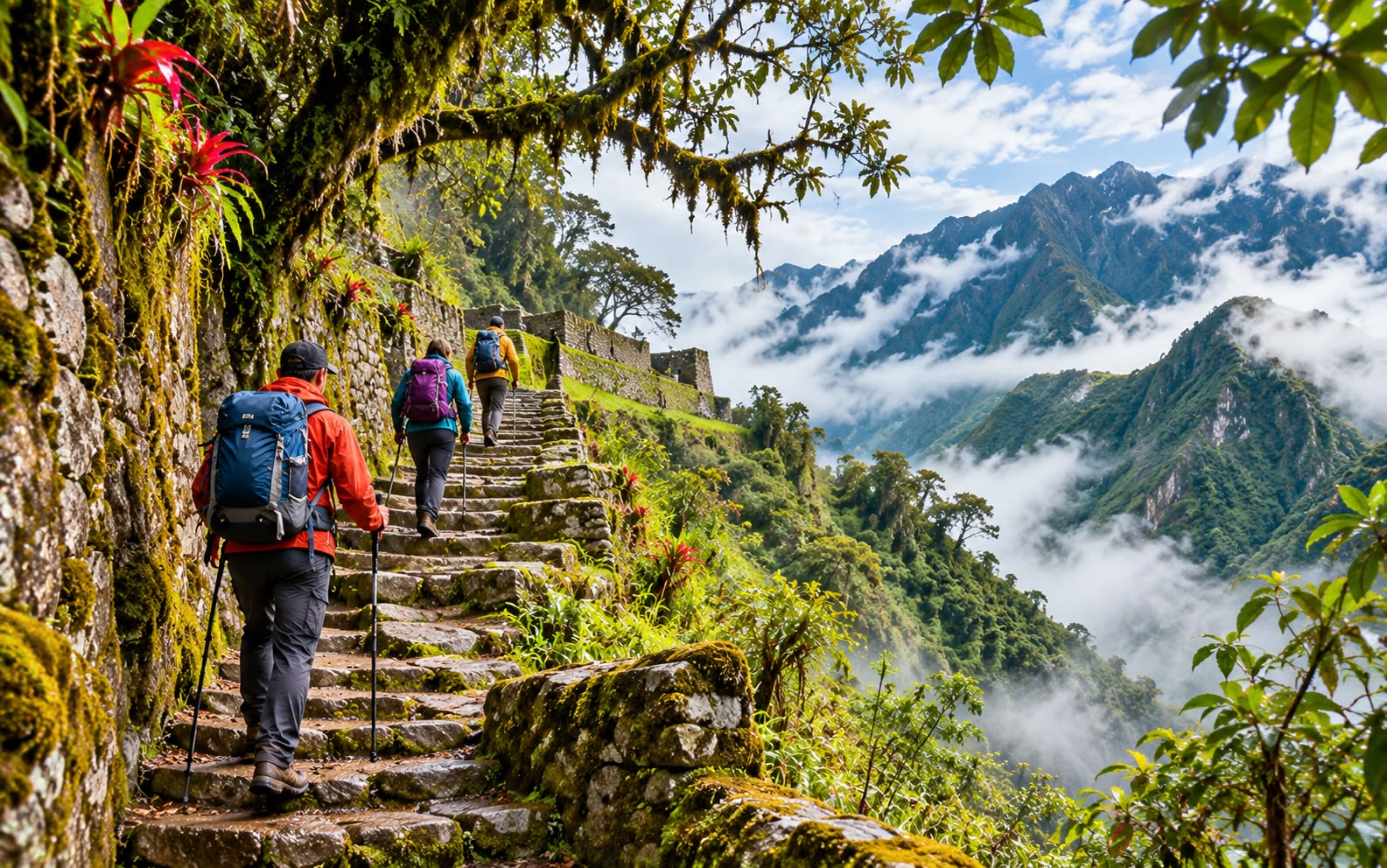
The Inca Trail in 8 days: permits, altitude and Machu Picchu
The classic four-day trek with the acclimatisation days it actually needs. Permits are capped and sell out months ahead, February is closed, and Dead Woman's Pass is at 4,215 metres — this is the guide to booking it in the right order.
- The Andes
- 8 days
- ≈ AED 7,700 / person
- Walking in rather than taking the train
Before you go
The site’s Peru in 9 days reaches Machu Picchu by train. This one walks in, which is a different trip with a different booking problem.
Read this first: permits are capped and they sell out. The government limits the trail to 500 people a day, and that number includes guides and porters — so roughly 200 trekkers. Peak-season dates often go several months ahead, sometimes within days of release.
You cannot walk it independently. A licensed operator is a legal requirement, and the permit is issued to your passport number. The name on the permit must match the passport you carry.
Three days in the mountains before you start walking. Cusco is at 3,400 metres and the trail crosses Dead Woman’s Pass at 4,215. Altitude is the thing that ruins this trek, and it is almost entirely preventable with time.
Figure PEN 7,200 (≈ AED 7,676) per person. May to September, and the trail closes every February.
Before you go: the admin
The permit, in the right order
- Fix your dates. Work backwards from the trail, not forwards from your flights.
- Choose a licensed operator and book immediately. They hold the permit application; you cannot do it yourself.
- Send your passport details exactly as printed. The permit is tied to the passport number, and a renewed passport between booking and walking has to be notified in advance — turning up with a different number can mean being refused at the checkpoint.
- Then book flights.
- February is closed for maintenance every year. The trail reopens in March.
- If permits are gone, the alternatives are real and good: the Salkantay, which is higher, wilder and needs no permit; the Lares, which is shorter and more about villages than ruins; or the two-day Short Inca Trail, which has its own smaller permit allocation.
Altitude, which is the real difficulty
- Cusco is 3,400 m. Dead Woman’s Pass is 4,215 m. For most people arriving from sea level, this is the hardest part of the trek — harder than the distance, which is only about 42 km over four days.
- Give yourself two full days in Cusco or, better, the Sacred Valley before the trek. The Sacred Valley sits lower, around 2,800 m, and sleeping there is the better acclimatisation.
- Symptoms of mild altitude sickness — headache, nausea, breathlessness, poor sleep — are common and usually pass. Confusion, severe breathlessness at rest or an inability to walk straight are not, and mean going down immediately.
- Discuss acetazolamide with a doctor before you travel. Coca tea and coca leaves are traditional, legal in Peru and mildly helpful — but they can show on a drug test and are illegal to carry home.
- Drink far more water than feels necessary. Avoid alcohol on arrival.
Entry and health
- Many nationalities enter Peru visa-free for up to 183 days. Check yours.
- Yellow fever vaccination is not required for Cusco or Machu Picchu, but may be advised if you are continuing into the Amazon. Take travel health advice several weeks ahead.
- Travel insurance that covers trekking to 4,500 m and emergency evacuation. Standard policies often cap altitude far lower. Check the number in the policy, not the brochure.
- Last checked: 2 November 2026.
The porters
- Porter welfare is regulated and it matters. There are legal limits on the weight a porter may carry and on their minimum pay and equipment.
- Reputable operators pay properly, feed their crew the same food as the clients, and provide sleeping gear. The cheapest quotes on the trail are usually cheap because of this.
- You will normally carry a daypack and the porters carry the rest, up to a personal allowance of a few kilos that you pack into a duffel the night before.
- Tipping at the end is customary and expected. Your operator will advise a figure; budget it separately.
Day by day
Day 1 — Land in Lima
- Most international flights arrive late. Stay in Miraflores or Barranco, near the sea, rather than near the airport.
- If you have the afternoon: the Larco Museum, which is the best introduction to pre-Inca Peru you can get in three hours, or the Malecón cliff walk at sunset.
- Eat well. Lima is one of the great food cities and the trail is four days of camp meals.
- Do not drink the tap water anywhere in Peru.
Day 2 — Fly to Cusco, then straight down to the valley
- Morning flight to Cusco, about an hour and a half. Take the early one — afternoon flights are more often delayed by cloud.
- Do not spend this day in Cusco. Transfer straight to the Sacred Valley, about an hour, and sleep at Urubamba, Ollantaytambo or Yucay at around 2,800 m. This is the single best acclimatisation decision available to you.
- Afternoon — Rest. Walk slowly, drink water, eat lightly. No alcohol.
Where to stay in the Sacred Valley (two nights)
- Grand: a converted hacienda outside Urubamba with gardens.
- Mid-range: a small hotel in Ollantaytambo, within walking distance of the ruins.
- Simple: a guesthouse in Urubamba, which is the valley’s working town.
Day 3 — The Sacred Valley
- A gentle day by design. Walking at this altitude is the acclimatisation.
- 09:00 — Pisac: the hilltop ruins with their agricultural terraces, and the market in the town below.
- 13:00 — Lunch at Urubamba.
- 15:00 — Ollantaytambo, the terraced fortress above the town — and the town itself is the best-preserved example of Inca urban planning still lived in, with the original water channels running down the streets.
- The optional extra: Maras and Moray — the salt pans and the concentric agricultural terraces — which is a half-day and very good.
- Evening — Pack the duffel for the porters and the daypack for yourself. Early start tomorrow.
Day 4 — Trail day one: the easy day
- Pick-up is usually between 04:00 and 06:00.
- Kilometre 82, Piscacucho — the checkpoint. Passports are checked against the permit.
- About 11 km, mostly gentle, following the Urubamba river with Llactapata below the path.
- Camp at around 3,000 m.
- This is the day to set your pace. Slower than feels right. The people who struggle on day two are the ones who raced day one.
Day 5 — Trail day two: Dead Woman’s Pass
- The hard day, and everyone says so.
- About 12 km with roughly 1,200 m of ascent to Warmiwañusca — Dead Woman’s Pass — at 4,215 m.
- It is a long, relentless stone staircase. There is no technical difficulty whatsoever; it is purely altitude and patience.
- Rest at the pass, then a steep descent on uneven stone to camp in the Pacaymayo valley. The descent is where knees complain — trekking poles with rubber tips earn their keep here.
- Camp around 3,600 m. It gets properly cold after dark.
Day 6 — Trail day three: the best day
- The longest day and the most beautiful, about 16 km, with two smaller passes and then a long downhill.
- Runkurakay, a circular ruin on the climb; Sayacmarca, reached up a near-vertical stone stair; Phuyupatamarca, the “town above the clouds”, usually literally.
- The path enters cloud forest — orchids, hummingbirds, and genuine Inca paving under your boots for long stretches.
- Wiñay Wayna near camp is the finest ruin on the trail and most people are too tired to give it the hour it deserves. Give it the hour.
- Camp at around 2,650 m, and it is warmer.
Day 7 — The Sun Gate, and Machu Picchu
- Up at about 03:30 to queue at the final checkpoint, which opens around 05:30.
- An hour and a half to Inti Punku, the Sun Gate, including the short flight of near-vertical steps that everyone photographs.
- Machu Picchu appears below you. Whether you get the view or a wall of cloud is luck; the cloud often lifts within the hour.
- Down into the site. Entry is by timed circuit and the circuits are fixed — your ticket specifies which route you walk and you cannot double back. Your guide will have this arranged.
- Huayna Picchu and Machu Picchu Mountain are separate, capped tickets booked months ahead. After four days of walking, think honestly about whether you want them.
- Afternoon — Bus down to Aguas Calientes, then the train back to Ollantaytambo and transfer to Cusco.
- Evening — Cusco. Eat something that is not from a camp kitchen.
Where to stay in Cusco (one night)
- Grand: a converted monastery in the historic centre.
- Mid-range: a hotel in San Blas, uphill and characterful.
- Simple: a guesthouse near the Plaza de Armas.
Day 8 — Cusco, and out
- Morning — Qorikancha, the sun temple with a colonial church built on top of it, which is the whole history of Peru in one building. Sacsayhuamán above the city, with stonework that has to be seen to be believed.
- Afternoon — Fly to Lima and connect, or stay a night.
- Allow a generous connection. Cusco’s afternoon departures are frequently delayed by weather, and missing an international flight because of it is common.
Costs and practicalities
Best time to visit
May to September is the dry season and the trekking season. February is closed.
- May — the best month. The rains have just finished, the hills are green, and the crowds have not peaked.
- June to August — driest, coldest at night, busiest, and permits for these months go furthest ahead. Clear mornings.
- September and October — the other good window. Warming, thinning out, with occasional rain late in October.
- November to March — the wet season. The trail is open except in February, and it is green, cheap and quiet — but the stone is slippery, views are often cloud, and camp is damp.
- February — the trail is closed for maintenance. Machu Picchu itself stays open and the train still runs; the alternative treks mostly run too.
Travel tips
- Book the permit before the flights. Everything else is reschedulable; the permit is not.
- Passport number on the permit must match the passport you carry.
- Sleep in the Sacred Valley, not Cusco, for the two nights before.
- Walk slower than feels right on day one.
- Trekking poles with rubber tips. Metal tips are prohibited on the stone.
- Budget the porter tip separately and in cash, in soles.
- Cash in small notes — there are no machines on the trail and few in Aguas Calientes that work reliably.
- Insurance that explicitly covers 4,500 m and evacuation.
- Do not drink tap water. Your operator provides boiled or treated water on the trail.
- Leave a generous connection on the way home.
What this trip actually costs
Two people, 7 nights, mid-range throughout, international flights excluded:
| Item | Cost |
|---|---|
| The Inca Trail: licensed operator, permits, porters, meals, two people | PEN 6,400 (≈ AED 6,823) |
| Hotels, 4 nights in the Sacred Valley and Cusco | PEN 2,600 (≈ AED 2,772) |
| Food and drink off the trail, 8 days | PEN 2,000 (≈ AED 2,132) |
| Machu Picchu entry, the train back, the shuttle bus | PEN 1,800 (≈ AED 1,919) |
| Lima–Cusco flights, two people | PEN 1,100 (≈ AED 1,173) |
| Sacred Valley ticket, porter tips, extras | PEN 500 (≈ AED 533) |
| Total for two | PEN 14,400 (≈ AED 15,352) |
- Roughly PEN 7,200 (≈ AED 7,676) per person for eight days.
- The trek is the single biggest line and the wrong place to economise. Very cheap operators are usually cheap on porter pay, food and equipment, and the difference between the middle and the bottom of the market is substantial in comfort and in ethics.
- Peru is otherwise inexpensive. Food, buses and guesthouses outside the trek cost very little.
- The porter tip is not included in any quote. Budget it as a real line.
- Hotel picks here are chosen on location, not on commission — always check prices and recent reviews before booking.
What to pack
- Broken-in boots with ankle support. New boots on this trail is the classic avoidable misery.
- Trekking poles with rubber tips, which are required.
- A proper sleeping bag rated for around freezing, or rent one from the operator.
- Layers: thermal base, fleece, waterproof shell. Hot by day, below freezing at the high camp.
- A head torch, for the 03:30 start and for camp.
- Sun hat, sunglasses and very high-factor sunscreen. UV at 4,000 m is severe even when it is cold.
- Blister plasters and painkillers, and whatever you discussed with your doctor about altitude.
- Cash in small soles notes for tips and for Aguas Calientes.
- A dry bag for the wet season, and a rain cover for the daypack.
Part of a bigger trip?
- Peru in 9 days is the train version — Lima, Cusco, the Sacred Valley and Machu Picchu without the trek.
- Add Lake Titicaca and Arequipa for four or five more days in the south, with the Colca canyon and its condors.
- Add the Amazon from Puerto Maldonado, an hour’s flight from Cusco, which is a completely different Peru and needs three days minimum.
FAQ
How far ahead do I need the permit? For May to September, several months, and often more — peak dates can be gone within days of release. Fix your dates, book the operator, and only then book flights. There is no waiting list that works reliably and no way to buy a permit at the gate.
What if the permits are gone? Take one of the alternatives, which are genuinely good rather than consolation prizes. The Salkantay is higher, wilder and needs no permit; the Lares is shorter and passes through working villages; the two-day Short Inca Trail has its own smaller allocation and still arrives through the Sun Gate. All of them end at Machu Picchu.
How fit do I need to be? Fitter than for a city holiday, and less fit than people fear. It is 42 km over four days with one big climb, no technical ground and no scrambling. The difficulty is altitude and consecutive days. If you can walk six to eight hours on hills at home, you can do this — the deciding factor is acclimatisation, not training.
Is altitude sickness likely? Mild symptoms are common and usually pass: headache, poor sleep, breathlessness on the stairs. Serious altitude sickness is rare at these heights and almost always preventable by arriving early and sleeping low. The two nights in the Sacred Valley at 2,800 m are in this itinerary for exactly that reason, and skipping them is the commonest mistake.
Can I do the trek without a guide? No. A licensed operator is a legal requirement on the Inca Trail and the permit is issued through them against your passport. This is not enforcement theatre — there are checkpoints at the start and before Machu Picchu, and your name and number are checked at both.
Prices and entry rules change, and what you need depends on your passport; last checked 3 November 2026, so confirm with the embassy or your airline before booking.


