 The Itinerary
Peru and Bolivia in 13 days: Machu Picchu, Lake Titicaca and the Uyuni salt flat
An Inca city on a ridge above a cloud forest, a lake two countries share at 3,800m, and a salt flat the size of a small country that becomes a mirror when it rains — with the altitude as the thread running through all of it.
- The Andes
- 13 days
- ≈ AED 9,200 / person
- The two great Andean sights, joined by the highest navigable lake in the world
Before you go
Before you go: the admin
Two entries, one lake between them
- Most nationalities enter both visa-free — Peru gives 90 days at the counter, Bolivia 30 to 90 depending on passport.
- Bolivia charges US, and some other, passport holders a reciprocity fee and requires more paperwork. Check yours specifically; Bolivia’s requirements vary more by nationality than almost any country on this site.
- A yellow fever certificate is required for parts of Bolivia and is sometimes asked for at the land border. Carry it.
- The crossing is at Kasani, on the lake between Puno and Copacabana, and takes about an hour.
Flights, buses and the one long day
- Fly into Lima and out of La Paz, or the reverse.
- Lima to Cusco is an hour and a quarter and is the only internal flight you genuinely need. The bus is 22 hours.
- Cusco to Puno is a 7-hour bus — take the tourist service that stops at Andahuaylillas, Raqchi and La Raya, which turns a transfer into a day out.
- Puno to La Paz is another 7 hours including the border and a stop at Copacabana.
- La Paz to Uyuni is a 45-minute flight or a 10-hour overnight bus. Fly it; the bus arrives at dawn in the cold and wrecks the first day of the tour.
Money
- Peruvian soles and Bolivian bolivianos, neither usable in the other.
- Carry small notes in Bolivia. Nobody has change for a 100-boliviano note and taxis and markets will refuse one.
- Cards work in Lima, Cusco, La Paz and Santa Cruz and barely anywhere else. ATMs run out at weekends.
- Bring some US dollars as a reserve; both countries change them.
Altitude: the actual constraint
- This is a high-altitude trip from day three onwards. Cusco is 3,400m, Puno 3,830m, La Paz 3,600m, Uyuni 3,660m and the Eduardo Avaroa lagoons go above 4,800m.
- Sleep lower first if you can. The Sacred Valley at 2,800m is a kinder first night than Cusco, and many operators now route it that way deliberately.
- Two nights before anything strenuous. Arrive, do nothing, drink water, skip alcohol.
Day by day
Day 1 — Land in Lima
- Arrive and stay in Miraflores or Barranco, which are the two neighbourhoods worth your time. Lima is at sea level, which is the last easy night for a while.
- 13:00 — Ceviche for lunch, not dinner. The fish is that morning’s, and a cevichería open in the evening is a warning sign.
- 16:00 — Huaca Pucllana, an adobe pyramid in the middle of Miraflores, which is lit after dark.
- 18:00 — The Malecón along the cliff at sunset, with the paragliders going out over the Pacific.
- 20:30 — Barranco for the evening, over the Bridge of Sighs.
Day 2 — Lima: Larco, and the food
- 09:30 — The Larco Museum — pre-Columbian gold and ceramics in a colonial house, with an open storeroom of 45,000 pieces you can walk through.
- 13:00 — The Centro Histórico, the cathedral and the catacombs at San Francisco, which hold the bones of some 25,000 people stacked by type.
- 16:00 — The Plaza Mayor and the changing of the guard at the government palace, which is at noon if you reorder the day.
- 20:00 — Lima is one of the best eating cities in the world and the tasting menus book out months ahead. The menú del día at a neighbourhood place is a tenth of the price and most of the pleasure.
Day 3 — Fly to Cusco, go straight down to the valley
- 08:00 — Land at 3,400m and leave. Drive down to Urubamba or Ollantaytambo at 2,800m and sleep there; it is the single best thing you can do for the rest of the trip.
- 12:00 — Do nothing on arrival. Coca tea, water, an early night.
- 16:00 — A flat walk through the village, and nothing more than that.
- Altitude sickness is not about fitness. Headache and breathlessness are normal; vomiting and confusion are not, and mean going lower.
Day 4 — The Sacred Valley
- 08:00 — Pisac in the morning — the terraces and the hilltop ruins above the market town, and the cemetery cliff opposite with its thousands of looted tombs. Ruins first, market after.
- 12:30 — Lunch in Pisac or Calca.
- 14:00 — Maras and Moray — the concentric agricultural terraces, each ring a different microclimate, and the salt pans worked since Inca times by the same families. The salt pans take afternoon light best.
- 17:30 — Ollantaytambo in the late afternoon, which is the only Inca town still laid out and lived in on its original plan — the water channels have run down the streets for five centuries.
Day 5 — Machu Picchu
- Entry is on timed slots and fixed circuits with a daily cap. Book months ahead, and Huayna Picchu or Huchuy Picchu sell out first.
- 05:00 — Take the first bus up at 5.30 or the last slot of the afternoon. The middle of the day is the coaches and the cloud.
- The train from Ollantaytambo to Aguas Calientes is 90 minutes along the Urubamba, and the only way in short of walking — take it the evening before for a dawn slot.
- 06:00 — A guide is now effectively required for the circuits and is worth it regardless — the site makes far more sense explained.
- 10:00 — Down, and the hot springs if you want them.
- Stay in Aguas Calientes and go up twice if the budget allows, or return to the valley on the evening train.
Day 6 — Cusco
- 09:00 — Now go up to 3,400m, acclimatised.
- 10:00 — Qorikancha, the sun temple the Spanish built a monastery on top of, where the Inca stonework holds and the colonial walls have cracked in every earthquake.
- 12:30 — San Pedro market for lunch, and the boleto turístico if you are doing several sites.
- 15:00 — Sacsayhuamán above the city — blocks of up to 120 tonnes fitted without mortar, and nobody has fully explained how.
- 17:30 — San Blas for the evening, up the steep lanes above the Plaza de Armas.
Day 7 — The bus to Puno
- 07:00 — Seven hours, and far better than the direct service.
- 09:00 — The tourist bus stops at Andahuaylillas — the “Sistine Chapel of the Americas”, a small church with an astonishing painted interior.
- 12:00 — Raqchi, the temple of Wiracocha, with the tallest surviving Inca wall.
- 14:30 — La Raya pass at 4,335m, which is the high point of the road.
- 18:00 — Arrive at Puno on the lake shore at 3,830m, which is the highest you will sleep so far. Eat lightly.
Day 8 — Lake Titicaca
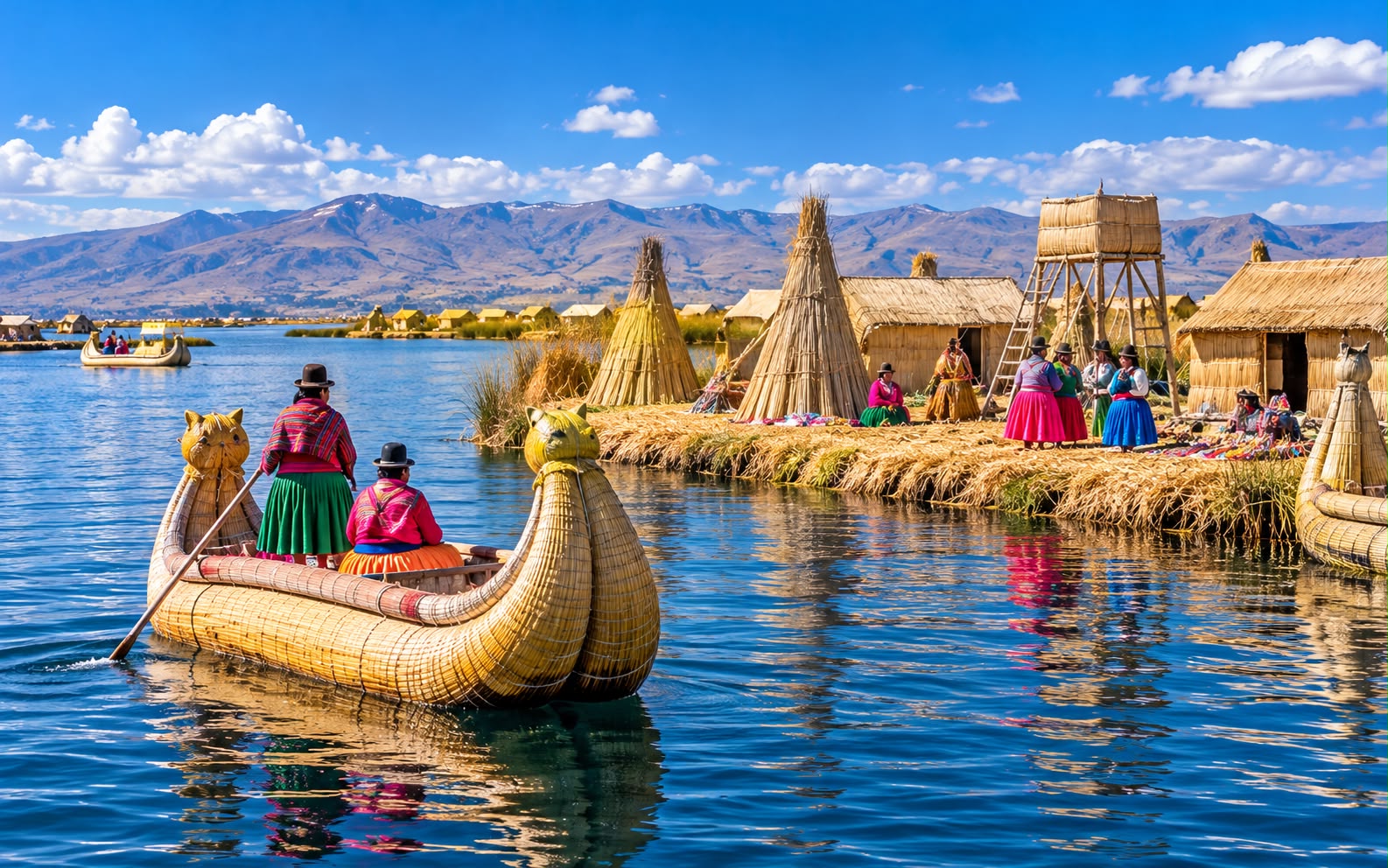
- 07:00 — The Uros floating islands are made of totora reed and are rebuilt continuously. They are also heavily commercialised — go early, go with an operator that visits a working island rather than a performance one, and expect a sales pitch.
- 10:30 — Taquile or Amantaní further out are the better half of the day — terraced, car-free, and Taquile’s weaving is UNESCO-listed. On Taquile the men knit and the women spin, which is the opposite of what visitors expect.
- 13:00 — Lunch on the island, trout from the lake.
- A homestay on Amantaní if you have the night, which is the most rewarding version — basic, cold, and the best evening on the lake.
- 18:00 — Back to Puno.
Day 9 — Cross to Bolivia, Copacabana and Isla del Sol
- 07:30 — The Kasani border is an hour from Puno and straightforward.
- 09:30 — Copacabana on the Bolivian shore, with its Moorish-domed basilica and the Virgin that Bolivian drivers come to have their vehicles blessed by. The blessings happen outside most mornings.
- 11:00 — Isla del Sol by boat — the Inca creation myth puts the birth of the sun here. The north and south of the island have had a long-running dispute that has closed the connecting path at times; check what is open.
- 17:00 — On to La Paz in the evening, crossing the Tiquina strait by barge — passengers and vehicle travel separately.
Day 10 — La Paz
- 09:00 — The teleférico is public transport, not a ride — ten lines, cheap, and the fastest way across the city. The Red and Yellow lines up to El Alto give the view.
- 11:00 — The Witches’ Market on Linares, which sells llama foetuses for construction blessings and is entirely in earnest.
- 14:00 — The Valle de la Luna on the southern edge, eroded clay spires twenty minutes from the centre.
- Or Tiwanaku as a half-day if you have it — the pre-Inca site with the Gate of the Sun, 70km out on the altiplano.
- 19:00 — Sopocachi for dinner.
Day 11 — Fly to Uyuni, and onto the salt
- 09:00 — Forty-five minutes, and the altiplano from the air is worth the window.
- 11:00 — The train cemetery outside town, where the British-built locomotives of the nitrate trade were abandoned.
- 14:00 — Onto the salar in the afternoon — 10,500km² of salt, flat to within a metre over its whole extent, which is why it is used to calibrate satellites.
- 15:30 — Incahuasi island in the middle, covered in cactus up to twelve metres tall and sitting on fossil coral.
- 18:30 — Sunset on the salt and a night at a salt hotel.
Day 12 — The lagoons, to the Chilean border
- 06:00 — South across the Eduardo Avaroa reserve.
- 10:00 — The Árbol de Piedra and the Salvador Dalí desert on the way.
- 13:00 — Laguna Colorada red with algae and full of James’s flamingos.
- 16:00 — Laguna Verde under Licancabur, and the Sol de Mañana geysers at 4,850m.
- This is the highest and coldest part of the trip. Nights at the refugios drop well below freezing. Sleep in your clothes.
- Many tours end at the Chilean border for San Pedro de Atacama; this one loops back to Uyuni — say which you want when you book, because the vehicles differ.
Day 13 — Back to Uyuni and out
- 07:00 — The return crossing of the salar, which is a different thing in the morning light.
- 13:00 — Fly back to La Paz for the international connection.
- Leave a buffer day. Bolivian internal flights and road blockades both happen, and neither cares about your schedule.
Costs and practicalities
Best time to visit
The planning tension is the Uyuni mirror. Dry season is easier for everything else; wet season is the reason most people come.
- May–October (dry) — clear skies, cold nights, reliable roads, and the best for Cusco, Machu Picchu, Titicaca and the Altiplano generally. The salar is a hard white plain you drive across and Incahuasi is reachable.
- December–March (wet) — a shallow film of water turns the salar into the mirror, which is the photograph everyone is after. January and February are the most reliable. The trade-off is that the crossing to Incahuasi is often impossible and some lagoon routes close.
- June–August — peak in Peru, with Inti Raymi in Cusco on 24 June the biggest festival of the year.
- The Inca Trail closes for the whole of February for maintenance. Machu Picchu stays open.
- April–May and September–October are the shoulders and arguably the best overall: green from the rains, clear enough, and far fewer people.
Travel tips
- Sleep in the Sacred Valley before Cusco. 2,800m then 3,400m is a far kinder sequence than flying straight to 3,400m and it costs nothing to arrange.
- Book Machu Picchu months ahead — timed slots, fixed circuits, a daily cap, and Huayna Picchu goes first. The Inca Trail permit needs six to seven months for the dry season.
- Carry travel insurance that covers altitude — many policies exclude activity above 4,000m, and the lagoon circuit goes to 4,850m.
- Small notes in Bolivia. Nothing above 50 bolivianos is usable in a market or a taxi.
- Blockades are a normal political instrument in Bolivia and close roads with little notice. Ask locally that morning and build slack into any overland leg.
- Choose the Uyuni operator on safety, not price. The cheap tours have a record of exhausted drivers on long desert stretches, and there is no recovery service out there.
- The sun at altitude burns through cloud. SPF 50, a hat, and lip balm — the salar reflects it from below as well.
What this trip actually costs
Two people, 12 nights, mid-range comfort, international flights excluded:
| Item | Cost |
|---|---|
| Hotels and guesthouses, 12 nights | USD 1,440 (≈ AED 5,288) |
| Machu Picchu entry, train and shuttle bus, two people | USD 700 (≈ AED 2,571) |
| Uyuni three-day tour, two people | USD 700 (≈ AED 2,571) |
| Food and drink, 13 days | USD 650 (≈ AED 2,387) |
| Lima–Cusco and La Paz–Uyuni flights, two people | USD 600 (≈ AED 2,204) |
| Guides, site entries and the Titicaca boats | USD 560 (≈ AED 2,057) |
| Buses, border transfers and local transport | USD 350 (≈ AED 1,285) |
| Total for two | USD 5,000 (≈ AED 18,363) |
- Roughly USD 2,500 (≈ AED 9,181) per person. Bolivia is substantially cheaper than Peru and the Uyuni tour is the best value on the page.
- Machu Picchu is the single largest fixed cost — entry, the train and the bus together run to several hundred dollars for two and none of it is discountable.
- Flying La Paz to Uyuni rather than taking the night bus costs about $200 more for two and saves the first day of the salt tour.
- Hotel picks here are chosen on location, not on commission — always check prices and recent reviews before booking.
What to pack
- Layers, and more of them than you expect. Altiplano days are warm in the sun and the nights are below freezing.
- A proper warm jacket and gloves for the lagoon circuit at 4,850m.
- Sunglasses and SPF 50. The salar reflects from below and people burn under their chin.
- Walking shoes with grip for Machu Picchu’s wet stone.
- Small notes in bolivianos and a wallet that closes.
- Altitude medication if your doctor agrees, and the willingness to descend if it does not work.
- A head torch for the salt hotel and the refugios.
FAQ
Dry season or wet season for Uyuni? Wet, if the mirror is what you came for — January and February are the most reliable. Dry, if you want to reach Incahuasi and do the full lagoon circuit. You cannot have both.
How bad is the altitude? Real, and it affects most people. Two nights of acclimatisation before anything strenuous, starting in the Sacred Valley rather than Cusco, solves it for the great majority.
Do I need the Inca Trail? No. The train takes you to the same place and the site is the point. If you want to walk, the permits go six to seven months ahead and it is closed every February.
Is the border crossing difficult? No. Kasani between Puno and Copacabana takes about an hour and is routine. Check Bolivia’s requirements for your nationality first — they vary more than most.
Can I add the Atacama? Yes — most Uyuni tours offer a drop at the Chilean border for San Pedro de Atacama, which saves a day of backtracking if Chile is next.
Prices and entry rules change, and what you need depends on your passport; last checked 29 October 2026, so confirm with the embassy or your airline before booking.


