 The Itinerary
Ecuador and Peru in 14 days: the Galápagos, Quito and Machu Picchu
Islands where the animals have no fear of people because nothing ever hunted them, and an Inca city on a ridge that the Spanish never found — the two sights that sell this continent, six hundred miles of Pacific and a mountain range apart.
- The Andes
- 14 days
- ≈ AED 16,550 / person
- The two things everyone wants from South America, in one trip
Before you go
Before you go: the admin
Two entries, both simple
- Most nationalities enter both visa-free — Ecuador 90 days, Peru 90 to 183.
- Both ask for proof of onward travel.
- The Galápagos has its own entry requirements on top of Ecuador’s: a transit control card bought at the mainland airport before you fly, and the national park entrance fee paid in cash on arrival. The park fee roughly doubled in 2024 — check the current figure and bring dollars.
Flights and the shape
- Fly into Quito and out of Lima, open-jaw.
- The Galápagos is a two-hour flight from Quito or Guayaquil to Baltra or San Cristóbal, and the fare is substantially higher than the distance suggests because the route is restricted.
- Quito to Lima is two hours; Lima to Cusco another ninety minutes.
- Four flights in fourteen days. This is an air-heavy itinerary and there is no overland alternative worth considering.
Money
- Ecuador’s official currency is the US dollar — there is nothing to change. Bring small notes; nobody has change for a 50, and old US coins circulate alongside Ecuadorian ones.
- Peru uses the sol. Cards work in Lima, Cusco and Arequipa; markets and buses are cash.
- The Galápagos is cash-heavy — the park fee, the transit card and many small operators take nothing else.
Altitude, which decides the order
- Quito is 2,850m. Cusco is 3,400m. The Galápagos is at sea level.
- Doing the Galápagos in the middle is the right order — you acclimatise in Quito, drop to sea level for five days, then come back up to Cusco.
- Sleep in the Sacred Valley at 2,800m before Cusco rather than the other way round. It costs nothing to arrange and solves altitude for most people.
Day by day
Day 1 — Quito, gently
- Arrive and do nothing strenuous. 2,850m from sea level is felt on the first day — headache, breathlessness on stairs, and a poor night’s sleep are all normal.
- 14:00 — Check in, and lie down for an hour. Coca tea if it is offered.
- 16:00 — A short flat walk in the Old Town, no more.
- 18:00 — La Ronda, the restored lane of workshops and canelazo bars, which is the gentlest possible first evening.
- No alcohol tonight. It hits differently at this altitude.
Day 2 — The Old Town, and the equator
- 09:00 — The Old Town is UNESCO-listed and is the best-preserved colonial centre in the Americas — La Compañía, which is gilded floor to ceiling, and San Francisco.
- 11:30 — The Basílica del Voto Nacional, whose gargoyles are Galápagos animals — iguanas, tortoises and boobies — and whose towers you can climb if the ladders do not alarm you.
- 13:30 — El Panecillo for the winged Virgin and the city in its bowl — take a taxi up, not the steps.
- 15:30 — Mitad del Mundo is in the wrong place by about 240m; the Intiñan museum next door is nearer the real line, and both are theatre. Enjoy them as that.
- Or the TelefériQo to 4,000m if the altitude is behaving, which is the better option on a clear afternoon.
Day 3 — To the Galápagos
- Cruise or land-based is the first decision. A cruise reaches the outer islands — Genovesa, Fernandina, Española — that day trips cannot, and is two to three times the price. Land-based from Santa Cruz or Isabela covers the central islands well and costs far less.
- 08:00 — Fly to Baltra or San Cristóbal, about two hours. The national park fee and transit card are paid at the airports in cash.
- 13:00 — Into Puerto Ayora or Puerto Baquerizo Moreno.
- 15:30 — The Charles Darwin Research Station on Santa Cruz, which sets up everything you will see this week.
- 17:30 — Tortuga Bay, a 45-minute walk from town on a paved path, with marine iguanas on the sand and no road access.
- The animals do not move away from you. Nothing has hunted them, so sea lions sleep on benches and boobies nest beside the path. The two-metre rule is yours to keep, not theirs.
Day 4 — The highlands, and the tortoises
- 08:30 — The highlands for giant tortoises in the wild, on the farms above Santa Cruz where they wander freely. Wellingtons are lent and are needed.
- 11:00 — The lava tunnels, which you walk through underground for several hundred metres.
- 14:00 — Los Gemelos, two collapsed craters in Scalesia forest, where the Galápagos vermilion flycatcher is.
- 16:30 — Las Grietas, a swimmable crevice of clear water reached by a short water taxi and a walk over lava.
Day 5 — Snorkelling
- 08:00 — Snorkelling is the better half — sea lions will play with you, and the hammerheads are at Kicker Rock and Gordon Rocks. Gordon Rocks is for confident swimmers only; the current is real.
- A naturalist guide is compulsory on most visitor sites, the trails are marked, and nothing may be taken off the islands — not a shell, not a pebble.
- 14:00 — A second site, usually a bay with turtles and rays in the shallows.
- 17:00 — Back, and the fish market on the dock at Puerto Ayora, where pelicans and a sea lion queue beside the customers.
Day 6 — Isabela, or an outer island
- 07:00 — The boat to Isabela, two hours and often rough, or the day boat to Bartolomé for the Pinnacle Rock view.
- 11:00 — Sierra Negra, the second-largest volcanic caldera in the world, a 16km return walk along the rim.
- 15:00 — Concha de Perla and the flamingo lagoon, both walkable from Puerto Villamil.
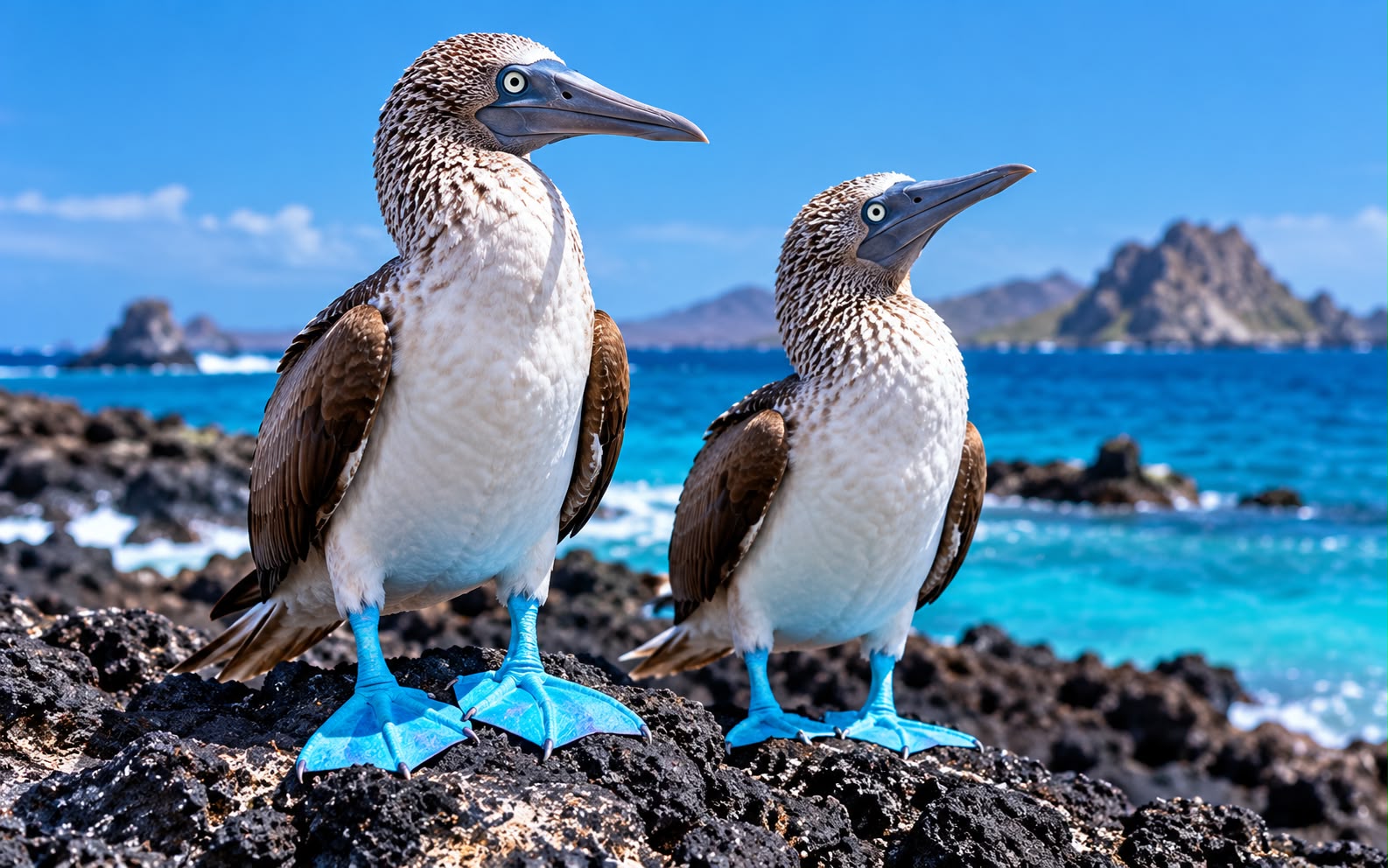
- What to look for: marine iguanas, the only sea-going lizard on earth; flightless cormorants on Fernandina; waved albatross on Española April to December; blue-footed boobies dancing; Galápagos penguins, the only ones north of the equator.
Day 7 — A last island morning
- 08:00 — One more snorkel or a kayak, which is the best use of a last morning.
- 12:00 — Back toward the airport island. On Santa Cruz that means a bus, the Itabaca channel ferry and another bus — allow three hours, not one.
- The transit card is checked on the way out as well as in.
Day 8 — Fly to Lima
- Back to the mainland and on to Peru. A long travel day — Galápagos to Guayaquil or Quito, then on to Lima.
- 18:00 — Miraflores or Barranco for the evening, the Malecón at sunset with the paragliders going out over the Pacific.
- 20:30 — Dinner in Barranco, which is the better of the two for an evening.
- Ceviche for lunch tomorrow, not dinner. The fish is that morning’s and an evening cevichería is a warning sign.
Day 9 — Lima
- 09:30 — The Larco Museum — pre-Columbian gold and ceramics in a colonial house, with an open storeroom of 45,000 pieces you walk through.
- 13:00 — Ceviche, as above, at a cevichería that closes in the afternoon — which is the sign you want.
- 15:00 — The Centro Histórico, the cathedral and the San Francisco catacombs, which hold the bones of some 25,000 people arranged by type.
- 18:00 — Huaca Pucllana in Miraflores, an adobe pyramid in the middle of the modern city, lit after dark.
- Lima is one of the best eating cities in the world. The tasting menus book months ahead; the menú del día at a neighbourhood place is a tenth of the price and most of the pleasure.
Day 10 — Fly to Cusco, go down to the valley
- 08:00 — Land at 3,400m and leave. Drive down to Urubamba or Ollantaytambo at 2,800m and sleep there. This single decision prevents most altitude trouble on this trip.
- 12:00 — Do nothing on arrival. Coca tea, water, an early night.
- 16:00 — A flat walk through the village and nothing more.
Day 11 — The Sacred Valley
- 08:00 — Pisac — terraces and hilltop ruins above the market town, with the looted tomb cliff opposite. Go to the ruins first and the market after.
- 12:00 — Lunch in Pisac or Calca.
- 14:00 — Maras and Moray — concentric agricultural terraces, each ring a different microclimate, and salt pans worked since Inca times by the same families. The salt pans are best in afternoon light.
- 17:30 — Ollantaytambo in the late afternoon, the only Inca town still lived in on its original plan — the water channels down the streets have run continuously for five centuries.
Day 12 — Machu Picchu
- Entry is on timed slots and fixed circuits with a daily cap. Book months ahead; Huayna Picchu and Huchuy Picchu go first.
- 05:00 — Take the first bus up at 5.30, or the last afternoon slot. The middle of the day is coaches and cloud.
- The train from Ollantaytambo to Aguas Calientes is 90 minutes along the Urubamba — take it the afternoon before if your slot is the dawn one.
- 06:00 — A guide is now effectively required for the circuits and makes the site make sense.
- 11:00 — Back down, and the hot springs in Aguas Calientes if you want them.
- 16:00 — The train back, which is the better direction for the light.
Day 13 — Cusco
- 09:00 — Now go up to 3,400m, acclimatised.
- 10:00 — Qorikancha, the sun temple the Spanish built a monastery on top of, where the Inca stonework holds and the colonial walls have cracked in every earthquake.
- 12:30 — San Pedro market for lunch.
- 14:30 — Sacsayhuamán above the city — blocks of up to 120 tonnes fitted without mortar, and the walk back down into the centre takes half an hour.
- 17:30 — The San Blas quarter for the evening, up the steep lanes above the Plaza de Armas.
Day 14 — Fly home via Lima
- 08:00 — Cusco to Lima, then the international connection.
- Leave a buffer. Cusco’s airport closes for weather and the afternoon flights slip — take a morning departure and do not book the tightest connection offered.
Costs and practicalities
Best time to visit
The two halves disagree, and the Galápagos is the one with two quite different good seasons rather than a good one and a bad one.
- The Peruvian Andes: May–September is the dry season — clear, cold at night, and the only sensible window for Machu Picchu and the Sacred Valley. June to August is peak, with Inti Raymi in Cusco on 24 June.
- November–March is the Andean wet season. Machu Picchu stays open and the cloud is heavier; the Inca Trail closes for the whole of February.
- The Galápagos, December–May — warmer air and sea, calmer crossings, better snorkelling visibility, and the green turtle and land iguana nesting season.
- The Galápagos, June–November — cooler and choppier, but the Humboldt current brings nutrients, so this is the best season for marine life, and the waved albatross is on Española April to December. Wetsuits are useful.
- April–May and September–October are the overlap — shoulder in the Andes and good in the islands, and the best single compromise for this route.
Travel tips
- Do the Galápagos in the middle. Quito at 2,850m, then five days at sea level, then Cusco — it is the kindest altitude sequence available and it is free to arrange.
- Sleep in the Sacred Valley before Cusco, not after.
- Book Machu Picchu months ahead — timed slots, fixed circuits, daily cap, and Huayna Picchu goes first. The Inca Trail permit needs six to seven months and is closed every February.
- Decide cruise or land-based for the Galápagos early. A cruise reaches the outer islands and costs two to three times as much; land-based covers the central ones well. There is no wrong answer, only a budget.
- Bring cash dollars for the Galápagos — the transit card and the park fee are both cash, and the fee rose sharply in 2024.
- Keep two metres from Galápagos wildlife, stay on the marked trails, no flash, and take nothing off the islands.
- Use apps for taxis in Lima — Uber, Cabify, Beat. Street taxis are not advisable.
What this trip actually costs
Two people, 13 nights, mid-range comfort, international flights excluded:
| Item | Cost |
|---|---|
| Galápagos: land-based programme, boats and guides, 5 days | USD 4,000 (≈ AED 14,690) |
| Four internal flights, two people | USD 1,400 (≈ AED 5,142) |
| Hotels on the mainland, 8 nights | USD 1,100 (≈ AED 4,040) |
| Machu Picchu entry, train and shuttle bus, two people | USD 700 (≈ AED 2,571) |
| Food and drink, 14 days | USD 700 (≈ AED 2,571) |
| Galápagos park fee and transit cards | USD 600 (≈ AED 2,204) |
| Guides, museums and Sacred Valley entries | USD 500 (≈ AED 1,836) |
| Total for two | USD 9,000 (≈ AED 33,053) |
- Roughly USD 4,500 (≈ AED 16,526) per person, and the Galápagos is more than half of it — the park fee, the restricted flight route and the guiding requirement all compound.
- A cruise instead of land-based adds $3,000–6,000 for two and reaches islands day trips cannot.
- Peru alone is a far cheaper trip; the islands are what makes this an expensive one.
- Hotel picks here are chosen on location, not on commission — always check prices and recent reviews before booking.
What to pack
- Reef-safe sunscreen and a rash vest. You are on the equator and in the water daily.
- A wetsuit top if you go June to November, when the Humboldt makes the water cold; most operators hire them.
- Layers for the Andes. Sacred Valley days are warm and the nights are near freezing.
- Walking shoes with grip for Machu Picchu’s wet stone and the Galápagos lava.
- Small US dollar notes for Ecuador and the park fees.
- Binoculars for the islands, which are a birding site as much as anything.
- Altitude medication if your doctor agrees, and the willingness to go slowly.
FAQ
Cruise or land-based in the Galápagos? Cruise if you want Genovesa, Fernandina and Española, which day trips cannot reach, and can absorb two to three times the cost. Land-based from Santa Cruz and Isabela covers the central islands well and is how most independent travellers now do it.
Which order — Galápagos first or Peru? Galápagos in the middle. Quito acclimatises you at 2,850m, five days at sea level resets you, and then Cusco. It is the kindest sequence and costs nothing to arrange.
Is five days enough in the islands? For a land-based trip, yes. For a cruise, four to eight nights is standard and the longer itineraries reach the far islands.
How bad is the altitude in Cusco? Real for most people. Two nights in the Sacred Valley at 2,800m before going up to 3,400m solves it for the great majority.
Can I add Bolivia? Yes — the Peru and Bolivia route picks up from Cusco and adds a week. Uyuni and Titicaca are the additions.
Prices and entry rules change, and what you need depends on your passport; last checked 29 October 2026, so confirm with the embassy or your airline before booking.


