 The Itinerary
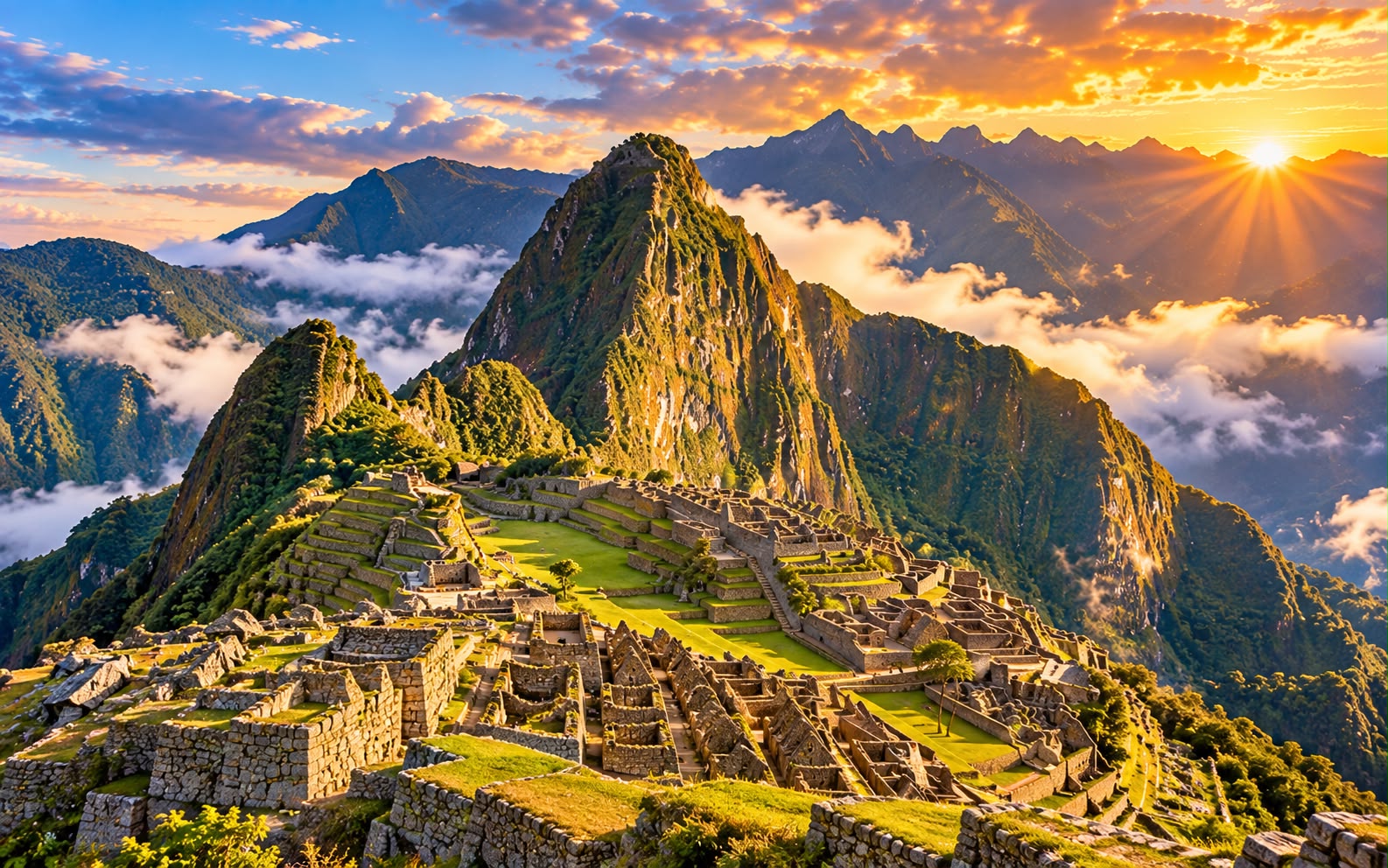
Peru in 9 days: Lima, Cusco and Machu Picchu
The Andes classic, sequenced so the altitude does not ruin it: Lima's coastline and its extraordinary food, the Sacred Valley first to acclimatise, Cusco's Inca-and-baroque streets, and Machu Picchu on a timed circuit booked months ahead — with the permits, the train and the acclimatisation order that most itineraries get backwards.
- The Andes
- 9 days
- ≈ AED 7,250 / person
- Machu Picchu, done right
Before you go
Almost everyone goes to Peru for one photograph, and almost everyone plans it in the wrong order. The mistake is the same every time: land, fly straight to Cusco at 3,400 m, and spend the first two days of a hard-won trip with a headache.
This route does it the way the altitude wants. Lima at sea level for two nights, which is no hardship — it is one of the great eating cities. Then Cusco, but straight down to the Sacred Valley at around 2,800 m to sleep, which is where you actually acclimatise. Cusco itself comes later, when your body can enjoy it. Machu Picchu sits in the middle, not at the end, so a cancelled train does not end the trip.
The other thing to understand early: almost nothing here is bookable last-minute. Permits, entry circuits and trains all sell out, and the good hotels in Aguas Calientes go first.
Before you go: the bookings that decide the trip
Entry and the altitude
- Most nationalities enter Peru visa-free for 90 days on arrival — the EU, UK, US, Canada, Australia, most of Latin America and many others. Some passports, Indian among them, need a visa unless the traveller holds a valid US, UK, Canadian, Schengen or Australian visa, which grants visa-free entry. Check your own case; the rules here change more often than most.
- Altitude is the real planning constraint, not the paperwork. Cusco is 3,400 m — higher than most people have ever slept. The Sacred Valley sits 500–600 m lower, and that difference is the reason this itinerary sleeps there first.
- Give yourself two nights before any hard walking, drink far more water than feels necessary, and go easy on alcohol the first two days. Coca tea is everywhere and helps a little; if you are prone to altitude sickness, ask a doctor about acetazolamide before you fly.
The three things that sell out
- Machu Picchu entry is timed and routed. You book a specific circuit and a specific entry hour, and the daily total is capped. It sells out weeks ahead in high season and months ahead for the best slots. Book this before your flights if your dates are flexible at all.
- The Inca Trail needs a permit, capped per day including porters and guides, sold through licensed operators only, and it goes months in advance — often close to a year for peak dates. The trail also closes each February for maintenance. The Salkantay and Lares routes need no permit and are the usual fallback.
- The train to Aguas Calientes is the only practical way in without trekking, and it books out. Two operators run it; both sell online.
Verify all three on the official sites close to booking. Circuit numbering and capacities have been revised more than once.
Money, and the two-price system
- The sol (PEN). Cards work in Lima, Cusco and hotels everywhere; markets, taxis, small restaurants and every entrance in the Sacred Valley want cash.
- US dollars are widely accepted but at a poor rate. Pay in soles. Bring dollars only as a backup, and only clean notes.
- The boleto turístico is a combined ticket covering most Sacred Valley and Cusco sites. It is not optional at most of them — you cannot pay per site — so buy it on your first valley day.
- Withdraw from bank-branded ATMs and decline the machine’s offer to charge you in your home currency.
Getting around
- Domestic flights link Lima and Cusco in about ninety minutes, several times a day. Book the morning departure: Cusco’s airport sits in a bowl and afternoon weather cancels flights.
- A private driver for the valley day costs little and saves hours of waiting. Agree the route and the price before setting off.
- Taxis are unmetered. Agree the fare first, or use a ride-hailing app in Lima, where they work properly.
Day by day
Day 1 — Land in Lima, sea level and dinner
- 14:00 — Land at Jorge Chávez (LIM). The new terminal opened in 2025; allow for the transfer, which is 40–60 minutes to Miraflores.
- 15:30 — Stay in Miraflores for convenience or Barranco for character. Both are on the clifftop above the Pacific.
- 17:00 — The Malecón — six kilometres of clifftop park above the sea, with paragliders launching off the edge at Parque Raimondi.
- 18:30 — It will probably be grey. Lima sits under the garúa — a coastal fog — for much of the year, and it almost never rains. Do not judge the city by the light.
- 20:00 — Eat. Lima is one of the world’s great food cities and it is the reason to stop here rather than connect straight through. Start with ceviche at a cevichería — lunchtime is when locals eat it, but the good ones serve through — and pisco sour first.
Day 2 — Lima, and the reason to stop here
- 09:30 — Museo Larco in Pueblo Libre: 45,000 pre-Columbian pieces in a colonial mansion, arranged chronologically so that 3,000 years of Andean cultures make sense before you reach Cusco. It reframes everything you see later. The storage rooms are open to visitors, which almost no museum does.
- 12:30 — Lunch in the museum garden, which is genuinely good.
- 14:00 — The Centro Histórico: Plaza Mayor, the cathedral with Pizarro’s remains, and the San Francisco catacombs — bone-lined ossuaries under the monastery holding an estimated 25,000 burials.
- 17:00 — Barranco: the bohemian quarter, the Puente de los Suspiros, and a slower evening than Miraflores.
- 19:30 — Dinner. If you want one of the famous kitchens — Central, Maido — they book months ahead; the mid-range places in Barranco are extraordinary and take walk-ins.
- 21:30 — Early night. Tomorrow starts high.
Day 3 — Fly to Cusco, then straight down to the valley
- 08:00 — Fly Lima → Cusco, about 90 minutes. Take a morning flight: afternoon departures out of Cusco are cancelled often enough that the airline schedules around it.
- 09:30 — Land at 3,400 m. You will feel it in the walk to the terminal.
- 10:30 — Do not stay in Cusco tonight. Transfer straight down to the Sacred Valley — Urubamba at 2,870 m or Ollantaytambo at 2,790 m. This single decision is what makes the rest of the trip pleasant, and it is the most useful thing in this guide.
- 12:30 — Arrive. Lunch, lightly.
- 14:00 — Nothing strenuous. Walk the village slowly, drink far more water than you want, and have mate de coca. Altitude sickness is not about fitness — fit young people get it worst because they push on.
- 19:00 — Early dinner, early bed.
Day 4 — The Sacred Valley
- 08:30 — Pisac: the terraces climb the mountainside above the town in curves, with a ceremonial centre, baths and a cliff face honeycombed with over a thousand looted tombs. Enter at the top and walk down — the taxi takes you up, and the descent through the site is the right direction.
- 11:30 — Pisac market below. Tuesday, Thursday and Sunday are the big days.
- 13:00 — Lunch in the valley.
- 15:00 — Ollantaytambo, and it is two things at once: a spectacular terraced temple site where the Incas defeated the Spanish in 1537, with six monoliths of rose rhyolite hauled across the valley from a quarry 6 km away — and the last living Inca town, whose street plan, canals and foundations are original and still lived in.
- 18:00 — Walk the lanes behind the plaza, which is where that last point becomes obvious.
- 19:30 — Early dinner. The train leaves from here and tomorrow is early.
- Note — Buy the Boleto Turístico if you are doing several sites; Machu Picchu is ticketed separately and must be bought months ahead with a chosen circuit and entry time.
Day 5 — Machu Picchu
- 05:00 — Train to Aguas Calientes from Ollantaytambo, 90 minutes up the Urubamba gorge. Sit on the left going out.
- 07:00 — The shuttle bus up the switchbacks, 25 minutes, and the queue for it is long — be in it before your entry slot.
- 08:00 — Your circuit. Entry is now by fixed circuit and timed slot, bought in advance, and you cannot wander between them. The classic postcard view is from the upper circuits (1 or 2); the lower ones get you closer to the stonework of the Temple of the Sun and the Intihuatana and are easier underfoot. A guide is required at the entrance.
- 11:00 — Huayna Picchu or Machu Picchu Mountain if you booked one — separately ticketed, capped daily, and sold with your entry months earlier. Huayna Picchu is the steep peak behind the ruins, with exposed steps and cables. Neither is for anyone uneasy with heights.
- 14:00 — Down. Aguas Calientes is a functional town in a gorge, with hot springs and inflated prices.
- 16:00 — Train back to the valley rather than sleeping here, if you can — you will wake up somewhere far nicer.
Day 6 — Back to Cusco, now acclimatised
- 09:00 — Transfer up to Cusco, an hour and a half. By now it will feel fine, which is the whole reason the valley came first.
- 11:00 — Check in around San Blas or the Plaza.
- 13:00 — Lunch.
- 14:30 — Qorikancha: the Inca Temple of the Sun, once lined with gold sheet, with the Santo Domingo convent built directly on top of it. The Spanish could not demolish the foundations, so they built on them — and the earthquakes of 1650 and 1950 brought down the convent while the Inca walls did not move. The joint between the two is the point.
- 17:00 — Plaza de Armas at dusk, with the cathedral lit.
- 19:30 — Dinner in San Blas.
Day 7 — Cusco properly
- 09:00 — Sacsayhuamán, above the town: zigzag ramparts of stones weighing up to 120 tonnes, cut and fitted without mortar so precisely that a blade will not enter the joints. Walk up if you are feeling strong — it is steep — or take a taxi and walk down.
- 11:30 — The nearby sites on the same ticket: Q’enqo, Puka Pukara and Tambomachay.
- 13:00 — San Pedro market for lunch — juice stalls, soups, and the cheese and bread counters.
- 15:00 — The cathedral on the Plaza, for the Last Supper painted with a roast guinea pig on the table, and the Twelve-Angled Stone on Hatunrumiyoc street.
- 17:00 — San Blas: the artisan quarter, steep and narrow, and the best wandering in the city.
- 20:00 — Dinner. Cusco’s restaurants are better than a town of this size has any right to be.
Day 8 — Rainbow Mountain, Maras, or rest
- Option A — Maras and Moray, 08:30. The gentle one and the best value: Moray’s concentric circular terraces, an Inca agricultural laboratory where each ring sits at a different temperature, and the Maras salt pans — 3,000 shallow terraces fed by a saline spring, worked by the same families since pre-Inca times. Back by mid-afternoon.
- Option B — Rainbow Mountain, 03:00. A three-hour drive, then a 90-minute climb to 5,036 m for a striped mineral hillside. It is higher than Everest base camp, it is genuinely hard, the colours are weaker than the photographs, and it is very crowded. Go in only if you are well acclimatised and want it.
- Option C — nothing. After a week at altitude this is a legitimate and under-chosen answer.
- 19:30 — Last dinner.
Day 9 — Fly home via Lima
- 07:00 — Fly Cusco → Lima, and take the earliest flight of the day. Cusco sits in a bowl, the weather closes in, and afternoon cancellations are common enough to plan around.
- 09:00 — Land in Lima.
- Leave a long connection — four hours minimum to an international departure. If your flight home is late evening, the airport is 40 minutes from Miraflores and a last ceviche is entirely achievable.
Costs and practicalities
Best time to visit
May–September is the dry season in the Andes, which is where the Inca Trail and Machu Picchu are, and the single most important planning fact.
- May–September — dry, clear, cold at night, and peak. June to August is the busiest, with Inti Raymi in Cusco on 24 June the biggest festival of the year.
- April–May and September–October — the shoulders, and arguably the best: green from the rains, clear enough, and fewer people.
- November–March — the wet season in the highlands. The Inca Trail closes for the whole of February for maintenance. Machu Picchu stays open; the cloud is heavier and the alternative treks are muddy.
- The Amazon is wet year-round, with high water December to May for canoeing and low water June to November for walking and beaches.
- The coast and Nazca are dry all year; Lima is under garúa fog from May to November.
Travel tips
- Machu Picchu uses timed entry on fixed circuits and daily caps. Book months ahead, especially for Huayna Picchu or Huchuy Picchu, which sell out first.
- The Inca Trail requires a licensed operator and a permit released months in advance — often selling out six to seven months ahead for the dry season. It is closed every February.
- Acclimatise in Cusco (3,400m) for two days before trekking, or better, start in the Sacred Valley at 2,800m, which is lower and kinder.
- Coca tea and mate de coca help a little; descending helps more. Do not fly into Cusco and walk the same day.
- Carry small soles. Cards work in Cusco, Lima and Arequipa; markets and buses are cash.
- Use registered taxis or apps in Lima — Uber, Cabify, Beat. Street taxis are not advisable.
- Ceviche is lunch, not dinner. The fish is that morning’s, and a cevichería open in the evening is a warning sign.
What this trip actually costs
Two people, 8 nights, mid-range, excluding international flights:
| Item | Cost |
|---|---|
| Hotels, 8 nights across Lima, the valley, Aguas Calientes and Cusco | PEN 5,600 (≈ AED 5,970) |
| Lima–Cusco flights ×2 return | PEN 1,600 (≈ AED 1,706) |
| Machu Picchu entry, trains and shuttle buses ×2 | PEN 2,800 (≈ AED 2,985) |
| Boleto turístico, Sacred Valley sites, a driver day | PEN 1,400 (≈ AED 1,493) |
| Food and drink, 9 days | PEN 2,000 (≈ AED 2,132) |
| eSIM, taxis, extras | PEN 200 (≈ AED 213) |
| Total for two | PEN 13,600 (≈ AED 14,499) |
- Roughly PEN 6,800 (≈ AED 7,249) per person. The Machu Picchu day is the single biggest line by far — entry, train and bus together cost more than several nights of accommodation.
- Lima and Cusco are inexpensive; the Machu Picchu corridor is not. Aguas Calientes prices are captive-market prices. Eat well either side of it.
- Trekking the Inca Trail instead of taking the train costs more, not less, once the permit and mandatory guide are counted.
What to pack
- Layers, seriously. The valley swings from cold mornings to strong sun to cold nights, all in one day, all year.
- Proper walking shoes. Inca stonework is uneven, polished and often wet.
- Sun protection at altitude, which burns far faster than the temperature suggests. Hat, high-factor sunscreen, lip balm.
- Type A/B and C plugs — Peru uses both, so bring a universal adapter.
- A day pack with a rain layer between November and March.
- Cash in small notes for site entries, markets and taxis.
FAQ
Is nine days enough? For this route, comfortably. Adding days is better spent on the Amazon or Arequipa and Colca than on stretching this loop.
Do I have to do the Inca Trail? No, and most people should not. It needs a permit booked many months ahead, costs more than the train, and takes four days. Salkantay is the better trek if you want one; the train is the better choice if you do not.
Will the altitude ruin it? Not if you sequence it as above. The people who suffer are almost always the ones who flew into Cusco and went straight up to a 3,400 m hotel on day one.
Which Machu Picchu circuit should I book? The upper circuits give the classic postcard view; the lower ones bring you closer to the buildings. If the photograph is why you came, book an upper circuit — and book it early, because those go first.
When should I go? May to September is the dry season and the reliable choice. January and February are wettest, and the Inca Trail closes each February.
Prices and entry rules change, and what you need depends on your passport; last checked 8 October 2026, so confirm with the embassy or your airline before booking.


