 The Itinerary
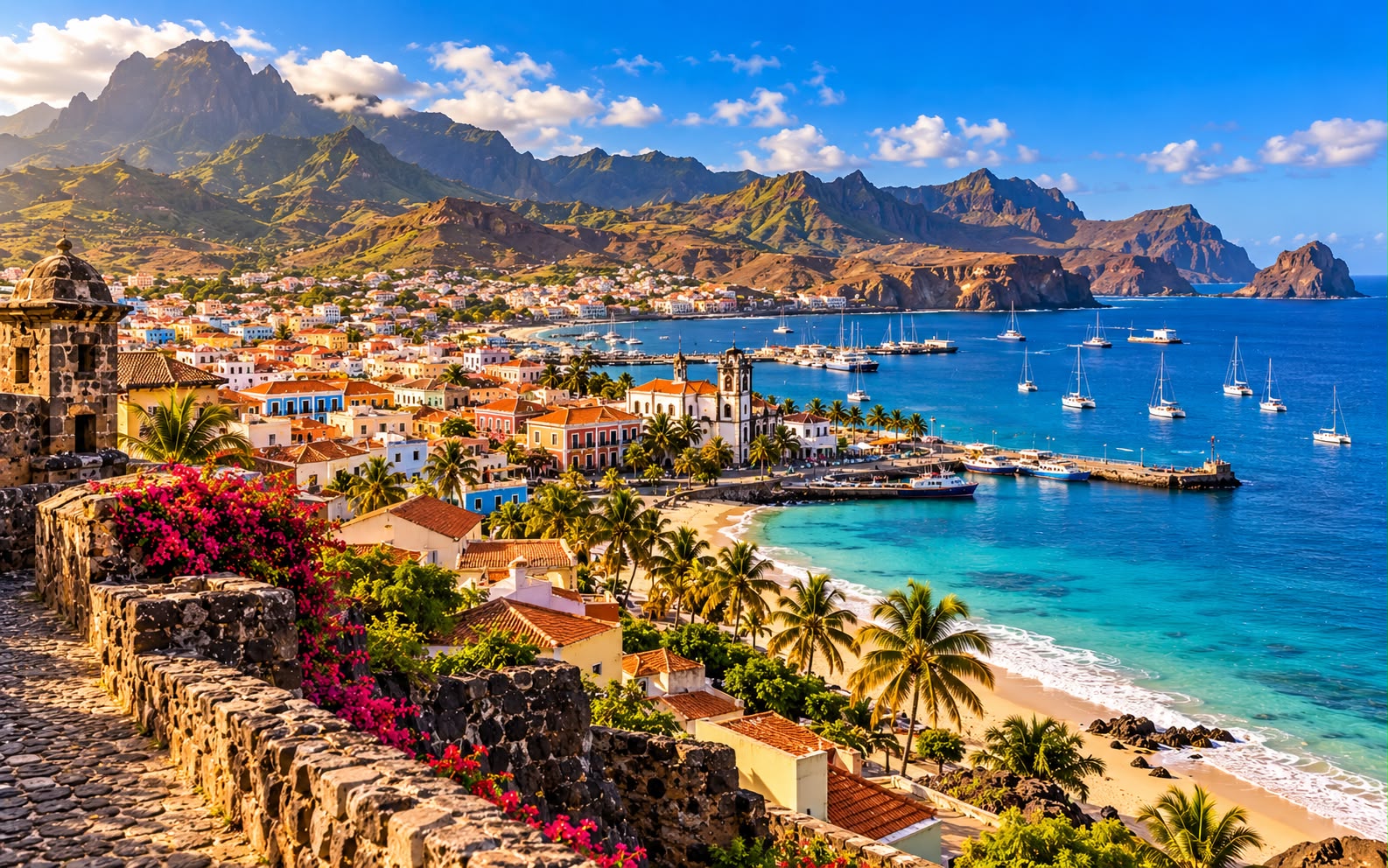
Cape Verde in 9 days: Mindelo, Santo Antão and Cidade Velha
The islands sold as winter sun, done the other way: Mindelo's music bars where morna was invented, a neighbouring island with no airport and some of the best ridge walking in the Atlantic, and the first European colonial town in the tropics with its whipping post still standing in the square.
- West Africa
- 9 days
- ≈ AED 4,250 / person
- Hiking and morna, not resorts
Before you go
Most visitors to Cape Verde land on Sal or Boa Vista, check into an all-inclusive on a flat sandy island, and never leave it. Those two islands are the desert ones. The archipelago has ten, and the others are mountainous, green in places, and considerably more interesting.
Mindelo on São Vicente is the cultural capital — a harbour town of faded Portuguese buildings and live music every night, where morna was born and Cesária Évora sang barefoot in bars long before the world heard her.
An hour away by ferry, Santo Antão has no working airport, a hand-built cobbled road over a crater rim, and ridge walks that drop two thousand metres into valleys of sugar cane and mango. It is among the best hiking in the Atlantic and almost nobody outside Cape Verde knows it.
And on Santiago, Cidade Velha was the first European colonial settlement in the tropics — with the pillory still standing in the square it was used in.
Before you go: the inter-island problem, and the season
Entry and money
- Many nationalities enter visa-free, including the EU and UK. Others pay an airport security fee (TSA) registered online in advance — check your own case and register before you fly if required.
- Cape Verdean escudo (CVE), pegged to the euro at a fixed rate, so there is no currency guesswork. Euros are widely accepted at roughly that rate.
- Cards work in Mindelo, Praia and the resort islands. Santo Antão is cash — draw before the ferry.
- Portuguese is official; Kriolu is what everyone speaks. French gets you further than English outside the tourist islands.
The inter-island flights are the weak point
- Domestic flights are unreliable. Cancellations and retimings are routine, the fleet is small, and a cancelled leg can cost you a day.
- Never connect a domestic flight to an international one on the same day. Build a night’s buffer in whichever island you fly home from.
- Ferries link São Vicente–Santo Antão (about an hour, several daily, reliable) and some southern islands (slower, rougher, and prone to cancellation in swell).
- Book domestic legs early, and keep the itinerary loose.
Santo Antão has no airport
- The island’s airstrip has been closed for years. The only way in is the ferry from Mindelo to Porto Novo — about an hour, two or three sailings daily, and it can be a rough crossing in winter swell.
- Check the day’s timetable locally. It changes.
When to go
- Year-round warm, 24–30°C, with the Atlantic keeping it moderate.
- November to June is dry and the hiking season on Santo Antão.
- August to October brings the brief rains, which is when Santo Antão is greenest and also when trails are slippery and ferries lumpier.
- The harmattan can blow Saharan dust across in December to February, hazing the views for a few days at a time.
- Loggerhead turtles nest on Boa Vista and Sal from June to October, if that shapes your dates.
Day by day
Day 1 — Land, and into Mindelo
- 14:00 — Land at São Vicente (VXE), which is 15 minutes from town — or at Sal (SID) and connect, which is the more common routing.
- 15:30 — Mindelo: a natural harbour under a bare volcanic ridge, with a grid of pastel Portuguese colonial buildings in varying states of repair.
- 17:00 — Walk Rua de Lisboa and the Praça Nova, where the town sits out in the evening, and the pink Palácio do Povo.
- 18:00 — The Torre de Belém replica on the waterfront — a scaled copy of the Lisbon original, which tells you something about how this place saw itself.
- 19:30 — Dinner. Cachupa — the slow-cooked corn and bean stew that is the national dish, eaten at dinner and fried up with an egg for breakfast the next morning as cachupa refogada.
- 21:30 — Live music. Mindelo has it nightly — the bars on and around Rua de Lisboa — and this is where morna and coladeira come from. The musicians are often extremely good and the entry is usually free.
Day 2 — Mindelo, and Cesária
- 09:00 — The Mercado Municipal and the fish market on the front, where the morning catch is sold and argued over.
- 10:30 — The Casa da Morna or the Cesária Évora museum — the barefoot diva was born here, sang in these bars for decades, and died in 2011; morna is now on UNESCO’s intangible heritage list. The airport carries her name.
- 12:30 — Lunch, then across to Laginha beach, which is in the town itself.
- 15:00 — Drive out to Monte Verde, the island’s high point at 750 m, for the view over the harbour and across to Santo Antão sitting on the horizon — which is where you are going tomorrow and it looks impossible from here.
- 17:30 — Baía das Gatas on the north coast, or Calhau with its volcanic cone and black beach.
- 19:30 — Dinner, and more music. Draw cash tonight.
Day 3 — Ferry to Santo Antão, and the Cova crater
- 08:00 — The ferry to Porto Novo, about an hour. Sit outside; the crossing is open water and the island grows in front of you.
- 09:30 — Land, and take the estrada da corda — the cobbled road, laid by hand across the spine of the island and one of the genuine feats of the archipelago. It climbs from dry desert on the south coast to cloud forest on the ridge.
- 10:30 — Cova de Paúl: a collapsed volcanic crater with fields farmed on its floor, which you look down into from the rim.
- 11:00 — The walk down into the Paúl valley. From the Cova rim you descend through the crater, over the lip and down the valley — about three to four hours and 1,100 m of descent — past sugar cane, mango, breadfruit and houses stacked on terraces, finishing at the sea at Vila das Pombas. It is steep, cobbled in places, and the best single walk in Cape Verde.
- 15:30 — A grogue distillery in the valley — sugarcane spirit, distilled in small trapiches, often with an ox turning the press. Try the ponche, which is grogue with honey and lime.
- 18:00 — Check in at Paúl or Ponta do Sol.
- 19:30 — Dinner.
Day 4 — The coast road and Ponta do Sol
- 08:30 — Ponta do Sol, the island’s northern tip, a small town of coloured houses with the Atlantic hitting the rocks below it.
- 09:30 — The coastal path to Fontainhas, and this is the one people come for: a trail cut into the cliff face, dropping to sea level and climbing again, with Fontainhas itself — a village of perhaps two hundred people perched on a spur above the ocean, which from a distance looks like it has been glued on. About two hours to there.
- 12:00 — Continue to Corvo and Formiguinhas if you are walking on, or turn back.
- 13:30 — Lunch at Ponta do Sol.
- 15:30 — Ribeira Grande (Povoação), the island’s main town, and the valley behind it.
- 17:30 — Sunset at Ponta do Sol, from the old airstrip that is now a promenade.
- 19:30 — Dinner — lagosta if it is on, or tuna, which is everywhere and excellent.
Day 5 — Santo Antão, the big walk
- 07:30 — Choose your day. These are the two best:
- Option A — Xoxo to Cruzinha. From the Ribeira Grande valley over to the north coast, about six hours, with the Xoxo needle rock and villages reached by no road at all. It ends at the sea and you arrange a pickup.
- Option B — Ribeira da Torre. Up the valley behind Ribeira Grande, three to four hours, into a gorge with walls that close over and terraced cultivation to the top of them.
- 13:00 — Lunch wherever you finish.
- 15:30 — Tarrafal de Monte Trigo if you have a 4x4 and a spare day — a black-sand village on the west coast reached by a track with a thousand-metre drop, and genuinely remote.
- 18:00 — Back. Your legs will know about it.
- 19:30 — Dinner, and grogue.
Day 6 — Back across, and fly to Santiago
- 08:00 — The ferry back to Mindelo, an hour.
- 10:00 — Time in Mindelo, then the airport.
- 13:00 — Fly to Santiago (Praia), about 50 minutes — and this is the leg most likely to move, so keep the afternoon flexible.
- 15:00 — Praia is the capital and the largest city in the country, built on a plateau — the Plateau — above the harbour. It is louder, poorer and more African than Mindelo, and that contrast is worth seeing.
- 17:00 — The Plateau: the Praça Alexandre Albuquerque, the Mercado de Sucupira — a vast informal market — and the Museu Etnográfico.
- 19:30 — Dinner, and funaná rather than morna here — faster, accordion-driven, and banned by the Portuguese for decades.
Day 7 — Cidade Velha
- 09:00 — Cidade Velha, 15 km west, and give it the morning. Founded in 1462 as Ribeira Grande, it was the first European colonial settlement in the tropics and the archipelago’s capital for three centuries.
- 09:30 — Its reason for existing was the Atlantic slave trade: Cape Verde was uninhabited before the Portuguese arrived, and this town was the entrepôt where enslaved people from the West African coast were held, processed and shipped onward. The pelourinho — the marble pillory — still stands in the main square, where it was used.
- 11:00 — The Fortaleza Real de São Filipe above the town, built in 1590 after Francis Drake sacked the place twice, with the whole valley and coast below it.
- 12:00 — The ruins of the Sé Catedral, begun 1556, and the Igreja de Nossa Senhora do Rosário — the oldest colonial church still standing anywhere in the world.
- 13:30 — Lunch by the beach at the bottom of the Ribeira, under the coconut palms.
- 15:30 — Back to Praia, or on into the interior.
- 17:00 — Quebra Canela beach for the late afternoon.
- 19:30 — Dinner.
Day 8 — The interior of Santiago
- 08:30 — North into the mountains, which most visitors to this island never see.
- 10:00 — Assomada and its Sucupira market — the biggest on the island, best on a Wednesday or Saturday, and entirely a working market rather than a craft one.
- 11:30 — The Tabanka museum at Assomada, on the syncretic religious brotherhoods that survived here.
- 13:00 — Serra Malagueta Natural Park, a ridge at 1,000 m with walking trails and views down both coasts.
- 15:00 — Tarrafal on the north coast: a crescent of white sand under palms, and the best beach on Santiago — with the former concentration camp above it, where the Portuguese Estado Novo imprisoned political dissidents from Portugal and the colonies. The museum is small and unsparing.
- 18:00 — Drive back, about 90 minutes.
- 19:30 — Last dinner.
Day 9 — Fly home
- Morning — Praia (RAI) for international departures, or connect via Sal.
- Build in the buffer. If your international flight leaves from a different island, do not take the domestic leg on the same day — this is the single most common way to miss a flight out of Cape Verde.
- Last buy — grogue from Santo Antão, Cesária Évora on CD, and coffee from Fogo, which is grown in volcanic ash and is very good.
Costs and practicalities
Best time to visit
November–June is the dry season and the practical answer, with the caveat that these islands have a wind season that matters as much as the rain.
- November–February — cooler, dry, and the windiest months, which is exactly why Sal and Boa Vista are a world kitesurfing destination.
- March–June — warm, dry, calmer water, and the best for swimming and for walking on Santo Antão.
- July–October — hotter and humid, with the brief rains in August and September. The hiking islands are green afterwards.
- Loggerhead turtles nest on Boa Vista and Sal from June to October, with hatchlings into November. Go with a licensed guide; the beaches are protected.
The islands have different climates. Santo Antão and São Nicolau are green and mountainous; Sal and Boa Vista are flat and desert.
Travel tips
- Inter-island travel is the planning problem. Flights are limited and change; the Santo Antão ferry from Mindelo is the one reliable boat link. Build buffer days around any connection.
- The escudo is pegged to the euro and euros are widely accepted, usually at a round rate. Cards work in hotels and in Praia and Mindelo.
- Portuguese is official; Kriolu is what people actually speak. French is common on some islands from the diaspora.
- The Santo Antão coastal road is closed and the mountain road is the route. It is spectacular and not for nervous drivers.
- Tap water is desalinated and generally fine in hotels, but bottled is the norm.
- Music is the point in Mindelo. Ask where there is live morna; it does not advertise.
- Sun and wind together burn you without feeling hot. This catches people out on the flat islands constantly.
What this trip actually costs
Two people, 8 nights, mid-range, excluding international flights:
| Item | Cost |
|---|---|
| Accommodation, 8 nights | CVE 72,000 (≈ AED 2,674) |
| Inter-island flights, two people | CVE 48,000 (≈ AED 1,782) |
| Ferries to and from Santo Antão, two people | CVE 9,000 (≈ AED 334) |
| Drivers, guides and 4x4 on Santo Antão and Santiago | CVE 36,000 (≈ AED 1,337) |
| Cidade Velha, museums, park fees, distillery | CVE 8,000 (≈ AED 297) |
| Food and drink, 9 days | CVE 48,000 (≈ AED 1,782) |
| SIM, extras | CVE 9,000 (≈ AED 334) |
| Total for two | CVE 230,000 (≈ AED 8,541) |
- Roughly CVE 115,000 (≈ AED 4,270) per person — about EUR 1,040, since the escudo is pegged to the euro.
- This costs more than an all-inclusive on Sal and is a completely different holiday.
- The inter-island flights are the awkward line — a fifth of the trip, and the part most likely to go wrong.
- Santo Antão is cheap once you are on it; the ferry and the driver are the costs.
What to pack
- Proper walking boots with grip. The Santo Antão trails are cobbled, loose and steep, and trainers are not enough on the descents.
- Walking poles if your knees have opinions — the Paúl descent is 1,100 m in one go.
- A windproof layer. The Cova rim and the ridges are cold and the trade wind never stops.
- Cash in escudos, drawn before the ferry.
- Sun protection. The Atlantic light is strong and the dry islands have no shade.
- European Type C/F plugs, 220V.
- Something for the ferry if you are prone — it can be rough.
FAQ
Which islands should I pick? Santo Antão for walking, São Vicente for music, Santiago for history, Fogo for the volcano, Sal and Boa Vista for beaches and kitesurfing. They are genuinely different places and choosing the wrong one for what you want is the commonest mistake. This route takes the first three.
Is the hiking really that good? Yes, and it is the island’s secret. Santo Antão has ridge and valley walking comparable to Madeira or La Gomera, with hand-built cobbled paths linking villages that have no road, and a fraction of the visitors. If you only have four days in Cape Verde, spend them there.
What about Fogo? Pico do Fogo is 2,829 m and you can climb it, and people live inside the caldera at Chã das Caldeiras, growing vines in volcanic ash. The 2014 eruption buried the village and it was rebuilt on top. It is a superb addition and it needs two or three days and another flight — which is why it is not in this nine.
How bad are the domestic flights? Bad enough to plan around. Cancellations and retimings are normal. Keep a night’s buffer before any international departure, and do not book tight connections between islands.
Do I need Portuguese? It helps a great deal, and French helps too. English is limited outside Sal, Boa Vista and the Mindelo tourist places.
Prices and entry rules change, and what you need depends on your passport; last checked 8 October 2026, so confirm with the embassy or your airline before booking.


