 The Itinerary
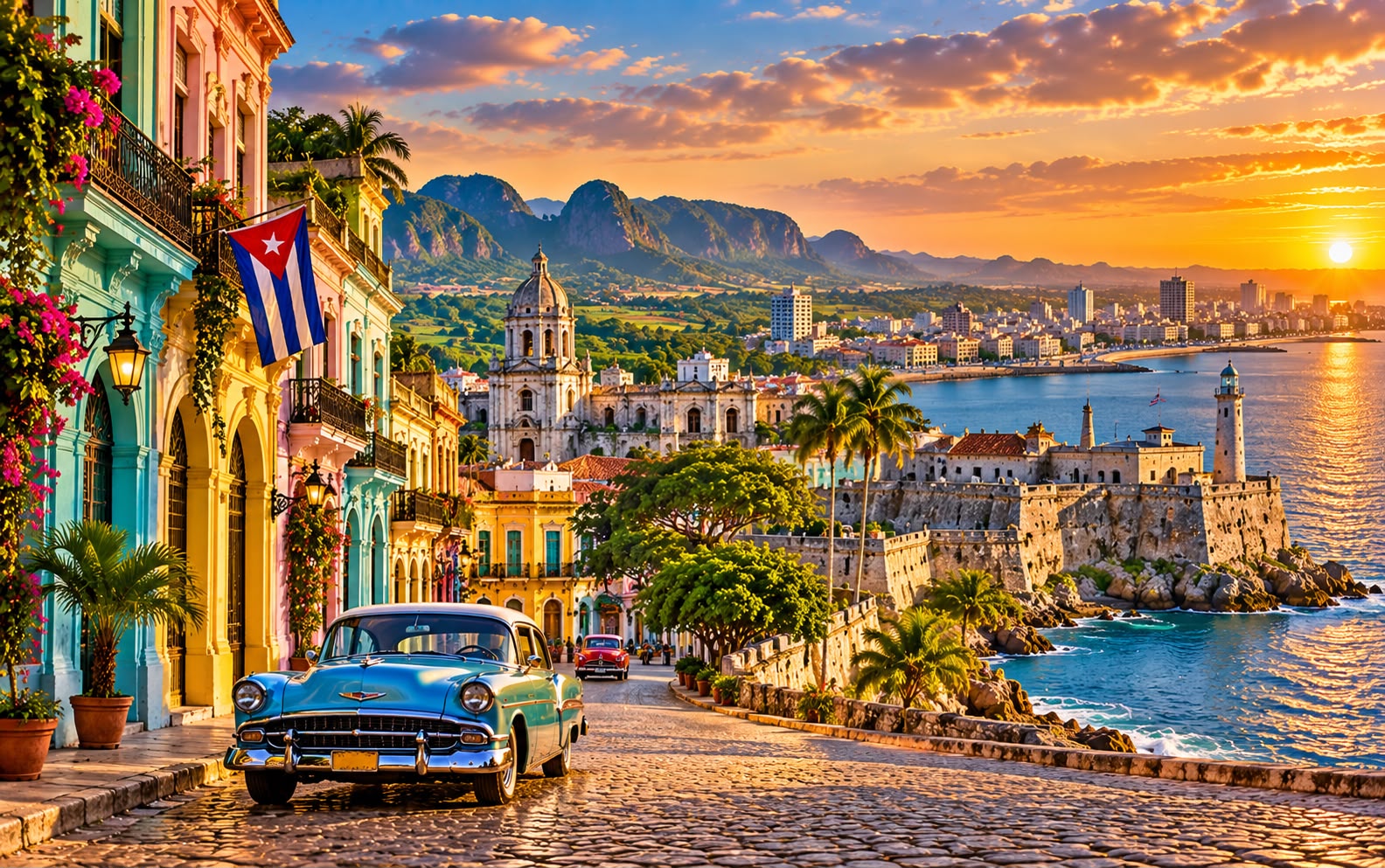
Cuba in 9 days: Havana, Viñales and Trinidad
A country that runs on cash you bring with you: Havana's crumbling grandeur and live son in the plazas, tobacco valleys worked by ox and hand, and a colonial town frozen in the 1850s — plus the honest brief on cards that will not work, shortages that are real, and why casas particulares beat hotels on every measure.
- The Caribbean
- 9 days
- ≈ AED 4,050 / person
- Music + old cities
Before you go
Cuba is the trip that most rewards preparation, because almost nothing about it works the way travel usually does. Your cards will probably not work. The internet is limited. Shops are not reliably stocked. None of that spoils it — but arriving without knowing it does.
What you get in return is a country unlike any other in the hemisphere. Havana is a capital of collapsing baroque and 1950s American cars where live music happens in ordinary bars rather than for tourists. Viñales is a tobacco valley of limestone domes farmed by ox and hand. Trinidad is a colonial sugar town so completely preserved that the cobbles are the original ones.
Nine days covers all three at a Cuban pace, which is slower than you plan for and better than you expect.
Before you go: money, the card problem and the bookings
Entry, and the tourist card
- Most visitors need a tourist card (tarjeta del turista) — effectively a visa, bought through your airline, a Cuban consulate or an agency, and valid for 30 days. It is usually straightforward and inexpensive; the airline selling you the flight will normally sell you the card.
- Travel insurance is mandatory and can be checked on arrival. Bring the policy document.
- US travellers face separate restrictions under their own country’s rules, including permitted categories of travel and limits on where money may be spent. That is US law rather than Cuban, and it needs checking independently.
- Visiting Cuba can affect later US entry under the visa-waiver scheme — worth knowing if a US trip may follow.
The money situation, which is the whole trip
This is the part that catches people, so it comes first.
- Bring all the cash you need, for the entire trip, from home. There is no reliable fallback.
- Cards issued by US banks do not work in Cuba at all. Cards from elsewhere work inconsistently at best — assume they will not.
- Euros, and to a lesser extent pounds and Canadian dollars, are the practical currencies to bring. US dollars are accepted in places but have at times attracted penalties on exchange; bring euros if you can.
- Bring clean, undamaged notes. Torn or marked ones get refused.
- The official exchange rate and the rate people actually use are not the same, and the gap has been large and volatile. Change money at your casa, a bank or a formal exchange, never on the street, and check the current situation close to travel.
- This guide budgets in US dollars because a figure in Cuban pesos would be meaningless by the time you read it.
Stay in casas particulares
- Casas particulares — licensed rooms in private homes — are better than almost every hotel at the price, and the money goes to a family rather than a state chain.
- Your host will cook breakfast, arrange the next casa, book the taxi between towns and explain what is actually open this week. That last service is worth the stay on its own.
- Book the first two nights ahead and let your host chain the rest.
Getting around, and what to expect
- Shared and private taxis run between the towns, arranged through your casa the day before. Viñales is about three hours from Havana, Trinidad about four and a half.
- Viazul buses are the cheaper scheduled option and need booking ahead.
- Shortages are real and rotating. Some weeks it is fuel, some weeks bottled water, some weeks eggs. Carry a refillable bottle with a filter, keep snacks, and treat any shop with what you need as the moment to buy it.
- The internet is limited. Wi-fi exists in hotels and some plazas via scratch cards; a Cuban tourist eSIM now works but not everywhere. Plan to be offline and tell people at home so.
Day by day
Day 1 — Land in Havana
- 14:00 — Land at José Martí (HAV), 20 km south of the centre. There is no ride-hailing app: agree the taxi fare before you get in, in cash, and have small notes.
- 15:30 — Check into your casa particular in Habana Vieja or Vedado. Casas are private homes, licensed, and the single best decision on a Cuba trip — your hosts will solve problems no hotel desk can.
- 16:30 — Change money with your host or at a bank, never on the street. Bring cash in euros; cards issued by US banks do not work at all and others fail often enough that you should plan for none of them working.
- 18:00 — The Malecón at sunset. Eight kilometres of sea wall where the whole city comes to sit — fishermen, couples, trumpet practice, and the spray coming over when the wind is up.
- 20:30 — Dinner at the casa. Ask tonight about tomorrow’s breakfast and the taxi west on day four; both want a day’s notice.
Day 2 — Old Havana on foot
- 09:00 — The four colonial plazas, in this order: Plaza de la Catedral for the baroque facade, Plaza de Armas and its second-hand book stalls, Plaza de San Francisco by the cruise dock, and Plaza Vieja, the liveliest, with its camera obscura for the rooftop view.
- 11:30 — The streets between them are the point rather than the squares — Obispo and Mercaderes, restoration on one block and propped-up ruins on the next.
- 13:00 — Lunch on a rooftop off Plaza Vieja.
- 15:00 — Museo de la Revolución, in the former Presidential Palace, with the Granma yacht outside under glass. It is the official version told with total confidence, and that is what makes it worth two hours.
- 17:30 — El Floridita or La Bodeguita del Medio if you want the Hemingway box ticked — both are crowded and overpriced, and one drink is the correct dose.
- 21:00 — Live son somewhere with no cover charge. Ask your host tonight, not a guidebook: the good rooms change month to month.
Day 3 — The other Havana
- 09:30 — A 1950s American car tour through Vedado and Miramar. It is touristy and unavoidable, and it is genuinely the best way to cover the wider city — convertible Chevrolets kept running for seventy years on improvised parts, which is its own story.
- 10:30 — Plaza de la Revolución: the José Martí memorial, and Che and Camilo picked out in steel on the ministry facades.
- 11:30 — Fusterlandia in Jaimanitas, where José Fuster has covered his own house and much of the neighbourhood in mosaic — Gaudí by way of the Caribbean, and still expanding.
- 13:30 — Lunch in Vedado.
- 15:00 — Necrópolis de Colón, 56 hectares of marble, or Callejón de Hamel for Afro-Cuban murals — the rumba there runs Sunday around noon and is a genuine community event rather than a performance.
- 17:30 — Hotel Nacional terrace for a daiquiri and the view down the Malecón. Cheaper than it looks.
- 19:30 — Dinner. Confirm the Viñales taxi for the morning.
Day 4 — West to Viñales
- 09:00 — Three hours west by colectivo taxi, through increasingly green country and past roadside stalls selling strings of garlic and onions.
- 12:00 — Arrive Viñales. The valley is a UNESCO site of mogotes — limestone domes with vertical sides, left standing when the ground between them dissolved.
- 13:00 — Lunch at your casa.
- 15:00 — Walk or ride into the valley. On foot, the loop out past the tobacco fields and back takes two to three hours; on horseback it covers more and costs little.
- 17:30 — A mirador for sunset — the Hotel Los Jazmines terrace has the classic view over the whole valley.
- 19:30 — Dinner at the casa, which will be better than any restaurant in town and roughly half the price.
Day 5 — Tobacco, caves and horses
- 08:30 — A tobacco farm. The drying barns, the hand-rolling, and a straight answer about the arrangement: the state takes 90% of the crop at a fixed price, the farmer keeps 10%, and what he rolls himself is what you are smoking.
- 10:30 — A coffee and honey smallholding, usually on the same circuit.
- 12:30 — Lunch.
- 14:00 — Cueva del Indio, entered on foot and left by boat along the underground river — twenty minutes, mildly kitsch, and everyone does it.
- 15:30 — The Mural de la Prehistoria, 120 m of painted cliff from 1961. It is not good art. It is a good story, and the cocktail terrace beneath it has the better view.
- 17:30 — Sunset from the valley floor, or a second ride.
- 19:30 — Dinner, and an early night — tomorrow is long.
Day 6 — The long drive to Trinidad
- 07:00 — Leave early. Viñales to Trinidad is around seven hours by colectivo, skirting Havana and crossing the island.
- 11:00 — Most drivers stop at Playa Girón or the Bay of Pigs — the museum there tells the 1961 invasion from the Cuban side, and the snorkelling off the shore is genuinely good if you have brought a mask.
- 13:30 — Lunch at Cienfuegos, the French-founded city with a Parisian-looking main square, worth the 45 minutes you get.
- 17:00 — Arrive Trinidad, cobbled, low-rise and largely unchanged since the sugar money stopped in the 1860s.
- 20:00 — Dinner, then the Casa de la Música steps beside the church, where a band plays every night and the town turns up.
Day 7 — Trinidad, and the sugar valley
- 08:30 — Plaza Mayor before the heat: the pastel palaces of the sugar barons, and the Museo Histórico Municipal whose Cantero tower gives the roof-level view over the whole town.
- 10:30 — The cobbled streets away from the square, which is where Trinidad stops being a museum and starts being a town.
- 12:30 — Lunch.
- 14:30 — The Valle de los Ingenios, the sugar valley worked by 30,000 enslaved people at its peak. The Manaca Iznaga tower, 45 m, was built to watch them; you climb it now for the view. The steam train runs some seasons and not others — a taxi covers it either way.
- 17:30 — Back for sunset from the Ermita de Popa ruins above town.
- 21:00 — The steps again, and the Disco Ayala in a cave above the town afterwards if you want the late version.
Day 8 — Beach, then back
- 09:00 — Playa Ancón, twenty minutes south — white sand on the Caribbean, and the swimming half of the trip.
- 12:30 — Back for lunch, and collect your bags.
- 14:00 — Drive to Havana, about four and a half hours on the autopista.
- 18:30 — Arrive. Last casa, in Habana Vieja if you can.
- 20:30 — Dinner somewhere you liked the first time, then the Malecón. The city is at its best on the last night, when you have stopped trying to work it out.
Day 9 — Fly home
- Morning — Allow far more time than seems reasonable. Cuban airports are slow, the queues do not move for your schedule, and three hours is not excessive.
- Before you go — Spend the last of your cash. Converting it back is difficult and carrying it out is pointless.
- Note — There is no reliable airport wi-fi. Tell people at home you will be uncontactable until you land.
Costs and practicalities
Best time to visit
December–April is the dry season and the obvious window, with the caveat that it is also the busiest and the most expensive.
- December–April — dry, 25°C, low humidity. Christmas, New Year and Easter are at a premium and casas fill.
- May–June — the rains begin as short afternoon showers; good value and still very usable.
- July–August — hot, humid, and Carnival in Santiago in late July, which is the real one.
- September–November — the peak of hurricane season, especially September and October, and the quietest months.
- Havana’s Habanos festival in February and the Jazz Festival in January both fill the city.
Travel tips
- Bring every peso you will spend, in cash. US-issued cards do not work at all, and other foreign cards are unreliable. Euros and Canadian dollars change best; US dollars are penalised.
- The exchange situation changes constantly and the official and informal rates have diverged widely. Change through your casa or a bank and check the current position before travelling.
- Stay in casas particulares. They are better, cheaper and the money reaches a household rather than a state hotel.
- Internet is via ETECSA wi-fi cards and patchy mobile data. Expect to be largely offline; download maps and anything you need in advance.
- Shortages are real. Pharmacies lack basics — bring your own medicines, and consider bringing some to leave behind.
- Two prices exist for many things and asking politely for the local one is normal.
- Agree every taxi fare before getting in, including the classic American cars, which are priced for the photograph.
What this trip actually costs
Two people, 8 nights, mid-range, excluding international flights:
| Item | Cost |
|---|---|
| Casas particulares, 8 nights including breakfasts | USD 480 (≈ AED 1,763) |
| Private taxis between towns, airport transfers | USD 400 (≈ AED 1,469) |
| Car tour, tobacco farm, caves, horses, museums | USD 260 (≈ AED 955) |
| Food, drink and music, 9 days | USD 800 (≈ AED 2,938) |
| Tourist cards ×2, insurance, eSIM, extras | USD 260 (≈ AED 955) |
| Total for two | USD 2,200 (≈ AED 8,080) |
- Roughly USD 1,100 (≈ AED 4,040) per person, which makes Cuba one of the better-value trips here — provided you bring it all in cash.
- Budget 20% more cash than you think you need. There is no cash machine to rescue you, and running out is a genuine problem rather than an inconvenience.
- Casas are the biggest saving and the best experience at once.
What to pack
- All your money, in clean euro notes, split between two places.
- A refillable bottle with a filter, because bottled water is one of the things that periodically runs out.
- Basic medicines — painkillers, rehydration salts, plasters, antihistamines. Pharmacies are poorly stocked, and small gifts of these to your hosts are genuinely appreciated.
- Type A/B and C sockets both appear; bring a universal adapter.
- A torch. Power cuts are common.
- Cash-friendly small denominations for tips and music.
FAQ
Will my card really not work? Assume not. US-issued cards definitely will not. Others are unreliable. Bring cash for the whole trip, plus a margin.
Is it safe? Cuba has very low violent crime and visitors are generally left alone. Petty scams around tourist areas exist — inflated taxi fares, “my cousin’s restaurant” — and are the main annoyance.
Hotel or casa particular? Casa, on every measure: better rooms at the price, far better food, and a host who can explain what is open, what is short this week and how to get to the next town.
When should I go? December to April is the dry season and the best weather. June to November is hurricane season, with September and October the peak risk.
Prices and entry rules change, and what you need depends on your passport; last checked 8 October 2026, so confirm with the embassy or your airline before booking.


