 The Itinerary
Haiti in 7 days: the Citadelle, Jacmel and Cap-Haïtien — and why not now
The first Black republic, holding a mountaintop fortress built against an invasion that never came — described honestly, in a country where gangs control much of the capital and every major government advises against all travel.
- The Caribbean
- 7 days
- ≈ AED 2,500 / person
- The largest fortress in the Americas, built by people who had just freed themselves
Before you go
Read this first
Every major government currently advises against all travel to Haiti. This is not a cautious formula applied to a slightly risky place. It reflects:
- Armed gangs control a large part of Port-au-Prince and the roads out of it, including the routes to the north and south. Control shifts and roadblocks appear without warning.
- Kidnapping for ransom is widespread and foreigners are specifically targeted.
- Toussaint Louverture International Airport has closed repeatedly, and commercial flights have been suspended for extended periods after aircraft were fired on.
- Police and state authority are absent in much of the country.
- Several countries have evacuated embassy staff and can offer little or no consular assistance.
- Travel insurance will not cover you for travel against government advice, and medical evacuation from Haiti is difficult to arrange at any price.
This guide is not telling you to go. It is telling you what is there. Haiti has a UNESCO World Heritage site that very few people have seen, an art tradition of real international standing, and a history that changed the world. People research countries long before they can visit them, and a page that says “not now, and here is why” is more honest than no page at all.
Check your own government’s current advice. If it changes, this itinerary describes the country that is worth the trip.
One specific note. Labadee, the cruise destination on the north coast, is a leased, fenced peninsula that cruise lines have at times marketed without naming the country. Calling there is not visiting Haiti, and it is worth being clear-eyed about that.
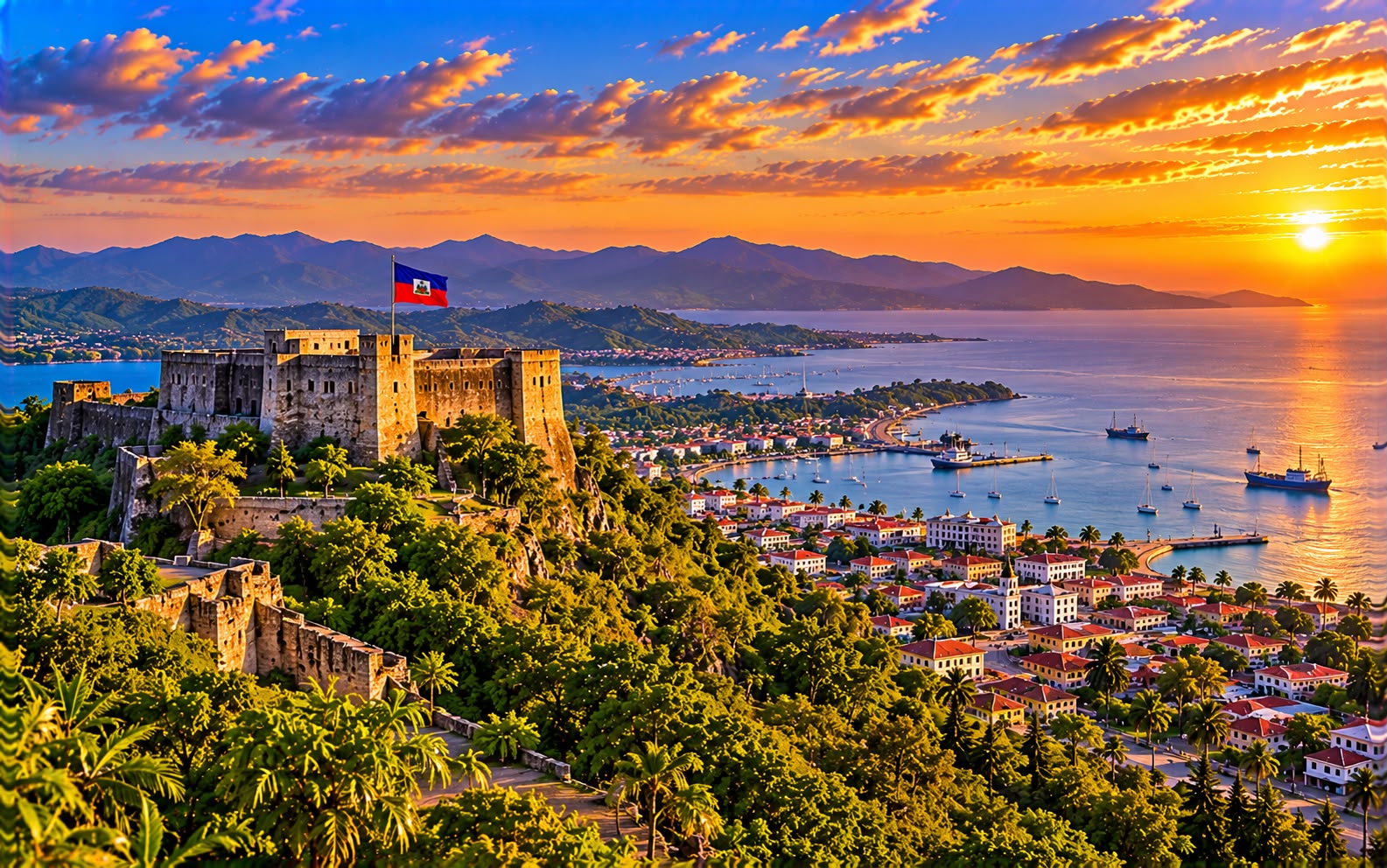
The Citadelle Laferrière is the reason this page exists. After the revolution that made Haiti the first Black republic and the only state founded by a successful slave revolt, Henri Christophe built a fortress on a 900-metre peak against a French return that never came. It is the largest fortress in the Americas, it took fifteen years and perhaps twenty thousand labourers, and it still holds hundreds of cannon hauled up by hand. With the ruined palace of Sans-Souci below it, it is a UNESCO World Heritage site.
Jacmel, on the south coast, is a port of iron-fronted nineteenth- century merchant houses, a serious papier-mâché tradition and a carnival with masks unlike anywhere else in the Caribbean.
And Haitian art — the Saint-Soleil movement, the Centre d’Art, the metalwork of Croix-des-Bouquets cut from oil drums — is collected internationally and made in workshops you can walk into.
Seven days, when it is possible. Figure HTG 90,000 (≈ AED 2,522) per person. Historically November–March, the dry season.
Before you go: the 15-minute admin
Entry, under current conditions
- Flights have been repeatedly suspended to Port-au-Prince. Cap-Haïtien in the north has at times remained served from Miami and from Turks and Caicos, and is the safer gateway when it is operating.
- The Dominican land border opens and closes with the politics.
- A visa is not required for most nationalities; a tourist fee is charged on arrival.
- Yellow fever certificate if arriving from an endemic country.
- Malaria is present. Prophylaxis is advised; Haiti is one of the few Caribbean countries where this is still true.
- Cholera has recurred. Drink only treated or bottled water.
If you go, how people actually do it
- Nobody competent travels here independently. Visitors go with Haitian operators who know which roads are passable today, and who provide a driver and local contacts.
- Avoid Port-au-Prince. If you must transit it, do so with arranged transport and do not stop.
- Do not travel after dark, between cities, at all.
- Keep a low profile, do not display anything of value, and do not photograph people or incidents without asking.
Money
- The gourde (HTG), with US dollars widely used alongside it. Prices are often quoted in “Haitian dollars”, an informal unit of five gourdes, which confuses everyone.
- Bring US cash. ATMs are unreliable and cards are accepted in very few places.
Day by day
Day 1 — Cap-Haïtien
- Fly directly into Cap-Haïtien if you possibly can. Port-au-Prince is the part of this itinerary that makes it conditional, and the north has been the functioning half.
- 14:00 — Cap-Haïtien was Cap-Français, the richest colonial city in the Caribbean, and its grid of balconied houses survives.
- 16:00 — The cathedral and the Place d’Armes, and the waterfront boulevard.
- 18:00 — Sunset from the Carénage, which is where the city walks.
- Arrange everything through a local fixer. Movement, not sightseeing, is the hard part here.
Day 2 — The Citadelle
- 07:00 — The Citadelle Laferrière, reached from Milot — a steep climb by foot or on horseback up to 900 metres. Go early; it is an hour of climbing and there is no shade on the last stretch.
- 09:00 — The walls are four metres thick, the cannon were dragged up by hand, and the view from the terrace takes in the whole northern plain and the sea the French were expected from. It was built for 5,000 men and never attacked.
- 12:00 — Sans-Souci Palace below it: Christophe’s court, built to rival Versailles, wrecked by the 1842 earthquake and left as a shell.
- The two together are UNESCO-listed, and you will often be among very few visitors.
- 15:00 — Milot itself, and the chapel modelled on the Pantheon.
- 17:00 — Back to Cap-Haïtien before dark.
Day 3 — The plain, and the plantations
- 08:00 — The Habitation Dondon or the ruined sugar estates on the plain below, which is where the wealth that built the Cap came from and at what cost.
- 11:00 — The Grotte du Bassin Zim, a cave and waterfall used as a Vodou site, if the road allows.
- 14:00 — The ironwork and craft market in the city.
- 16:30 — Fort Picolet on the headland, a twenty-minute walk out along the shore, and the best sunset in the north.
- 19:00 — Dinner in town, and griot — fried pork with pikliz — is the dish.
Day 4 — The north coast
- 08:00 — Bois Caïman, near Cap-Haïtien, where the Vodou ceremony that began the 1791 revolt is traditionally held to have taken place. There is little to see and a great deal to stand in.
- 11:00 — The beaches at Cormier and Labadie village — the village, not the cruise enclave next to it. The enclave is fenced and leased; the village is reached by boat from Labadie’s jetty.
- 14:00 — A boat along the coast, which is how people here move between the coves.
- 17:00 — Back to the Cap.
Day 5 — Jacmel, conditionally
- Jacmel, on the south coast, reached via Port-au-Prince, which is the hard part of this itinerary and the reason it may not be possible.
- Take the domestic flight if one is running, and do not plan the overland route through the capital without current advice from someone on the ground this week.
- 14:00 — If it runs: the historic centre of iron-columned merchant houses, shipped in from France and Belgium in the coffee boom.
- 17:00 — The seafront and the Place Toussaint Louverture.
- If Jacmel is off, spend these days in the north — a second Citadelle morning and the coast is a better trip than a forced transit.
Day 6 — Jacmel: the workshops and Bassin Bleu
- 09:00 — The artists’ workshops — papier-mâché masks, painted furniture, and the carnival tradition that produces them. The mask-makers work on Rue Sainte-Anne and will show you the moulds.
- Jacmel’s Carnival, in February, is the most distinctive in the Caribbean — and the masks are made for months beforehand, so February is when the workshops are fullest.
- 13:00 — Bassin Bleu, a chain of cobalt pools up a river gorge, reached on foot with a local guide and a rope on the last descent. The guide is required and the rope is not optional.
- 17:00 — Back into town, and the beach at Raymond les Bains if there is light.
Day 7 — Croix-des-Bouquets, and out
- 09:00 — Croix-des-Bouquets, outside Port-au-Prince, where metalworkers cut sculpture from flattened oil drums — a craft invented here in the 1950s and now collected worldwide. This is in a high-risk area and may not be reachable.
- Do not attempt it on your own judgement. If your fixer says no, the answer is no.
- 13:00 — Fly out from whichever airport is operating.
- Leave very wide margins, and have a plan for the night if the flight does not go.
Costs and practicalities
Best time to visit
Historically November–March was the dry, cooler season and the practical window — though current travel advice makes the question of when secondary to whether.
- November–March — the dry season. Cooler, less humid, and the best months for the Citadelle climb and for the north generally.
- April–June — the first rains, with heavy afternoon storms.
- July–October — hot, wet, and the peak of hurricane season. Haiti’s deforestation makes flooding and landslides far worse than rainfall alone would suggest.
- Carnival, in the days before Lent, was the largest event of the Haitian year, centred on Port-au-Prince and Jacmel.
Jacmel’s Carnival and the Fête Gede in early November are the two dates the cultural calendar is built around, and both depend entirely on the security position in the year you ask.
Travel tips
- Check current advice before anything else. Most governments advise against all travel; gang control of large parts of Port-au-Prince and the roads out of it has made independent movement unviable.
- The airport has closed repeatedly. Do not treat a booked flight as a guarantee of getting in or out.
- Nothing here is a self-drive trip. Movement requires a trusted local fixer with current knowledge of which roads are passable that day.
- Bring US dollars in cash. The gourde is quoted alongside the “Haitian dollar”, which is five gourdes and exists only as a unit of speech — confirm which you are being quoted.
- Creole is what everyone speaks; French is the formal language and understood by a minority.
- Vodou is a practised religion, not a spectacle. Ceremonies are attended by invitation and with a guide.
- Cholera has recurred. Bottled or treated water only, and be careful with food outside established places.
What this trip would cost
Two people, 6 nights, mid-range comfort, flights excluded:
| Item | Cost |
|---|---|
| Hotels, 6 nights | HTG 72,000 (≈ AED 2,017) |
| Driver and security-aware operator, 6 days | HTG 78,000 (≈ AED 2,185) |
| Citadelle, guides, horses, entries | HTG 12,000 (≈ AED 336) |
| Food and drink, 7 days | HTG 18,000 (≈ AED 504) |
| Total for two | HTG 180,000 (≈ AED 5,043) |
- Roughly HTG 90,000 (≈ AED 2,522) per person. The operator and driver are most of it, and they are not the place to economise — they are the reason the trip is possible at all.
- These figures are indicative. The gourde has depreciated sharply and pricing moves.
- Insurance does not appear here because standard policies will not cover travel against government advice.
- Hotel picks here are chosen on location, not on commission — always check prices and recent reviews before booking.
What to pack
- US dollars in cash, in small notes.
- Malaria prophylaxis and a water filter or purification tablets.
- Shoes for the Citadelle climb, which is steep and loose.
- Nothing that advertises money.
FAQ
Can I visit Haiti now? Every major government advises against all travel. Gangs control much of the capital and the roads out of it, kidnapping of foreigners is common, and flights have been repeatedly suspended. For an ordinary traveller the answer is no.
Is a cruise stop at Labadee visiting Haiti? Not really. It is a leased, fenced peninsula with controlled access, and cruise lines have at times marketed it without naming the country. That is worth knowing either way.
What is the Citadelle? The largest fortress in the Americas, built from 1805 on a 900-metre peak by the newly independent Haitian state against a French return that never came. UNESCO-listed with the Sans-Souci palace below it.
Why publish a guide to somewhere you should not go? Because Haiti’s history and art matter, because conditions change, and because an honest page is more use to someone researching than silence.
What language do they speak? Haitian Creole and French, both official. Creole is what is actually spoken by nearly everyone.
Prices and entry rules change, and what you need depends on your passport; last checked 29 October 2026, so confirm with the embassy or your airline before booking.


