 The Itinerary
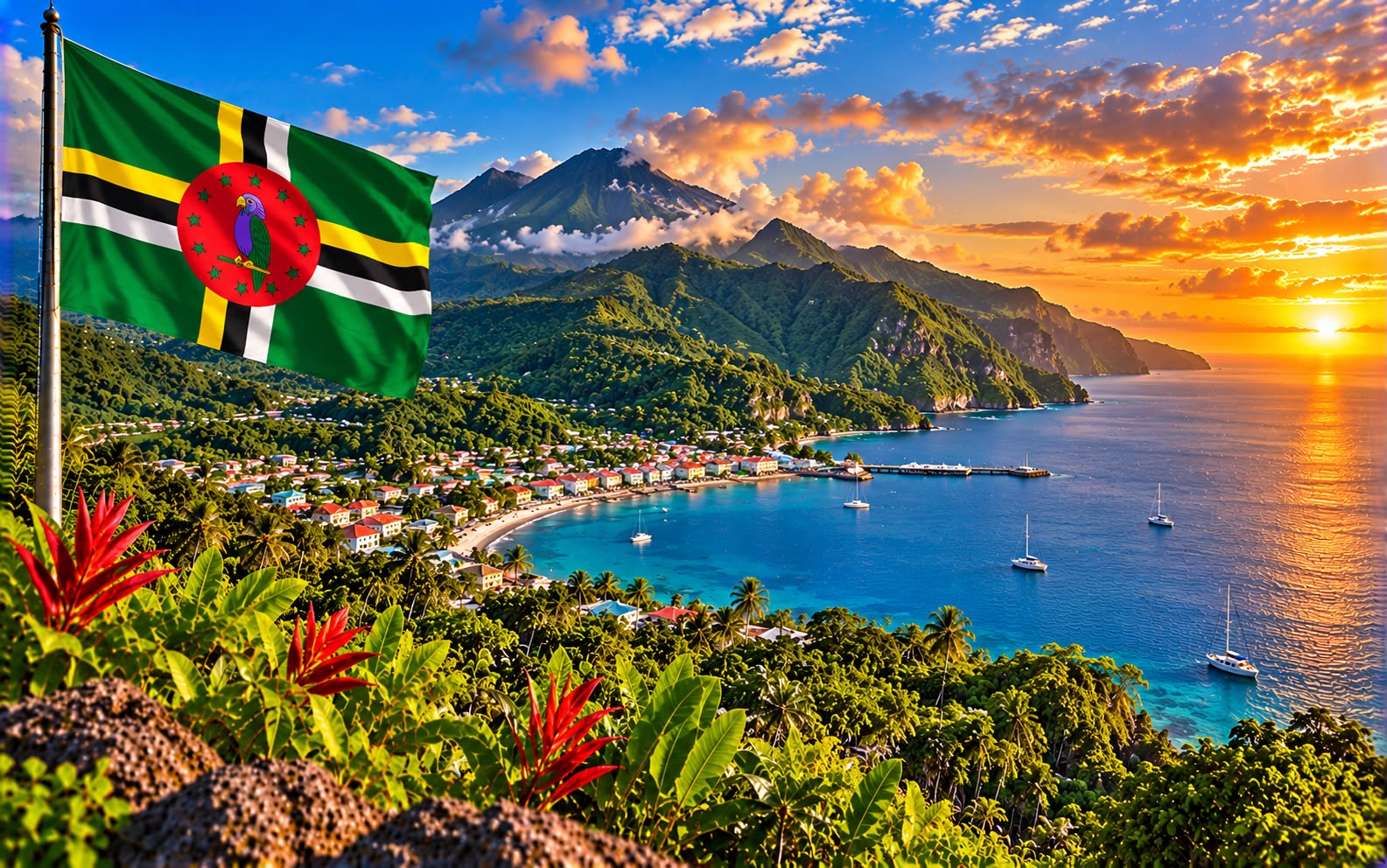
Dominica in 8 days: the Boiling Lake, sperm whales and the Waitukubuli trail
The Caribbean island with almost no beaches and the best hiking in the region — a flooded fumarole that boils, a 115-mile trail the length of the country, and the only place on earth where sperm whales live all year.
- The Caribbean
- 8 days
- ≈ AED 1,850 / person
- A six-hour hike to a boiling lake, and sperm whales resident year-round
Before you go
This is not the Dominican Republic. They are different countries, seven hundred kilometres apart, and the confusion is the single most common thing that happens to Dominica. It is pronounced dom-in-EE-ka.
It is also the Caribbean island for people who do not want a beach holiday. Dominica has very few beaches and most of them are black sand. What it has instead is mountains, rivers, rainforest and volcanic plumbing, protected as the Morne Trois Pitons National Park, the first natural UNESCO site in the eastern Caribbean.
The Boiling Lake is the headline — a flooded fumarole roughly sixty metres across, grey, churning and genuinely boiling at the centre, and the second largest of its kind in the world. Getting there is six to eight hours of hard walking through the Valley of Desolation, a sulphur field of steaming vents and coloured mud. It is one of the great day hikes anywhere.
Sperm whales live here all year. Dominica’s west coast drops into deep water close inshore and a resident population of families stays in it — the only place in the world where that is true. The country has declared a sperm whale reserve in its waters.
And the Waitukubuli National Trail runs 115 miles down the length of the island in fourteen segments, the longest in the Caribbean.
Eight days. Figure XCD 1,350 (≈ AED 1,836) per person excluding flights. Go February–May; whale watching runs roughly November to March.
Before you go: the 15-minute admin
Getting there, which is the hard part
- Dominica has no large international airport. Douglas–Charles (DOM) takes regional aircraft only, and there are no direct long-haul flights.
- You connect — through Antigua, Barbados, St Lucia, San Juan or Miami, on a regional carrier.
- Allow a full day each way, and do not book the last connection of the day in either direction.
- The ferry from Guadeloupe, Martinique and St Lucia is a real alternative and often cheaper. It takes a couple of hours and runs several times a week.
- Douglas–Charles is on the north-east coast, about 45 minutes to an hour from Roseau over the mountains.
After Maria, and the hurricane season
- Hurricane Maria hit Dominica directly in September 2017 as a category five and destroyed a very large share of the island’s buildings and nearly all of its forest canopy.
- The island has rebuilt, and declared an intention to become the world’s first climate-resilient nation. The forest has come back faster than anyone expected.
- Some trails and sites still close for repair after storms. Check what is open before you fix an itinerary around it — particularly the Boiling Lake trail.
- Season runs June to November, peaking August to October. Travel insurance that covers hurricane disruption is worth having.
Visas and money
- Many nationalities enter visa-free for short stays. Check your own case officially.
- The East Caribbean dollar (XCD), pegged to the US dollar at 2.70, so the arithmetic is fixed and simple. US dollars are widely accepted, usually at 2.60–2.65, so paying in EC is slightly better value.
- Cards work in Roseau hotels and larger restaurants. Carry cash for guides, site passes, buses and anywhere rural.
Site passes and guides
- A site pass covers the national park attractions — buy a weekly one rather than paying individually if you are doing more than three.
- The Boiling Lake requires a guide in practice and you should take one regardless. People have died on this hike.
- Waitukubuli segments vary enormously in difficulty; the trail office advises on which are currently open.
Getting around
- Hire a car — around US$50–60 a day, driving on the left, and a local permit is issued on presentation of your licence.
- The roads are steep, narrow and spectacular, and you will average perhaps 30 km/h. Nothing is far; everything takes a while.
- Minibuses run between towns cheaply and are how the island moves.
- Do not drive the interior at night.
Travelling with kids?
- Champagne Reef and the river pools are excellent and easy.
- The Boiling Lake is not a family hike — six to eight hours over scree, steam vents and a river crossing.
- Trafalgar Falls, Emerald Pool and the Titou Gorge swim are all short and very good.
Day by day
Day 1 — Roseau
- Afternoon — Arrive, over the mountains to Roseau.
- 16:00 — The Botanic Gardens, with the school bus still crushed under the baobab that fell on it in the 1979 hurricane — left there deliberately.
- 17:30 — The Old Market and the French colonial streets around it, and the Dominica Museum on the bayfront.
Where to stay (four nights Roseau area, three in the north)
- Mid-range: the villages just south of Roseau — Castle Comfort, Loubiere — where the dive operators and most guesthouses are.
Day 2 — Trafalgar and the valley
- 08:00 — Trafalgar Falls, twenty minutes above Roseau: two falls side by side, locally the Father and the Mother, with a hot stream running into the cold pool at the base.
- 10:30 — Titou Gorge — you swim up a narrow volcanic slot to a waterfall at the end, in cold water, between walls a few metres apart. The Pirates of the Caribbean crew filmed here.
- 13:00 — Wotten Waven for the sulphur hot springs, which is the right order: gorge first, then sit in hot water.
- 16:00 — Morne Bruce above Roseau for the view down over the harbour.
Day 3 — The Boiling Lake
- 05:30 — Start from Titou Gorge with a guide. This is a six to eight hour round trip and the hardest day walk in the Caribbean.
- The route climbs Morne Nicholls, drops into the Valley of Desolation — a field of steaming vents, sulphur crusts and hot streams where the forest simply stops — and then climbs to the rim.
- The lake is around sixty metres across, grey, wreathed in steam, and the centre is at a rolling boil. It is a flooded fumarole, and its level rises and falls unpredictably.
- Take three litres of water each, lunch, and shoes you do not mind destroying. Follow the guide exactly in the valley — the crust is thin in places.
- Evening — The hot springs again. You will want them.
Day 4 — Whales
- Morning — Out from Roseau into the Soufrière–Scotts Head Marine Reserve and the deep water beyond.
- Sperm whales are resident here year-round, which is true nowhere else — families of females and calves stay in the lee of the island because the drop-off is close inshore. Hydrophones are used, so you hear them clicking before you see anything.
- Best from November to March. Sightings are good but not guaranteed.
- Afternoon — Champagne Reef, where volcanic gas bubbles up through the sand and you snorkel through it. Easy, shallow and unlike anywhere else.
- Or dive — Dominica’s west coast walls are superb and uncrowded.
Day 5 — The east coast and the Kalinago
- 09:00 — Across to the windward side.
- 10:30 — The Kalinago Territory, 3,700 acres on the east coast — the last organised Carib community in the Caribbean, with their own chief and council. Kalinago Barana Autê is the cultural village they run; go with a Kalinago guide and the visit is substantial rather than a display.
- 13:00 — Emerald Pool, a waterfall into a green basin in deep forest, fifteen minutes’ walk from the road.
- 15:00 — North to Portsmouth via the Atlantic coast, where the surf comes in with nothing between here and Africa.
Where to stay in the north (three nights)
- Simple: Portsmouth and Calibishie, which have the guesthouses and the island’s few decent beaches.
Day 6 — Indian River and Cabrits
- 07:00 — The Indian River, rowed — engines are banned — up under bloodwood trees whose roots arch over the water. Go early for the birds.
- 10:00 — Cabrits National Park and Fort Shirley, a British garrison restored out of the forest above Prince Rupert Bay, with a good story: the 1802 mutiny of the 8th West India Regiment here led directly to Black soldiers in the British army being freed.
- 14:00 — Batibou or Pointe Baptiste on the north coast — about as close to a classic Caribbean beach as Dominica gets, and reached down a rough track.
Day 7 — Waitukubuli, a segment
- A day on the trail. The Waitukubuli National Trail runs 115 miles in fourteen segments, and you can walk one without committing to the whole thing.
- Segment 12 from Penville toward Capuchin, or Segment 4 through the Central Forest Reserve, are the usual picks — half a day to a full day each, with transport arranged at both ends.
- Or climb Morne Diablotin, the island’s highest point at 1,447 metres, for the imperial parrot — the national bird, found nowhere else, and down to a few hundred individuals.
Day 8 — Fly out
- Morning — The drive back across the island to Douglas–Charles, an hour from the north.
- Leave margin. Regional connections are tight and the road is slow.
Costs and practicalities
Best time to visit
February–May is the driest window on an island that is wet by design — Dominica’s rainforest exists because it rains here far more than on its neighbours.
- February–May — the driest and best for hiking the Waitukubuli trail and the Boiling Lake. Still expect rain.
- June–November — the wet season and the hurricane season. Dominica was devastated by Maria in 2017 and the risk is taken seriously here; September and October are the peak.
- December–January — cooler, wetter than spring but very green, and the Creole music festival falls in late October.
- Sperm whales are resident year-round and best seen November to March, which is Dominica’s real distinction — one of the few places on earth with a resident population.
The Boiling Lake hike needs a dry run of days, not just a dry morning. The trail is eight hours and treacherous when wet.
Travel tips
- This is not a beach island. The beaches are black sand and modest; the interior is the point. Come for the hiking, the rivers and the whales.
- A guide is mandatory for the Boiling Lake and strongly advised for most of the Waitukubuli segments.
- A Site Pass covers the national park attractions — Trafalgar Falls, Emerald Pool, Boiling Lake — and is cheaper than paying individually.
- The East Caribbean dollar is pegged to the US dollar at about 2.70; US dollars are accepted at a rounder rate.
- Driving is on the left, on steep, narrow, switchbacked roads. A local permit is issued with the hire.
- Whale watching is regulated and the season for permits is set annually. Book with a licensed operator.
- Expect rain daily and pack for it. Quick-dry clothing and a dry bag matter more here than a rain jacket.
What this trip actually costs
Two people, 7 nights, mid-range comfort, flights excluded:
| Item | Cost |
|---|---|
| Guesthouses, 7 nights | XCD 1,050 (≈ AED 1,428) |
| Car hire, 7 days, fuel and permit | XCD 700 (≈ AED 952) |
| Boiling Lake and trail guides | XCD 350 (≈ AED 476) |
| Whale watching, two | XCD 400 (≈ AED 544) |
| Site passes, Kalinago, Indian River | XCD 200 (≈ AED 272) |
| Total for two | XCD 2,700 (≈ AED 3,672) |
- Roughly XCD 1,350 (≈ AED 1,836) per person — around US$500 — which makes Dominica one of the cheapest islands in the Caribbean, because there is almost no resort infrastructure to pay for.
- Guides are the line not to cut. The Boiling Lake in particular.
- Site passes are much cheaper bought as a week than per visit.
- Eco-lodges here are genuinely eco rather than branded as such, and several are excellent value.
- Hotel picks here are chosen on location, not on commission — always check prices and recent reviews before booking.
What to pack
- Hiking boots you can write off. The Valley of Desolation is sulphur and scree.
- A dry bag — Titou Gorge and the Indian River both soak everything.
- Three litres of water capacity per person for the Boiling Lake.
- Rain gear. It is a rainforest island and it rains most days.
- Reef-safe sun cream and a rash vest for Champagne Reef.
- Cash in EC dollars for guides and rural stops.
FAQ
Is this the Dominican Republic? No. Different country, different language, seven hundred kilometres away. Dominica is an English-speaking island of 70,000 people with no large resorts.
How hard is the Boiling Lake hike? Genuinely hard — six to eight hours, steep, hot, with a river crossing and a sulphur field. Normal fitness and a guide are both required. Start at dawn.
Can I see sperm whales? Dominica is the only country with a resident year-round population, and sightings are good from November to March. It is still wildlife rather than a guarantee.
Are there beaches? A few, mostly black sand, and the north coast has the best of them. If beaches are the point of your holiday, go somewhere else — that is not an insult to Dominica, it is the whole proposition.
What language do they speak? English is official, and Kwéyòl, a French-based creole, is widely spoken. You will have no difficulty.
Prices and entry rules change, and what you need depends on your passport; last checked 8 October 2026, so confirm with the embassy or your airline before booking.


