 The Itinerary
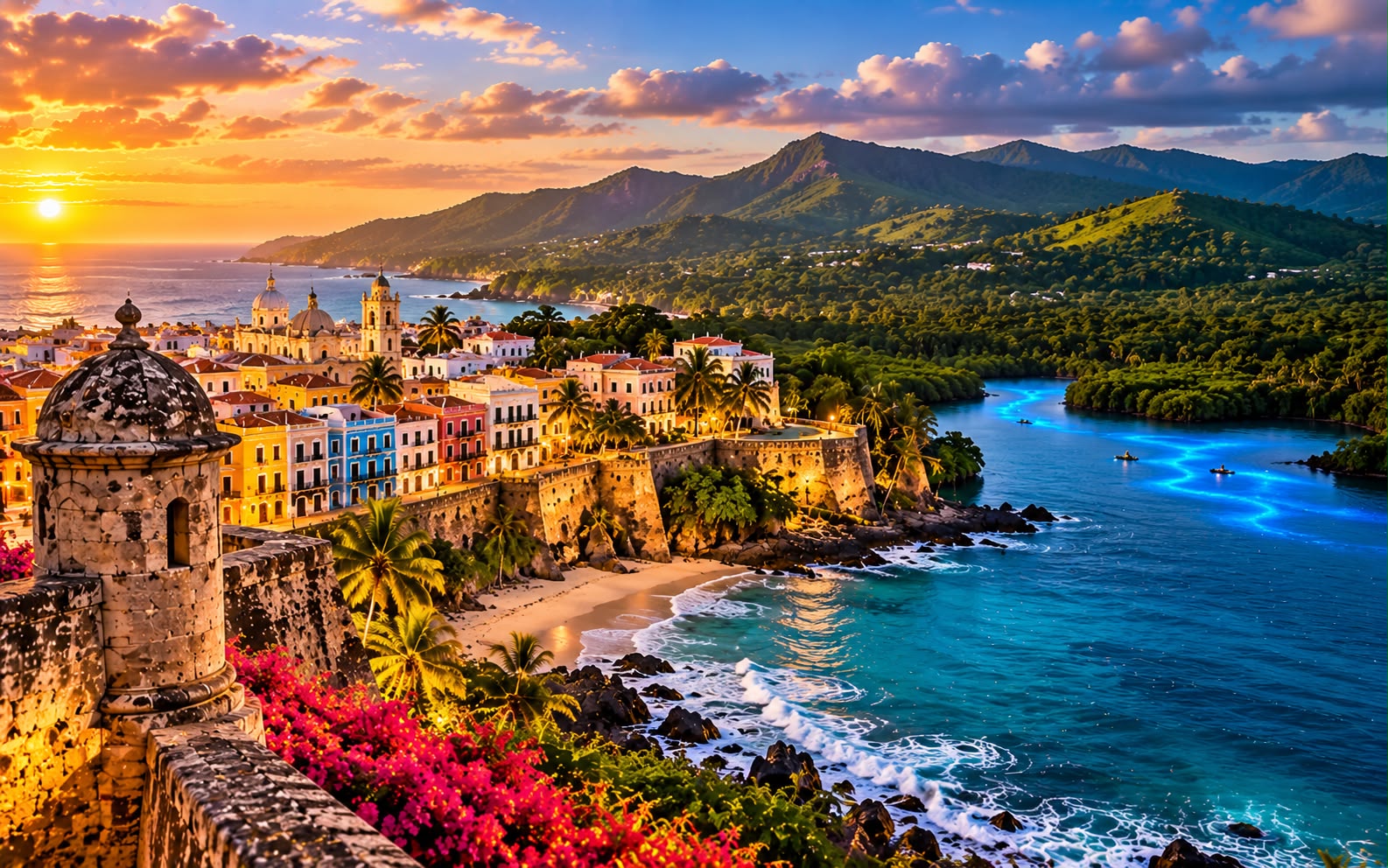
Dominican Republic in 9 days: Santo Domingo, Samaná and the mountains
The Caribbean's oldest European city and its highest mountains in one country: the first cathedral in the Americas, humpback whales calving in Samaná bay between January and March, a 27-waterfall river you jump down, and beaches that earned the resorts their reputation.
- The Caribbean
- 9 days
- ≈ AED 5,750 / person
- Colonial city + whales
Before you go
The Dominican Republic receives more visitors than any other Caribbean country, and the overwhelming majority of them see one walled resort in Punta Cana. That is a shame, because the country behind it is the most varied in the region.
Santo Domingo’s Zona Colonial is the oldest continuously inhabited European settlement in the Americas — founded 1498, with the first cathedral, the first university and the first paved street in the New World, all still standing and all still in use.
The island also has the Caribbean’s highest mountains — Pico Duarte is 3,098 m, and the valleys below it are cool enough to grow strawberries. And between January and March, several thousand humpback whales arrive in Samaná bay to calve, which is among the most reliable whale encounters anywhere.
Before you go: seasons, driving and the two coasts
Entry and money
- Most nationalities enter visa-free. A tourist card is bundled into the air fare for most arrivals — check, because occasionally it is not.
- You must complete the free online E-Ticket form before arrival and departure. Do it the day before; the QR code is checked.
- Dominican peso (DOP). US dollars are accepted in resorts at a poor rate. Pay in pesos. Cards work in cities and resorts; colmados, guaguas and street food are cash.
When to go — and the whales
- December to April is the dry season and the peak.
- Mid-January to late March is whale season in Samaná, and it is the single best reason to time a trip. Thousands of humpbacks come to the Silver Bank and the bay to breed and calve. Outside those weeks the boats do not run, so if the whales matter, that is your window.
- June to November is hurricane season, with August and September the peak. Rain comes in bursts and prices drop.
- The north coast (Samaná, Puerto Plata) is wetter year-round than the south and east.
Driving, honestly
- Hiring a car gives you this itinerary, and Dominican driving demands attention: motoconchos — motorbike taxis — appear from any direction, lanes are advisory, and rural roads are unlit with livestock on them.
- Do not drive at night outside cities.
- Full insurance is effectively mandatory and sold on top of every quoted rate.
- The alternative is guaguas (shared minibuses) and long- distance coaches, which are cheap and good between cities but will not get you to the Jarabacoa waterfalls.
Day by day
Day 1 — Land in Santo Domingo
- 14:00 — Land at Las Américas (SDQ), 30 minutes east of the city.
- 15:30 — Stay in the Zona Colonial. This is not a preserved quarter — people live and work in it — and staying inside means the evenings are yours.
- 17:00 — Calle El Conde, the pedestrian spine, down to Parque Colón with the cathedral on it.
- 18:00 — The Catedral Primada de América, begun 1512 and the first cathedral built in the Americas, in a Gothic shell with a Renaissance front.
- 19:30 — Plaza España at dusk, with the Alcázar de Colón — Diego Columbus’s palace, 1510 — lit above the row of restaurants in the old arsenal below it.
- 20:30 — Dinner. Mofongo — mashed fried plantain with garlic and pork crackling — and a Presidente, served vestida de novia, so cold the bottle frosts.
Day 2 — The Zona Colonial
- 09:00 — Calle Las Damas, the first paved street in the Americas, named for the ladies of the viceroy’s court who walked it. The Museo de las Casas Reales on it covers the colonial administration properly.
- 10:30 — The Alcázar de Colón inside — furnished to period, and the family that built it ran the Spanish colonial enterprise from these rooms.
- 12:00 — The Monasterio de San Francisco ruins, roofless since a 1673 earthquake and a hurricane finished it, now used for concerts, and the Hospital San Nicolás de Bari — the first hospital in the Americas, also a ruin.
- 13:30 — Lunch, then out of the heat.
- 16:00 — The Fortaleza Ozama on the river, the oldest military structure in the Americas, with its 1505 tower.
- 18:00 — Calle Hostos and the back streets, which is where the quarter stops being a monument.
- 21:00 — Merengue or bachata. Both were born here, bachata out of the rural south and dismissed for decades as music for the poor before it conquered Latin America. Sunday evening at Parque Duarte is where people actually dance.
Day 3 — North-east to Samaná
- 08:30 — Drive north-east on the toll road, about three hours, and it is a good road.
- 12:00 — Samaná town on its bay, a small port that looks across at hills.
- 13:00 — Lunch on the waterfront.
- 14:30 — Cayo Levantado, twenty minutes offshore by boat — a small island with a public beach, busy at midday and empty by four.
- 16:30 — Or drive out to Playa Rincón, which is consistently rated one of the best beaches in the Caribbean: 3 km of sand backed by coconut palms with a cold river at one end, and a rough track in that keeps the numbers down.
- 19:00 — Dinner in Samaná or Las Galeras.
- Note — Book tomorrow’s whale trip tonight if you are here in season; the licensed operators fill.
Day 4 — Whales, or the waterfall
- In season (mid-January to late March), 08:30 — The whale watching boat into Samaná bay. Humpbacks migrate from the North Atlantic to breed here — the males sing, and the boats cut their engines so you hear it through the hull. Breaching and tail-slapping are routine. Regulation is strict: licensed boats only, limited numbers, set distances.
- 12:30 — Back, and lunch.
- Out of season, 09:00 — El Limón waterfall: 40 m, reached on horseback or on foot through muddy forest for about 40 minutes, with a pool you swim in at the bottom.
- 15:00 — Las Terrenas, the north-coast town — French and Italian-influenced, with the best restaurants in the region and a long beach.
- 18:00 — Sunset at Playa Bonita.
- 20:00 — Dinner in Las Terrenas.
Day 5 — Los Haitises, and inland
- 08:00 — Los Haitises National Park by boat from Sabana de la Mar: mogotes — limestone karst humps — rising straight out of the water in a mangrove bay, with caves containing Taíno pictographs several hundred years old, and frigatebird and pelican colonies on the rocks.
- 12:30 — Back, and lunch.
- 14:00 — Drive inland and south-west toward the Cordillera Central, about three and a half hours.
- 17:30 — Jarabacoa, at 530 m, and the temperature drops noticeably — this is pine forest, river gorges and strawberry farms, which is not the Caribbean anybody advertises.
- 19:30 — Dinner, and you may want a jumper.
Day 6 — The mountains
- 08:30 — Salto de Jimenoa Uno, a 60 m fall reached across a swinging footbridge, and Salto de Baiguate, lower and swimmable.
- 11:00 — White-water rafting on the Yaque del Norte, the Caribbean’s longest river — grade II–III, half a day, and the only commercial rafting in the region.
- 14:30 — Lunch, then the Pico Duarte trailhead at La Ciénaga if you want to see where it starts. The summit is 3,098 m, the highest point in the Caribbean, and a two to three day trek with guides and mules — a different trip, but worth knowing exists.
- 17:00 — Constanza if you have the afternoon: higher still, growing vegetables, and genuinely cold at night.
- 19:30 — Dinner.
Day 7 — Across to the east coast
- 08:30 — The drive east, four to five hours via Santo Domingo and the toll road.
- 11:00 — Break at Boca Chica or push on.
- 14:00 — Arrive Punta Cana or Bávaro, and this is where the country’s reputation comes from: 50 km of continuous white sand and coconut palm on the eastern tip, with the resorts strung along it.
- 15:30 — Playa Bávaro or Macao, the latter public, wilder and with surf.
- 18:00 — Sunset.
- 19:30 — Dinner — and if you are not in an all-inclusive, El Cortecito and Los Corales have the independent restaurants.
Day 8 — The east, your way
- Option A — the water, 09:00. Isla Saona inside Parque Nacional del Este: a catamaran and speedboat day to a sandbar and a shallow natural pool with starfish. It is the classic excursion and it is busy; the early boats are better.
- Option B — the inland east, 09:00. Hoyo Azul, a cenote of improbable blue at the foot of a cliff, and the Indigenous Eyes lagoons — twelve freshwater pools in a private reserve, five of which you can swim in.
- Option C — Montaña Redonda, 07:00. A hill an hour north with swings and hammocks on the summit facing the lagoon, which is entirely an Instagram construction and is also a genuinely good sunrise.
- 16:00 — The beach, properly, for the last afternoon.
- 19:30 — Last dinner.
Day 9 — Fly home
- Morning — Punta Cana (PUJ) is the country’s busiest airport and 20 minutes from the hotels. If you are flying from Santo Domingo (SDQ) instead, that is a three-hour drive — check which your ticket says before you book the car’s drop-off.
- Return the car with a full tank and allow for the inspection.
- Note — Complete the departure E-Ticket before you get to the airport.
Costs and practicalities
Best time to visit
January–March is the driest and coolest stretch, and also when the island’s best wildlife event happens.
- December–April — dry season and peak. Humpback whales gather in Samaná Bay from mid-January to mid-March, which is one of the most reliable whale encounters anywhere and the single best reason to time a trip.
- May–June — the first rains, mostly short afternoon showers. Good value and still warm.
- July–October — hot, humid, and the heart of hurricane season, with September and October the riskiest.
- November — the rains ease and rates have not yet climbed.
The north coast and the south have different rainfall patterns — Puerto Plata and Samaná are wetter year-round than Punta Cana and the southeast.
Travel tips
- Resort pricing hides the country. The all-inclusive coast is a different experience from Santo Domingo’s Zona Colonial, Barahona or Jarabacoa, and the second is why the island is interesting.
- The peso is the currency but dollars circulate, usually at a poor rate in tourist areas. Pay in pesos where you can.
- Agree taxi fares in advance. Uber works in Santo Domingo and Santiago and removes the argument; elsewhere, negotiate before getting in.
- Guaguas — the shared minibuses — are cheap, crowded and the real transport network. Caribe Tours and Metro run comfortable intercity coaches.
- A 10% service charge plus 18% tax is standard on bills. Check before tipping again.
- Drink bottled water, including for teeth, outside good hotels.
- Haiti’s border carries separate and much stronger travel advice. Do not treat a day trip across as routine.
What this trip actually costs
Two people, 8 nights, mid-range, excluding international flights:
| Item | Cost |
|---|---|
| Hotels, 8 nights (Zona Colonial, Samaná, Jarabacoa, Punta Cana) | DOP 72,000 (≈ AED 4,375) |
| Hire car, 8 days, fuel, tolls and insurance | DOP 44,000 (≈ AED 2,673) |
| Whale trip or El Limón, Los Haitises, rafting | DOP 29,000 (≈ AED 1,762) |
| Museums, Alcázar, national park fees | DOP 7,000 (≈ AED 425) |
| Food and drink, 9 days | DOP 36,000 (≈ AED 2,187) |
| SIM, tips, extras | DOP 2,000 (≈ AED 122) |
| Total for two | DOP 190,000 (≈ AED 11,544) |
- Roughly DOP 95,000 (≈ AED 5,772) per person — about USD 1,600.
- This is more than an all-inclusive package and it is a different holiday. A week in a Punta Cana resort can be bought for less than half, and you will see the resort.
- Insurance is the hidden car cost — it is compulsory and quoted separately, so the headline rate is never the price.
- Guaguas and guesthouses would cut this by around 40% and cost you the mountains.
What to pack
- Reef-safe sunscreen and more than you think.
- A warm layer for Jarabacoa and Constanza — the mountains get genuinely cold at night and nobody packs for it.
- Water shoes for the waterfalls and the river.
- Repellent for the mangroves and the mountain evenings.
- Pesos in small notes for colmados, motoconchos and tips.
- US-style Type A/B plugs, 110V.
- A dry bag for the whale boat and Los Haitises, both of which are wet.
FAQ
When exactly are the whales? Mid-January to late March, with February the peak. Several thousand humpbacks come to Samaná bay and the Silver Bank to breed and calve, and the encounters are regulated and reliable. Outside that window the boats simply do not run — so if this is why you are going, book the dates around it.
Is it worth leaving Punta Cana? That is the whole argument of this itinerary. Punta Cana has the best beaches and nothing else; Santo Domingo has 500 years of Americas history and the mountains have pine forest and white water. Doing both is why this is nine days and not seven.
Is driving really that demanding? It needs attention rather than nerve. Motoconchos, informal overtaking and unlit rural roads are the issues. Stick to daylight outside the cities and take the full insurance. If that does not appeal, a driver for the week is common and not expensive.
Haiti shares the island — does that affect travel? The border is closed to ordinary tourism and the situation in Haiti is severe. Nothing on this itinerary goes near it — the whole route is in the east and centre of the country.
Santo Domingo or Puerto Plata for the north? This route uses Samaná, which has the whales and the better beaches. Puerto Plata has the cable car and more resorts, and is the alternative if you are flying into POP rather than SDQ.
Prices and entry rules change, and what you need depends on your passport; last checked 8 October 2026, so confirm with the embassy or your airline before booking.


