 The Itinerary
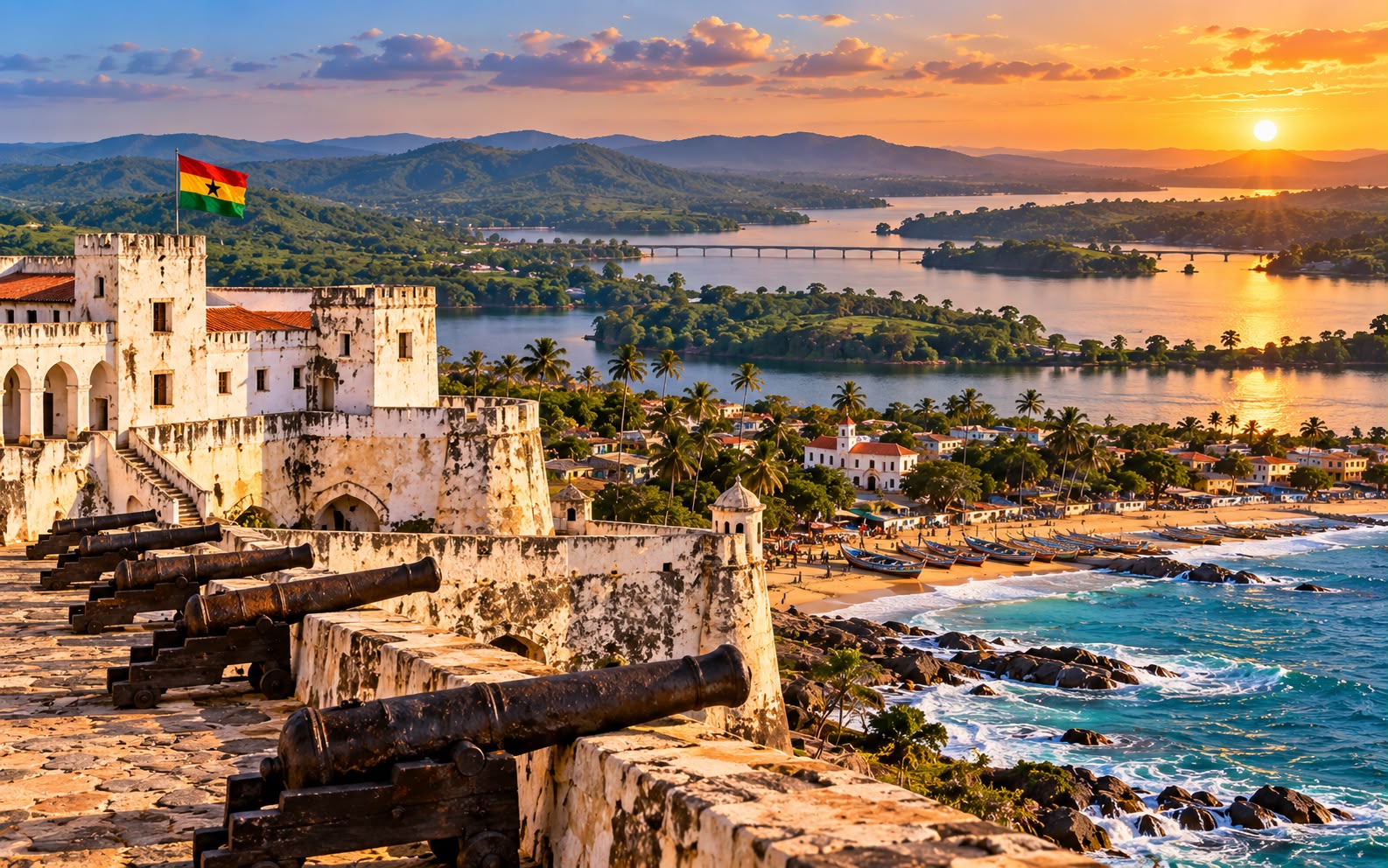
Ghana in 9 days: Accra, the slave castles and the Volta
West Africa's most straightforward country to travel, and the one where the Atlantic slave trade is not a museum subject but a set of buildings you walk through — Cape Coast and Elmina, the dungeons and the Door of No Return, alongside Ashanti goldweights, a rainforest canopy walk and the Volta's waterfalls.
- West Africa
- 9 days
- ≈ AED 3,750 / person
- History you cannot unsee
Before you go
Ghana is where most people start in West Africa, and the reasons are practical: English is the official language, it is one of the more stable democracies on the continent, and the distances between the things worth seeing are manageable.
It is also where the Atlantic slave trade is least abstract. Cape Coast Castle and Elmina Castle stand on the shore within twenty minutes of each other — whitewashed, UNESCO-listed, and holding dungeons where people were kept for months before being walked through a doorway onto a ship. You go into those rooms. The guides are Ghanaian and they do not soften it.
The rest of the country is lighter: Ashanti craft villages still working in kente and brass, a rainforest canopy walkway at Kakum, and the Volta region’s waterfalls and monkey sanctuaries.
Before you go: visas, roads and the harmattan
Entry and health
- Most nationalities need a visa in advance, applied for online or at a mission before travel. Start this early — it is the single biggest piece of admin on this trip.
- Yellow fever vaccination is mandatory and the certificate is checked on arrival. Without it you will not be let in.
- Malaria is present year-round and Ghana is a high-transmission country. Take prophylaxis properly, from before you arrive to after you leave.
Getting around
- Hire a car with a driver. It is the normal arrangement, it costs far less than you would expect, and it removes the two real difficulties: Accra’s traffic and finding anywhere without local knowledge. Budget roughly GHS 900 (≈ AED 283) a day including fuel.
- Roads between the main towns are tarred and fine. The Accra–Cape Coast road is good; the road north to Kumasi is mostly good and sometimes not.
- Tro-tros — shared minibuses — are how Ghanaians travel, cost almost nothing, and leave when full rather than on a timetable. Worth doing once.
- Accra traffic is severe. Allow double what the distance suggests for anything crossing the city at rush hour.
When to go
- November to March is the dry season and the best time, with December and January the most comfortable.
- The harmattan blows Saharan dust south roughly December to February: hazy skies, cooler nights, and poor long-distance visibility. It makes photographs flat and the heat bearable.
- April to July is the main wet season — heavy afternoon rain, green landscape, fewer visitors.
- Note on timing: the Year of Return and its successors have made December extremely busy in Accra, with high prices and full flights.
Money and courtesies
- Ghanaian cedi (GHS). Cash dominates outside hotels; mobile money is near-universal and cards are not. Draw cash in Accra.
- Greet before you transact. Walking up and asking a question without a good morning and a handshake reads as rude. The handshake often ends with a finger snap, which is worth learning.
- Use your right hand for giving, receiving and eating.
- Ask before photographing people, and always at the castles, the markets and in villages.
Day by day
Day 1 — Land in Accra
- 14:00 — Land at Kotoka (ACC), which is inside the city — 20 minutes to Osu in light traffic and an hour in real traffic.
- 15:30 — Drop bags. Osu and Airport Residential are the convenient areas; Jamestown is where the city started and is better visited than slept in.
- 17:00 — Independence Square and Black Star Gate — Ghana was the first sub-Saharan African country to gain independence, in 1957, and the square was built to say so.
- 18:00 — The Kwame Nkrumah Memorial Park, with the first president’s mausoleum and the statue the British-era authorities once toppled, reassembled.
- 19:30 — Dinner in Osu. Jollof rice — and Ghanaians will tell you unprompted that Nigeria’s is inferior, which is a genuine and good-humoured national argument — plus waakye, banku with tilapia, and grilled kelewele.
- 21:00 — Confirm the driver and the route for the week.
Day 2 — Accra, and Jamestown
- 08:30 — Jamestown with a local guide, and go with one: this is a dense working fishing quarter below the colonial lighthouse, and a guided walk is both more informative and more welcome than wandering with a camera.
- 09:30 — Climb the lighthouse for the view over the fishing harbour, then down into it — hundreds of painted canoes, the catch being landed and sorted, and a crowd that is entirely indifferent to you.
- 11:30 — Makola Market, which is enormous and overwhelming and the commercial centre of the city.
- 13:00 — Lunch, then out of the heat.
- 15:00 — The W.E.B. Du Bois Centre, where the American scholar lived out his last years and is buried, having taken Ghanaian citizenship at 95.
- 17:00 — Labadi Beach late afternoon, when half of Accra arrives and there is drumming, horses, and a great deal going on.
- 19:30 — Dinner, and live highlife if it is a weekend.
Day 3 — West to Cape Coast
- 08:00 — Drive west along the coast, about three hours.
- 11:00 — Stop at Elmina, and start here rather than at Cape Coast. São Jorge da Mina was built by the Portuguese in 1482 — the oldest European building in sub-Saharan Africa — taken by the Dutch, then the British, and used throughout for the same trade.
- 11:30 — The guide takes you through the female dungeon, the punishment cell with no ventilation, the church built directly above the dungeon, and the Door of No Return. The governor’s quarters are airy and have a sea view. That juxtaposition is the entire point and the guides make sure it lands.
- 13:30 — The Elmina fishing harbour below the castle, which is one of the most photographed and most alive places in Ghana.
- 15:00 — Check in at Cape Coast, 20 minutes on.
- 17:00 — Walk the town — the old post office, the colonial-era streets.
- 19:30 — Dinner, early. Tomorrow is heavy.
Day 4 — Cape Coast Castle, and Kakum
- 08:00 — Cape Coast Castle at opening, when it is quiet. Built by the Swedes in 1653, enlarged by the British, and the headquarters of the Gold Coast administration.
- 08:30 — The tour goes down into the male dungeon: a stone chamber that held up to a thousand people at a time, for six to twelve weeks, with a single narrow light shaft. The floor you stand on is compacted waste and remains that archaeologists have left in place. There is a wreath there. Most groups go silent and stay that way.
- 09:30 — Then the Door of No Return, and on the far side of it, facing the sea, a second sign added later: Door of Return, for the descendants who have come back.
- 11:00 — The museum upstairs, which is excellent and unflinching on the numbers and on African complicity.
- 12:30 — Out, and lunch. Take the time; people need it.
- 14:30 — Kakum National Park, 45 minutes inland — and the deliberate change of register. The canopy walkway is seven rope bridges, 350 m long and 40 m up, strung between emergent trees above rainforest. It moves underfoot and it is safe.
- 16:30 — The shorter forest trail below, with a guide, for the medicinal plants and the butterflies.
- 18:30 — Back to Cape Coast.
Day 5 — North to Kumasi
- 08:00 — Drive north to Kumasi, about four hours through cocoa country — Ghana is the world’s second largest producer and you will pass the beans drying on mats at the roadside.
- 12:30 — Arrive in the Ashanti capital, a city of two million and the heart of a kingdom that fought the British to a standstill four times in the 19th century.
- 14:00 — The Manhyia Palace Museum, the former seat of the Asantehene — the Ashanti king, who is still a constitutionally recognised figure with real authority.
- 16:00 — Kejetia Market, among the largest open-air markets in West Africa — tens of thousands of stalls under a sea of rusted roofs. Go with your guide and keep your bag in front of you.
- 18:30 — Back out, which will take a while.
- 19:30 — Dinner.
Day 6 — The Ashanti craft villages
- 08:30 — Bonwire, 30 minutes out, where kente is woven. The cloth is made in narrow strips on a treadle loom and sewn together; the patterns have names and meanings, and cloth was historically restricted to royalty. Sit at a loom and try — you will be very bad at it, and that is the point.
- 10:30 — Ntonso for adinkra: symbols stamped with carved calabash dies in bark dye, each with a proverb attached. You print your own cloth and the printing takes five minutes and the explanation takes an hour, which is the right ratio.
- 12:30 — Lunch.
- 14:00 — Ahwiaa for woodcarving — stools especially. The Golden Stool is the Ashanti nation’s soul, said to have descended from the sky, and the 1900 war began when a British governor demanded to sit on it.
- 16:00 — Lake Bosumtwi, an hour south-east: a meteorite crater lake, sacred to the Ashanti, where fishermen traditionally paddle on wooden planks rather than boats. Swim if you want.
- 19:00 — Back in Kumasi.
Day 7 — East to the Volta
- 08:00 — The long drive east to the Volta Region, five to six hours, crossing the Volta River at Adomi Bridge.
- 13:00 — Lunch on the way.
- 15:00 — Tafi Atome Monkey Sanctuary: a village where the mona monkeys are considered sacred and have been protected by local taboo for generations. They come down for bananas held in your hand and take them with both of theirs.
- 17:00 — Check in near Hohoe or Wli.
- 18:30 — The Volta is green, hilly and quiet — a completely different Ghana from the coast.
- 19:30 — Dinner at the guesthouse.
Day 8 — Wli Falls, and back west
- 07:30 — Wli Falls, the highest waterfall in West Africa. The lower falls are a flat 45-minute walk through forest with nine stream crossings on footbridges, ending at a pool you swim in under the spray, with thousands of fruit bats on the cliff face above.
- 10:00 — The upper falls if you are fit: three hours return, steep, muddy and genuinely hard, with a view back over the Togo border.
- 12:30 — Lunch, then start west.
- 14:00 — Mount Afadja (Afadjato), Ghana’s highest point at 885 m, is a 45-minute climb if the legs are willing.
- 16:00 — The drive back toward Accra, about four hours.
- 20:00 — Last dinner in the city.
Day 9 — Fly home
- Morning — Accra Arts Centre or the Wild Gecko showroom for kente, carvings and adinkra — and bargain, politely and at length, because it is expected and enjoyed.
- Afternoon — Allow serious time for traffic to Kotoka. The airport is in the city and the roads to it are the worst in the country at the wrong hour.
- Note — Spend the cedis. They are not convertible outside Ghana.
Costs and practicalities
Best time to visit
November–March is the dry season and the best window, with the harmattan as the one complication.
- November–March — dry, and the most comfortable months. The harmattan in December and January brings Saharan dust that hazes the light and drops the humidity — welcome relief in the north, frustrating for photographs.
- April–June — the main rains, heavy and humid. Kakum’s canopy walk is slippery and the northern roads soften.
- July–August — a short drier break, and the Homowo festivals in Accra in August.
- September–October — the second, lighter rains.
- Mole National Park is best in the dry, when game concentrates on the waterhole below the camp — February and March are the peak.
The Year of Return has made December the biggest month for diaspora visitors; Accra is full and prices rise.
Travel tips
- Cape Coast and Elmina castles are sites of the transatlantic slave trade, not sightseeing stops. Guides take them seriously and so should you; photography inside the dungeons is often restricted.
- Ghana is one of the friendliest countries in West Africa and English is the official language, which makes it the easiest entry point to the region.
- Bring cash, in dollars or euros. The cedi has been volatile; mobile money (MTN MoMo) is how Ghanaians pay and cards work at Accra hotels.
- Tro-tros are the shared minibus network — cheap, crowded and routed by shouted destination. Intercity, VIP and STC coaches are far more comfortable.
- A yellow fever certificate is mandatory and checked on arrival. Malaria prophylaxis is essential year-round.
- Use the left hand for nothing — eating, giving, receiving. This matters more in the north.
- Agree taxi fares before getting in; Bolt and Uber work in Accra and Kumasi.
What this trip actually costs
Two people, 8 nights, mid-range, excluding international flights:
| Item | Cost |
|---|---|
| Hotels, 8 nights | GHS 9,600 (≈ AED 3,020) |
| Car with driver, 8 days, including fuel | GHS 7,200 (≈ AED 2,265) |
| Castles, Kakum, sanctuaries, museums | GHS 1,800 (≈ AED 566) |
| Craft village visits and workshops | GHS 900 (≈ AED 283) |
| Food and drink, 9 days | GHS 3,600 (≈ AED 1,132) |
| SIM, tips, extras | GHS 900 (≈ AED 283) |
| Total for two | GHS 24,000 (≈ AED 7,549) |
- Roughly GHS 12,000 (≈ AED 3,775) per person, which makes Ghana one of the better-value destinations on this site once you are there.
- The flight is the expensive part, not the ground costs.
- The driver is the line worth paying. It is about a third of the total and it is what makes the week work.
- Tro-tros and guesthouses instead would roughly halve this, and cost you time at every single transfer.
What to pack
- Light, modest cotton. Shoulders and knees covered is normal dress away from the beach, and it is respected.
- Long sleeves and trousers for dusk, plus DEET repellent — this is a serious malaria area.
- A torch — power cuts (dumsor) still happen.
- Shoes you can get wet and muddy for Wli and Kakum.
- Cash in small cedi notes. Change for a large note is often genuinely unavailable.
- UK-style Type G plugs, 230V.
- Something smarter for an evening in Accra, which dresses up.
FAQ
How hard are the castles, emotionally? Harder than people expect. You stand in a dungeon where a thousand people were held in the dark for weeks, and the guide tells you what happened in that room without softening it. Visitors cry regularly, including on group tours. Allow the afternoon afterwards, do not stack anything demanding behind it, and go — it is the single most important thing in the country.
Both Cape Coast and Elmina, or just one? Both, and in that order of significance but the opposite order of travel. Elmina is older and the building is more striking; Cape Coast has the better museum and the heavier tour. They are twenty minutes apart and doing both in one day is a great deal to absorb, which is why this itinerary splits them.
Is Ghana safe? Yes, for this itinerary, with ordinary urban caution in Accra and Kumasi markets. It is among the more stable countries in the region, and the standard advisories concern the far northern border areas, which are nowhere near this route.
Do I need a driver? Not strictly, but almost everyone uses one and it is the single best decision here. Self-driving Accra is unpleasant, and a driver who knows the Volta roads turns a difficult day into a simple one.
Is December the time to go? It is the most comfortable weather and the busiest month by a distance — the diaspora return season fills flights and hotels and raises prices sharply. January and February are nearly as pleasant and much calmer.
Prices and entry rules change, and what you need depends on your passport; last checked 8 October 2026, so confirm with the embassy or your airline before booking.


