 The Itinerary
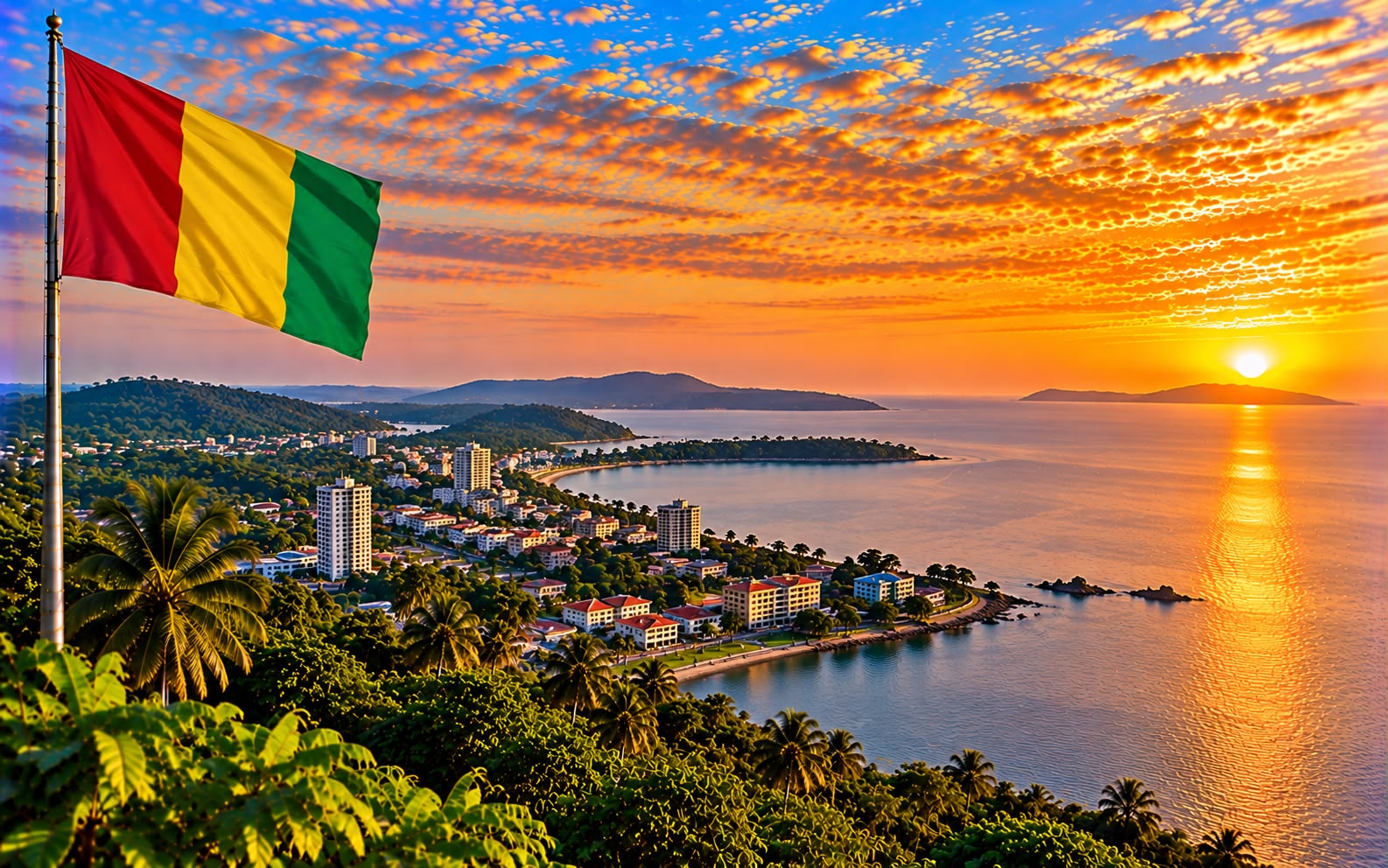
Guinea in 8 days: the Fouta Djallon, Ditinn Falls and the Îles de Los
A sandstone plateau cut into canyons and waterfalls, where the Niger, the Senegal and the Gambia all begin — the best hiking in West Africa, reached through a capital on a peninsula and done almost entirely on foot with Fula guides.
- West Africa
- 8 days
- ≈ AED 3,100 / person
- Trekking a highland plateau that three of West Africa's great rivers rise from
Before you go
Guinea has the Fouta Djallon, and the Fouta Djallon is the reason to come.
It is a sandstone plateau in the middle of the country, rising to around 1,500 metres, cut by canyons and dropping in waterfalls, and it is the source of three of West Africa’s great rivers — the Niger, the Senegal and the Gambia. The region is called the water tower of West Africa, and standing on the escarpment at Doucki with the land falling away in terraces, you can see why.
It is also the best hiking in West Africa, and almost nobody does it. The trails run between Fula villages, through the terraces and down into the canyons, and the guiding tradition that exists is local, informal and very good.
Ditinn and Kambadaga are the waterfalls worth building days around — Ditinn drops something over a hundred metres in a single fall into a bowl of rock.
Conakry, on its peninsula, is loud, hot and hard work, and the Îles de Los just offshore are the antidote: a half-hour boat ride to beaches and forest, and the islands Robert Louis Stevenson is sometimes said to have had in mind for Treasure Island.
Eight days. Figure USD 850 (≈ AED 3,122) per person excluding flights. Go November–April, the dry season — the Fouta is impassable in parts during the rains, and the waterfalls are at their best at the start of the dry season around November and December.
Before you go: the 15-minute admin
Money, and the size of the notes
- The Guinean franc (GNF), and the arithmetic takes getting used to: a modest meal runs into tens of thousands, and a hotel night into hundreds of thousands.
- Bring euros in cash. This is a cash economy. ATMs in Conakry sometimes work with foreign cards; nothing outside it does.
- Carry a lot of paper. The largest note is not large, so changing a few hundred euros produces a brick of cash. Split it between bags and keep a day’s worth accessible.
- Change at a bank or a reputable bureau in Conakry, not on the street.
- Costs are low — this is a cheap country once you are in it, and the guides and village fees are the fair part of the budget.
Visas and vaccinations
- An e-visa is applied for online and is reasonably quick. Print the approval and carry it.
- Yellow fever vaccination is compulsory and the certificate is checked on arrival.
- Malaria is present year-round and the risk is high. Prophylaxis is essential.
- Carry printed copies of everything for the checkpoints.
Getting around
- Hire a 4WD with a driver. Around $120–140 a day. The road to Mamou and Dalaba is tarred and reasonable; what branches off it is not.
- The Fouta’s roads are rough and the tracks to the trailheads are worse. A saloon car will not do it.
- Expect frequent police checkpoints. Carry passport, visa and vaccination certificate; let the driver talk.
- Conakry traffic is severe — the city is on a long narrow peninsula with one spine road, and it can take two hours to cross.
- Leave Conakry early. Any day beginning with a drive out of the city should start before six.
Hiking in the Fouta
- Doucki is the known base — a hamlet on the escarpment where a local guiding family has cut and named a set of day routes through the canyons. You stay in a simple hut and walk from the door.
- Hire local guides, always. Routes are unmarked, the terrain is cliff and scree, and the guides are the reason the walking is as good as it is.
- Carry your own water and more than you think. There is nothing to buy out there.
- Village fees are normal and small. Pay them without haggling.
Language and etiquette
- French is official; Fula (Pular) is what is spoken across the Fouta, along with Malinké and Susu. English is rare.
- The Fouta is Muslim and conservative. Cover shoulders and knees, men included.
- Ask before photographing people, always, and never photograph police, military, the airport, the port or government buildings.
Travelling with kids?
- The walking is genuinely demanding — cliffs, scree and heat — and the accommodation in the Fouta is basic.
- The Îles de Los and the waterfalls work well for all ages.
- High malaria risk and limited medical facilities outside Conakry make this a trip for older children at best. Evacuation cover is essential.
Day by day
Day 1 — Conakry
- Afternoon — Arrive. The airport is in the city and the traffic is the first impression.
- 16:00 — The Grande Mosquée, one of the largest in West Africa, and the Jardin du 2 Octobre nearby.
- 17:30 — The Musée National for Baga and Nalu masks, and the Marché Madina if you have the nerve — it is enormous, overwhelming and the real thing.
- 19:30 — Dinner. Conakry’s seafood is excellent and the live music scene is one of the best in the region.
Where to stay in Conakry (two nights across the trip)
- Mid-range: Kaloum, the downtown peninsula tip, close to the ferry and the museum.
- Quieter: Camayenne and Taouyah, further out, with the traffic as the cost.
Day 2 — Îles de Los
- 09:00 — Ferry or pirogue to the Îles de Los, about half an hour offshore. Roume has the best beach and the forest walk; Kassa is larger and has the villages.
- The islands were a slave-trading station and later British, and the bauxite workings on Kassa are the twentieth century’s contribution.
- All day — Swim, walk the island, eat grilled fish on the sand.
- 17:00 — Back to the mainland.
Day 3 — Into the Fouta: Dalaba
- 06:00 — Leave early. North-east towards Mamou, then up onto the plateau, around seven hours in total.
- 14:00 — Dalaba, at 1,200 metres, the French colonial hill station, noticeably cool after the coast.
- 16:00 — The Case à Palabres — a meeting house with a painted and woven interior done by Fula craftsmen — the Villa Jeanne d’Arc, and the Chutes de Ditinn if the light holds, though they deserve their own morning.
Where to stay in Dalaba (one night)
- Simple: the small hotels in town. Bring a warm layer; nights at this altitude are cold.
Day 4 — Ditinn, and on to Doucki
- 07:00 — Chutes de Ditinn, about an hour away: a single drop of well over a hundred metres off the plateau’s edge into a rock amphitheatre. A short walk gets you to the base, and you can swim in the pool.
- 11:00 — North through Pita — the Chutes de Kambadaga are near here and are a sequence of falls rather than one, worth the detour in the early dry season when the water is still high.
- 16:00 — Doucki, on the escarpment.
Where to stay at Doucki (two nights)
- Very simple: huts at the guiding family’s compound. Mattress, bucket, candlelight, and the best hiking in West Africa out of the door.
Day 5 — The canyons
- Full day walking. The routes out of Doucki have local names — the Indiana Jones trail, the Chutes de la Gorge, the Hyena’s Cave among them — and they drop off the escarpment into canyons of layered sandstone, through gallery forest, past terraced gardens and waterfalls.
- Five to seven hours, with climbs on both ends. It is hot, exposed in places and genuinely steep, and it is the single best day in Guinea.
- Evening — Back up for dinner at the compound and a very dark sky.
Day 6 — A second walk, and north or back
- Morning — A second, different route — the guides will offer the harder one if you managed the first.
- Afternoon — Either stay a third night, or begin moving back towards Mamou.
- If you have longer, the Fouta continues north to Labé and the trails around it, and the country continues east to Bossou near the Liberian border, where chimpanzees have been studied using stone tools for decades. Both need days this itinerary does not have.
Day 7 — Back to Conakry
- 06:00 — The long drive down off the plateau, seven to eight hours with stops. Break it at Mamou for lunch.
- 16:00 — Conakry. The contrast after four days in the Fouta is considerable.
Day 8 — Fly out
- Morning — Last of the markets, and the craft stalls for indigo cloth and masks.
- Afternoon — The airport, allowing properly for the traffic.
Costs and practicalities
Best time to visit
November–April is the dry season, and in a country that gets some of the heaviest rain in West Africa the distinction matters more than usual.
- November–February — the best months. Dry, with the harmattan hazing the light in December and January and cooling the nights in the Fouta Djallon.
- March–April — still dry but increasingly hot, and the waterfalls of the Fouta are reduced to a trickle.
- May–October — the rains. Conakry gets well over three metres a year and the laterite roads into the highlands become impassable.
- The paradox is the waterfalls. Ditinn, Kambadaga and the Kinkon falls are spectacular at the end of the rains in September and October and disappointing in March — but that is also when you cannot reach them.
Late October and early November is the narrow window where the water is still high and the roads have dried.
Travel tips
- Bring euros in cash. The Guinean franc comes in enormous numbers, cards are essentially unusable, and ATMs are limited to a few Conakry banks.
- French is essential. Very little English is spoken anywhere.
- Conakry traffic is severe and the city is strung along a narrow peninsula, so crossing it can take hours. Plan one thing per half-day.
- The Fouta Djallon needs a 4x4 and a local guide. Villages charge a small fee for access to waterfalls and it goes to the community — pay it without haggling.
- A yellow fever certificate is mandatory and checked. Malaria prophylaxis is essential.
- Photography of government buildings, the airport, the port, bridges and anyone in uniform is prohibited.
- Power cuts are constant. A head torch and a good power bank are not optional.
What this trip actually costs
Two people, 7 nights, simple comfort, flights excluded:
| Item | Cost |
|---|---|
| Hotels and Fouta huts, 7 nights | USD 450 (≈ AED 1,653) |
| 4WD with driver, 6 days | USD 780 (≈ AED 2,865) |
| Local guides, village and site fees | USD 250 (≈ AED 918) |
| Food and drink, 8 days | USD 220 (≈ AED 808) |
| Total for two | USD 1,700 (≈ AED 6,243) |
- Roughly USD 850 (≈ AED 3,122) per person, and the vehicle is nearly half of it. It splits well across four.
- Doucki is very cheap — the huts, the food and the guiding together cost less than a night in a Conakry hotel.
- Local guides are the best money in the budget. Pay them properly; the walking does not exist without them.
- Bring it all in euros, and expect to be carrying a great deal of paper once you change it.
- Hotel picks here are chosen on location, not on commission — always check prices and recent reviews before booking.
What to pack
- Euros in cash, and a way to carry a lot of local notes.
- Yellow fever certificate and malaria prophylaxis.
- Proper walking boots — the canyons are scree and rock, not paths.
- A warm layer and a sleeping bag liner for the Fouta, which is cold at night at 1,200 metres.
- Two litres of water capacity per person, minimum.
- A head torch, because there is no electricity at Doucki.
- Modest clothing throughout.
FAQ
Is the Fouta Djallon hard walking? Yes. The day routes involve several hundred metres of descent and ascent on rough ground in heat. Ordinary fitness is enough; a casual stroll it is not.
Do I need a guide? Yes, and you want one. The routes are unmarked, the terrain is genuinely hazardous in places, and the guides at Doucki are the reason the region is walkable at all.
Is Guinea safe? Ordinary travel is generally straightforward and Guineans are hospitable. Political demonstrations in Conakry can turn disruptive — avoid them entirely — and check your government’s current advice before booking, particularly for the border regions.
When are the waterfalls best? November and December, at the start of the dry season, when the roads are passable and the water is still high. By March some falls are much reduced.
What language do I need? French for anything official, and your guide will handle Pular in the villages. English is rare.
Prices and entry rules change, and what you need depends on your passport; last checked 8 October 2026, so confirm with the embassy or your airline before booking.


