 The Itinerary
Indonesia in 14 days: Jakarta, Yogyakarta, Mount Bromo and Bali
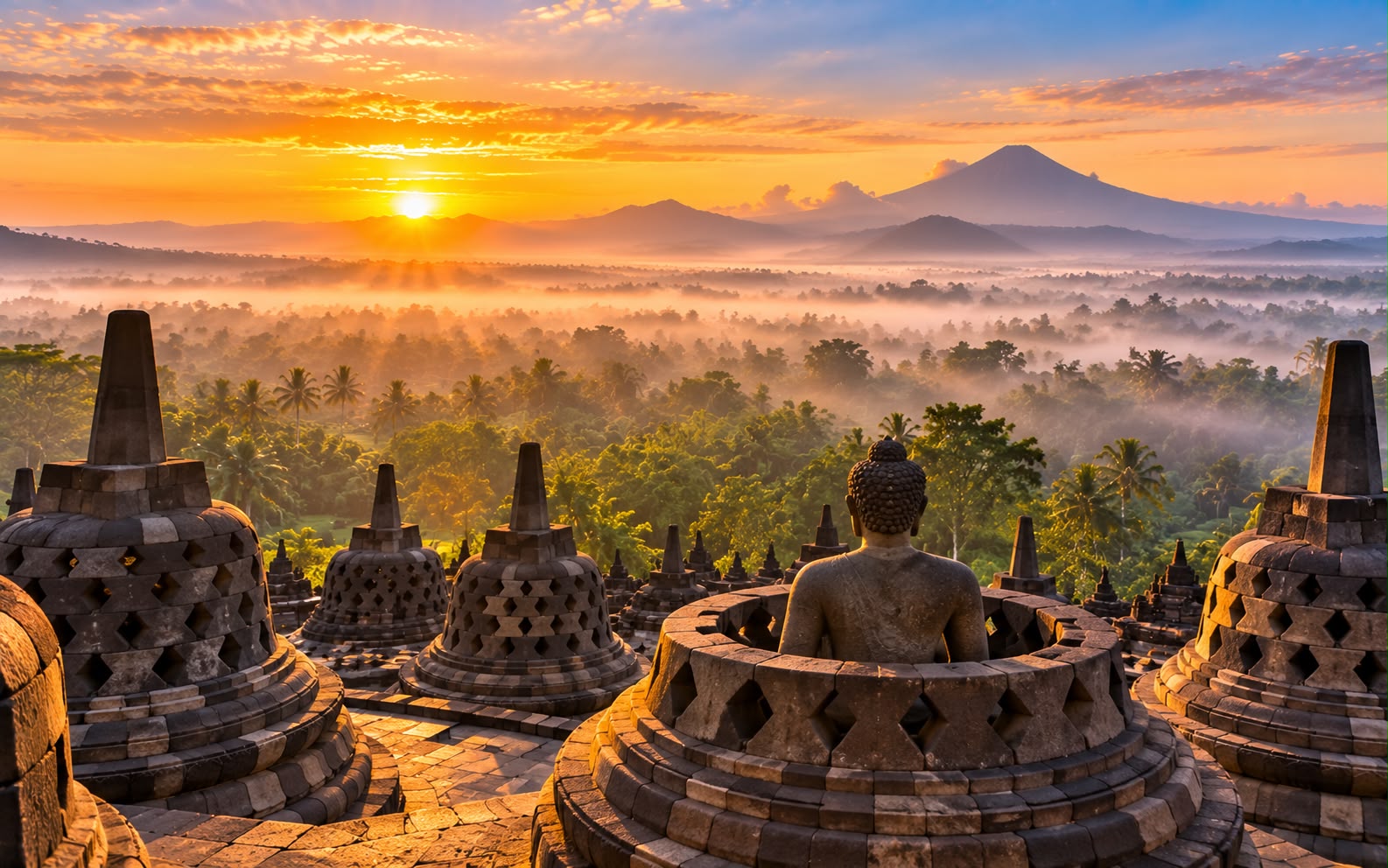
Most people fly straight to Bali and never see Java, which has the largest Buddhist temple on earth and two of the most extraordinary volcanoes in Asia. Two weeks does Borobudur, a sunrise over Bromo, the blue fire at Ijen, and still leaves five nights in Bali.
- Southeast Asia
- 14 days
- ≈ AED 5,500 / person
- Java's temples and volcanoes first, Bali as the reward at the end
Before you go
Indonesia has 17,000 islands and most visitors see one. Two weeks is enough for Java and Bali, which is a genuinely different trip from a week in Bali — temples, two volcanoes and a train journey, finishing on a beach.
Yogyakarta is the cultural capital, with Borobudur (the largest Buddhist monument in the world, ninth century, 2,672 relief panels) and Prambanan (the Hindu answer to it) within an hour. Bromo is a smoking cone inside a sea of volcanic sand. Ijen burns blue at night — ignited sulphuric gas, visible only in darkness — and is worked by men carrying 70kg baskets of sulphur out of the crater.
Then Bali, with the last five nights, because by then you will want them.
Figure IDR 27,200,000 (≈ AED 5,518) per person. April to October is the dry season across all of it.
Before you go: the admin
Entry
- Visa on arrival for most nationalities, 30 days, extendable once, payable by card. e-VOA online beforehand saves the queue.
- The Bali tourist levy of IDR 150,000 per person is separate and paid online or on arrival.
- Six months’ validity and an onward ticket.
Getting across Java
- Jakarta → Yogyakarta by train, seven to eight hours, executive class, and it is a genuinely good journey through rice country. The alternative is a one-hour flight.
- Yogyakarta → Surabaya or Probolinggo by train, then road to Bromo.
- Bromo → Ijen is a long drive, four to five hours, usually done as part of a two-volcano tour package.
- Ijen → Bali by road to Ketapang and the short ferry to Gilimanuk, then three hours to Ubud — or fly Surabaya to Denpasar and skip the ferry.
- Book trains on the KAI app a week or two out; executive class sells out.
Money
- Rupiah, and the zeroes are serious. One million is about sixty dollars.
- Use ATMs inside bank branches. Skimming at freestanding machines is a real problem.
- Cash everywhere outside hotels and Bali’s tourist areas.
The volcano nights, which are cold
- Bromo’s sunrise viewpoint is at 2,770m and the jeep leaves at 3am. It is near freezing.
- Ijen starts at midnight and climbs to 2,386m, and you need a gas mask for the crater rim, which the guides supply.
- Both are genuinely demanding nights. Do not plan a travel day immediately after either.
Day by day
Day 1 — Jakarta
- Most long-haul arrives here, and two nights is honest. Jakarta is not a tourist city and it is the capital of the fourth most populous country on earth, which is worth seeing.
- 15:00 — Kota Tua, the old Batavia town square, with the Jakarta History Museum in the former city hall — Dutch, and with the cells underneath still there.
- 17:00 — Glodok, the Chinatown, for the food and the medicine shops.
- 19:30 — Dinner there. Jakarta’s traffic means you do not cross the city twice in an evening.
Day 2 — Jakarta, then east
- 09:00 — The National Museum for the archaeology, which gives Borobudur its context before you go — see it now and the temple makes far more sense.
- 12:00 — Istiqlal Mosque, the largest in Southeast Asia, standing directly opposite the Catholic cathedral. The two share parking at festivals, deliberately, and a tunnel was built between them in 2021.
- 15:00 — Take the train east. Jakarta to Yogyakarta is about seven hours by day train, or an overnight sleeper.
Day 3 — Yogyakarta
- 10:00 — Arrive and settle. Yogyakarta is the easiest city in Java and the one most people wish they had given another day.
- 14:00 — The Kraton, the sultan’s palace, still occupied, with court servants in traditional dress and gamelan most mornings.
- 16:00 — Taman Sari, the water castle behind it: bathing pools for the royal household and an underground mosque with a five-way staircase.
- 19:00 — Malioboro Street and the night market.
Day 4 — Borobudur and Prambanan
- 04:00 — Borobudur for sunrise. Built around 800 AD, abandoned, and rediscovered under volcanic ash in 1814. Access to the upper terraces is limited and ticketed separately — book ahead and check the current rules, which have changed repeatedly in recent years.
- 09:00 — Breakfast, and back to the city for the hot hours.
- 16:00 — Prambanan in late afternoon: ninth-century Hindu temples, tall and sharp where Borobudur is broad and stepped.
- 19:30 — The Ramayana ballet performed in front of them in the dry season, outdoors with the temples lit behind the dancers.
Day 5 — Merapi, and the batik
- 05:00 — The Mount Merapi jeep tour. The most active volcano in Indonesia, which killed 350 people in 2010 and is still erupting — the tour runs through the lava fields and a village buried in that eruption.
- 11:00 — The batik workshops, which is what the city is known for domestically rather than for its temples.
- 15:00 — Kotagede, the old silver quarter and the original Mataram capital.
- Overnight train or morning train east.
Day 6 — To Mount Bromo
- 08:00 — Train to Probolinggo or Surabaya, then road up.
- 15:00 — Cemoro Lawang, on the crater rim — the village the jeeps leave from, and the only sensible place to sleep.
- It is near freezing here at night and tropical by nine in the morning. Pack for both.
- 19:00 — Eat early and sleep early. You are up at three.
Day 7 — Bromo at sunrise
- 03:00 — The jeep to Penanjakan for sunrise over the caldera: Bromo smoking in the middle of the Sea of Sand, with Semeru erupting behind it on the hour.
- 06:00 — Down into the caldera, across the sand, and up 250 steps to Bromo’s own rim. Horses are available and are not necessary.
- 09:00 — Back for breakfast, and the four to five hours east.
- 15:00 — Into Banyuwangi or Ketapang, for Ijen.
Day 8 — Ijen at midnight
- The day is for sleeping, because the climb starts at midnight.
- 00:00 — The midnight climb: two hours up, then down into the crater for the blue fire — sulphuric gas igniting as it escapes, visible only in darkness.
- A gas mask is essential and is supplied. The fumes are genuinely dangerous and the wind shifts without warning.
- 05:00 — At dawn the crater lake appears: a kilometre wide, turquoise, and the most acidic lake in the world.
- The sulphur miners carry 70–90kg loads out of the crater twice a day. Buying a carved sulphur souvenir from them is the straightforward way to put money in their hands.
Day 9 — Across to Bali
- 09:00 — Down and sleep, properly, after two nights of almost none.
- 14:00 — Road to Ketapang, ferry to Gilimanuk, and on into Bali. The crossing is under an hour; the drive east from Gilimanuk is three to four.
- 19:00 — Into Ubud, or stop at Lovina on the north coast if the day has run long.
Day 10 — Ubud
- 07:00 — Tegalalang rice terraces, before the coaches. By nine it is a queue for the swing.
- 10:00 — Tirta Empul, the purification temple, where you can take part in the ritual bathing — sarong required, and there is an order to the fountains.
- 13:00 — Goa Gajah, the “elephant cave”, with a carved demon mouth for a doorway.
- 16:00 — The Sacred Monkey Forest. Nothing loose, nothing shiny, and no plastic bags — they are taken as food.
Day 11 — Ubud, slower
- 08:00 — The Campuhan Ridge Walk, which is free, an hour, and best before the heat.
- 11:00 — A cooking class, which Ubud does better than anywhere else on the island, usually starting at the market.
- 16:00 — Ubud Palace and the evening Legong dance in the courtyard.
- Move south tomorrow.
Day 12 — South, and Uluwatu
- 10:00 — Down to Seminyak, Canggu or Jimbaran, about an hour and a half.
- 14:00 — The beach, and nothing else.
- 17:30 — Uluwatu Temple at sunset with the Kecak fire dance, booked ahead — it sells out, and the cliff setting is the point. The monkeys here are practised thieves; sunglasses go in a bag.
- 20:00 — Jimbaran for grilled fish on the sand.
Day 13 — The south, or Nusa Penida
- 06:00 — Nusa Penida as a day trip, if you still have the energy — after two volcanoes you may not, and that is a reasonable thing to skip. The fast boat is 45 minutes and the island’s roads are genuinely rough.
- Otherwise: the beach clubs at Seminyak or Canggu, Tanah Lot at sunset, or simply a day doing nothing after a fortnight that has included two 3am starts.
Day 14 — Home
- 08:00 — A last morning on the beach, early, before the sand gets hot.
- The airport is 30–45 minutes from Seminyak, longer from Canggu and longer again in traffic.
Costs and practicalities
Best time to visit
April to October, and this route needs the dry season more than a Bali-only trip does.
- May, June and September — dry, clearest volcano views, and cheaper than peak. The best window.
- July–August — peak, dry and reliable. Bromo’s sunrise viewpoint is genuinely crowded and Bali’s traffic is at its worst.
- April and October — shoulder, mostly dry, good value.
- November–March — the wet season. Bromo and Ijen sunrise trips are frequently cancelled or fogged out, which is the real argument against these months; Bali alone is fine in the rain but volcanoes are not.
Nyepi, the Balinese day of silence, falls in March — the island closes completely for 24 hours, including the airport.
Travel tips
- Book Borobudur’s upper-terrace access ahead and check the current rules, which change.
- Book Java trains on the KAI app a week or two out.
- Do not plan a travel day straight after Bromo or Ijen. Both are overnight and both are exhausting.
- Take real warm layers for both volcano nights.
- A gas mask for Ijen is not optional — use the guide’s, and follow him when the wind turns.
- Use ATMs inside bank branches.
- Carry a sarong for Balinese temples.
- Allow double the map time for any Bali road.
What this trip actually costs
Two people, 13 nights, mid-range comfort, international flights excluded:
| Item | Cost |
|---|---|
| Hotels and guesthouses, 13 nights | IDR 19,200,000 (≈ AED 3,895) |
| Trains, the Java–Bali transfer and internal flights | IDR 11,200,000 (≈ AED 2,272) |
| Food and drink, 14 days | IDR 11,200,000 (≈ AED 2,272) |
| Borobudur, Prambanan, Bromo and Ijen tours | IDR 9,600,000 (≈ AED 1,948) |
| Drivers, ferries and airport transfers | IDR 3,200,000 (≈ AED 649) |
| Total for two | IDR 54,400,000 (≈ AED 11,036) |
- Roughly IDR 27,200,000 (≈ AED 5,518) per person for two weeks across two islands.
- Java is markedly cheaper than Bali — the same money buys more there, and the Bali half carries most of the accommodation figure.
- The two-volcano tour is the biggest activity line and is usually bought as a package including transport between them.
- Hotel picks here are chosen on location, not on commission — always check prices and recent reviews before booking.
What to pack
- A proper warm layer, hat and gloves for Bromo and Ijen. This is the thing people get wrong.
- Walking shoes with grip for both crater climbs.
- A head torch for the Ijen night climb.
- A sarong for temples in both Java and Bali.
- Reef-safe sun cream for the Bali half.
- Mosquito repellent.
- A Type C/F adapter, 230V.
FAQ
Is Java worth the time, or should I just do Bali? Java has Borobudur, Prambanan and two of the most striking volcanoes in Asia, and almost no Western visitors. If you have fourteen days, giving nine of them to Java is what makes this trip different from everyone else’s Bali holiday.
How hard are Bromo and Ijen? Bromo is easy — a jeep and 250 steps. Ijen is a two-hour climb at night followed by a steep descent into a crater, and it is the harder of the two by a wide margin.
Can I skip Jakarta? Yes, and many do — fly straight into Yogyakarta and give the two nights to Java elsewhere. Jakarta is worth seeing but it is the least essential stop here.
Is the blue fire guaranteed? No. It needs darkness, so you must be in the crater before about 4:30, and it is weather-dependent. Wet season trips are often cancelled outright.
Bali first or last? Last. After two overnight volcano climbs you will want a beach, not a temple.
Prices and entry rules change, and what you need depends on your passport; last checked 29 October 2026, so confirm with the embassy or your airline before booking.


