 The Itinerary
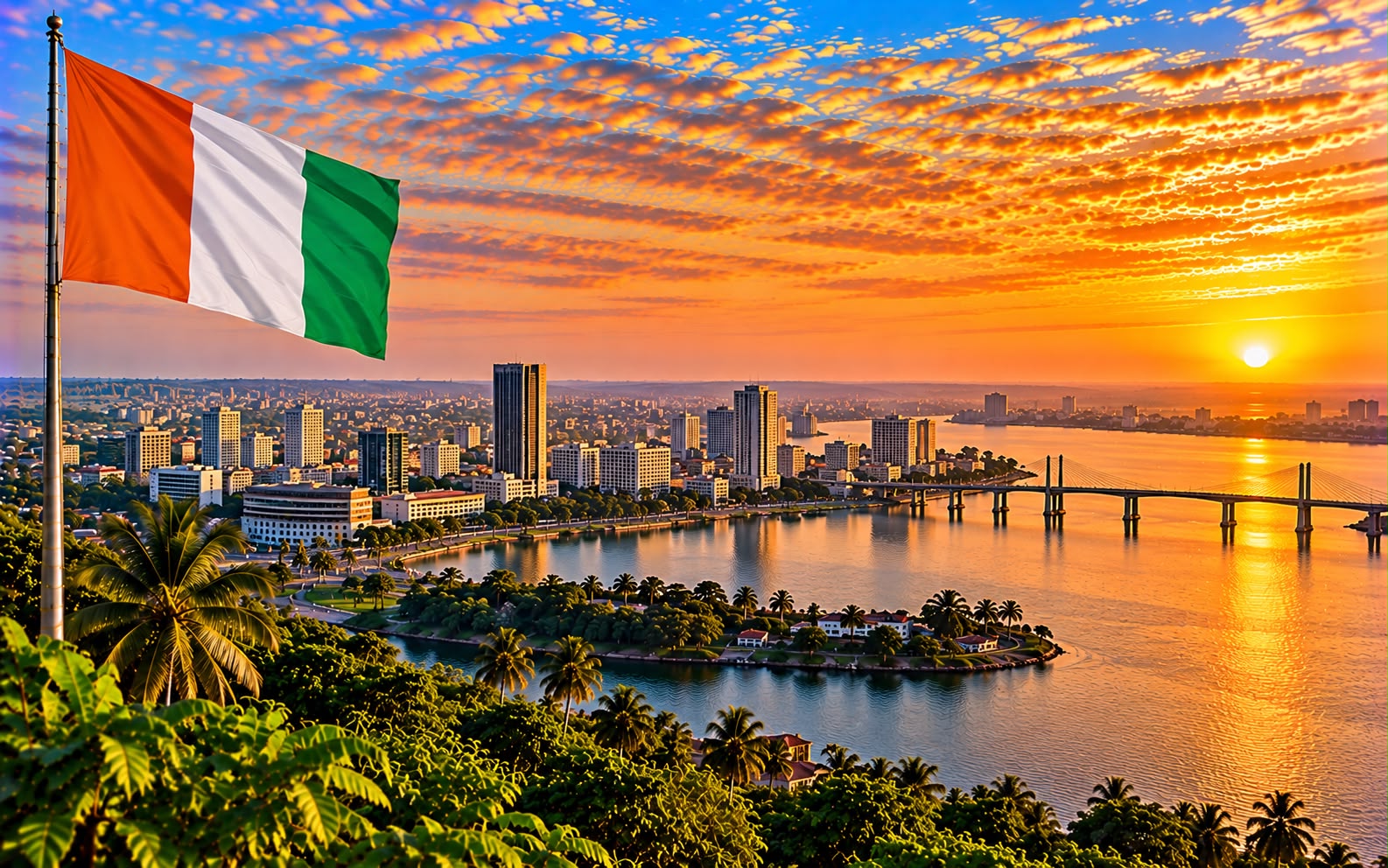
Ivory Coast in 8 days: the world's largest church, Grand-Bassam and the mountains of Man
A replica of St Peter's built larger than the original in the founding president's home village, a UNESCO colonial quarter crumbling on a lagoon, stilt dancers in the western mountains, and the city West Africa actually runs on.
- West Africa
- 8 days
- ≈ AED 3,650 / person
- A basilica bigger than St Peter's, in a village of 200,000 people
Before you go
Côte d’Ivoire is the economic engine of French-speaking West Africa, the world’s largest cocoa producer, and — in Abidjan — the one city in the region that feels like a metropolis rather than a capital.
It also holds the single strangest building in Africa.
The Basilica of Our Lady of Peace at Yamoussoukro is modelled on St Peter’s in Rome and is larger than it, which makes it, by surface area, the largest church in the world. It stands in the home village of Félix Houphouët-Boigny, the founding president, who moved the official capital there and built it in the late 1980s. It seats a few thousand in a village-turned-city, and the contrast between the marble and the surrounding savanna is the whole point and the whole problem.
Grand-Bassam was the French colonial capital and is on the UNESCO list: a sandbar between lagoon and ocean, with a quarter of decaying administrative buildings and villas, and a beach behind them.
Man, in the west, sits among what the country calls its eighteen mountains — forested hills with waterfalls, liana bridges woven from living vines, and the Dan villages where the stilt dancers perform, masked, several metres up.
And Abidjan itself: a lagoon city of towers and markets and the best food in West Africa.
Eight days. Figure USD 1,000 (≈ AED 3,673) per person excluding flights. Go November–March, the dry season.
Before you go: the 15-minute admin
Visas and vaccinations
- An e-visa is applied for online before travel for most nationalities and collected on arrival at Abidjan. The process is reasonably quick; apply at least a few weeks out.
- Yellow fever vaccination is compulsory and the certificate is checked at the airport. No certificate, no entry.
- Malaria is present year-round. Take prophylaxis and take advice early.
Current advice, and the north
- Read your government’s current travel advice before booking. It is normally area-specific here.
- The areas usually named are the northern border regions with Mali and Burkina Faso, where there has been spillover from the Sahel, and sometimes the far west near the Liberian border.
- This itinerary stays south and west of those areas — Abidjan, the lagoon coast, Yamoussoukro and Man are not normally in that category. Comoé National Park, in the north-east, is, which is why it is not on this route.
- The country has been stable since 2011, and Abidjan is busy and ordinary.
Money
- The West African CFA franc (XOF), pegged to the euro — the same currency as Senegal, Benin and Guinea-Bissau.
- Cards work in Abidjan at hotels, supermarkets and larger restaurants, which is unusual for the region. ATMs in Abidjan are reliable.
- Carry cash everywhere else. Yamoussoukro and Man are cash economies.
- Costs are moderate: Abidjan is expensive by regional standards, the rest is cheap.
Getting around
- Hire a car with a driver. Around $110–130 a day. The main roads are good — the Abidjan–Yamoussoukro motorway is genuinely fast — and the one to Man is long.
- Abidjan traffic is severe. Allow double what the map suggests inside the city.
- Domestic flights link Abidjan with Man and Korhogo and save a day each way if the budget allows.
- Expect police checkpoints between cities. Carry your passport and vaccination certificate.
- Woro-woro shared taxis and the gbaka minibuses run in Abidjan and are not practical for a visitor.
Language and etiquette
- French, with around sixty local languages behind it. English is limited to the better Abidjan hotels.
- Ask before photographing people, and never photograph police, military or the presidential palace.
- At the sacred masks and dances in the west, the rules are set by the village — your guide will tell you what is permitted and it is sometimes nothing at all.
Travelling with kids?
- Grand-Bassam and Assinie are proper beach days, with the caveat that the Atlantic here has a strong undertow. Swim where you are told.
- The drive to Man is long — two full days of the week.
- Banco National Park inside Abidjan is a short, shaded rainforest walk with monkeys, and works well.
Day by day
Day 1 — Abidjan
- Afternoon — Arrive at Félix-Houphouët-Boigny, 20 minutes from Plateau in light traffic and an hour otherwise.
- 16:00 — Le Plateau, the business district, for St Paul’s Cathedral — a 1980s concrete structure with a figure of St Paul leaning out over the entrance and the cables of his robe holding the roof, which is far better than that description suggests.
- 17:30 — Across to Treichville for the Marché de Treichville, and the Musée des Civilisations de Côte d’Ivoire if the timing works.
- 19:30 — Dinner in Cocody or at a maquis — the open-air grill restaurants that are the country’s real contribution to eating out. Attiéké, grilled fish, and nothing fussy.
Where to stay in Abidjan (three nights across the trip)
- Mid-range: Cocody, green and residential, or Plateau for the business hotels.
- Lively: Zone 4 in Marcory, where the restaurants and bars are.
Day 2 — Banco, and Grand-Bassam
- 08:00 — Banco National Park, a block of primary rainforest inside the city limits. Short trails, monkeys, and at the entrance the fanicos — the laundrymen who have washed Abidjan’s clothes in the river by hand for generations, each with his own stone.
- 11:00 — East to Grand-Bassam, 45 minutes.
- 12:30 — Lunch on the beach, then the Quartier France: the French colonial capital until 1896, left to decay after a yellow fever epidemic, now on the UNESCO list. The old post office, the governor’s palace, the Musée National du Costume, and villas with the vegetation coming through them.
- 17:00 — The beach. The undertow here is serious — swim only where locals do and preferably not at all if the sea is up.
- 19:00 — Back to Abidjan, or stay in Bassam.
Day 3 — Up to Yamoussoukro
- 08:00 — The motorway north, about three hours.
- 11:30 — The Basilica of Our Lady of Peace. Consecrated in 1990, built in marble shipped from Italy, with stained glass covering 7,400 square metres — and with Houphouët-Boigny himself kneeling in one of the windows among the worshippers. By area it is the largest church in the world, and it is bigger than St Peter’s, which it was modelled on.
- 14:00 — Lunch, then the Presidential Palace lake, where the sacred crocodiles are fed in the afternoon — a Houphouët-Boigny tradition that is still observed.
- 16:00 — The Fondation Félix Houphouët-Boigny, a conference complex of unused marble halls that explains the city better than any guidebook.
- 17:30 — Dinner and the night in Yamoussoukro.
Day 4 — West to Man
- 07:30 — The long drive west, five to six hours, through cocoa and coffee country.
- 14:00 — Man, in the hills. Check in.
- 16:00 — La Cascade, a waterfall in bamboo forest twenty minutes from town, and La Dent de Man, the tooth-shaped peak above it.
Where to stay in Man (two nights)
- Simple: the hotels in town. There is nothing elaborate and the setting makes up for it.
Day 5 — The mountains and the stilt dancers
- 08:00 — The liana bridges near Lieupleu — vine bridges grown and woven across the rivers, maintained by the villages, and crossed one person at a time. They are sacred and the village charges a fee; pay it.
- 11:00 — Mount Tonkoui, the second-highest point in the country at around 1,200 metres, with a view into Guinea and Liberia on a clear day.
- 14:00 — Lunch, then a Dan village for the stilt dancers — masked performers on stilts several metres high, spinning and dropping into splits. This is a masked tradition with religious weight, not a floor show; it is arranged in advance through a guide, the village sets the terms, and photography may be restricted.
- 17:00 — The weavers and mask carvers of the area.
Day 6 — Back east, slowly
- 07:30 — The drive back towards the coast, breaking it at Yamoussoukro or at a cocoa cooperative if your driver can arrange one — this is the crop the entire economy rests on and almost no visitor sees it.
- 16:00 — Abidjan.
Day 7 — Assinie
- 08:00 — East past Bassam to Assinie, about two hours, where the lagoon and the ocean run side by side with a sandbar between them.
- All day — Boats on the lagoon, the fishing villages, and the beach. This is where Abidjan goes at weekends, so come on a weekday if you want it quiet.
- 18:00 — Back to the city.
Day 8 — Fly out
- Morning — The Marché de Cocody or the artisans’ village for masks, kita cloth and bronze.
- Afternoon — Airport. Allow for the traffic.
Costs and practicalities
Best time to visit
November–March is the main dry season in the south, and the country’s climate splits sharply between coast and north.
- November–February — the best months. Dry, with the harmattan reaching the north in December and January.
- March–May — the first rains in the south, heavy and humid.
- June–August — the main wet season on the coast; Abidjan gets most of its rain now. The north stays drier.
- September–October — the second, lighter rains in the south; the north’s single wet season is ending.
Taï National Park and the western forests are wet in most months and best attempted in the driest weeks of January and February. The Grand-Bassam colonial quarter and the Abidjan lagoon are comfortable whenever it is not raining hard.
Travel tips
- Abidjan is one of West Africa’s easiest cities to arrive in — good hotels, working taxis, and a functioning airport — which makes it a sensible first stop in the region.
- Bring euros in cash. The CFA franc is pegged to the euro; cards work in Abidjan hotels and restaurants and much less elsewhere.
- French is essential. English is rare outside international business.
- Agree taxi fares in advance or use Yango, which works well in Abidjan. Orange taxis are metered in theory.
- A yellow fever certificate is mandatory and checked on arrival. Malaria prophylaxis is essential.
- Do not photograph military, police, the airport, bridges or government buildings — the Abidjan lagoon bridges in particular.
- The Basilica at Yamoussoukro requires modest dress and is far larger than photographs suggest; allow a half-day from Abidjan.
What this trip actually costs
Two people, 7 nights, mid-range comfort, flights excluded:
| Item | Cost |
|---|---|
| Hotels, 7 nights | USD 700 (≈ AED 2,571) |
| Car with driver, 6 days | USD 720 (≈ AED 2,644) |
| Entries, village fees, guides | USD 250 (≈ AED 918) |
| Food and drink, 8 days | USD 330 (≈ AED 1,212) |
| Total for two | USD 2,000 (≈ AED 7,345) |
- Roughly USD 1,000 (≈ AED 3,673) per person. Abidjan is where the money goes — hotels there cost two or three times what Man does.
- The drive west is two days of the week. Flying Abidjan–Man buys you a day and costs about what the car does.
- Village and performance fees go to the communities and are small. Agree them through your guide beforehand.
- Maquis eating is very cheap and better than the hotel restaurants.
- Hotel picks here are chosen on location, not on commission — always check prices and recent reviews before booking.
What to pack
- Yellow fever certificate — checked on arrival — and malaria prophylaxis.
- Light, modest clothing for the villages, and something smarter for Abidjan, which dresses well.
- Strong repellent and long sleeves for the evenings.
- Cash in CFA for everywhere outside Abidjan.
- Rain gear for Man, which is wet even in the dry season.
FAQ
Is the basilica really bigger than St Peter’s? By total area, yes — that is the Guinness-recognised claim, and it includes the colonnade and the rectory. St Peter’s holds far more people. Standing in front of it, the argument stops mattering.
Is Ivory Coast safe? The south, where this itinerary goes, is stable and busy. The northern border areas with Mali and Burkina Faso carry travel advisories and are deliberately not on this route — check your own government’s current position.
Can I see the stilt dancers any day? No. It is a masked tradition tied to specific occasions, arranged through a guide with the village, and sometimes declined. Treat an arranged performance as a privilege rather than a ticket.
Is Abidjan worth time on its own? Yes. It has the best restaurants and nightlife in French-speaking West Africa and a genuine city energy that nothing else in the region matches.
What language do I need? French. English is limited to international hotels.
Prices and entry rules change, and what you need depends on your passport; last checked 8 October 2026, so confirm with the embassy or your airline before booking.


