 The Itinerary
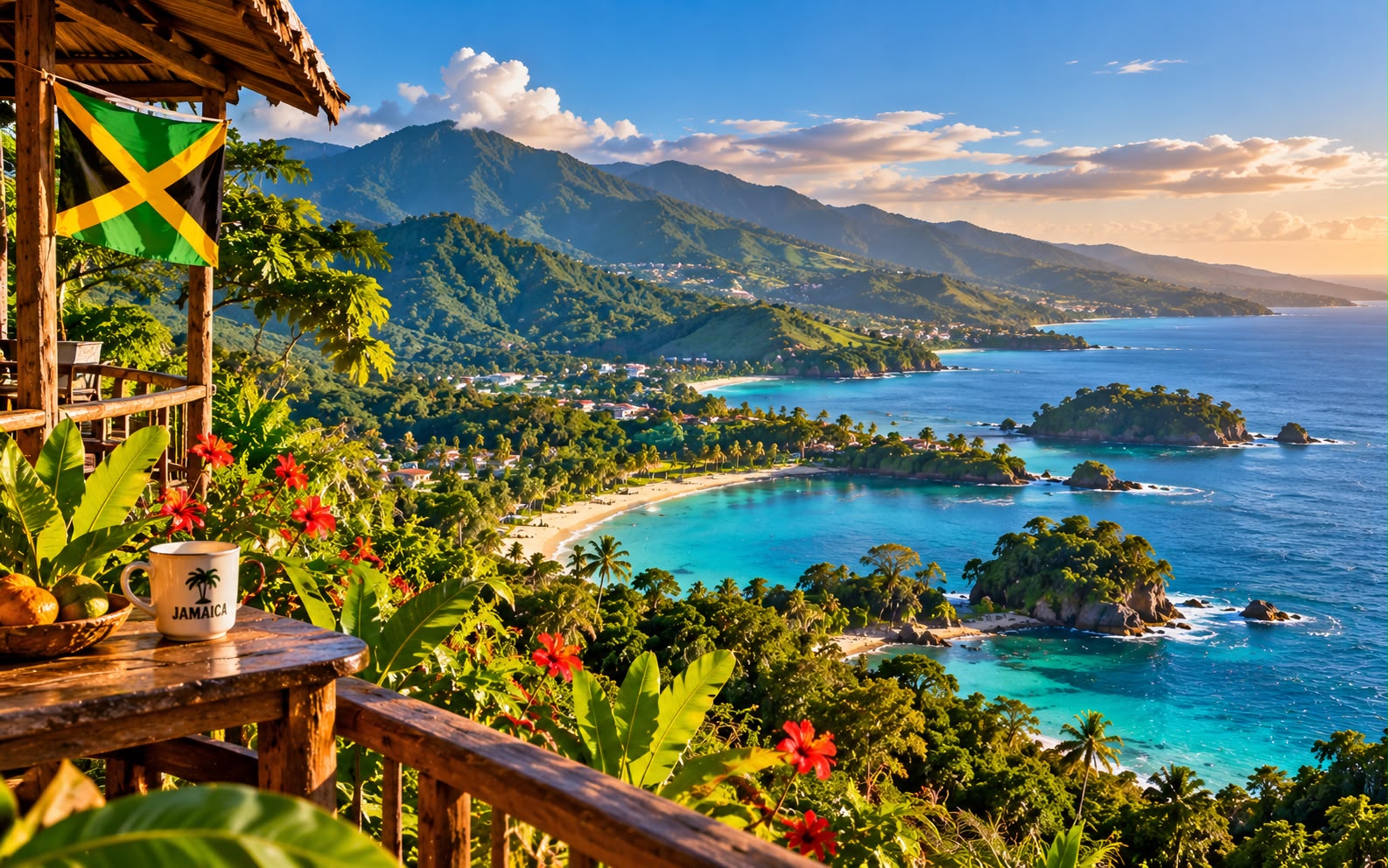
Jamaica in 8 days: Kingston, the Blue Mountains and Port Antonio
The Jamaica that all-inclusives never show you: Trench Town and the Bob Marley house in Kingston, coffee farms at 1,200 metres, a river you raft on a bamboo punt, lagoons the colour of antifreeze on the north-east coast, and a fishing village on the south where almost nobody goes.
- The Caribbean
- 8 days
- ≈ AED 6,250 / person
- The island behind the resorts
Before you go
Most visitors to Jamaica see a strip of Montego Bay or Negril from inside a wristband, and leave having met nobody. That is a perfectly good holiday and it is not this one.
This route runs the other way round the island: Kingston first, because the music that Jamaica exported to the world came out of a specific few streets there and you can stand in them; then up into the Blue Mountains, where the coffee grows at 1,200 m and the air is suddenly cold; then Port Antonio on the north-east coast, which is the lushest and least developed part of the island; and finally Treasure Beach on the arid south, which looks and feels like a different country.
It is harder work than a resort. It is also the only version where you come home with a sense of the place.
Before you go: driving, Kingston and the seasons
Entry and money
- Most nationalities enter visa-free for tourism. You must complete the online immigration/customs form before arrival — do it the day before, not at the airport.
- Jamaican dollar (JMD), and US dollars are widely accepted at a rate that is rarely in your favour. Pay in JMD where you can.
- Cards work in hotels and larger restaurants. Jerk stands, route taxis and markets are cash.
Getting around, honestly
- Hiring a car gives you this itinerary. Driving is on the left, the main roads are decent, and the north coast highway is fast and tolled. Minor roads are potholed and unlit, and nobody should drive them after dark.
- Jamaican driving is assertive. Overtaking happens where you would not expect it. Drive defensively and let people past.
- Route taxis — shared, marked with red plates — are how most Jamaicans travel and cost very little.
- A driver for the week is the alternative and is common. It costs more than a hire car and removes every navigational problem.
- Avoid unlit rural roads at night, and do not take shortcuts suggested by a map app in Kingston.
Kingston, straight
- Kingston is a working capital of a million people with genuinely dangerous neighbourhoods and entirely ordinary ones. New Kingston, where you will stay, is the latter.
- Trench Town and the downtown music sites are visited with a guide, from an organised tour or a driver who knows them. That is not nervousness — it is how these visits are arranged, and the guides are often from those communities.
- Do not wander downtown after dark, do not display valuables, and the rest is a normal city.
When to go
- Mid-December to April is the dry season and the peak — best weather, highest prices.
- Late April, May and early June are the sweet spot: dry enough, hot, and much cheaper.
- June to November is hurricane season, with August to October the peak. Rain comes in heavy bursts rather than all day.
- Blue Mountain mornings are cold — single digits at the peak before dawn — in any season.
Day by day
Day 1 — Land in Kingston
- 14:00 — Land at Norman Manley (KIN) on the Palisadoes spit, 20 minutes from New Kingston. Fly into Kingston, not Montego Bay — this itinerary runs the opposite way to the resort traffic.
- 15:30 — Drop bags in New Kingston.
- 17:00 — Devon House, a 19th-century mansion built by Jamaica’s first Black millionaire, George Stiebel, who made it in Venezuelan gold. The grounds are a public park and the ice cream is a national institution — the queue is the review.
- 19:00 — Dinner. Jerk properly: pork or chicken rubbed with scotch bonnet and pimento, smoked slowly over pimento wood, chopped with a cleaver and served on paper with festival.
- 21:00 — Confirm tomorrow’s guide for downtown.
Day 2 — Trench Town, and the music
- 09:00 — The Bob Marley Museum at 56 Hope Road, his home and studio from 1975 until his death. The bullet holes from the 1976 assassination attempt are still in the wall, deliberately left. The tour is guided, no photographs inside, and the last room is a cinema.
- 11:00 — Trench Town Culture Yard, downtown, with a guide. This is the government housing scheme where Marley lived as a teenager, where the Wailers formed, and where the term trench town rock comes from. It is a working community and the guides live there.
- 13:00 — Lunch downtown.
- 14:30 — Tuff Gong studio tour if it is running — still a working pressing plant and studio — or the National Gallery, which is small and excellent on Jamaican art.
- 16:30 — Emancipation Park and the Redemption Song statue.
- 19:30 — Dinner, and live music if it is a weekend. Kingston is where this all comes from and it is still happening.
Day 3 — Up into the Blue Mountains
- 08:30 — Drive up. It is only 25 km but takes two hours: single-track switchbacks, blind bends, and a drop on one side with no barrier. Sound the horn on corners, which everyone does.
- 10:30 — Craighton Estate or Clifton Mount for a coffee tour. Blue Mountain coffee grows between 900 and 1,700 m, is picked by hand, and about 80% of it goes to Japan. The tour walks the slopes and ends with a cupping.
- 13:00 — Lunch at Strawberry Hill or a guesthouse, with the whole of Kingston and the sea laid out two thousand metres below.
- 15:00 — Walk a forest trail — the mountains hold endemic birds, giant swallowtail butterflies and tree ferns, and it is ten degrees cooler than the coast.
- 17:00 — Check in at a mountain guesthouse.
- 18:30 — Dinner, early.
- Optional, 01:00 — The Blue Mountain Peak hike: 7 miles up in the dark to 2,256 m for sunrise, and on a clear morning you can see Cuba. It is cold, steep and long, and it takes the night out of tomorrow.
Day 4 — Over to Port Antonio
- 08:30 — Down the other side and east to Port Antonio, about three hours through the forest road or round the coast.
- 12:00 — Arrive. This was the island’s first tourist town — Errol Flynn ran aground here in 1946 and stayed — and it has been quietly forgotten by the industry since, which is exactly its appeal.
- 13:00 — Lunch at the Boston Bay end.
- 14:00 — Boston Bay is where jerk comes from. The stands along the roadside here are the original and the pimento wood is cut locally. Eat again if you have room.
- 16:00 — Frenchman’s Cove, where a freshwater river meets the sea on a small beach, so you swim between cold and warm water in the same place.
- 18:00 — The Blue Lagoon at dusk — 60 m deep, fed by underground springs, and the colour genuinely does shift through the day from turquoise to a deep indigo.
- 20:00 — Dinner in town.
Day 5 — Rafting, and the falls
- 08:30 — Rafting the Rio Grande on a bamboo punt — thirty feet of lashed bamboo, poled by a captain standing at the front, drifting three hours down the river between forested hills. It was started by Errol Flynn, who raced them for bets, and the raft captains have been a licensed guild ever since.
- 12:00 — Lunch at the landing.
- 14:00 — Reach Falls, inland and far quieter than Dunn’s River on the north coast: a series of pools under forest, with a guide who will take you up the riverbed through the falls themselves and into the underwater cave if you want it.
- 17:00 — Back to Port Antonio.
- 19:00 — Dinner. Winnifred Beach if you want one more swim — it is community-run, free, and the one the locals use.
Day 6 — Across to the south coast
- 08:00 — The long leg: Port Antonio to Treasure Beach, four and a half to five hours, right across the island.
- 11:00 — Break it at Bath Fountain, a hot mineral spring in the south-east, or push on.
- 13:30 — Lunch on the way.
- 15:00 — Arrive Treasure Beach, and it is a different country: the south coast is in the rain shadow and semi-arid, with cactus, fishing boats, black sand and almost no hotels. The area runs a community tourism model — guesthouses rather than resorts, and a trust that puts a share back into the villages.
- 17:30 — Sunset on Frenchman’s Bay or Calabash Bay.
- 19:30 — Dinner at a guesthouse, cooked to order because everything is.
Day 7 — Pelican Bar, and the Black River
- 09:00 — The Black River Safari — a boat up Jamaica’s longest river through mangrove, with American crocodiles basking on the banks, which the boatmen know individually and by name.
- 12:00 — YS Falls inland, a seven-tier cascade on a working estate with rope swings and a natural pool, and far fewer people than the north-coast equivalent.
- 15:00 — Floyd’s Pelican Bar, and leave time for it: a shack built on stilts on a sandbar a kilometre out to sea, reached only by boat, serving beer and fried fish to whoever turns up. You stand in waist-deep Caribbean around it. There is nothing else like it anywhere.
- 18:00 — Back ashore for sunset.
- 19:30 — Last dinner.
Day 8 — Fly home
- Morning — Treasure Beach to Montego Bay (MBJ) is about two hours and to Kingston (KIN) about three and a half. Book your outbound from Montego Bay if you follow this route — it saves a long drive back across the island.
- Last stop — Blue Mountain coffee, bought at the estate rather than the airport, and a bottle of overproof white rum that you will regret opening.
- Note — There is a departure tax, usually in the ticket. Check yours.
Costs and practicalities
Best time to visit
December–April is the dry season and the obvious window, with June–November the hurricane season and the reason the rates fall.
- December–April — dry, 25–30°C, and peak. Christmas and Easter are at a premium and the north coast fills.
- May–June — the first rains as short afternoon showers; good value and still very usable.
- July–August — hot and humid, with Reggae Sumfest in Montego Bay in July and the diaspora home for the summer.
- September–October — the wettest and the peak of hurricane risk. Quietest and cheapest.
- November — the rains ease before the rates climb.
The Blue Mountains are cooler and wetter than the coast in any month — the Blue Mountain Peak hike leaves at 2am to reach the summit before the cloud closes in, which it does most mornings by eight.
Travel tips
- Driving is on the left on narrow, potholed mountain roads with assertive overtaking. Many visitors hire a driver instead, which costs less than it sounds.
- Route taxis are the shared local network — cheap, crowded, and identified by a red licence plate. Agree the fare if it is a charter rather than a route.
- The Jamaican dollar is the currency and US dollars circulate, usually at a worse rate. Pay in Jamaican where you can.
- Ganja is decriminalised in small amounts, not legal. Possession above the threshold, and taking any out of the country, remain serious offences.
- Persistent selling on the resort beaches is normal rather than threatening. A clear, friendly no works.
- Check advice for parts of Kingston, Montego Bay and Spanish Town. Some areas carry specific warnings; the resort corridors and the Blue Mountains are a different matter.
- Jerk from a roadside drum pan is the real thing. Boston Bay is where it comes from.
What this trip actually costs
Two people, 7 nights, mid-range guesthouses, excluding international flights:
| Item | Cost |
|---|---|
| Accommodation, 7 nights | JMD 196,000 (≈ AED 4,534) |
| Hire car, 7 days, and fuel | JMD 112,000 (≈ AED 2,591) |
| Bob Marley Museum, Trench Town tour, coffee estate | JMD 31,000 (≈ AED 717) |
| Rio Grande raft, Black River, YS Falls, Pelican Bar boat | JMD 47,000 (≈ AED 1,087) |
| Food and drink, 8 days | JMD 125,000 (≈ AED 2,892) |
| SIM, tips, extras | JMD 28,000 (≈ AED 648) |
| Total for two | JMD 539,000 (≈ AED 12,469) |
- Roughly JMD 269,500 (≈ AED 6,235) per person — about USD 1,700.
- This is not the cheap version of Jamaica and it is not the expensive one either. An all-inclusive week costs less and shows you a wristband; a villa costs several times this.
- Guesthouses on the south coast are a third of north-coast hotel prices and better.
- The car is the enabling cost. Without it this route does not work.
What to pack
- Reef-safe sunscreen and more than you expect.
- A warm layer and long trousers for the Blue Mountains, which genuinely get cold at night and freezing at the peak.
- Water shoes for the falls and the river rocks.
- A dry bag for the raft and the Pelican Bar boat.
- Repellent — mosquitoes on the north-east coast at dusk are serious.
- UK-style Type A/B plugs, 110V — American style, not British, despite the driving.
- Small JMD notes. Nobody at a jerk stand has change for a five-thousand.
FAQ
Is Kingston safe to visit? New Kingston, Devon House, the museums and the uptown restaurants are ordinary. Downtown and Trench Town are visited with a guide, which is how it is done rather than a precaution being suggested here — the tours are run by people from those communities. Do not drive yourself around downtown at night. With that, Kingston is the most interesting part of this trip.
Can I do this without a car? Partly. Route taxis and buses link the towns cheaply, but Treasure Beach, Reach Falls and the Blue Mountains all need private transport at the last stage. A driver for the week is the alternative and costs roughly double the car.
Is it worth skipping Negril and Montego Bay? This itinerary thinks so. They have the famous beaches and almost all of the resorts; Port Antonio and Treasure Beach have the island. If you want two days of Seven Mile Beach, add them to the end and fly out of Montego Bay.
When is the weather best? Mid-December to April is driest and most expensive. May and early June are nearly as good and much cheaper. Hurricane risk peaks August to October.
Is the Blue Mountain Peak hike worth losing a night over? If you like walking in the dark for five hours to be cold at sunrise, yes, genuinely — and on a clear morning Cuba is visible. If not, the coffee estates at 1,200 m give you the mountains without the 1 a.m. start.
Prices and entry rules change, and what you need depends on your passport; last checked 8 October 2026, so confirm with the embassy or your airline before booking.


