 The Itinerary
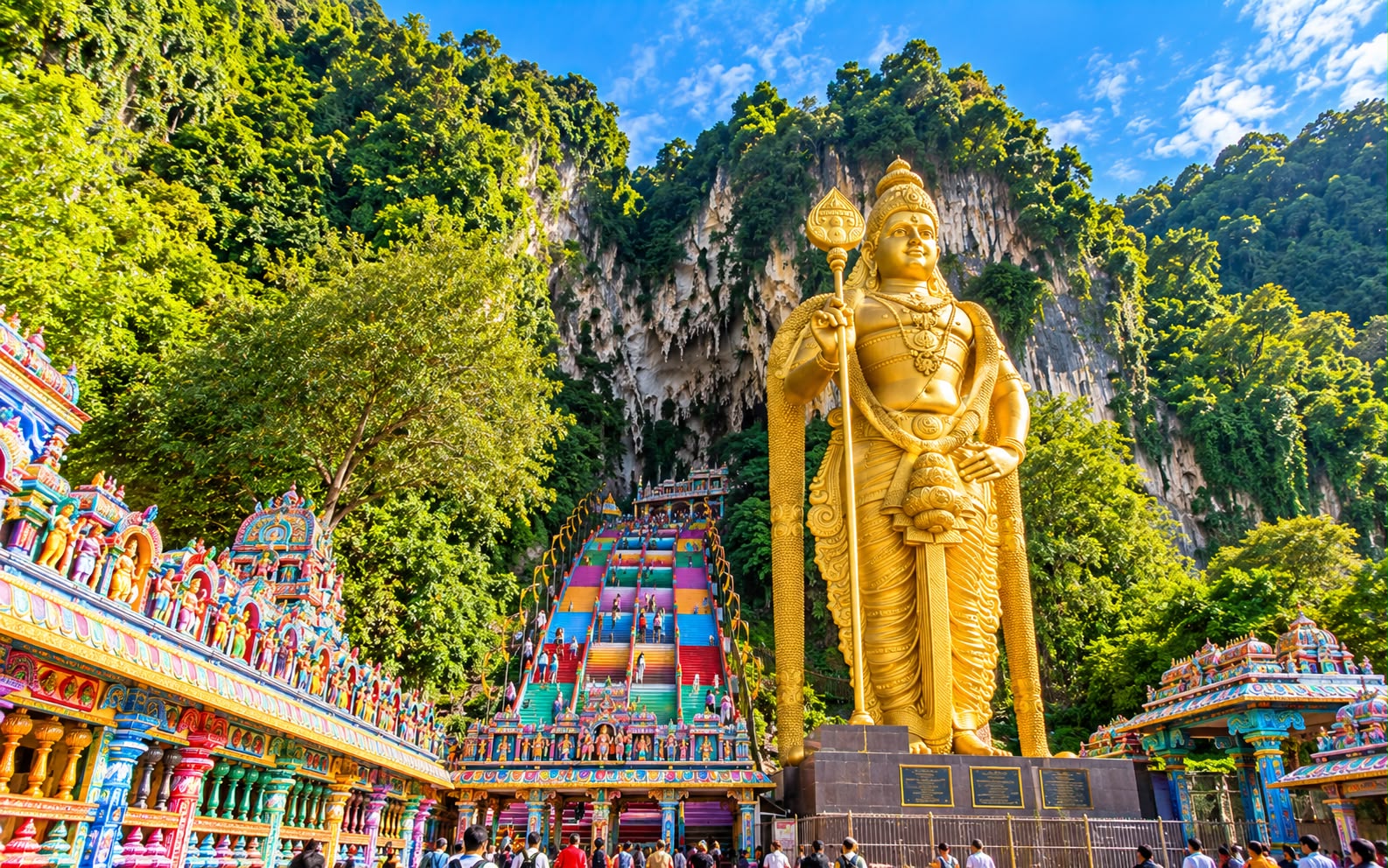
Kuala Lumpur in 2 days: the towers, Batu Caves and old KL
Batu Caves before the heat, the skybridge booked ahead, and a second day on foot through colonial KL and Chinatown. Plus why the Islamic Arts Museum is the best thing in the city and almost nobody goes.
- Southeast Asia
- 2 days
- ≈ AED 450 / person
- Two days where the best photograph of the towers is the free one
Before you go
Kuala Lumpur is a city people pass through on the way to the islands, and two days is enough to see why it deserves better. It is three cultures in one place — Malay, Chinese and Indian, each with its own quarter, its own food and its own festivals — and the eating is the best argument for stopping.
Two days: one that goes out to Batu Caves and up the Petronas Towers, and one on foot through colonial KL, Chinatown and the food streets.
One thing worth saying early: the best photograph of the Petronas Towers is from KLCC Park, at dusk, and it is free. The skybridge is worth doing, but not for the view of the building you are standing in.
Part of a Malaysia trip? See Malaysia in 7 days.
Figure the budget below. Year-round, with afternoon rain.
Before you go: the short version
Entry
- Most nationalities enter visa-free for 30 or 90 days.
- Everyone must complete the Malaysia Digital Arrival Card (MDAC) online within three days before arrival. It is free.
Getting in and around
- KLIA is 45 minutes out. The KLIA Ekspres is RM 55 and takes 28 minutes to KL Sentral; a Grab is RM 70–100 and takes longer in traffic.
- Grab is the default and is cheap — most city hops are RM 8–15.
- The LRT, MRT and monorail cover the centre well but do not connect as neatly as you would hope — some interchanges involve a walk outside.
- KL is hot and the pavements are poor. Short Grab hops beat walking between quarters, even when the map says otherwise.
What to book
- The Petronas skybridge and observation deck sell out days ahead, especially for sunset slots. Book online.
Day by day
Day 1 — Batu Caves and the towers
Walking order: Batu Caves is 272 steps and the temple at the top. KLCC is a park and a mall — about 2km of walking in total, in two separate places.
- 07:30 — Batu Caves, 30 minutes north on the KTM Komuter line or by Grab. Go first thing — it is hot by nine and the steps face the sun.
- 272 painted steps up to a limestone cavern temple, with a 42.7m gold statue of Lord Murugan at the bottom — the tallest statue of him anywhere.
- The macaques are bold. Carry nothing loose, and do not hold food.
- Thaipusam, in January or February, brings over a million pilgrims here and is one of the great religious spectacles in Asia.
- 11:00 — The Islamic Arts Museum, back in the city. It is the best museum in Malaysia and consistently overlooked — the architecture gallery with its scale models of mosques is worth the entry alone, and it is air-conditioned at exactly the right hour.
- 14:00 — Lunch in Brickfields, which is Little India, and a banana-leaf meal eaten with your right hand, with refills included, is the thing.
- 17:00 — The Petronas Towers, booked. The skybridge is on level 41 and the observation deck on 86. It is worth doing once.
- 19:00 — KLCC Park at dusk for the photograph — the towers reflected in the fountain pool, which is free and is the image everyone actually wants.
- 20:30 — Jalan Alor, the food street — plastic stools, grilled seafood, satay, and it runs until very late.
Day 2 — Old KL on foot
Walking order: Merdeka Square → Sultan Abdul Samad building (on the square) → Masjid Jamek (10 min) → Central Market (10 min) → Petaling Street (5 min) → Guan Di and Sri Mahamariamman temples (on the street). About 3km, flat, and shaded in parts.
- 09:00 — Merdeka Square, where independence was declared in 1957, and the Sultan Abdul Samad Building along one side — Moorish-revival, built by the British in 1897, and the most photographed colonial building in the country.
- 10:00 — Masjid Jamek, at the confluence of the Klang and Gombak rivers — the confluence that gives the city its name: kuala lumpur, “muddy estuary”. Robes are lent at the entrance and non-Muslims may visit outside prayer times.
- 11:30 — Central Market, a 1888 wet market turned craft hall, and Kasturi Walk beside it.
- 13:00 — Petaling Street, Chinatown, for lunch — and the Guan Di Temple and Sri Mahamariamman, a Taoist temple and a Hindu one on the same street.
- 15:00 — Out of the heat. The afternoon downpour usually arrives between three and five.
- 17:00 — Thean Hou Temple on its hill, a six-tiered Chinese temple with the city laid out below, which is best in late light.
- 19:00 — Chinatown after dark, or Bukit Bintang for the malls and the bars.
If you have a third day
- Melaka is two hours south — UNESCO-listed, Dutch and Portuguese, and a better day than anything left in KL.
- Or Genting Highlands, an hour up, for the cable car and a climate 10°C cooler.
Costs and practicalities
Getting around, and what it costs
| Grab, typical city hop | RM 8–15 |
| KLIA Ekspres from the airport | RM 55 |
| LRT or MRT, single | RM 2–5 |
| KTM Komuter to Batu Caves | RM 2.60 |
| Petronas skybridge and deck | RM 98 |
| Islamic Arts Museum | RM 20 |
| Batu Caves | free |
| Hawker meal | RM 10–20 |
- Grab is cheap enough to use constantly, and in this heat it is the right call.
- Batu Caves, Merdeka Square and KLCC Park are all free, which covers a good share of the two days.
Best time to visit
- Year-round, 27–33°C and humid. There is no cool season.
- May to July is marginally drier.
- November to February sees the heaviest rain, which arrives as an afternoon downpour rather than all day.
- Haze from regional fires can affect air quality between June and September, varying a great deal year to year.
- Thaipusam in January or February at Batu Caves is extraordinary and extremely crowded.
Travel tips
- Batu Caves at half seven, before the heat and the coaches.
- Book the Petronas tickets online — walk-ups are turned away.
- The free towers photograph is from KLCC Park at dusk.
- The Islamic Arts Museum is the city’s most underrated hour.
- Plan the afternoon indoors; the rain is reliable.
- Dress modestly at mosques and temples; robes are lent at Masjid Jamek and the National Mosque.
What this trip actually costs
Two people, 1 night, mid-range comfort, international flights excluded:
| Item | Cost |
|---|---|
| Hotel, 1 night | MYR 300 (≈ AED 271) |
| Food and drink, 2 days | MYR 260 (≈ AED 235) |
| Petronas, Islamic Arts Museum, two people | MYR 236 (≈ AED 214) |
| Grab, trains and the airport | MYR 204 (≈ AED 185) |
| Total for two | MYR 1,000 (≈ AED 905) |
- Kuala Lumpur is the cheapest major city in this region, and the food is the best value in it.
- The Petronas tickets are the biggest single line and the one genuinely optional item.
- Hotel picks here are chosen on location, not on commission — always check prices and recent reviews before booking.
What to pack
- Light clothing and a change for midday.
- Something that covers shoulders and knees for mosques and temples.
- An umbrella. The afternoon rain is near-daily.
- A Type G adapter, 240V — the same as the UK.
Part of a bigger trip?
- Malaysia in 7 days adds the Cameron Highlands and Penang.
- Malaysia in 14 days adds Borneo.
- Singapore and Malaysia in 10 days runs the peninsula south.
- Singapore in 3 days is an hour by air.
FAQ
Is two days enough for KL? Yes. One day out to Batu Caves and the towers, one on foot through old KL. A third day is better spent in Melaka than in the city.
Is the Petronas skybridge worth it? Once. But the best photograph of the towers is from KLCC Park at dusk and costs nothing — you cannot see the building you are standing in.
What is the best thing in Kuala Lumpur? The Islamic Arts Museum, and almost nobody goes. After that, the food — Jalan Alor, Brickfields and Chinatown in that order.
Is KL walkable? Less than it looks. The quarters are walkable within themselves, but the heat and the pavements make the gaps between them a Grab ride.
KL or Singapore? KL is cheaper, messier and better to eat in. Singapore is cleaner, easier and more expensive. Two days in each, three hundred miles apart, is the honest answer.
Prices and entry rules change, and what you need depends on your passport; last checked 29 October 2026, so confirm with the embassy or your airline before booking.


