 The Itinerary
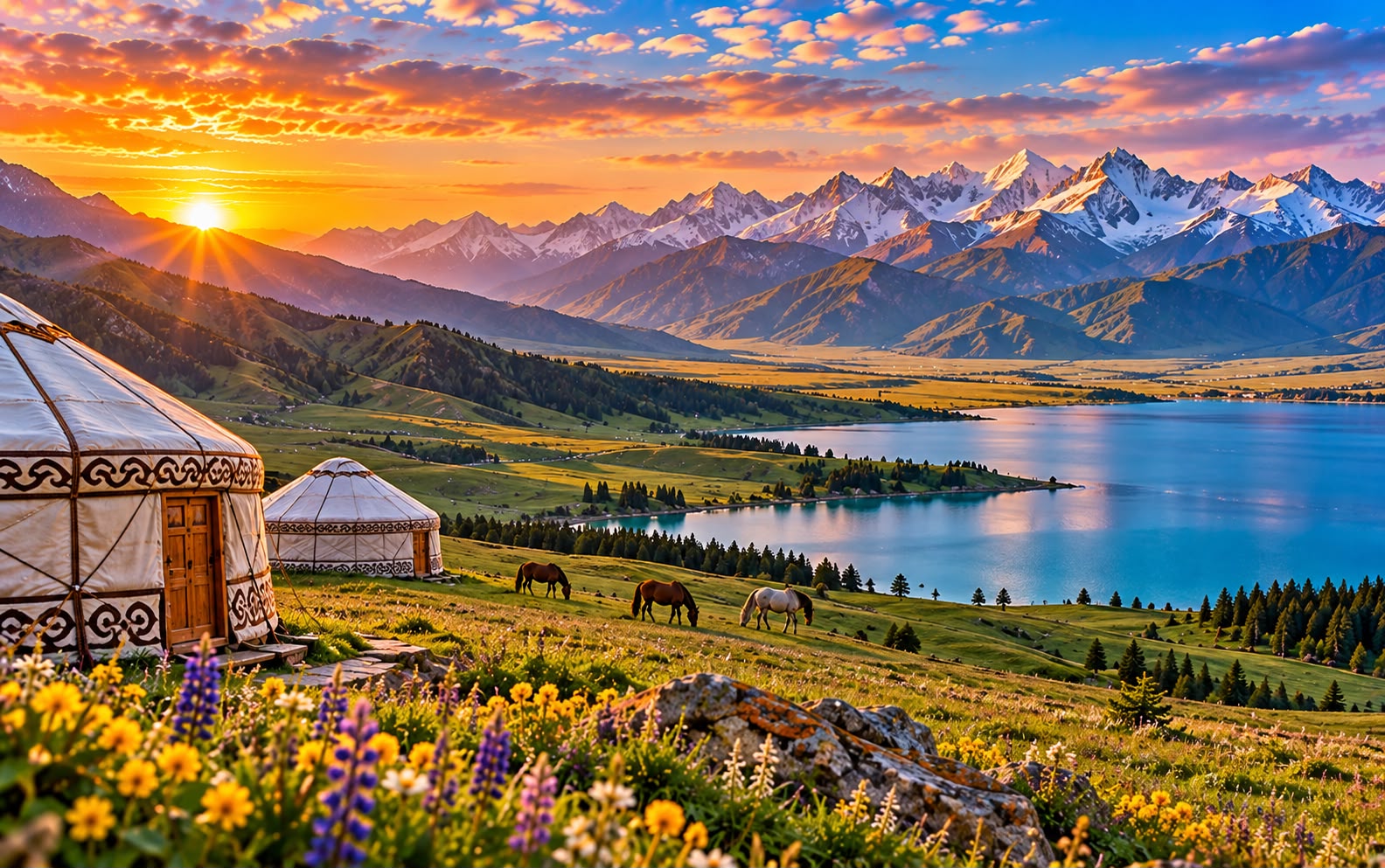
Kyrgyzstan in 9 days: Song-Kul, Issyk-Kul and the Tian Shan
Ninety per cent mountain, visa-free for most passports, and still almost empty: a night in a yurt beside a lake at 3,000 metres, a canyon of red rock towers, an alpine lake the size of a small sea, and a valley of seven bulls — with the short season that decides everything and the shared taxis that are how the country moves.
- Central Asia
- 9 days
- ≈ AED 2,750 / person
- Mountains + yurts
Before you go
Kyrgyzstan is the most mountainous country most people have never considered. Ninety-odd per cent of it sits above 1,500 m, the Tian Shan runs across the whole of it, and the summer pastures still fill with families who take their animals up and live in yurts until autumn.
That last part is the trip. Song-Kul is an alpine lake at 3,016 m where you sleep in a yurt on a plain with no road, no signal and an enormous sky. Issyk-Kul is the world’s second-largest alpine lake, warm enough to swim in, ringed by snow peaks. Karakol has a wooden mosque built without nails and a Russian Orthodox cathedral, both in the same small town.
Two things decide whether this works: the season, which is short and non-negotiable, and accepting that transport here is shared taxis and dirt roads rather than timetables.
Before you go: the season, the roads and the yurts
Entry, and why it is easy
- Kyrgyzstan is one of the most open countries in the region. Around sixty nationalities enter visa-free for 60 days — the EU, UK, US, Canada, Australia, Japan, Korea and more. Most others can use a straightforward eVisa.
- Passports outside that list, Indian among them, currently need an eVisa; it is applied for online and issued in a few working days. Check your own case, which is the fastest-changing detail here.
- Passport valid six months.
The season is short, and it is the whole plan
- The high pastures are open roughly late June to early September. That is it.
- Song-Kul is snowbound outside that window, the yurt camps come down, and the passes close. Arriving in May or October means a different, lesser trip.
- July and August are the reliable months: warm days, cold nights, everything open.
- Nights at Song-Kul are near freezing even in July. The camps provide thick blankets and a stove; bring a warm layer regardless.
How the country actually moves
- Shared taxis (marshrutka and shared cars) run between towns from set stands, leaving when full rather than on a timetable. They are cheap, frequent on main routes and how everyone travels.
- For Song-Kul you need a driver. The road is unpaved, steep and unsigned. Arrange a car with driver through your guesthouse — this is normal, expected and inexpensive.
- A rented 4x4 is possible if you are confident on mountain dirt, but a local driver costs little and knows which fords are passable this week.
- Allow more time than distances suggest. Bishkek to Song-Kul is around six hours for 300 km.
Yurts, and what to expect
- A yurt stay is the point of coming, and it is simple rather than luxurious: felt walls, a stove, shared long-drop toilets, a wash basin, and meals with the family.
- No electricity in most camps, limited or no signal, and no hot shower. Bring a power bank and let people at home know.
- Book through your guesthouse in Bishkek or Kochkor, which is how it is done — the camps are family operations, not online businesses.
- Community-based tourism organisations in Kochkor and Karakol arrange yurt stays, horse treks and drivers, and the money stays local.
Money and small things
- The som (KGS). Cards work in Bishkek and larger hotels and nowhere else on this route. Withdraw cash in Bishkek and carry enough for the whole mountain section.
- No ATM at Song-Kul, obviously, and often none in villages.
- Russian is the lingua franca; Kyrgyz is the national language. English is limited outside guesthouses.
- Tap water is not drinkable; the guesthouses provide boiled or bottled.
Day by day
Day 1 — Land in Bishkek
- 04:00 — Most flights into Manas (FRU) land in the small hours, which is worth knowing when you book the first night. The airport is 30 minutes out.
- 11:00 — Bishkek is a wide, green Soviet grid of poplars and irrigation channels, with the Ala-Too range standing 4,800 m directly south of it. It has good coffee and almost no sights, and that is fine.
- 13:00 — Lunch — laghman, hand-pulled noodles, or samsa from a tandoor.
- 15:00 — Ala-Too Square, the changing of the guard on the hour, and Osh Bazaar for the practical shopping: a SIM, dried fruit, and a warm layer if you did not bring one.
- 17:00 — Draw cash. Outside Bishkek, card acceptance is patchy and in the mountains it is nil. Take plenty of som.
- 19:00 — Dinner, and confirm the driver and the Song-Kul yurt booking tonight — the whole middle of this trip is one chain and there is no mobile signal to fix it later.
Day 2 — Burana, then south to Kochkor
- 09:00 — Drive east to Burana Tower, 80 km, about 90 minutes.
- 10:30 — Burana: an 11th-century minaret standing alone on the Silk Road plain, all that is left of Balasagun, a Karakhanid capital. You climb the inside on a steep dark stair. Around it is a field of balbals — Turkic stone grave markers, carved with faces, moved here from across the valley.
- 12:30 — Lunch at Tokmok or on the road.
- 14:00 — South to Kochkor, about three hours, climbing out of the Chui valley.
- 17:00 — Arrive. Kochkor is the staging town for Song-Kul and the base of the community-based tourism network that runs the yurt stays.
- 18:00 — A felt-making demonstration if you want one — shyrdak rugs, which are a genuine craft here and the best thing to take home.
- 19:30 — Guesthouse dinner, and an early night.
Day 3 — Up to Song-Kul
- 09:00 — The climb. Three to four hours on dirt track over the Kalmak-Ashuu pass at 3,446 m — switchbacks, no barriers, and a 4x4 is not optional.
- 12:30 — The lake appears suddenly as you come over the lip: Song-Kul at 3,016 m, 29 km across, on an open plain surrounded by low green hills with nothing built on them.
- 13:30 — Lunch at the yurt camp. These are summer pastures — jailoo — and the families move up here with their herds from roughly June to September. Outside those months there is nobody and nothing.
- 15:00 — Walk, or ride. The plain is enormous, horses and sheep are everywhere, and there is nothing to do, which is precisely the attraction.
- 18:30 — Dinner in the family yurt — besh barmak, bread, kurut, and fermented mare’s milk if you want it.
- 21:00 — The sky. No settlement for 60 km in any direction, at 3,000 m, with no moisture in the air. It is one of the darkest places you will ever stand.
- Note — It gets close to freezing at night even in July. The stove goes out; sleep in layers.
Day 4 — Song-Kul, and down the other side
- 07:00 — Sunrise over the lake with the herds being moved out to graze.
- 09:00 — A horse ride along the shore, two to four hours. Kyrgyz horses are small, sure-footed and semi-wild, and this is how the distances here are meant to be covered — the whole culture is built on it.
- 13:00 — Lunch, then down the northern pass toward Kochkor.
- 16:00 — East along the south shore of Issyk-Kul, the world’s second largest alpine lake — 182 km long, 668 m deep, slightly saline, and it never freezes, which is what the name means.
- 18:30 — Arrive at the lake. The contrast with the high plain is total: it is warm down here.
- 20:00 — Dinner, and a bed with a mattress.
Day 5 — The canyons of the south shore
- 09:00 — Skazka (Fairytale) Canyon: eroded red, orange and purple sandstone, which you walk into and then up onto — there are no paths and no rails, you simply pick a ridge. An hour or two, and it is far bigger inside than it looks from the road.
- 12:00 — Lunch at Bokonbaevo, and the eagle hunters here if a demonstration is running — golden eagles, hunted with from horseback, and the practice is real rather than staged for tourists though the demonstration is.
- 15:00 — Jeti-Ögüz — the Seven Bulls — a wall of red sandstone fins above a village, with the Broken Heart rock beside them, and a green valley behind that is worth driving up.
- 17:30 — On to Karakol.
- 19:30 — Dinner.
Day 6 — Karakol
- 09:00 — The Dungan Mosque: built 1907–1910 by Chinese Muslim craftsmen in the form of a Buddhist pagoda, painted red, green and yellow, and assembled without a single nail. There is nothing else like it.
- 10:30 — The Holy Trinity Orthodox Cathedral, wooden, also built without nails, rebuilt after the 1890 earthquake.
- 12:00 — Lunch — ashlyan-fu, the Dungan cold noodle dish in a sour broth, from a stall at the market, with a fried potato patty on the side. It is Karakol’s own and costs almost nothing.
- 14:00 — The animal market — mal bazar — if it is a Sunday morning, and plan the week around that if you can. Horses, sheep and cattle traded from dawn, no concession to visitors at all, and one of the best mornings in Central Asia.
- 16:00 — The Przhevalsky memorial and museum by the lake.
- 19:00 — Dinner.
Day 7 — Ala-Kul or the valley
- Option A — the Karakol valley, 08:00. A day walk from the trailhead up toward Ala-Kul: spruce forest, river, and increasingly alpine. The full Ala-Kul circuit is a serious three-day trek over a 3,900 m pass, but the valley gives a fine day out and back.
- Option B — Altyn-Arashan, 08:00. A valley of hot springs under 4,000 m peaks, reached by an hour and a half of 4x4 on a track that is more riverbed than road. Soak, eat, come back — or stay the night in one of the huts.
- Option C — the ski base. The chairlift at Karakol runs in summer for the view over Issyk-Kul.
- 18:00 — Back in Karakol.
- 19:30 — Last mountain dinner.
Day 8 — The north shore back to Bishkek
- 08:30 — West along the north shore, which is the developed side — Soviet-era sanatoria, beaches and holidaymakers.
- 10:30 — A swim. The water is around 20°C in summer, slightly saline, and clear.
- 12:30 — Cholpon-Ata’s petroglyph field: hundreds of Saka-era carvings on glacial boulders spread across an open site, mostly ibex, from around 800 BC. Free to walk, and nobody there.
- 14:00 — Lunch, then on to Bishkek — about five hours in total from Karakol.
- 18:00 — Arrive.
- 20:00 — Last dinner. Buy the shyrdak you have been thinking about since Kochkor.
Day 9 — Fly home
- Manas is 30 minutes out, and many flights leave between 03:00 and 06:00 — check yours before you plan the last evening, because it may mean no sleep rather than a lie-in.
- Note — Kyrgyzstan is visa-free for most nationalities for 60 days, which is unusually generous for the region and one reason it is the easiest Central Asian country to start with.
Costs and practicalities
Best time to visit
The high pastures are open roughly late June to early September, and that short window is what the whole trip depends on.
- Late June–early September — the jailoo season: the yurt camps at Song-Köl and Tash Rabat are up, the passes are clear, and the herders are at the high pastures. Outside it the yurts are packed away and the lakes are frozen.
- July–August — the warmest and the busiest. The World Nomad Games and the regional horse festivals fall in late summer.
- September — the best light and the first colour, but the camps start closing mid-month.
- May–June — green and flowering at lower altitude, with the passes still snowbound. Issyk-Köl is cold.
- October–April — Song-Köl is inaccessible, Bishkek is cold, and Karakol skis from December to March on genuinely good snow.
Song-Köl sits at 3,016m and can snow in July.
Travel tips
- Most nationalities enter visa-free for 60 days, which makes Kyrgyzstan the easiest country in Central Asia to visit.
- A border permit is required for parts of the Pamir-adjacent south and some areas near China. Arrange through an agency if your route goes there.
- CBT (Community Based Tourism) offices in each town arrange homestays, horses and drivers at fixed fair prices. They are the backbone of independent travel here.
- Marshrutkas and shared taxis cover everything and leave when full. For Song-Köl you need a 4x4 and a driver.
- Carry cash in som. ATMs are in the towns; the yurt camps and villages are cash only.
- Nights at altitude are cold even in July. A proper sleeping bag liner and a warm layer for the yurt.
- Kumis — fermented mare’s milk — will be offered. Accept a little; refusing outright is a discourtesy.
What this trip actually costs
Two people, 8 nights, mid-range, excluding international flights:
| Item | Cost |
|---|---|
| Guesthouses and yurt camp, 8 nights, most with meals | KGS 44,000 (≈ AED 1,847) |
| Drivers and shared transport, all legs | KGS 40,000 (≈ AED 1,679) |
| Horse riding, park fees, petroglyphs, museums | KGS 14,000 (≈ AED 588) |
| Food and drink, 9 days | KGS 22,000 (≈ AED 923) |
| eSIM, extras | KGS 10,000 (≈ AED 420) |
| Total for two | KGS 130,000 (≈ AED 5,457) |
- Roughly KGS 65,000 (≈ AED 2,728) per person — one of the cheapest trips on this site, and most meals are already included in the beds.
- Transport is the biggest line, because mountain roads need drivers. Shared taxis on the main routes cut it substantially if you are flexible.
- Yurt stays almost always include dinner and breakfast.
What to pack
- A warm layer and a hat for the yurt night, even in July. It drops close to freezing at 3,000 m.
- Walking boots — the ground everywhere is uneven.
- A power bank. No electricity at Song-Kul.
- Cash in som, withdrawn in Bishkek, for the whole mountain leg.
- Type C/F European plugs.
- Sun protection. Altitude sun is fierce even when the air is cold.
- Wet wipes and a quick-dry towel for the days without a shower.
FAQ
Is the yurt stay comfortable? Simple rather than comfortable, and that is the deal: felt walls, a stove, thick blankets, a long-drop toilet and no shower. It is also the thing people remember for years.
Can I go outside July and August? You can visit the country, but not this itinerary. Song-Kul and the high pastures are closed by snow outside roughly late June to early September.
Do I need a guide? No, but you need drivers for the mountain sections, and the community tourism offices in Kochkor and Karakol arrange those cheaply and well.
How does it compare to Kazakhstan? Kazakhstan is the easier, more urban trip — Almaty is a proper city with mountains behind it. Kyrgyzstan is rougher, higher and more remote, and the yurt nights have no equivalent there. See our Kazakhstan guide for the other half of Central Asia.
Prices and entry rules change, and what you need depends on your passport; last checked 8 October 2026, so confirm with the embassy or your airline before booking.


