 The Itinerary
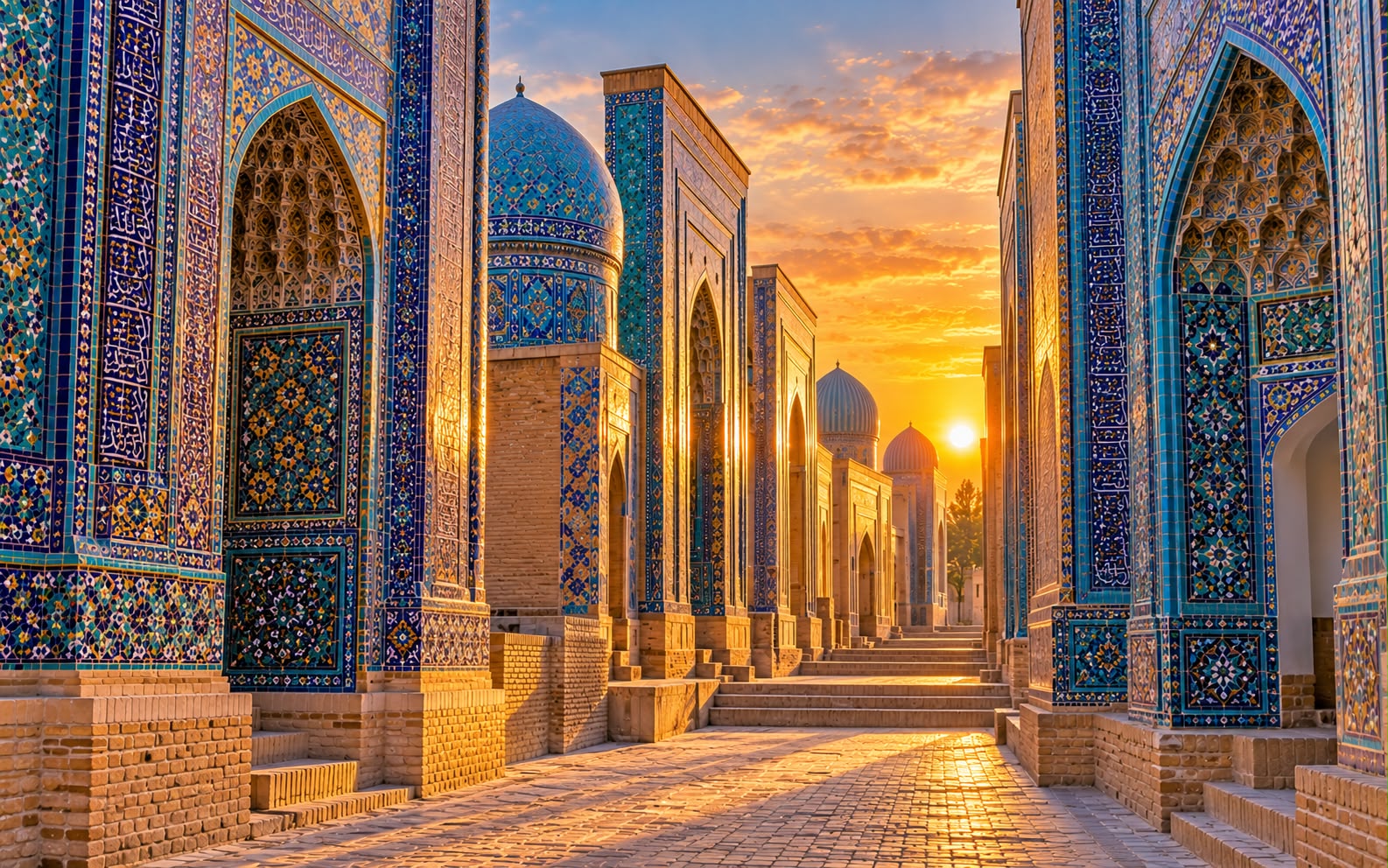
The Silk Road in 13 days: Samarkand, Bukhara, Khiva and the Kyrgyz jailoo
The cities first — a square of madrasas that stops conversation, a working old town nobody has prettified, a walled desert capital — and then up into the Tian Shan, where the summer pastures are still used the way they were when the caravans came through.
- Central Asia
- 13 days
- ≈ AED 6,600 / person
- Three blue-tiled cities and then the high pastures the caravans crossed to reach them
Before you go
Before you go: the admin
Two of the easiest visas in Asia
- Uzbekistan admits most nationalities visa-free for 30 days or issues a quick e-visa. This changed in 2018 and transformed travel here.
- Kyrgyzstan admits most nationalities visa-free for 60 days — the most generous policy in Central Asia.
- Uzbek registration still matters. Each night must be registered and hotels issue a slip. Keep every one. They can be asked for on departure, particularly if you stayed in private accommodation or camped.
- Kyrgyzstan requires a border permit for some areas near China and the Tajik border. Not needed on this route.
Flights and the awkward leg
- Fly into Tashkent and out of Bishkek.
- The Uzbek cities are linked by the Afrosiyob high-speed train — Tashkent to Samarkand in two hours, on to Bukhara in another two. Book ahead; it sells out in spring and autumn.
- Khiva is the outlier. It is a night train or a six-hour drive across the Kyzylkum from Bukhara, or a flight to Urgench. The desert drive is the better experience.
- Getting from Uzbekistan to Kyrgyzstan is the one awkward joint. The Dostyk crossing at Osh from Andijan works and is the overland route; flying Tashkent to Osh or Bishkek is simpler and costs little.
Money
- Uzbek som and Kyrgyz som — same name, different currencies, neither convertible in the other.
- The Uzbek som comes in enormous numbers. Carry a wallet that shuts.
- Cards increasingly work in Uzbek cities and in Bishkek; bazaars, yurt camps and villages are cash.
- Bring US dollars to change in both. Euros work too.
One gentle brief
- The two halves are completely different trips. Uzbekistan is architecture, tilework and desert cities with good trains; Kyrgyzstan is mountains, horses and a driver.
- The yurt season is short. The Song-Köl camps are up roughly late June to early September and packed away outside it. If your dates fall outside that, do a different Kyrgyz route rather than a disappointing version of this one.
- Hospitality is relentless and refusing food or tea repeatedly causes real offence in both countries.
Day by day
Day 1 — Land in Tashkent
- Arrive, and take the metro. Tashkent’s stations are Soviet-era palaces — Kosmonavtlar with its astronaut medallions is the one to see — and photography was banned until 2018 and is now permitted.
- Chorsu Bazaar under its blue dome, which is the best market in the country and a working one.
- The Khast Imam complex for the Uthman Quran, claimed as the oldest in the world and stained with the caliph’s blood.
Day 2 — Afrosiyob to Samarkand, and the Registan
- Two hours at 250km/h across the steppe.
- The Registan — three madrasas round a square, and the one sight on the Silk Road that people stop talking in front of. Go at opening, then again after dark when it is lit.
- Bibi-Khanym mosque, which Timur built too big and too fast and which started collapsing in his lifetime.
- Siyob bazaar behind it for bread and dried apricots.
Day 3 — Samarkand: Shah-i-Zinda and Gur-e-Amir
- Shah-i-Zinda at opening — an avenue of mausoleums, each tiled differently, which is the most beautiful place in Uzbekistan and is at its best when the light comes down the lane.
- Gur-e-Amir, Timur’s tomb, with the ribbed dome and the jade cenotaph.
- Ulugh Beg’s observatory, where his grandson measured the year to within a minute in the 1420s, and the surviving arc of the sextant cut into the bedrock.
- The Afrosiyob museum for the seventh-century murals, if there is time.
Day 4 — To Bukhara
- Two hours on the Afrosiyob, arriving mid-morning.
- Bukhara is the one that is still a town — the monuments are embedded in a working old city rather than set apart from it.
- Lyab-i-Hauz, the pool with the mulberry trees, which is where the city sits in the evening.
- The Kalyan minaret — 47m, built 1127, and the one thing Genghis Khan reportedly refused to destroy.
Day 5 — Bukhara: the Ark, and the trading domes
- The Ark, the fortress-citadel, mostly ruined inside but with the throne room and the view over the city.
- The three trading domes — Taki-Zargaron for jewellers, Telpak Furushon for hats, Sarrafon for money-changers — still functioning as markets and still named for their trades.
- Chor Minor, four brick towers in a back lane, each dome a different colour.
- Bolo Hauz mosque opposite the Ark, with twenty carved wooden columns reflected in the pool.
- A suzani workshop — the silk embroidery is Bukhara’s craft and the good pieces take months.
Day 6 — Across the Kyzylkum to Khiva
- Six hours of desert on the Bukhara–Urgench road, which is the Silk Road’s own stretch and is more interesting than it sounds — the Amu Darya crossing, and the chaikhanas where the drivers stop.
- Or the overnight train, which is cheaper and loses a day either side.
- Arrive at Khiva in the evening and walk Ichan Kala at dusk, when the day groups have gone.
Day 7 — Khiva: a walled city, entire
- Ichan Kala is UNESCO-listed and is the whole old town — mud walls, fifty monuments, and you can walk the circuit of the ramparts.
- The Kalta Minor, the fat turquoise stump of a minaret the khan died before finishing.
- Islam Khoja minaret for the climb, which is narrow, dark and worth it.
- Tosh-Hovli palace for the harem courtyards and the best tilework in the city.
- Khiva is the most restored of the three and some find it museum-like. It is also the only one where you can see what a walled Central Asian city actually looked like.
Day 8 — Fly to Osh
- Urgench or Tashkent to Osh, or the Dostyk land crossing from Andijan if you want the overland continuity.
- Osh is 3,000 years old and is the oldest city in Kyrgyzstan.
- Sulaiman-Too, the sacred mountain in the middle of it, UNESCO-listed, and still a pilgrimage site — women come to the shrine caves for fertility.
- Osh bazaar along the river, which is the biggest in Central Asia and where the two halves of this trip meet.
Day 9 — Into the mountains
- North on the Osh–Bishkek road, which crosses two passes above 3,000m and is one of the great mountain drives.
- A 4x4 and a driver is how this is done. Shared transport exists and is slow.
- Arslanbob as a detour — the largest walnut forest in the world, which Alexander’s army is said to have taken cuttings from.
- Or straight to Kazarman and the Song-Köl approach.
Day 10 — Song-Köl
- Up over the Kalmak-Ashuu pass to 3,016m and the lake.
- The jailoo — the summer pasture — with herders’ yurts, horses, and nothing else. The camps are up roughly late June to early September.
- Stay in a yurt. Felt walls, a dung stove, and a mattress on the floor. It is cold at night in any month and it can snow in July.
- Ride out in the afternoon if you can sit a horse; the herders will put you on one.
Day 11 — Song-Köl to Kochkor, and the felt
- Down the other side by the Thirty Parrots pass.
- Kochkor for shyrdak — the stitched felt carpets that are the Kyrgyz craft, bought through the women’s cooperatives rather than a shop.
- Burana Tower on the way to Bishkek, an eleventh-century minaret on the Balasagun site, with a field of balbal stone figures beside it.
Day 12 — Ala-Archa, and Bishkek
- Ala-Archa gorge is forty minutes from the capital and is where Bishkek walks at weekends — glaciers at the head of it and a day hike to the Ak-Sai waterfall.
- Bishkek itself is a Soviet grid with good cafés, Osh Bazaar, and Ala-Too Square with the changing of the guard.
- The State Historical Museum if it is open, which it intermittently is not.
Day 13 — Fly out of Bishkek
- Buy felt and honey at Osh Bazaar rather than at the airport.
- Manas airport is 30 minutes out and most departures are at unsociable hours.
Costs and practicalities
Best time to visit
Late June to early September, and the window is set by the Kyrgyz high pastures rather than by the Uzbek cities.
- Late June–early September — the jailoo season. The Song-Köl yurt camps are up, the passes are clear, and the herders are at the high pastures. Outside it the camps are packed away and the lake is frozen.
- July–August — warmest in the mountains and 40°C and above in Bukhara and Khiva, where the tiled courtyards hold the heat and the desert cities are punishing by mid-morning.
- April–May and September–October — the best months for the Uzbek half: blossom or harvest, comfortable temperatures, clear light on the tilework. But the Kyrgyz passes are snowbound in May and the camps are closing by late September.
- November–March — the Uzbek cities are cold, quiet and beautiful under snow; the Kyrgyz half of this route is simply not possible.
Navruz on 21 March is the biggest holiday in both countries.
Travel tips
- The seasons of the two halves barely overlap. Late June and early September are the weeks that work for both; outside them you are choosing one country over the other.
- Keep every Uzbek registration slip. They are checked on departure and a gap in the sequence causes a long conversation at the airport.
- Book the Afrosiyob ahead. It sells out, and the slow train on the same route takes twice as long.
- Use the CBT offices in Kyrgyzstan — Community Based Tourism, with an office in each town, arranging homestays, horses and drivers at fixed fair prices. They are the backbone of independent travel here.
- Nights at Song-Köl are cold even in July, at 3,016m. A sleeping bag liner and a proper warm layer.
- Accept the kumis — fermented mare’s milk — at least a sip. Refusing outright is a discourtesy.
- Bargaining is expected at the bazaars and not in shops. Siyob, Chorsu and Osh are all bargaining places.
What this trip actually costs
Two people, 12 nights, mid-range comfort, international flights excluded:
| Item | Cost |
|---|---|
| Hotels, guesthouses and yurt camps, 12 nights | USD 1,000 (≈ AED 3,673) |
| 4x4 and driver for the Kyrgyz legs | USD 900 (≈ AED 3,305) |
| Food and drink, 13 days | USD 500 (≈ AED 1,836) |
| Tashkent–Osh flight and the Kyzylkum transfer, two people | USD 500 (≈ AED 1,836) |
| Guides and site entries | USD 400 (≈ AED 1,469) |
| Afrosiyob trains, two people | USD 300 (≈ AED 1,102) |
| Total for two | USD 3,600 (≈ AED 13,221) |
- Roughly USD 1,800 (≈ AED 6,611) per person, which makes this remarkable value for a thirteen-day trip across two countries.
- The driver is the largest single line and is what makes the Kyrgyz half possible — Song-Köl is not reachable any other way.
- Uzbek accommodation is cheap and good, and the restored madrasa guesthouses in Bukhara and Khiva are the best value on the route.
- Hotel picks here are chosen on location, not on commission — always check prices and recent reviews before booking.
What to pack
- A warm layer and a sleeping bag liner for the yurt. 3,016m is cold at night in July.
- Sun protection for both halves — the Uzbek desert and the Kyrgyz altitude both burn.
- Modest clothing for mosques and madrasas, and a scarf for women.
- Shoes you can take off easily, repeatedly.
- Cash in dollars to change, and a wallet that handles very large numbers of notes.
- A power bank. Yurt camps have solar for a few hours at best.
- Rehydration salts. The combination of altitude, heat and hospitality is dehydrating.
FAQ
Can I do this route in one season? Late June to early September only. Outside that the Kyrgyz yurt camps are closed, and in high summer the Uzbek cities are brutally hot. It is a genuine compromise either way.
Is the land crossing between the two countries difficult? The Dostyk crossing at Osh works and is routine. Flying Tashkent to Osh or Bishkek is simpler and not much dearer.
Do I need a guide in Uzbekistan? No. The trains are easy, the cities are walkable and English is spoken in tourism. A guide for one Samarkand morning adds a great deal and is cheap.
Is Khiva worth the desert drive? If you want to see a complete walled city, yes. If you are short of days, Samarkand and Bukhara are the two that nobody regrets.
What about Tajikistan or Kazakhstan? Both are good additions and both need their own time — the Pamir Highway is eleven days on its own, and Kazakhstan’s distances are continental.
Prices and entry rules change, and what you need depends on your passport; last checked 19 October 2026, so confirm with the embassy or your airline before booking.


